Chapter 2 Giving Shape to Your Writing
Elements of the Paragraph Topic sentence  States the main idea of the paragraph Don’t tell me what you are going to be writing about…just do it! Supporting Details Explain the main idea, making it clear and specific for the audience Order and Transitions Details are arranged in a logical order that is made visible by the use of transition words and phrases Concluding Sentence Generally restates the main idea, but it can also make a comment that emphasizes it.
The Topic Sentence Usually comes at the beginning of your paragraph Makes a general statement that tells the reader what your paragraph is about Can sometimes come at the end of a paragraph, summing up the facts and ideas in order to make the point of a paragraph It is good practice, when you draft, to  underline your topic sentence, just to make  sure it is there!
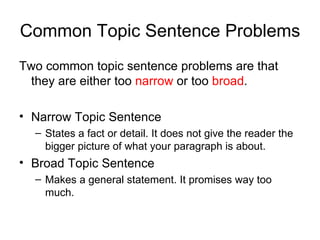
Common Topic Sentence Problems Two common topic sentence problems are that they are either too  narrow  or too  broad . Narrow Topic Sentence States a fact or detail. It does not give the reader the bigger picture of what your paragraph is about. Broad Topic Sentence Makes a general statement. It promises way too much.
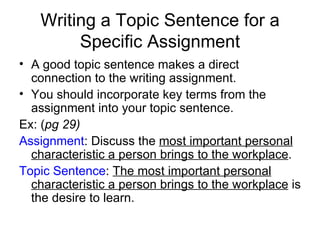
Writing a Topic Sentence for a Specific Assignment A good topic sentence makes a direct connection to the writing assignment. You should incorporate key terms from the assignment into your topic sentence. Ex: ( pg 29) Assignment : Discuss the  most important personal characteristic a person brings to the workplace . Topic Sentence :  The most important personal characteristic a person brings to the workplace  is the desire to learn.
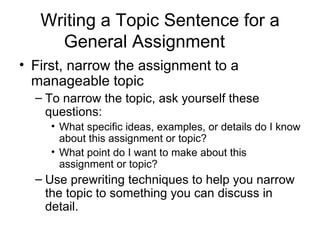
Writing a Topic Sentence for a General Assignment First, narrow the assignment to a manageable topic To narrow the topic, ask yourself these questions: What specific ideas, examples, or details do I know about this assignment or topic? What point do I want to make about this assignment or topic? Use prewriting techniques to help you narrow the topic to something you can discuss in detail.
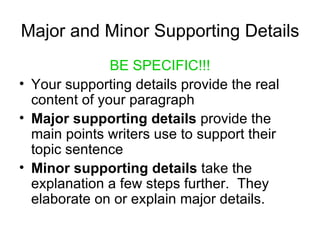
Major and Minor Supporting Details BE SPECIFIC!!! Your supporting details provide the real content of your paragraph Major supporting details  provide the main points writers use to support their topic sentence Minor supporting details  take the explanation a few steps further.  They elaborate on or explain major details.
Major Details: Thinking in Three’s It’s a good idea to think of three major supporting details that can be used to explain and illustrate the main idea of the paragraph You may eventually use more or fewer than three; however, to get started, it is helpful to think in three’s.
Minor Details Details almost always need explanation  In the drafting stage of writing, you present major details and elaborate on them with minor details.  You also make decisions about the order of details in your paragraph.
Unity: Eliminating Irrelevant Details All the details you think of do not necessarily belong in your paragraph Unity  means all the details, major and minor, relate directly to the main idea stated in the topic sentence.
Detail Double-Check Relevant details clarify or explain the topic. Ask yourself: Is it interesting? Is it important? If it is both,  keep it .  If it is just interesting,  cut it .
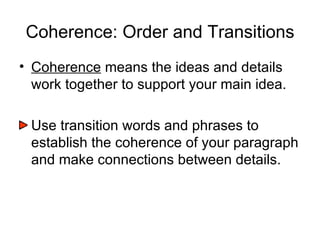
Coherence: Order and Transitions Coherence  means the ideas and details work together to support your main idea. Use transition words and phrases to establish the coherence of your paragraph and make connections between details.
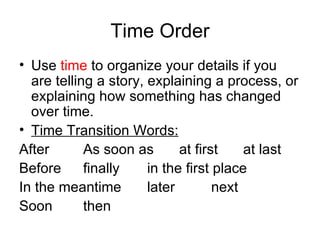
Time Order Use  time  to organize your details if you are telling a story, explaining a process, or explaining how something has changed over time.  Time Transition Words: After  As soon as at first  at last Before finally in the first place In the meantime later next Soon then
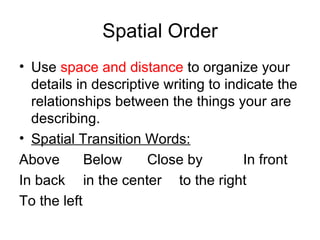
Spatial Order Use  space and distance  to organize your details in descriptive writing to indicate the relationships between the things your are describing. Spatial Transition Words: Above Below Close by In front In back in the center to the right To the left
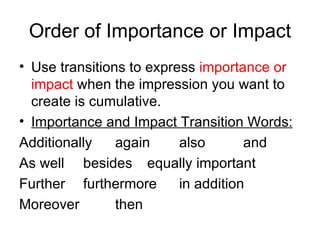
Order of Importance or Impact Use transitions to express  importance or impact  when the impression you want to create is cumulative.  Importance and Impact Transition Words: Additionally again also and As well besides equally important Further furthermore in addition Moreover then
The Concluding Sentence The Last Sentence Counts! A concluding sentence restates the main idea of the paragraph and emphasizes the importance of the topic. Your paragraph should not simply come to an end.  Your concluding sentence allows you to make an impression on your reader in closing.
Assignment: Draft a paragraph based on the topic you chose on Tuesday.  Use the prewriting we did in class as a starting point. Make sure you have a strong topic sentence, at least three solid supporting details, and a concluding sentence that clearly and concisely restates your main idea. Paragraphs may be handwritten or typed; just remember that this is only a first draft. Bring your paragraph with you to class on Tuesday, 10/13.  We will practice editing and revising with your paragraphs.

Chapter 2 notes

  • 1.
    Chapter 2 GivingShape to Your Writing
  • 2.
    Elements of theParagraph Topic sentence States the main idea of the paragraph Don’t tell me what you are going to be writing about…just do it! Supporting Details Explain the main idea, making it clear and specific for the audience Order and Transitions Details are arranged in a logical order that is made visible by the use of transition words and phrases Concluding Sentence Generally restates the main idea, but it can also make a comment that emphasizes it.
  • 3.
    The Topic SentenceUsually comes at the beginning of your paragraph Makes a general statement that tells the reader what your paragraph is about Can sometimes come at the end of a paragraph, summing up the facts and ideas in order to make the point of a paragraph It is good practice, when you draft, to underline your topic sentence, just to make sure it is there!
  • 4.
    Common Topic SentenceProblems Two common topic sentence problems are that they are either too narrow or too broad . Narrow Topic Sentence States a fact or detail. It does not give the reader the bigger picture of what your paragraph is about. Broad Topic Sentence Makes a general statement. It promises way too much.
  • 5.
    Writing a TopicSentence for a Specific Assignment A good topic sentence makes a direct connection to the writing assignment. You should incorporate key terms from the assignment into your topic sentence. Ex: ( pg 29) Assignment : Discuss the most important personal characteristic a person brings to the workplace . Topic Sentence : The most important personal characteristic a person brings to the workplace is the desire to learn.
  • 6.
    Writing a TopicSentence for a General Assignment First, narrow the assignment to a manageable topic To narrow the topic, ask yourself these questions: What specific ideas, examples, or details do I know about this assignment or topic? What point do I want to make about this assignment or topic? Use prewriting techniques to help you narrow the topic to something you can discuss in detail.
  • 7.
    Major and MinorSupporting Details BE SPECIFIC!!! Your supporting details provide the real content of your paragraph Major supporting details provide the main points writers use to support their topic sentence Minor supporting details take the explanation a few steps further. They elaborate on or explain major details.
  • 8.
    Major Details: Thinkingin Three’s It’s a good idea to think of three major supporting details that can be used to explain and illustrate the main idea of the paragraph You may eventually use more or fewer than three; however, to get started, it is helpful to think in three’s.
  • 9.
    Minor Details Detailsalmost always need explanation In the drafting stage of writing, you present major details and elaborate on them with minor details. You also make decisions about the order of details in your paragraph.
  • 10.
    Unity: Eliminating IrrelevantDetails All the details you think of do not necessarily belong in your paragraph Unity means all the details, major and minor, relate directly to the main idea stated in the topic sentence.
  • 11.
    Detail Double-Check Relevantdetails clarify or explain the topic. Ask yourself: Is it interesting? Is it important? If it is both, keep it . If it is just interesting, cut it .
  • 12.
    Coherence: Order andTransitions Coherence means the ideas and details work together to support your main idea. Use transition words and phrases to establish the coherence of your paragraph and make connections between details.
  • 13.
    Time Order Use time to organize your details if you are telling a story, explaining a process, or explaining how something has changed over time. Time Transition Words: After As soon as at first at last Before finally in the first place In the meantime later next Soon then
  • 14.
    Spatial Order Use space and distance to organize your details in descriptive writing to indicate the relationships between the things your are describing. Spatial Transition Words: Above Below Close by In front In back in the center to the right To the left
  • 15.
    Order of Importanceor Impact Use transitions to express importance or impact when the impression you want to create is cumulative. Importance and Impact Transition Words: Additionally again also and As well besides equally important Further furthermore in addition Moreover then
  • 16.
    The Concluding SentenceThe Last Sentence Counts! A concluding sentence restates the main idea of the paragraph and emphasizes the importance of the topic. Your paragraph should not simply come to an end. Your concluding sentence allows you to make an impression on your reader in closing.
  • 17.
    Assignment: Draft aparagraph based on the topic you chose on Tuesday. Use the prewriting we did in class as a starting point. Make sure you have a strong topic sentence, at least three solid supporting details, and a concluding sentence that clearly and concisely restates your main idea. Paragraphs may be handwritten or typed; just remember that this is only a first draft. Bring your paragraph with you to class on Tuesday, 10/13. We will practice editing and revising with your paragraphs.