ARGUMENTATIVE
APPEALS
Which appeal are advertisers using to
get you to buy their product?
ETHOS, PATHOS, and LOGOS
– AS YOU ANALYZE THE ADVERTISMENTS:

• Ethos: Is it Ethical? Do you trust its sources?
• Pathos: Does it make you feel a strong
emotion?
• Logos: Does it make you use your sense of
reason? Is it logical?
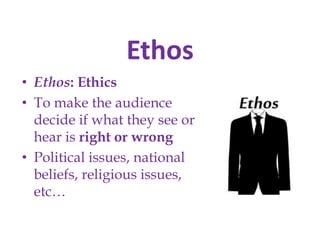
Ethos
• Ethos: Ethics
• To make the audience
decide if what they see or
hear is right or wrong
• Political issues, national
beliefs, religious issues,
etc…
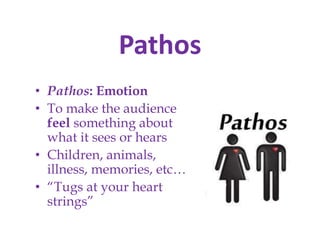
Pathos
• Pathos: Emotion
• To make the audience
feel something about
what it sees or hears
• Children, animals,
illness, memories, etc…
• “Tugs at your heart
strings”
Logos
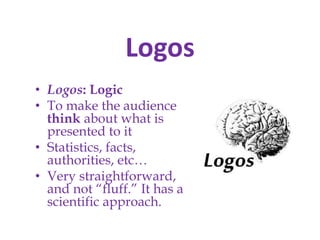
• Logos: Logic
• To make the audience
think about what is
presented to it
• Statistics, facts,
authorities, etc…
• Very straightforward,
and not “fluff.” It has a
scientific approach.
Can some advertisements have more
than one appeal?
• Yes! The more appeals used in an ad/speech
the more likely the consumer is to connect
with it.
• For the case of this lesson, pick the MOST
emphasized appeal used in each ad to write
down.
Ms. Long, I’m confused. What am I
supposed to write down?
• The most important appeal it’s making
(pick from ethos, pathos, or logos)

• A short “why.”
Why did you pick (ethos, pathos, or logos)?
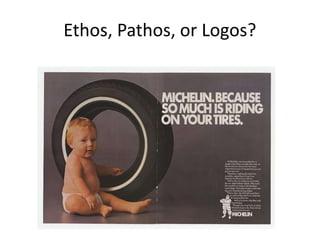
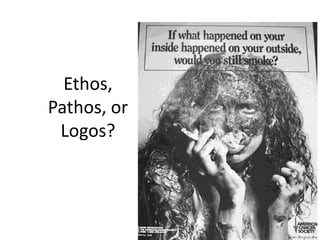
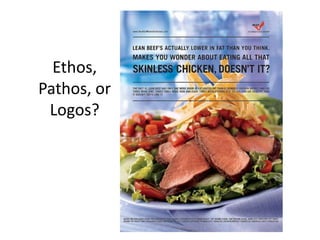
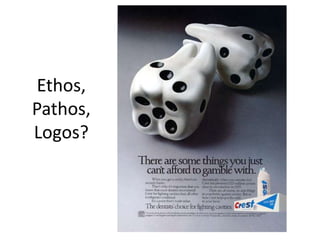
Ethos, Pathos, or Logos?
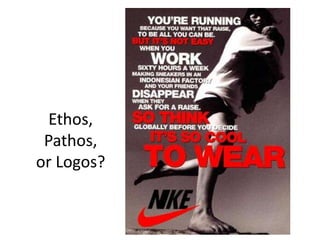
Ethos,
Pathos, or
Logos?
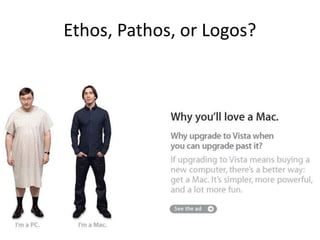
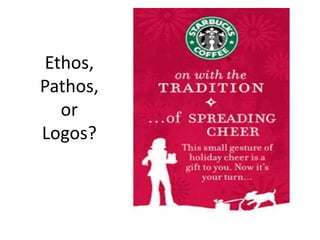
Ethos,
Pathos,
or Logos?
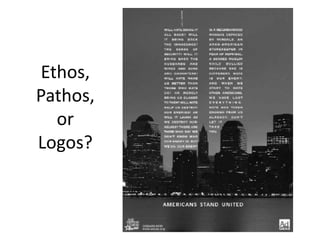
Ethos,
Pathos, or
Logos?
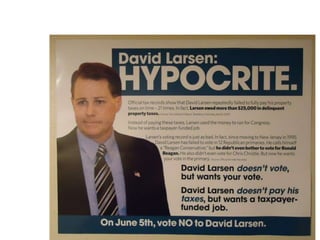
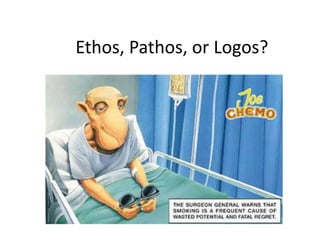
Ethos, Pathos, or Logos?
Ethos,
Pathos,
or
Logos?
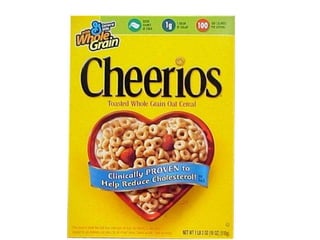
Ethos, Pathos, or Logos?
Ethos,
Pathos,
Logos?
Ethos,
Pathos,
or
Logos?
Good job!
Now let’s go back
and see how
Ethos, Pathos,
and Logos fit into
Cassius’ speech to
Brutus.
Claim Statements, Part II
• Arguable statement that can be supported
with evidence.
– Claim of Fact: Says something is true or not.
– Claim of Value: Says something is good or bad.
– Claim of Policy: Says it’s better to do one thing
than a different thing.
• DIRECTIONS: Read the rest of Cassius’
speech to Brutus looking for claim
statements. Underline each claim.
• Ask yourself:
– Is he saying something is true or untrue?
– Is he saying something is good or bad?
– Is he saying it’s better to do one thing than
another thing?

Argumentative Appeals: Ethos, Pathos & Logos

  • 1.
    ARGUMENTATIVE APPEALS Which appeal areadvertisers using to get you to buy their product?
  • 2.
    ETHOS, PATHOS, andLOGOS – AS YOU ANALYZE THE ADVERTISMENTS: • Ethos: Is it Ethical? Do you trust its sources? • Pathos: Does it make you feel a strong emotion? • Logos: Does it make you use your sense of reason? Is it logical?
  • 3.
    Ethos • Ethos: Ethics •To make the audience decide if what they see or hear is right or wrong • Political issues, national beliefs, religious issues, etc…
  • 4.
    Pathos • Pathos: Emotion •To make the audience feel something about what it sees or hears • Children, animals, illness, memories, etc… • “Tugs at your heart strings”
  • 5.
    Logos • Logos: Logic •To make the audience think about what is presented to it • Statistics, facts, authorities, etc… • Very straightforward, and not “fluff.” It has a scientific approach.
  • 6.
    Can some advertisementshave more than one appeal? • Yes! The more appeals used in an ad/speech the more likely the consumer is to connect with it. • For the case of this lesson, pick the MOST emphasized appeal used in each ad to write down.
  • 7.
    Ms. Long, I’mconfused. What am I supposed to write down? • The most important appeal it’s making (pick from ethos, pathos, or logos) • A short “why.” Why did you pick (ethos, pathos, or logos)?
  • 8.
  • 9.
  • 12.
  • 14.
  • 15.
  • 16.
  • 17.
  • 19.
  • 20.
  • 21.
  • 22.
    Good job! Now let’sgo back and see how Ethos, Pathos, and Logos fit into Cassius’ speech to Brutus.
  • 23.
    Claim Statements, PartII • Arguable statement that can be supported with evidence. – Claim of Fact: Says something is true or not. – Claim of Value: Says something is good or bad. – Claim of Policy: Says it’s better to do one thing than a different thing.
  • 24.
    • DIRECTIONS: Readthe rest of Cassius’ speech to Brutus looking for claim statements. Underline each claim. • Ask yourself: – Is he saying something is true or untrue? – Is he saying something is good or bad? – Is he saying it’s better to do one thing than another thing?