Spot Speed Study
With Laser Speed Gun
Priyansh Singh
(Research Scholar)
catchpriyansh@gmail.com
Departemt of Civil Engineering
Indian Institute of Technology Delhi 110016
March 29, 2016
Introduction Spot Speed Radar Gun Calculation Speed Percentile
Overview
Introduction
Spot Speed
Radar Gun
Calculation
Speed Percentile
2/22
Introduction Spot Speed Radar Gun Calculation Speed Percentile
Speed Study
Speed is an important transportation consideration
because it relates to safety, time, comfort, convenience, and
economics.
Spot speed studies are used to determine the speed
distribution of a traffic stream at a specific location.
The data gathered in spot speed studies are used to
determine vehicle speed percentiles, which are useful in
making many speed-related decisions.
3/22
Introduction Spot Speed Radar Gun Calculation Speed Percentile
Applications of Spot Speed
1. Determining existing traffic operations and evaluation of
traffic control devices.
2. Establishing roadway design elements.
3. Assessing roadway safety questions.
4. Monitoring traffic speed trends by systematic ongoing
speed studies.
5. Measuring effectiveness of traffic control devices or traffic
programs, including signs and markings, traffic
operational changes, and speed enforcement programs
4/22
Introduction Spot Speed Radar Gun Calculation Speed Percentile
traffic operations and evaluation
Evaluating and determining proper speed limits
Determining the 50th and 85th speed percentiles
Evaluating and determining proper advisory speeds
Establishing the limits of no-passing zones
Determining the proper placements of traffic control signs
and markings
Setting appropriate traffic signal timing
5/22
Introduction Spot Speed Radar Gun Calculation Speed Percentile
Overview
Introduction
Spot Speed
Radar Gun
Calculation
Speed Percentile
6/22
Introduction Spot Speed Radar Gun Calculation Speed Percentile
Introduction
For a spot speed study at a selected location, a sample size of at
least 50 and preferably 100 vehicles is usually obtained. Spot
speed data are gathered using one of three methods:
Stopwatch Method.
Radar Gun Method
Pneumatic Road Tube Method
7/22
Introduction Spot Speed Radar Gun Calculation Speed Percentile
Overview
Introduction
Spot Speed
Radar Gun
Calculation
Speed Percentile
8/22
Introduction Spot Speed Radar Gun Calculation Speed Percentile
Radar Gun Method
A radar gun is a commonly used device for directly
measuring speeds in spot speed studies
The effective measuring distance for radar meters ranges
from 200 feet up to 2 miles.
A radar gun requires line-of-sight to accurately measure
speed and is easily operated by one person.
(a) Radar Gun
9/22
Introduction Spot Speed Radar Gun Calculation Speed Percentile
Key Steps for Spot Speed Study
A radar gun spot speed study includes four key steps:
Select proper location and placement of radar meter.
Determine an appropriate selection strategy.
Record observations on radar meter spot speed study data
form.
Generate frequency distribution table and determine speed
percentiles.
10/22
Introduction Spot Speed Radar Gun Calculation Speed Percentile
Select Proper Location and Placement of Radar
Meter
The positioning of the radar unit is determined by the
capabilities of the radar unit. The unit should also be concealed
from the view of motorists.
Effective ranges may be up to 2 miles, but as the distance
increases the effectiveness decreases
The least accurate position, which often results in no
readings at all, is obtained when the meter is aimed at a
90-degree angle to the roadway centerline.
11/22
Introduction Spot Speed Radar Gun Calculation Speed Percentile
Determine an Appropriate Selection Strategy
Except for studies conducted under low-volume conditions, it is
impossible to obtain a radar measurement for every vehicle.
For peak flow analysis, speeds are measured during the
peak period.
For assessing general speed trends or for setting speed
limits, off-peak measurements are more appropriate.
The selection of the target vehicle that represents the
vehicle population under study is also important.
When the target vehicle is defined, a selection strategy is
developed to provide a random sample.
A random sample will reduce the tendency to select the
vehicles that stand out.
12/22
Introduction Spot Speed Radar Gun Calculation Speed Percentile
Record Observations on Radar Meter Spot Speed
Data Form
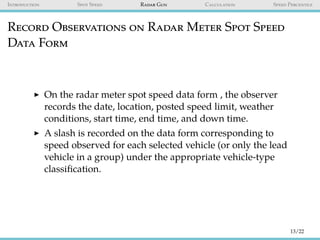
On the radar meter spot speed data form , the observer
records the date, location, posted speed limit, weather
conditions, start time, end time, and down time.
A slash is recorded on the data form corresponding to
speed observed for each selected vehicle (or only the lead
vehicle in a group) under the appropriate vehicle-type
classification.
13/22
Introduction Spot Speed Radar Gun Calculation Speed Percentile
Spot Speed
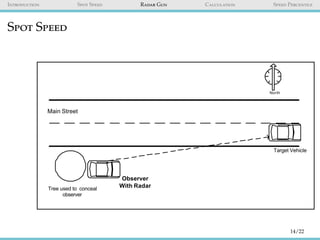
size of 100 was recorded. The study layout is illustrated in Figure 2.5. The o
o conceal the observation vehicle from the target vehicles. The results of the
in Figure 2.6 (data form) and Table 2.6 (distribution table).
Observer
With Radar
Main Street
Tree used to conceal
observer
North
Target Vehicle
Figure 2.5. Example Radar Meter Spot Speed Study Layout
(
-Vnr
14/22
Introduction Spot Speed Radar Gun Calculation Speed Percentile
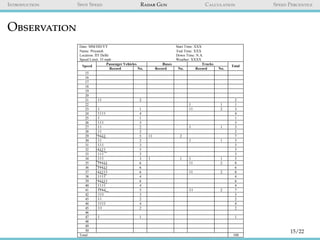
Observation
Date: MM/DD/YY Start Time: XXX
Name: Priyansh End Time: XXX
Location: IIT Delhi Down Time: N.A.
Speed Limit: 35 mph Weather: XXXX
Passenger Vehicles Buses Trucks
Speed
Record No. Record No. Record No.
Total
15
16
17
18
19
20
21 l l 2 2
22 l 1 1
23 l 1 l l 2 3
24 l l l l 4 4
25 l 1 1
26 l l l 3 3
27 l l 2 l 1 3
28 l l 2 2
29 l l l l 5 l l 2 7
30 l l 2 l 1 3
31 l l l 3 3
32 l l l l 5 5
33 l l l 3 3
34 l l l 3 l 1 l 1 5
35 l l l l l 6 l l 2 8
36 l l l l l 6 6
37 l l l l l 6 l l 2 8
38 l l l l 4 4
39 l l l l l 6 6
40 l l l l 4 4
41 l l I I 5 I I 2 7
42 I I I 3 3
43 l l 2 2
44 I I I I 4 4
45 I I 2 2
46
47 l 1 1
48
49
50
Total 100
15/22
Introduction Spot Speed Radar Gun Calculation Speed Percentile
Overview
Introduction
Spot Speed
Radar Gun
Calculation
Speed Percentile
16/22
Introduction Spot Speed Radar Gun Calculation Speed Percentile
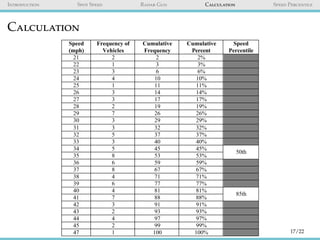
CalculationTable 2.6. Example Radar Meter Spot Speed Distribution Table
Speed
(mph)
Frequency of
Vehicles
Cumulative
Frequency
Cumulative
Percent
Speed
Percentile
21 2 2 2%
22 1 3 3%
23 3 6 6%
24 4 10 10%
25 1 11 11%
26 3 14 14%
27 3 17 17%
28 2 19 19%
29 7 26 26%
30 3 29 29%
31 3 32 32%
32 5 37 37%
33 3 40 40%
34 5 45 45%
35 8 53 53%
50th
36 6 59 59%
37 8 67 67%
38 4 71 71%
39 6 77 77%
40 4 81 81%
41 7 88 88%
85th
42 3 91 91%
43 2 93 93%
44 4 97 97%
45 2 99 99%
47 1 100 100%
_
17/22
Introduction Spot Speed Radar Gun Calculation Speed Percentile
Overview
Introduction
Spot Speed
Radar Gun
Calculation
Speed Percentile
18/22
Introduction Spot Speed Radar Gun Calculation Speed Percentile
Speed Percentile
Speed percentiles are tools used to determine effective and
adequate speed limits. The two speed percentiles most
important to understand are the 50th and the 85th percentiles.
19/22
Introduction Spot Speed Radar Gun Calculation Speed Percentile
50th Percentiles
The 50th percentile is the median speed of the observed data
set.
This percentile represents the speed at which half of the
observed vehicles are below and half of the observed
vehicles are above.
The 50th percentile of speed represents the average speed
of the traffic stream.
20/22
Introduction Spot Speed Radar Gun Calculation Speed Percentile
85th Percentiles
The 85th percentile is the speed at which 85% of the observed
vehicles are traveling at or below.
This percentile is used in evaluating/recommending
posted speed limits based on the assumption that 85% of
the drivers are traveling at a speed they perceive to be safe.
In other words, the 85th percentile of speed is normally
assumed to be the highest safe speed for a roadway section.
Weather conditions may affect speed percentiles. For
example, observed speeds may be slower in rainy or snowy
conditions.
21/22
Introduction Spot Speed Radar Gun Calculation Speed Percentile
Percentiles Calculation
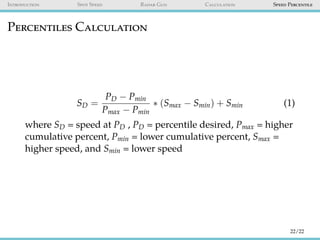
SD =
PD − Pmin
Pmax − Pmin
∗ (Smax − Smin) + Smin (1)
where SD = speed at PD , PD = percentile desired, Pmax = higher
cumulative percent, Pmin = lower cumulative percent, Smax =
higher speed, and Smin = lower speed
22/22
Introduction Spot Speed Radar Gun Calculation Speed Percentile
Thanks
Priyansh Singh
catchpriyansh@gmail.com
End of the Slide
23/22

Spot Speed Study (Lab)

  • 1.
    Spot Speed Study WithLaser Speed Gun Priyansh Singh (Research Scholar) catchpriyansh@gmail.com Departemt of Civil Engineering Indian Institute of Technology Delhi 110016 March 29, 2016
  • 2.
    Introduction Spot SpeedRadar Gun Calculation Speed Percentile Overview Introduction Spot Speed Radar Gun Calculation Speed Percentile 2/22
  • 3.
    Introduction Spot SpeedRadar Gun Calculation Speed Percentile Speed Study Speed is an important transportation consideration because it relates to safety, time, comfort, convenience, and economics. Spot speed studies are used to determine the speed distribution of a traffic stream at a specific location. The data gathered in spot speed studies are used to determine vehicle speed percentiles, which are useful in making many speed-related decisions. 3/22
  • 4.
    Introduction Spot SpeedRadar Gun Calculation Speed Percentile Applications of Spot Speed 1. Determining existing traffic operations and evaluation of traffic control devices. 2. Establishing roadway design elements. 3. Assessing roadway safety questions. 4. Monitoring traffic speed trends by systematic ongoing speed studies. 5. Measuring effectiveness of traffic control devices or traffic programs, including signs and markings, traffic operational changes, and speed enforcement programs 4/22
  • 5.
    Introduction Spot SpeedRadar Gun Calculation Speed Percentile traffic operations and evaluation Evaluating and determining proper speed limits Determining the 50th and 85th speed percentiles Evaluating and determining proper advisory speeds Establishing the limits of no-passing zones Determining the proper placements of traffic control signs and markings Setting appropriate traffic signal timing 5/22
  • 6.
    Introduction Spot SpeedRadar Gun Calculation Speed Percentile Overview Introduction Spot Speed Radar Gun Calculation Speed Percentile 6/22
  • 7.
    Introduction Spot SpeedRadar Gun Calculation Speed Percentile Introduction For a spot speed study at a selected location, a sample size of at least 50 and preferably 100 vehicles is usually obtained. Spot speed data are gathered using one of three methods: Stopwatch Method. Radar Gun Method Pneumatic Road Tube Method 7/22
  • 8.
    Introduction Spot SpeedRadar Gun Calculation Speed Percentile Overview Introduction Spot Speed Radar Gun Calculation Speed Percentile 8/22
  • 9.
    Introduction Spot SpeedRadar Gun Calculation Speed Percentile Radar Gun Method A radar gun is a commonly used device for directly measuring speeds in spot speed studies The effective measuring distance for radar meters ranges from 200 feet up to 2 miles. A radar gun requires line-of-sight to accurately measure speed and is easily operated by one person. (a) Radar Gun 9/22
  • 10.
    Introduction Spot SpeedRadar Gun Calculation Speed Percentile Key Steps for Spot Speed Study A radar gun spot speed study includes four key steps: Select proper location and placement of radar meter. Determine an appropriate selection strategy. Record observations on radar meter spot speed study data form. Generate frequency distribution table and determine speed percentiles. 10/22
  • 11.
    Introduction Spot SpeedRadar Gun Calculation Speed Percentile Select Proper Location and Placement of Radar Meter The positioning of the radar unit is determined by the capabilities of the radar unit. The unit should also be concealed from the view of motorists. Effective ranges may be up to 2 miles, but as the distance increases the effectiveness decreases The least accurate position, which often results in no readings at all, is obtained when the meter is aimed at a 90-degree angle to the roadway centerline. 11/22
  • 12.
    Introduction Spot SpeedRadar Gun Calculation Speed Percentile Determine an Appropriate Selection Strategy Except for studies conducted under low-volume conditions, it is impossible to obtain a radar measurement for every vehicle. For peak flow analysis, speeds are measured during the peak period. For assessing general speed trends or for setting speed limits, off-peak measurements are more appropriate. The selection of the target vehicle that represents the vehicle population under study is also important. When the target vehicle is defined, a selection strategy is developed to provide a random sample. A random sample will reduce the tendency to select the vehicles that stand out. 12/22
  • 13.
    Introduction Spot SpeedRadar Gun Calculation Speed Percentile Record Observations on Radar Meter Spot Speed Data Form On the radar meter spot speed data form , the observer records the date, location, posted speed limit, weather conditions, start time, end time, and down time. A slash is recorded on the data form corresponding to speed observed for each selected vehicle (or only the lead vehicle in a group) under the appropriate vehicle-type classification. 13/22
  • 14.
    Introduction Spot SpeedRadar Gun Calculation Speed Percentile Spot Speed size of 100 was recorded. The study layout is illustrated in Figure 2.5. The o o conceal the observation vehicle from the target vehicles. The results of the in Figure 2.6 (data form) and Table 2.6 (distribution table). Observer With Radar Main Street Tree used to conceal observer North Target Vehicle Figure 2.5. Example Radar Meter Spot Speed Study Layout ( -Vnr 14/22
  • 15.
    Introduction Spot SpeedRadar Gun Calculation Speed Percentile Observation Date: MM/DD/YY Start Time: XXX Name: Priyansh End Time: XXX Location: IIT Delhi Down Time: N.A. Speed Limit: 35 mph Weather: XXXX Passenger Vehicles Buses Trucks Speed Record No. Record No. Record No. Total 15 16 17 18 19 20 21 l l 2 2 22 l 1 1 23 l 1 l l 2 3 24 l l l l 4 4 25 l 1 1 26 l l l 3 3 27 l l 2 l 1 3 28 l l 2 2 29 l l l l 5 l l 2 7 30 l l 2 l 1 3 31 l l l 3 3 32 l l l l 5 5 33 l l l 3 3 34 l l l 3 l 1 l 1 5 35 l l l l l 6 l l 2 8 36 l l l l l 6 6 37 l l l l l 6 l l 2 8 38 l l l l 4 4 39 l l l l l 6 6 40 l l l l 4 4 41 l l I I 5 I I 2 7 42 I I I 3 3 43 l l 2 2 44 I I I I 4 4 45 I I 2 2 46 47 l 1 1 48 49 50 Total 100 15/22
  • 16.
    Introduction Spot SpeedRadar Gun Calculation Speed Percentile Overview Introduction Spot Speed Radar Gun Calculation Speed Percentile 16/22
  • 17.
    Introduction Spot SpeedRadar Gun Calculation Speed Percentile CalculationTable 2.6. Example Radar Meter Spot Speed Distribution Table Speed (mph) Frequency of Vehicles Cumulative Frequency Cumulative Percent Speed Percentile 21 2 2 2% 22 1 3 3% 23 3 6 6% 24 4 10 10% 25 1 11 11% 26 3 14 14% 27 3 17 17% 28 2 19 19% 29 7 26 26% 30 3 29 29% 31 3 32 32% 32 5 37 37% 33 3 40 40% 34 5 45 45% 35 8 53 53% 50th 36 6 59 59% 37 8 67 67% 38 4 71 71% 39 6 77 77% 40 4 81 81% 41 7 88 88% 85th 42 3 91 91% 43 2 93 93% 44 4 97 97% 45 2 99 99% 47 1 100 100% _ 17/22
  • 18.
    Introduction Spot SpeedRadar Gun Calculation Speed Percentile Overview Introduction Spot Speed Radar Gun Calculation Speed Percentile 18/22
  • 19.
    Introduction Spot SpeedRadar Gun Calculation Speed Percentile Speed Percentile Speed percentiles are tools used to determine effective and adequate speed limits. The two speed percentiles most important to understand are the 50th and the 85th percentiles. 19/22
  • 20.
    Introduction Spot SpeedRadar Gun Calculation Speed Percentile 50th Percentiles The 50th percentile is the median speed of the observed data set. This percentile represents the speed at which half of the observed vehicles are below and half of the observed vehicles are above. The 50th percentile of speed represents the average speed of the traffic stream. 20/22
  • 21.
    Introduction Spot SpeedRadar Gun Calculation Speed Percentile 85th Percentiles The 85th percentile is the speed at which 85% of the observed vehicles are traveling at or below. This percentile is used in evaluating/recommending posted speed limits based on the assumption that 85% of the drivers are traveling at a speed they perceive to be safe. In other words, the 85th percentile of speed is normally assumed to be the highest safe speed for a roadway section. Weather conditions may affect speed percentiles. For example, observed speeds may be slower in rainy or snowy conditions. 21/22
  • 22.
    Introduction Spot SpeedRadar Gun Calculation Speed Percentile Percentiles Calculation SD = PD − Pmin Pmax − Pmin ∗ (Smax − Smin) + Smin (1) where SD = speed at PD , PD = percentile desired, Pmax = higher cumulative percent, Pmin = lower cumulative percent, Smax = higher speed, and Smin = lower speed 22/22
  • 23.
    Introduction Spot SpeedRadar Gun Calculation Speed Percentile Thanks Priyansh Singh catchpriyansh@gmail.com End of the Slide 23/22