Engineering Physics (2110011)
Guided by :
Prof. Nikunj V. Joshi
Created By :
Name : Shah Preet .P.
Enroll. No. : 160410119117
Batch : C
Dept : Mechanical
Topic : Superconductors
1
Introduction
 Superconductivity is a phenomenon in
which certain metals, alloys and
ceramics conduct electricity without
resistance when it is cooled below a
certain temperature called the critical
temperature.
 Superconductivity was discovered by a
Dutch physicist, Heike Kammerlingh
Onnes, in 1911.
 Superconductivity is still an exciting field
of discovery and technological
applications. 2
Superconductor
 A Superconductor is a material that loses all its
resistance to the flow of electric current when it is
cooled below a certain temperature called the
critical temperature or transition temperature Tc.
 Examples :. Mercury(Hg), Vanadium(V).
3
Transition Temperature
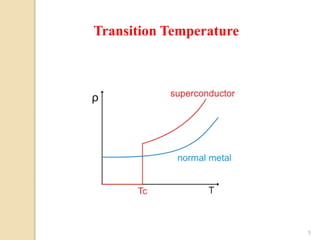
 The temperature at which a material’s electrical resistivity
drops to absolute zero is called the Transition temperature or
Critical temperature Tc.
 At and below Tc, the material is said to be in the
superconducting state and above this temperature, the
material is said to be in normal state.
 Figure shows the variation of electrical resistivity of a normal
metal silver(Ag) and a superconducting metal mercury(Hg)
versus temperature.
 It can be seen that the electrical resistivity of normal metal
decreases steadily as the temperature is decreased and
reaches a low value at 0K called the residual resistivity ρ̥ .
4
Transition Temperature
5
Properties
Electrical
Resistance
Effect of
impurities
Effect of
Pressure and
Stress
Isotop
e
effectsMagnetic
field
effect
Critical Current
and Critical
Current Density
Persistent
Current
Meissner
effect
6
Properties
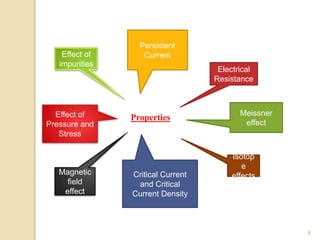
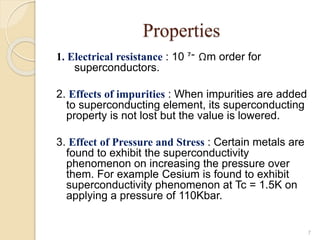
1. Electrical resistance : 10 ‫־‬⁷ Ωm order for
superconductors.
2. Effects of impurities : When impurities are added
to superconducting element, its superconducting
property is not lost but the value is lowered.
3. Effect of Pressure and Stress : Certain metals are
found to exhibit the superconductivity
phenomenon on increasing the pressure over
them. For example Cesium is found to exhibit
superconductivity phenomenon at Tc = 1.5K on
applying a pressure of 110Kbar.
7
Properties
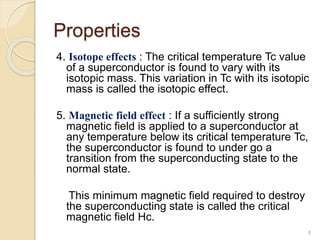
4. Isotope effects : The critical temperature Tc value
of a superconductor is found to vary with its
isotopic mass. This variation in Tc with its isotopic
mass is called the isotopic effect.
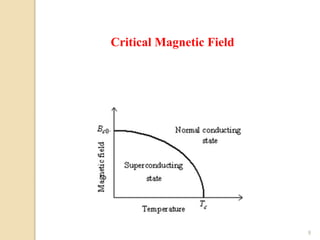
5. Magnetic field effect : If a sufficiently strong
magnetic field is applied to a superconductor at
any temperature below its critical temperature Tc,
the superconductor is found to under go a
transition from the superconducting state to the
normal state.
This minimum magnetic field required to destroy
the superconducting state is called the critical
magnetic field Hc.
8
Critical Magnetic Field
9
Properties
6. Critical current density : It can be defined as
the maximum current that can be permitted in
a superconducting material without
destroying its superconductivity state.
Jc = Ic/A
7. Persistent current : This steady flow of
current in a superconducting ring without any
potential deriving it is called the persistent
current.
10
Properties
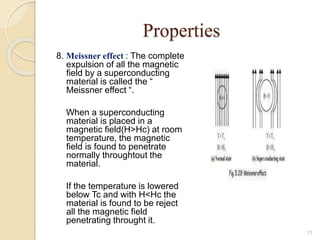
8. Meissner effect : The complete
expulsion of all the magnetic
field by a superconducting
material is called the “
Meissner effect “.
When a superconducting
material is placed in a
magnetic field(H>Hc) at room
temperature, the magnetic
field is found to penetrate
normally throughtout the
material.
If the temperature is lowered
below Tc and with H<Hc the
material is found to be reject
all the magnetic field
penetrating throught it.
11
Types of Superconductors
Type 1
Superconductors
Type 2
Superconductors
12
Types 1 Superconductors
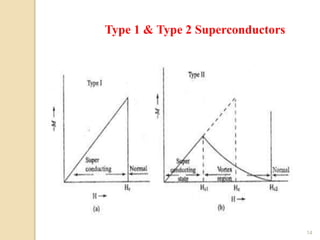
1. These superconductors are called as soft
superconductors.
2. Only one critical magnetic field exist for these
superconductors.
3. The critical field value is very low.
4. These superconductors exhibit perfect and complete
Meissner effect.
5. These materials have limited technical applications
because of very low field strength value.
Examples : Pb, Hg, Zn, etc.
13
Type 1 & Type 2 Superconductors
14
Type 2 Superconductors
1. These superconductors are called as hard
superconductors.
2. Two critical fields Hc1 and Hc2 exist for these
superconductors.
3. The critical field value is very high.
4. These superconductors do not exhibit perfect and
complete Meissner effect.
5. These materials have wider technological applications
because of very high field strength value.
Examples : Nb3Ge, Nb3Si, etc.
15
Temperature
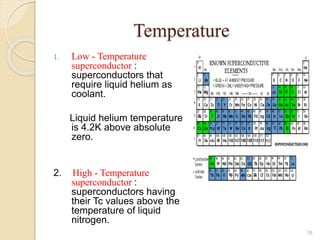
1. Low - Temperature
superconductor :
superconductors that
require liquid helium as
coolant.
Liquid helium temperature
is 4.2K above absolute
zero.
2. High - Temperature
superconductor :
superconductors having
their Tc values above the
temperature of liquid
nitrogen.
16
Applications Of Superconductors
1. Magnetic Levitation (Maglev)
Magnetic Levitation or Maglev is the process by which an object is suspended
above another object with no other support but magnetic fields.
The phenomenon of magnetic levitation is based on Meissner effect.
The magnetic levitation is brought about by enormous repulsion between two
highly powerful magnetic fields.
17
Application
1. Maglev Train : the levitation
is based on two techniques
(i) Electromagnetic
suspension (EMS) and (ii)
Electrodynamic suspension
(EDS).
The basic idea of maglev
train is to levitate it with
magnetic fields so that there
is no physical contact
between the train and the
rails. Consequently the
maglev train can travel at
very high speed.
These trains travel at a
speed of about 500km/h.
18
Application
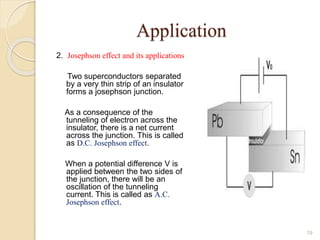
2. Josephson effect and its applications
Two superconductors separated
by a very thin strip of an insulator
forms a josephson junction.
As a consequence of the
tunneling of electron across the
insulator, there is a net current
across the junction. This is called
as D.C. Josephson effect.
When a potential difference V is
applied between the two sides of
the junction, there will be an
oscillation of the tunneling
current. This is called as A.C.
Josephson effect.
19
Application
Application of josephson junction
1. Josephson junctions are used in sensitive
magnetometers called SQUID – Superconducting Quantum
Interference Device.
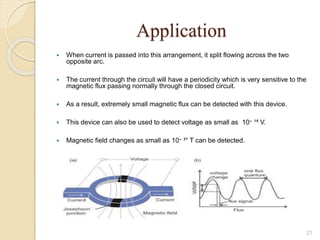
A SQUID is formed by connecting two josephson junction
in parallel.
20
Application
 When current is passed into this arrangement, it split flowing across the two
opposite arc.
 The current through the circuit will have a periodicity which is very sensitive to the
magnetic flux passing normally through the closed circuit.
 As a result, extremely small magnetic flux can be detected with this device.
 This device can also be used to detect voltage as small as 10‫־‬ ¹⁵ V.
 Magnetic field changes as small as 10‫־‬ ²¹ T can be detected.
21
Application
22
Application
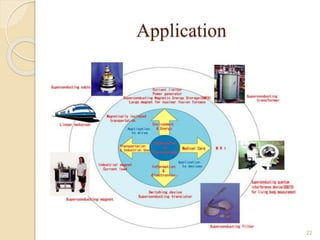
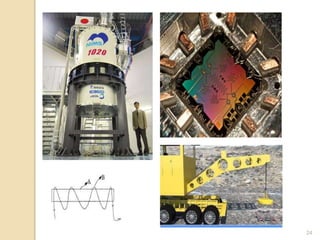
 RF and microwave filters (e.g., for mobile phone base stations, as
well as military ultrasensitive/selective receivers)
 High sensitivity particle detectors, including the transition edge
sensor, the superconducting bolometer, the superconducting tunnel
junction detector, the kinetic inductance detector, and the
superconducting nano wire single-photon detector.
 Rail gun and coil gun magnets.
 Electric motors and generators.
 Very strong magnetic fields can be generated with coils made of
high Tc superconducting materials.
 Ore separation can be done efficiently using superconducting
magnets.
23
24
THANK YOU
25

Superconductors

  • 1.
    Engineering Physics (2110011) Guidedby : Prof. Nikunj V. Joshi Created By : Name : Shah Preet .P. Enroll. No. : 160410119117 Batch : C Dept : Mechanical Topic : Superconductors 1
  • 2.
    Introduction  Superconductivity isa phenomenon in which certain metals, alloys and ceramics conduct electricity without resistance when it is cooled below a certain temperature called the critical temperature.  Superconductivity was discovered by a Dutch physicist, Heike Kammerlingh Onnes, in 1911.  Superconductivity is still an exciting field of discovery and technological applications. 2
  • 3.
    Superconductor  A Superconductoris a material that loses all its resistance to the flow of electric current when it is cooled below a certain temperature called the critical temperature or transition temperature Tc.  Examples :. Mercury(Hg), Vanadium(V). 3
  • 4.
    Transition Temperature  Thetemperature at which a material’s electrical resistivity drops to absolute zero is called the Transition temperature or Critical temperature Tc.  At and below Tc, the material is said to be in the superconducting state and above this temperature, the material is said to be in normal state.  Figure shows the variation of electrical resistivity of a normal metal silver(Ag) and a superconducting metal mercury(Hg) versus temperature.  It can be seen that the electrical resistivity of normal metal decreases steadily as the temperature is decreased and reaches a low value at 0K called the residual resistivity ρ̥ . 4
  • 5.
  • 6.
    Properties Electrical Resistance Effect of impurities Effect of Pressureand Stress Isotop e effectsMagnetic field effect Critical Current and Critical Current Density Persistent Current Meissner effect 6
  • 7.
    Properties 1. Electrical resistance: 10 ‫־‬⁷ Ωm order for superconductors. 2. Effects of impurities : When impurities are added to superconducting element, its superconducting property is not lost but the value is lowered. 3. Effect of Pressure and Stress : Certain metals are found to exhibit the superconductivity phenomenon on increasing the pressure over them. For example Cesium is found to exhibit superconductivity phenomenon at Tc = 1.5K on applying a pressure of 110Kbar. 7
  • 8.
    Properties 4. Isotope effects: The critical temperature Tc value of a superconductor is found to vary with its isotopic mass. This variation in Tc with its isotopic mass is called the isotopic effect. 5. Magnetic field effect : If a sufficiently strong magnetic field is applied to a superconductor at any temperature below its critical temperature Tc, the superconductor is found to under go a transition from the superconducting state to the normal state. This minimum magnetic field required to destroy the superconducting state is called the critical magnetic field Hc. 8
  • 9.
  • 10.
    Properties 6. Critical currentdensity : It can be defined as the maximum current that can be permitted in a superconducting material without destroying its superconductivity state. Jc = Ic/A 7. Persistent current : This steady flow of current in a superconducting ring without any potential deriving it is called the persistent current. 10
  • 11.
    Properties 8. Meissner effect: The complete expulsion of all the magnetic field by a superconducting material is called the “ Meissner effect “. When a superconducting material is placed in a magnetic field(H>Hc) at room temperature, the magnetic field is found to penetrate normally throughtout the material. If the temperature is lowered below Tc and with H<Hc the material is found to be reject all the magnetic field penetrating throught it. 11
  • 12.
    Types of Superconductors Type1 Superconductors Type 2 Superconductors 12
  • 13.
    Types 1 Superconductors 1.These superconductors are called as soft superconductors. 2. Only one critical magnetic field exist for these superconductors. 3. The critical field value is very low. 4. These superconductors exhibit perfect and complete Meissner effect. 5. These materials have limited technical applications because of very low field strength value. Examples : Pb, Hg, Zn, etc. 13
  • 14.
    Type 1 &Type 2 Superconductors 14
  • 15.
    Type 2 Superconductors 1.These superconductors are called as hard superconductors. 2. Two critical fields Hc1 and Hc2 exist for these superconductors. 3. The critical field value is very high. 4. These superconductors do not exhibit perfect and complete Meissner effect. 5. These materials have wider technological applications because of very high field strength value. Examples : Nb3Ge, Nb3Si, etc. 15
  • 16.
    Temperature 1. Low -Temperature superconductor : superconductors that require liquid helium as coolant. Liquid helium temperature is 4.2K above absolute zero. 2. High - Temperature superconductor : superconductors having their Tc values above the temperature of liquid nitrogen. 16
  • 17.
    Applications Of Superconductors 1.Magnetic Levitation (Maglev) Magnetic Levitation or Maglev is the process by which an object is suspended above another object with no other support but magnetic fields. The phenomenon of magnetic levitation is based on Meissner effect. The magnetic levitation is brought about by enormous repulsion between two highly powerful magnetic fields. 17
  • 18.
    Application 1. Maglev Train: the levitation is based on two techniques (i) Electromagnetic suspension (EMS) and (ii) Electrodynamic suspension (EDS). The basic idea of maglev train is to levitate it with magnetic fields so that there is no physical contact between the train and the rails. Consequently the maglev train can travel at very high speed. These trains travel at a speed of about 500km/h. 18
  • 19.
    Application 2. Josephson effectand its applications Two superconductors separated by a very thin strip of an insulator forms a josephson junction. As a consequence of the tunneling of electron across the insulator, there is a net current across the junction. This is called as D.C. Josephson effect. When a potential difference V is applied between the two sides of the junction, there will be an oscillation of the tunneling current. This is called as A.C. Josephson effect. 19
  • 20.
    Application Application of josephsonjunction 1. Josephson junctions are used in sensitive magnetometers called SQUID – Superconducting Quantum Interference Device. A SQUID is formed by connecting two josephson junction in parallel. 20
  • 21.
    Application  When currentis passed into this arrangement, it split flowing across the two opposite arc.  The current through the circuit will have a periodicity which is very sensitive to the magnetic flux passing normally through the closed circuit.  As a result, extremely small magnetic flux can be detected with this device.  This device can also be used to detect voltage as small as 10‫־‬ ¹⁵ V.  Magnetic field changes as small as 10‫־‬ ²¹ T can be detected. 21
  • 22.
  • 23.
    Application  RF andmicrowave filters (e.g., for mobile phone base stations, as well as military ultrasensitive/selective receivers)  High sensitivity particle detectors, including the transition edge sensor, the superconducting bolometer, the superconducting tunnel junction detector, the kinetic inductance detector, and the superconducting nano wire single-photon detector.  Rail gun and coil gun magnets.  Electric motors and generators.  Very strong magnetic fields can be generated with coils made of high Tc superconducting materials.  Ore separation can be done efficiently using superconducting magnets. 23
  • 24.
  • 25.