Smooth Muscle
Structure of Smooth Muscle
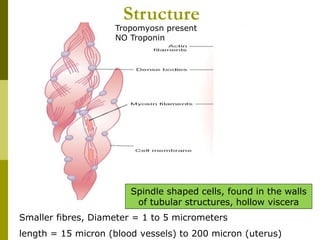
 Lacks visible cross-striations
 Actin and myosin-II are present but not
arranged in regular arrays
 Actin 5-10 times more than Myosin
 Dense bodies instead of Z lines
 In the cytoplasm and attached to cell membrane
 Connected to actin filaments by α-actinin
 Interspersed among the actin filaments are
myosin filaments
 Some of the dense bodies connected to adjacent
cells by intercellular protein bridges – transmits
force of contraction from one cell to the next
Spindle shaped cells, found in the walls
of tubular structures, hollow viscera
Smaller fibres, Diameter = 1 to 5 micrometers
length = 15 micron (blood vessels) to 200 micron (uterus)
Structure
Tropomyosn present
NO Troponin
Structure of Smooth Muscle
 Myosin filaments have “sidepolar” cross-
bridges
 Arranged so that bridges on one side hinge in
one direction and those on other side hinge in
opposite direction
 Allows myosin to pull an actin filament in one
direction on one side while simultaneously
pulling another actin filament in the opposite
direction on the other side
 Allows smooth muscle cells to contract as much
as 80% of their length instead of 30% (skeletal
muscle)
Smooth muscle contraction
Structure of Smooth Muscle
 Contains tropomyosin, but troponin absent
 Thus, mechanism for control of contraction is
different
 Regulatory protein is calmodulin instead of
troponin
 Sarcoplasmic reticulum less extensive
 Few mitochondria
 depends, to a large extent, on glycolysis for
their metabolic needs
 Divided into 2 main sub-types
Structure
Single unit Smooth Muscle
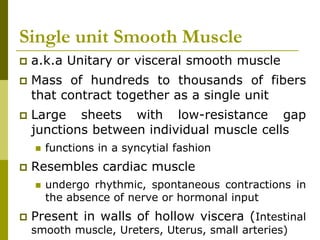
 a.k.a Unitary or visceral smooth muscle
 Mass of hundreds to thousands of fibers
that contract together as a single unit
 Large sheets with low-resistance gap
junctions between individual muscle cells
 functions in a syncytial fashion
 Resembles cardiac muscle
 undergo rhythmic, spontaneous contractions in
the absence of nerve or hormonal input
 Present in walls of hollow viscera (Intestinal
smooth muscle, Ureters, Uterus, small arteries)
Multi Unit Smooth Muscle
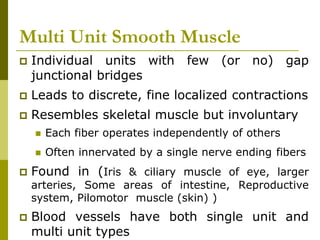
 Individual units with few (or no) gap
junctional bridges
 Leads to discrete, fine localized contractions
 Resembles skeletal muscle but involuntary
 Each fiber operates independently of others
 Often innervated by a single nerve ending fibers
 Found in (Iris & ciliary muscle of eye, larger
arteries, Some areas of intestine, Reproductive
system, Pilomotor muscle (skin) )
 Blood vessels have both single unit and
multi unit types
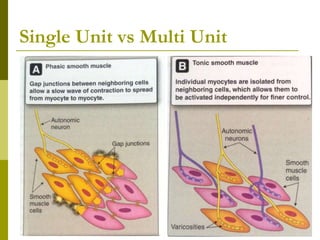
Single Unit vs Multi Unit
SINGLE UNIT SMOOTH MUSCLE MULTI – UNIT SMOOTH MUSCLE
Eg. – Muscle of GIT, bronchi,
urinary bladder and uterus
Eg. – Ciliary muscles, muscles
of iris and pilomotor muscles in
hair follicles
Pacemaker tissue present –
responsible for rhythmic
contraction & relaxation of
muscle
No pacemaker tissue
Autonomic nervous system can
modify the response
Only show contraction as per
the discharge in autonomic
nerves supplying them
Stretch of the muscle causes
reflex contraction
No effect of stretch on the
muscle
Low resistance bridges are
present in between the cells so
acting as functional synctium
No such bridges
Contracts as a single unit and
there is a widespread
contraction
Contraction is more discrete,
fine and localized
N-M Junction in Smooth Muscle
 Neurons are part of the autonomic nervous
system rather than somatic nervous
system
 Neuron makes multiple contacts with a
smooth muscle cell (no direct contact)
 At each contact point, the axon diameter
expands to form a varicosity that contains the
vesicles (can contain ACh or NE)
 Varicosity is in close proximity to postsynaptic
membrane (relatively little specialization)
 Receptors are spread more widely across
the postsynaptic membrane
N-M Junction in Smooth Muscle
 No typical end feet as seen in skeletal muscle,
axons have multiple varicosities distributed along
their axes
 Varicosities are about 5 μm apart, with up to
20,000 varicosities per neuron
 Transmitter is liberated at each varicosity, ie, at
many locations along each axon
 This arrangement permits one neuron to innervate
many effector cells
 The type of contact in which a neuron forms a
synapse on the surface of another neuron or a
smooth muscle cell and then passes on to make
similar contacts with other cells is called a
synapse en passant
NMJ: Smooth muscles
Unitary Smooth Muscle
 RMP : -50mV (-20 to -65mV (oscillates)
– No true value -Unstable
 Superimposed on the membrane potential are
(Divergent electrical activity)
 Slow sine wave like fluctuations – few microvolts in
magnitude
 Spikes – Duration 50msec
-AP has prolonged plateau during repolarization
 In addition, Pacemaker potentials
 Shows Continuous irregular contractions that are
independent of nerve supply
 Maintained state of partial contraction is called Tone or
tonus
 Generated in multiple foci that shift from place to place
Excitation & action potential in
smooth muscle fibers
 Transmission of impulse from terminal
nerve fibers to smooth muscle fiber is
same as in S.K. muscle
 When an action potential reaches the
terminal or excitatory nerve fibril there is
a latent period of 50sec
 Resting potential -50 mv
 Threshold potential for smooth muscle is
-30 to-35 mv
Role of Ca++ ions causing smooth
muscle action potential
 Depolarization process during action
potential of muscle & nerve fiber is caused
by rapid influx of Na+, but in action
potential of smooth muscle fibers, rapid
influx of ions include Na+ as well as Ca++
 Caused mainly by influx of Ca++ than Na+
 More voltage gated Ca++ channels
 Ca++ channels open more slowly and also
remain open much longer- resp. for plateau
 Also calcium acts directly on contractile
mechanism to cause contraction
Types of Smooth Muscle AP
Spike potential
Typical smooth muscle
action potential (spike
potential) elicited
by an external stimulus
Observed in GIT
Due to L-type calcium
channels
Spike potentials with slow waves
 Some smooth muscles are self excitatory
 No extrinsic stimulus is required
 Usually associated with basic slow wave
rhythms (BER) of membrane potentials
 not an action potential & do not cause
contraction
 local property of smooth muscle fiber
 Cause of slow wave rhythm is unknown
 When potentials of slow wave rises above
-35mv an AP develops & contraction occurs
 On Each peak of slow wave one or more
action potentials occurs
Spike potentials with slow waves
Observed
in GIT –
smooth
muscle of
intestinal
wall
Duration of
Spike
Potential is
10-50
millisec
Membrane potential of smooth muscles
Membrane potential
Tension
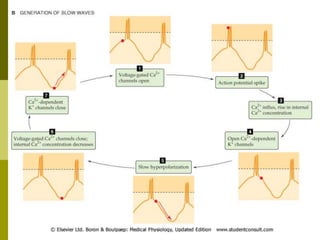
Slow waves- Leaky cation channels
Spike potentials with slow waves
 Causes series of rhythmical contractions
of the smooth muscle mass
 These slow waves are also called pace
maker waves found in gut, ureter
(tubular hollow viscera).
 Spread of action potential through
visceral smooth muscle is via gap
junctions
 Visceral smooth muscles generate
spontaneous action potential by stretch
also
Spike potentials with slow waves
 e.g if action potential begins at upper end
of intestine it spreads downwards along
the intestine wall creating a constriction
ring that moves forwards.
 This constriction ring propels the intestinal
contents forward - process is called
peristalsis
 when a gut is overstretched by intestinal
contents a local automatic contraction sets
up a peristaltic wave that moves the
contents away form the over stretched
area
Action Potential with Plateau
 Instead of rapid repolarization of muscle fiber membrane
the repolarization is delayed for several hundred to several
thousands millisecs
 Importance of plateau - can account for prolonged period of
contraction which occurs in ureter, uterine muscles
 Due to L-type Ca channels and K channels
Stimulus for AP/Contraction
 Final stimulus is Increased levels of
Calcium
 Can be brought about by
 Nerve stimulation
 Hormonal stimulation
 Stretch of fiber
 Change in chemical environment
 Or can be spontaneously generated in
muscle fiber itself
3 Sources of Calcium Influx
 Entry from ECF
 Major pathway
 time required for diffusion - averages 200- 300 millisecs
- latent period (50 times greater in sk. musc.)
 From Sarcoplasmic Reticulum (poorly dev.)
 Via ligand gated and voltage gated channels
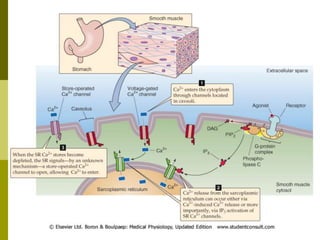
 Via IP3 mediated calcium release via G-protein coupled
receptors
 Store-operated Ca2+ channels in plasma
membrane
 Eventual depletion of calcium stores in SR stimulates
influx from SOCC
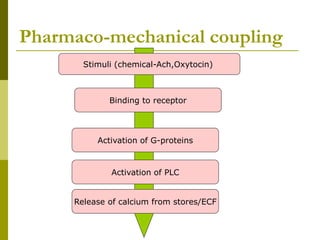
 Release via 2 & 3 – Pharmacomechanical
Coupling because independent of AP generation
Stimuli (stretch, cooling)
Action potential (mechanoreceptors , thermoreceptors)
Entry of calcium (CaV)
Electro-mechanical coupling
Stimuli (chemical-Ach,Oxytocin)
Binding to receptor
Activation of G-proteins
Release of calcium from stores/ECF
Activation of PLC
Pharmaco-mechanical coupling
Excitation Contraction Coupling
 Slow onset of Contraction & Relaxation
 Begins to contract 50 to 100 millisecs after it is
excited (can be as much as 500msec)
 Reaches full contraction about 0.5 sec later
 Declines in contractile force in another 1 -2 secs
 Total contraction time of 1 to 3 secs (30
times longer than skeletal muscle)
 Due to
 slowness of attachment and detachment of the
cross-bridges with actin filaments
 Initiation of contraction in response to calcium
ions is much slower than in skeletal muscle
Excitation Contraction Coupling
Release of calcium
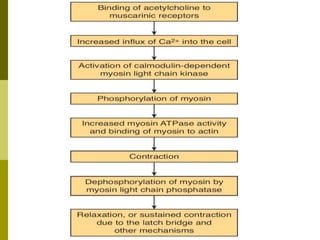
Binding of calcium to Calmodulin
Activation of MLCK by Ca-CaM
Phosphorylation of light chain of myosin
Binding of myosin to actin
Contractile mechanism
MLCK – myosin light chain kinase
Contractile mechanism
Relaxation mechanism
 Another enzyme, Myosin light chain phosphatase
removes the phosphate from the myosin
 But dephosphorylation of myosin light chain
kinase does not necessarily lead to relaxation of
the smooth muscle
 Latch bridge by which myosin cross bridge
remains attached to actin for sometime even after
cytoplasmic Ca++ conc falls
 Produces sustained contraction with little expenditure of
energy
 Relaxation finally occurs when Ca2+ - Calmodulin
complex dissociates – slower process
Latch Bridge Phenomenon –
Possible mechanism
 When myosin kinase and myosin phosphatase
enzymes are both strongly activated
 cycling frequency of myosin heads & velocity of contraction are
great
 As activation of enzymes decreases
 Cycling frequency decreases
 but at the same time, deactivation of enzymes allows the
myosin heads to remain attached to actin filament for a longer
and longer proportion of the cycling period
 Number of heads attached to the actin filament at any given
time remains large
 Because the number of heads attached to the
actin determines the static force of contraction,
tension is maintained, or “latched”; yet little
energy is used by the muscle
Slow cross bridge cycling : leading to
‘Latch’ state
1/10 to 1/300 the rate of skeletal muscle
Latch bridge mechanism
Force of Muscle Contraction
 Maximum force of contraction of smooth
muscle is often greater than that of
skeletal muscle
 As great as 4 to 6 kg/cm2 cross-sectional
area for smooth muscle, in comparison
with 3 to 4 kg for skeletal muscle
 Due to
 prolonged period of attachment of the
myosin cross bridges to actin filaments
Energy Requirement
 Energy required for sustained smooth
muscle contraction is very little due to
 Fewer myosin filament in smooth muscle as
compared to S.K. Muscle
 Lower myosin ATPase activity
 Lower rate of cross bridge cycling (only 1 ATP
used per cycle irrespective of duration of cross
bridge)
 Only 1/10 to 1/300 as much energy is
required to sustain the same tension of
contraction as in skeletal muscle
 Imp – need to work indefinitely
Contraction-Relaxation (cont.)
Figure 8-5Figure 8-3
Multi-Unit Smooth Muscle
 Normally contract mainly in response to
nerve stimuli (Transmitter substances -
Ach or NE)
 Action potentials usually do not develop
 Fibers are too small
 Local depolarization (Junctional potentials)
develop, spread electrotonically over the
entire fiber, and are enough to cause
muscle contraction
Effect of Ach and NE
 If epinephrine or norepinephrine is added to a
preparation of intestinal smooth muscle arranged
for recording of intracellular potentials in vitro
 membrane potential usually becomes larger, spikes
decrease in frequency, and muscle relaxes
 Ach has opposite effect
 membrane potential decreases, spikes become more
frequent. The muscle becomes more active, with an
increase in tonic tension and the number of rhythmic
contractions
 Other factors which depolarize the membrane are
Stretch and specific gastrointestinal hormones
Excitation/inhibition of smooth
muscle
Excitation/inhibition of smooth
muscle
Factors which increase Relaxation
 In addition to cellular mechanisms that increase
contraction, certain mechanisms lead to its
relaxation
 Endothelial cells that line the inside of blood cells
release a substance called (endothelial derived
relaxation factor, EDRF) or nitric oxide (NO)
 NO directly activates a soluble guanylate cyclase
to produce another second messenger molecule,
cyclic guanosine monophosphate (cGMP)
 Activate cGMP-specific protein kinases that can
affect ion channels, Ca2+ homeostasis, or
phosphatases, or all of those mentioned, that lead
to smooth muscle relaxation
Effect of Local Tissue Factors
 In the normal resting state, many of small
blood vessels remain contracted
 When extra blood flow is needed, multiple
factors can relax the vessel wall
 Local feedback control system
 Factors causing Vasodilation
 Lack of oxygen in the local tissues
 Excess carbon dioxide
 Increased hydrogen ion concentration
 Adenosine, lactic acid, increased potassium ions,
diminished calcium ion concentration, and increased
body temperature
Applied Aspect
 During an asthma attack – bronchoconstriction
can be relieved by rapid response inhaler drugs
(eg, ventolin, albuterol, sambuterol) which target
β-adrenergic receptors in the airway smooth
muscle to elicit a relaxation
 In Erectile dysfunction - specific inhibitors of PDE
(sildenafil, tadalafil, and vardenafil) are used
 NO is a natural signaling molecule that relaxes smooth
muscle by raising cGMP. This signaling pathway is
naturally down-regulated by the action of
phosphodiesterase (PDE), which transforms cGMP into
a nonsignaling form, GMP. Oral administration of these
drugs can block the action of PDE V, increasing blood flow
Relation of length to tension
 If a piece of visceral smooth muscle is
stretched, it 1st exerts increased tension
 However if muscle is held at the greater
length after stretching, the tension
gradually decreases, called Plasticity
 Sometimes the tension falls to or below the level
exerted before muscle was stretched
 Thus, no resting length can be assigned
 Impossible to correlate length and
developed tension accurately
Advantage of Plasticity
 Ability to return to nearly its original
force of contraction seconds or
minutes after it has been elongated
or shortened
 Importance is that, except for short
periods of time, they allow a hollow
organ to maintain about the same
amount of pressure inside its lumen
despite long-term, large changes in
volume
Stress Relaxation & Reverse
Stress Relaxation
Demonstration of Plasticity in
Urinary Bladder
Advantage of Plasticity
 Accommodating more blood/fluid by
vessels/viscera without increasing
pressure (stress relaxation & reverse
stress relaxation)
 Accommodating more urine by the
bladder
 Accommodating more food by
stomach without increase in
pressure. (receptive relaxation)
Characteristics of smooth muscle
 Difference in Structure
 Unstable RMP
 Slow excitation contraction coupling
 Marked shortening during contraction
 Latch phenomenon for prolonged contraction
 Plasticity : variability of tension exerted at
any given length
 Less energy required to sustain contraction
 Can respond to stretch in absence of
extrinsic innervation
Thank you
References:
Guyton- Textbook of Medical Physiology
Ganong’s- Review of Medical Physiology
Boron-Medical Physiology
Kandel-Principles of Neural Science
Silbernagl-Color atlas of Physiology
Ira Fox- Medical Physiology

Smooth Muscles

  • 1.
  • 2.
    Structure of SmoothMuscle  Lacks visible cross-striations  Actin and myosin-II are present but not arranged in regular arrays  Actin 5-10 times more than Myosin  Dense bodies instead of Z lines  In the cytoplasm and attached to cell membrane  Connected to actin filaments by α-actinin  Interspersed among the actin filaments are myosin filaments  Some of the dense bodies connected to adjacent cells by intercellular protein bridges – transmits force of contraction from one cell to the next
  • 3.
    Spindle shaped cells,found in the walls of tubular structures, hollow viscera Smaller fibres, Diameter = 1 to 5 micrometers length = 15 micron (blood vessels) to 200 micron (uterus) Structure Tropomyosn present NO Troponin
  • 4.
    Structure of SmoothMuscle  Myosin filaments have “sidepolar” cross- bridges  Arranged so that bridges on one side hinge in one direction and those on other side hinge in opposite direction  Allows myosin to pull an actin filament in one direction on one side while simultaneously pulling another actin filament in the opposite direction on the other side  Allows smooth muscle cells to contract as much as 80% of their length instead of 30% (skeletal muscle)
  • 6.
  • 7.
    Structure of SmoothMuscle  Contains tropomyosin, but troponin absent  Thus, mechanism for control of contraction is different  Regulatory protein is calmodulin instead of troponin  Sarcoplasmic reticulum less extensive  Few mitochondria  depends, to a large extent, on glycolysis for their metabolic needs  Divided into 2 main sub-types
  • 8.
  • 9.
    Single unit SmoothMuscle  a.k.a Unitary or visceral smooth muscle  Mass of hundreds to thousands of fibers that contract together as a single unit  Large sheets with low-resistance gap junctions between individual muscle cells  functions in a syncytial fashion  Resembles cardiac muscle  undergo rhythmic, spontaneous contractions in the absence of nerve or hormonal input  Present in walls of hollow viscera (Intestinal smooth muscle, Ureters, Uterus, small arteries)
  • 10.
    Multi Unit SmoothMuscle  Individual units with few (or no) gap junctional bridges  Leads to discrete, fine localized contractions  Resembles skeletal muscle but involuntary  Each fiber operates independently of others  Often innervated by a single nerve ending fibers  Found in (Iris & ciliary muscle of eye, larger arteries, Some areas of intestine, Reproductive system, Pilomotor muscle (skin) )  Blood vessels have both single unit and multi unit types
  • 11.
    Single Unit vsMulti Unit
  • 12.
    SINGLE UNIT SMOOTHMUSCLE MULTI – UNIT SMOOTH MUSCLE Eg. – Muscle of GIT, bronchi, urinary bladder and uterus Eg. – Ciliary muscles, muscles of iris and pilomotor muscles in hair follicles Pacemaker tissue present – responsible for rhythmic contraction & relaxation of muscle No pacemaker tissue Autonomic nervous system can modify the response Only show contraction as per the discharge in autonomic nerves supplying them Stretch of the muscle causes reflex contraction No effect of stretch on the muscle Low resistance bridges are present in between the cells so acting as functional synctium No such bridges Contracts as a single unit and there is a widespread contraction Contraction is more discrete, fine and localized
  • 13.
    N-M Junction inSmooth Muscle  Neurons are part of the autonomic nervous system rather than somatic nervous system  Neuron makes multiple contacts with a smooth muscle cell (no direct contact)  At each contact point, the axon diameter expands to form a varicosity that contains the vesicles (can contain ACh or NE)  Varicosity is in close proximity to postsynaptic membrane (relatively little specialization)  Receptors are spread more widely across the postsynaptic membrane
  • 14.
    N-M Junction inSmooth Muscle
  • 15.
    N-M Junction inSmooth Muscle  No typical end feet as seen in skeletal muscle, axons have multiple varicosities distributed along their axes  Varicosities are about 5 μm apart, with up to 20,000 varicosities per neuron  Transmitter is liberated at each varicosity, ie, at many locations along each axon  This arrangement permits one neuron to innervate many effector cells  The type of contact in which a neuron forms a synapse on the surface of another neuron or a smooth muscle cell and then passes on to make similar contacts with other cells is called a synapse en passant
  • 16.
  • 17.
    Unitary Smooth Muscle RMP : -50mV (-20 to -65mV (oscillates) – No true value -Unstable  Superimposed on the membrane potential are (Divergent electrical activity)  Slow sine wave like fluctuations – few microvolts in magnitude  Spikes – Duration 50msec -AP has prolonged plateau during repolarization  In addition, Pacemaker potentials  Shows Continuous irregular contractions that are independent of nerve supply  Maintained state of partial contraction is called Tone or tonus  Generated in multiple foci that shift from place to place
  • 18.
    Excitation & actionpotential in smooth muscle fibers  Transmission of impulse from terminal nerve fibers to smooth muscle fiber is same as in S.K. muscle  When an action potential reaches the terminal or excitatory nerve fibril there is a latent period of 50sec  Resting potential -50 mv  Threshold potential for smooth muscle is -30 to-35 mv
  • 19.
    Role of Ca++ions causing smooth muscle action potential  Depolarization process during action potential of muscle & nerve fiber is caused by rapid influx of Na+, but in action potential of smooth muscle fibers, rapid influx of ions include Na+ as well as Ca++  Caused mainly by influx of Ca++ than Na+  More voltage gated Ca++ channels  Ca++ channels open more slowly and also remain open much longer- resp. for plateau  Also calcium acts directly on contractile mechanism to cause contraction
  • 20.
    Types of SmoothMuscle AP
  • 21.
    Spike potential Typical smoothmuscle action potential (spike potential) elicited by an external stimulus Observed in GIT Due to L-type calcium channels
  • 22.
    Spike potentials withslow waves  Some smooth muscles are self excitatory  No extrinsic stimulus is required  Usually associated with basic slow wave rhythms (BER) of membrane potentials  not an action potential & do not cause contraction  local property of smooth muscle fiber  Cause of slow wave rhythm is unknown  When potentials of slow wave rises above -35mv an AP develops & contraction occurs  On Each peak of slow wave one or more action potentials occurs
  • 23.
    Spike potentials withslow waves Observed in GIT – smooth muscle of intestinal wall Duration of Spike Potential is 10-50 millisec
  • 24.
    Membrane potential ofsmooth muscles Membrane potential Tension Slow waves- Leaky cation channels
  • 26.
    Spike potentials withslow waves  Causes series of rhythmical contractions of the smooth muscle mass  These slow waves are also called pace maker waves found in gut, ureter (tubular hollow viscera).  Spread of action potential through visceral smooth muscle is via gap junctions  Visceral smooth muscles generate spontaneous action potential by stretch also
  • 27.
    Spike potentials withslow waves  e.g if action potential begins at upper end of intestine it spreads downwards along the intestine wall creating a constriction ring that moves forwards.  This constriction ring propels the intestinal contents forward - process is called peristalsis  when a gut is overstretched by intestinal contents a local automatic contraction sets up a peristaltic wave that moves the contents away form the over stretched area
  • 29.
    Action Potential withPlateau  Instead of rapid repolarization of muscle fiber membrane the repolarization is delayed for several hundred to several thousands millisecs  Importance of plateau - can account for prolonged period of contraction which occurs in ureter, uterine muscles  Due to L-type Ca channels and K channels
  • 30.
    Stimulus for AP/Contraction Final stimulus is Increased levels of Calcium  Can be brought about by  Nerve stimulation  Hormonal stimulation  Stretch of fiber  Change in chemical environment  Or can be spontaneously generated in muscle fiber itself
  • 31.
    3 Sources ofCalcium Influx  Entry from ECF  Major pathway  time required for diffusion - averages 200- 300 millisecs - latent period (50 times greater in sk. musc.)  From Sarcoplasmic Reticulum (poorly dev.)  Via ligand gated and voltage gated channels  Via IP3 mediated calcium release via G-protein coupled receptors  Store-operated Ca2+ channels in plasma membrane  Eventual depletion of calcium stores in SR stimulates influx from SOCC  Release via 2 & 3 – Pharmacomechanical Coupling because independent of AP generation
  • 33.
    Stimuli (stretch, cooling) Actionpotential (mechanoreceptors , thermoreceptors) Entry of calcium (CaV) Electro-mechanical coupling
  • 34.
    Stimuli (chemical-Ach,Oxytocin) Binding toreceptor Activation of G-proteins Release of calcium from stores/ECF Activation of PLC Pharmaco-mechanical coupling
  • 35.
    Excitation Contraction Coupling Slow onset of Contraction & Relaxation  Begins to contract 50 to 100 millisecs after it is excited (can be as much as 500msec)  Reaches full contraction about 0.5 sec later  Declines in contractile force in another 1 -2 secs  Total contraction time of 1 to 3 secs (30 times longer than skeletal muscle)  Due to  slowness of attachment and detachment of the cross-bridges with actin filaments  Initiation of contraction in response to calcium ions is much slower than in skeletal muscle
  • 36.
  • 37.
    Release of calcium Bindingof calcium to Calmodulin Activation of MLCK by Ca-CaM Phosphorylation of light chain of myosin Binding of myosin to actin Contractile mechanism MLCK – myosin light chain kinase
  • 38.
  • 40.
    Relaxation mechanism  Anotherenzyme, Myosin light chain phosphatase removes the phosphate from the myosin  But dephosphorylation of myosin light chain kinase does not necessarily lead to relaxation of the smooth muscle  Latch bridge by which myosin cross bridge remains attached to actin for sometime even after cytoplasmic Ca++ conc falls  Produces sustained contraction with little expenditure of energy  Relaxation finally occurs when Ca2+ - Calmodulin complex dissociates – slower process
  • 41.
    Latch Bridge Phenomenon– Possible mechanism  When myosin kinase and myosin phosphatase enzymes are both strongly activated  cycling frequency of myosin heads & velocity of contraction are great  As activation of enzymes decreases  Cycling frequency decreases  but at the same time, deactivation of enzymes allows the myosin heads to remain attached to actin filament for a longer and longer proportion of the cycling period  Number of heads attached to the actin filament at any given time remains large  Because the number of heads attached to the actin determines the static force of contraction, tension is maintained, or “latched”; yet little energy is used by the muscle
  • 42.
    Slow cross bridgecycling : leading to ‘Latch’ state 1/10 to 1/300 the rate of skeletal muscle Latch bridge mechanism
  • 43.
    Force of MuscleContraction  Maximum force of contraction of smooth muscle is often greater than that of skeletal muscle  As great as 4 to 6 kg/cm2 cross-sectional area for smooth muscle, in comparison with 3 to 4 kg for skeletal muscle  Due to  prolonged period of attachment of the myosin cross bridges to actin filaments
  • 44.
    Energy Requirement  Energyrequired for sustained smooth muscle contraction is very little due to  Fewer myosin filament in smooth muscle as compared to S.K. Muscle  Lower myosin ATPase activity  Lower rate of cross bridge cycling (only 1 ATP used per cycle irrespective of duration of cross bridge)  Only 1/10 to 1/300 as much energy is required to sustain the same tension of contraction as in skeletal muscle  Imp – need to work indefinitely
  • 46.
  • 47.
    Multi-Unit Smooth Muscle Normally contract mainly in response to nerve stimuli (Transmitter substances - Ach or NE)  Action potentials usually do not develop  Fibers are too small  Local depolarization (Junctional potentials) develop, spread electrotonically over the entire fiber, and are enough to cause muscle contraction
  • 48.
    Effect of Achand NE  If epinephrine or norepinephrine is added to a preparation of intestinal smooth muscle arranged for recording of intracellular potentials in vitro  membrane potential usually becomes larger, spikes decrease in frequency, and muscle relaxes  Ach has opposite effect  membrane potential decreases, spikes become more frequent. The muscle becomes more active, with an increase in tonic tension and the number of rhythmic contractions  Other factors which depolarize the membrane are Stretch and specific gastrointestinal hormones
  • 49.
  • 50.
  • 51.
    Factors which increaseRelaxation  In addition to cellular mechanisms that increase contraction, certain mechanisms lead to its relaxation  Endothelial cells that line the inside of blood cells release a substance called (endothelial derived relaxation factor, EDRF) or nitric oxide (NO)  NO directly activates a soluble guanylate cyclase to produce another second messenger molecule, cyclic guanosine monophosphate (cGMP)  Activate cGMP-specific protein kinases that can affect ion channels, Ca2+ homeostasis, or phosphatases, or all of those mentioned, that lead to smooth muscle relaxation
  • 52.
    Effect of LocalTissue Factors  In the normal resting state, many of small blood vessels remain contracted  When extra blood flow is needed, multiple factors can relax the vessel wall  Local feedback control system  Factors causing Vasodilation  Lack of oxygen in the local tissues  Excess carbon dioxide  Increased hydrogen ion concentration  Adenosine, lactic acid, increased potassium ions, diminished calcium ion concentration, and increased body temperature
  • 53.
    Applied Aspect  Duringan asthma attack – bronchoconstriction can be relieved by rapid response inhaler drugs (eg, ventolin, albuterol, sambuterol) which target β-adrenergic receptors in the airway smooth muscle to elicit a relaxation  In Erectile dysfunction - specific inhibitors of PDE (sildenafil, tadalafil, and vardenafil) are used  NO is a natural signaling molecule that relaxes smooth muscle by raising cGMP. This signaling pathway is naturally down-regulated by the action of phosphodiesterase (PDE), which transforms cGMP into a nonsignaling form, GMP. Oral administration of these drugs can block the action of PDE V, increasing blood flow
  • 54.
    Relation of lengthto tension  If a piece of visceral smooth muscle is stretched, it 1st exerts increased tension  However if muscle is held at the greater length after stretching, the tension gradually decreases, called Plasticity  Sometimes the tension falls to or below the level exerted before muscle was stretched  Thus, no resting length can be assigned  Impossible to correlate length and developed tension accurately
  • 55.
    Advantage of Plasticity Ability to return to nearly its original force of contraction seconds or minutes after it has been elongated or shortened  Importance is that, except for short periods of time, they allow a hollow organ to maintain about the same amount of pressure inside its lumen despite long-term, large changes in volume
  • 56.
    Stress Relaxation &Reverse Stress Relaxation
  • 57.
    Demonstration of Plasticityin Urinary Bladder
  • 58.
    Advantage of Plasticity Accommodating more blood/fluid by vessels/viscera without increasing pressure (stress relaxation & reverse stress relaxation)  Accommodating more urine by the bladder  Accommodating more food by stomach without increase in pressure. (receptive relaxation)
  • 59.
    Characteristics of smoothmuscle  Difference in Structure  Unstable RMP  Slow excitation contraction coupling  Marked shortening during contraction  Latch phenomenon for prolonged contraction  Plasticity : variability of tension exerted at any given length  Less energy required to sustain contraction  Can respond to stretch in absence of extrinsic innervation
  • 61.
    Thank you References: Guyton- Textbookof Medical Physiology Ganong’s- Review of Medical Physiology Boron-Medical Physiology Kandel-Principles of Neural Science Silbernagl-Color atlas of Physiology Ira Fox- Medical Physiology

Editor's Notes

  • #3 Appears smooth in polarized light
  • #4 Skeletal muscle fibers are as much as 30 times greater in diameter and hundreds of times as long.
  • #8 SR less developed so source of calcium is mainly frm ECF
  • #24 Due to interaction with interstitial cells of cajal
  • #41 Cycling of cross bridges is much slower
  • #52 Effect is mediated by phospholipase C, which produces IP3 and allows for Ca2+ release through IP3 receptors
  • #57 β action – increase intracellular binding of calcium, α action – increase calcium efflux from muscle cells