


Success Online by DesignConceptualizing Successful Online Learning
Assessing ExperienceHow many of you have taught an online course in the past 24 months?How many of you have designed /developed curriculum for online learning environments?How many of you occupy an eLearning administration / oversight position?Does your institution strongly support your eLearning initiatives with faculty training and administrative support?
Setting the SceneWhy are we here? The Paradox:More StudentsMore Suspicion Sloan Consortium Annual Report:Online enrollments up 17% in 20094.6 million students enrolled in 1 or more online courses75% of all institutions report increased demand for online coursesWhy the enrollment trend?  Turn to CNN.
The Value of Online Education?Based on the CNN news report, what values were NOT reflected in the evaluation and promotion of online education? *Convenience, job training, low cost were the values*Confronting the inevitable: when quantity and quality collideSloan Consortium Report ALSO reports:Two-thirds of chief academic officers assert that their faculty reject the “value and legitimacy” of online education70% of faculty assert online courses are inferior to face-to-face courses; 48% of faculty who have taught online assert this as wellWhy is there widespread perception that online courses lack quality?
Why Is There Widespread Perception That Online Courses Lack Quality?Generational issues Early linkage of online courses with correspondence coursesPerception that online courses were developed to accommodate degree-mill industry Lack of embodied face-to-face contact (the socializing element some believe is an important part of higher education)Inability to verify integrity of student work (plagiarism, other people taking your tests for you, etc); Faculty object to the value students place on online learning - cost, flexibility, convenience...these are not the "true" values of higher education.
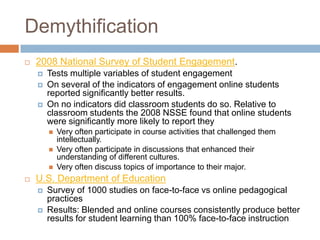
Demythification2008 National Survey of Student Engagement.
Tests multiple variables of student engagement
On several of the indicators of engagement online students reported significantly better results.
On no indicators did classroom students do so. Relative to classroom students the 2008 NSSE found that online students were significantly more likely to report they
Very often participate in course activities that challenged them intellectually.
Very often participate in discussions that enhanced their understanding of different cultures.
Very often discuss topics of importance to their major.
U.S. Department of Education
Survey of 1000 studies on face-to-face vs online pedagogical practices
Results: Blended and online courses consistently produce better results for student learning than 100% face-to-face instruction The Quest for QualityWhat are the characteristics of quality face-to-face instruction?Should these characteristics be any different for online instruction?The debate over derivative standards.What are the specific demands of online education that require unique quality control standards?
Seven Principles of Good Practice in Undergraduate EducationFOUNDATIONBottom line: meta-practices that you recognize as quality instructional practice face-to-face IS relevant to online environments – but it is just a starting pointGood practice encourages student-faculty contactGood practice encourages cooperation among studentsGood practice encourages active learningGood practice gives prompt feedbackGood practice emphasizes time on taskGood practice communicates high expectationsGood practice respects diverse talents and ways of learning
The Quest for QualityWhat are the specific demands of online education that require unique quality control standards?Accessibility Course navigation Appropriateness of technology Appropriateness of digitally mediated assessment instruments Resources allocated
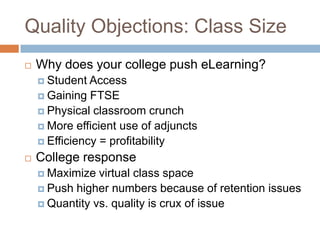
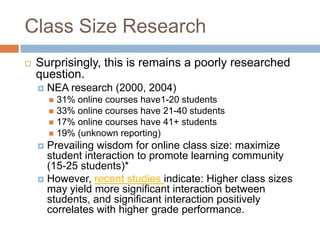
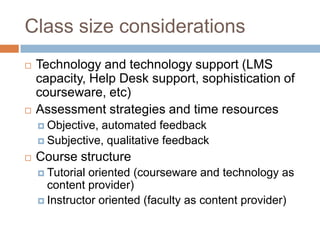
Three Strategies for Establishing QualityKnowing the emerging industry standards for the purpose of:Initial design considerationsSelf-EvaluationInstitutional EvaluationNew and grounded development in industry-standard design processesMaking sensible decisions regarding class sizeThe ResearchThe variables to consider
Articulating Industry StandardsAdvantages of articulated standards
Provides benchmarks for course development, faculty training
Increases student and faculty confidence in course quality; important for user satisfaction, course transfer and articulation, and accreditation
Examples
State-specific standards (California, etc)

FTCC - Distance Education Track

  • 1.
    Success Online byDesignConceptualizing Successful Online Learning
  • 2.
    Assessing ExperienceHow manyof you have taught an online course in the past 24 months?How many of you have designed /developed curriculum for online learning environments?How many of you occupy an eLearning administration / oversight position?Does your institution strongly support your eLearning initiatives with faculty training and administrative support?
  • 3.
    Setting the SceneWhyare we here? The Paradox:More StudentsMore Suspicion Sloan Consortium Annual Report:Online enrollments up 17% in 20094.6 million students enrolled in 1 or more online courses75% of all institutions report increased demand for online coursesWhy the enrollment trend? Turn to CNN.
  • 4.
    The Value ofOnline Education?Based on the CNN news report, what values were NOT reflected in the evaluation and promotion of online education? *Convenience, job training, low cost were the values*Confronting the inevitable: when quantity and quality collideSloan Consortium Report ALSO reports:Two-thirds of chief academic officers assert that their faculty reject the “value and legitimacy” of online education70% of faculty assert online courses are inferior to face-to-face courses; 48% of faculty who have taught online assert this as wellWhy is there widespread perception that online courses lack quality?
  • 5.
    Why Is ThereWidespread Perception That Online Courses Lack Quality?Generational issues Early linkage of online courses with correspondence coursesPerception that online courses were developed to accommodate degree-mill industry Lack of embodied face-to-face contact (the socializing element some believe is an important part of higher education)Inability to verify integrity of student work (plagiarism, other people taking your tests for you, etc); Faculty object to the value students place on online learning - cost, flexibility, convenience...these are not the "true" values of higher education.
  • 6.
  • 7.
    Tests multiple variablesof student engagement
  • 8.
    On several ofthe indicators of engagement online students reported significantly better results.
  • 9.
    On no indicatorsdid classroom students do so. Relative to classroom students the 2008 NSSE found that online students were significantly more likely to report they
  • 10.
    Very often participatein course activities that challenged them intellectually.
  • 11.
    Very often participatein discussions that enhanced their understanding of different cultures.
  • 12.
    Very often discusstopics of importance to their major.
  • 13.
  • 14.
    Survey of 1000studies on face-to-face vs online pedagogical practices
  • 15.
    Results: Blended andonline courses consistently produce better results for student learning than 100% face-to-face instruction The Quest for QualityWhat are the characteristics of quality face-to-face instruction?Should these characteristics be any different for online instruction?The debate over derivative standards.What are the specific demands of online education that require unique quality control standards?
  • 16.
    Seven Principles ofGood Practice in Undergraduate EducationFOUNDATIONBottom line: meta-practices that you recognize as quality instructional practice face-to-face IS relevant to online environments – but it is just a starting pointGood practice encourages student-faculty contactGood practice encourages cooperation among studentsGood practice encourages active learningGood practice gives prompt feedbackGood practice emphasizes time on taskGood practice communicates high expectationsGood practice respects diverse talents and ways of learning
  • 17.
    The Quest forQualityWhat are the specific demands of online education that require unique quality control standards?Accessibility Course navigation Appropriateness of technology Appropriateness of digitally mediated assessment instruments Resources allocated
  • 18.
    Three Strategies forEstablishing QualityKnowing the emerging industry standards for the purpose of:Initial design considerationsSelf-EvaluationInstitutional EvaluationNew and grounded development in industry-standard design processesMaking sensible decisions regarding class sizeThe ResearchThe variables to consider
  • 19.
  • 20.
    Provides benchmarks forcourse development, faculty training
  • 21.
    Increases student andfaculty confidence in course quality; important for user satisfaction, course transfer and articulation, and accreditation
  • 22.
  • 23.

Editor's Notes

  • #3 This should create a pyramid. Many will have taught online…fewer will be well-supported. Use this exercise to suggest that “many of us are tasked with teaching online, fewer of us have development experience, and fewer still feel well-supported” Here’s the bottom line: Most community college faculty are pressured to teach online BUT they feel they lack grants/money/incentives to support design and development, they have no targets for quality standards, and they are concerned about time resources for development and maintenance of online courses. So, your role here is to be suggestive of tools/considerations for self-starters.
  • #4 Hyperlinks = professor overview of report’s findings AND a CNN report on the attraction to online education in bad economic times. Use the next few slides to establish urgency…there are more online students than ever before, and there is more doubt than ever before about the validity of this modality.
  • #5 Quality was not mentioned in the CNN clip….convenience, job training, cost were the values. Not quality.
  • #6 Quality was not mentioned in the CNN clip….convenience, job training, cost were the values. Not quality.
  • #7 Use this slide to establish that, in fact, the industry is showing some great promise. Quality can be achieved, as can student success.
  • #8 Get them thinking about what constitutes quality in general. Use Q/A. Then, once they brainstorm, use the next slide to demonstrate that fundamentals are fundamentals and that best practices for instruction, in general, are achievable in eLearning.
  • #9 Arthur W. Chickering's and Zelda F. Gamson's book entitled, Seven Principles for Good Practice in Undergraduate Education
  • #10 Get them thinking about what constitutes quality in general. Use Q/A. Then, once they brainstorm, use the next slide to demonstrate that fundamentals are fundamentals and that best practices for instruction, in general, are achievable in eLearning.
  • #11 Use this as the framing slide for what you are delivering to the audience
  • #12 Sending you a PDF file containing HLC best practices. Just use as an example of published guidelines so people understand that there are specific, industry standard resources available.
  • #16 Remember, 99% of higher ed faculty have NO background in ID or pedagogy. Equipping them with a basic framework might be helpful. Provide a design document sample to illustrate the application of a design model to a development process.
  • #18 Provide examples of design documents
  • #21 * Palloff, R. & Pratt, K. (1999) Building Learning Communities in Cyberspace. San Francisco: Jossey-Bass Publishers
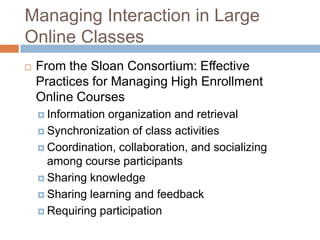
  • #23 Information organization and retrieval: Carefully structure course activities into different conferences or discussion forums, so that all of the information in one conference relates to a small number of topics, and no single conference gets so large that it is difficult to find information within that conference. Synchronization of the class as a whole: Set clear guidelines that tells students what needs to be done, where, and when so that the students are focusing on the same activities at the same time. Strictly enforce these guidelines to maintain the order laid out in the conference organization. Coordination, collaboration, and socializing among the members: A key instructor role is to motivate, encourage, and facilitate authentic, active and collaborative interaction among the students. Frequent (ideally daily) instructor activity helps to create a socially welcoming environment. Another critical strategy is establishing and enforcing a course structure that can accommodate high levels of interaction without creating an information overload, as well as support levels of trust required for open expression of views. Such a structure enables students to realize that their active participation supports content mastery, higher grades, and overall learning. The software used should enable students to have their own private conferences for doing group work. Sharing knowledge: Upper division and graduate courses usually have a mix of students with and without considerable working experience, so 'contextualized learning' is important: promote the relevance between experience and learning by teaching experienced students course concepts in the context of their real life experiences. These students then can bring these understandings to the rest of the class. Students then take what the course professor has to say far more seriously. Sharing learning and feedback: Particularly in courses with many abstract concepts, encouraging students to make experiential associations by elaborating course concepts in their own frames of reference helps the instructor to better gauge teaching effectiveness. Students may understand other students' representations and understandings better than the ones the instructor use. This is a form of the Montessori effect, i.e., having students help other students and thus minimizing instructor workload in the process. Requiring participation: Grade students on the quality and timeliness of their contributions rather than quantity (number or size) of their contributions. In the case study courses, 'required' (i.e. specified based on assignment) and 'voluntary' (i.e., discretionary) contributions each accounted for 10% of the total course grade.