

High Quality
Online Courses
         Patrick R. Lowenthal
                    Boise State University
            University of Colorado Denver
         slides @ www.patricklowenthal.com
Senate Bill No. 1184
“…the legislature finds that in order to better
provide students with the skills that they will
need to be successful as students,
employees, entrepreneurs, and parents in the
future, more exposure is needed in online
learning and informational environments…”
My Girls
Growth of Online Learning


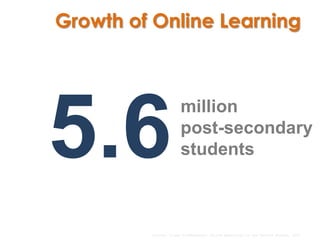
5.6
                      million
                      post-secondary
                      students


         Source: Class Differences: Online Education in the United States, 2010
Growth of Online Learning


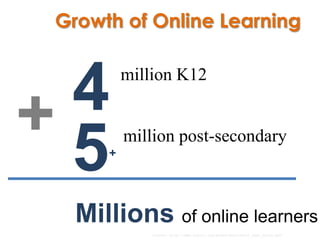
+ 4       million K12


  5   +
          million post-secondary


   Millions of online learners
              Source: http://www.inacol.org/press/docs/nacol_fast_facts.pdf
Growth of Online Learning


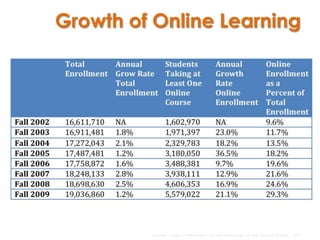
         Source: Class Differences: Online Education in the United States, 2010
Growth of Online Learning


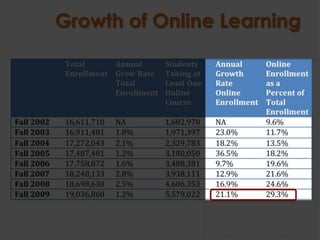
         Source: Class Differences: Online Education in the United States, 2010
Growth of Online Learning


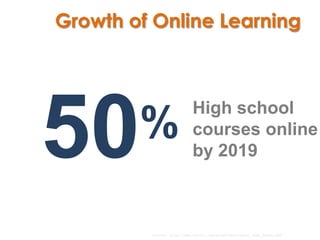
50      %
                           High school
                           courses online
                           by 2019


         Source: http://www.inacol.org/press/docs/nacol_fast_facts.pdf
My Girls
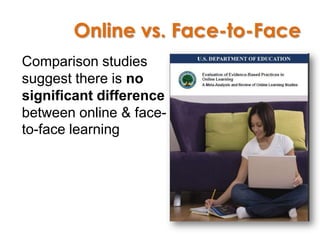
Online vs. Face-to-Face
Comparison studies
suggest there is no
significant difference
between online & face-
to-face learning
What Does Quality Look Like?
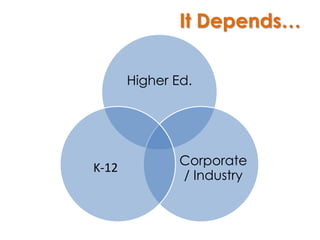
It Depends…

       Higher Ed.


               Corporate
K-12
               / Industry
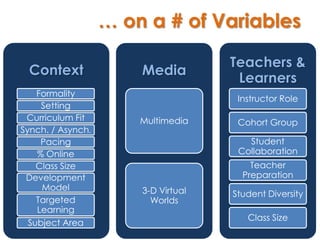
… on a # of Variables

                                     Teachers &
 Context               Media
                                      Learners
    Formality
                                      Instructor Role
     Setting
 Curriculum Fit        Multimedia     Cohort Group
Synch. / Asynch.
     Pacing                             Student
    % Online                          Collaboration
    Class Size                           Teacher
 Development                           Preparation
     Model             3-D Virtual   Student Diversity
    Targeted             Worlds
    Learning
                                        Class Size
  Subject Area
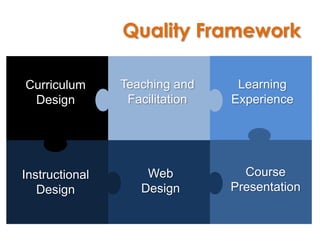
Quality Framework

Curriculum      Teaching and     Learning
 Design          Facilitation   Experience


Instructional       Web           Course
   Design          Design       Presentation
Standards / Guidelines
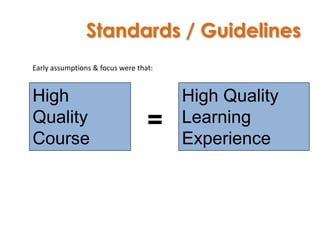
Early assumptions & focus were that:


High                                   High Quality
Quality                           =    Learning
Course                                 Experience
Standards
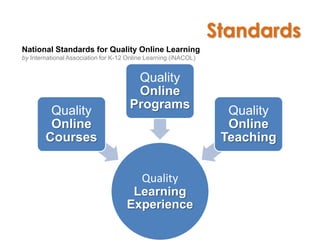
National Standards for Quality Online Learning
by International Association for K-12 Online Learning (iNACOL)


                                       Quality
                                       Online
         Quality                      Programs                     Quality
         Online                                                    Online
        Courses                                                   Teaching


                                       Quality
                                      Learning
                                     Experience
Standards
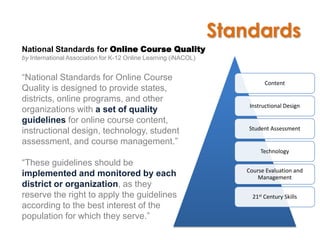
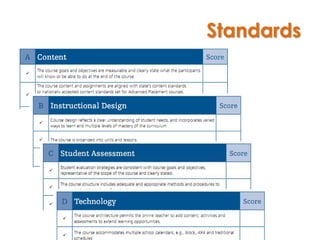
National Standards for Online Course Quality
by International Association for K-12 Online Learning (iNACOL)


“National Standards for Online Course
                                                                           Content
Quality is designed to provide states,
districts, online programs, and other
                                                                     Instructional Design
organizations with a set of quality
guidelines for online course content,
instructional design, technology, student                            Student Assessment

assessment, and course management.”
                                                                         Technology
“These guidelines should be
                                                                    Course Evaluation and
implemented and monitored by each                                       Management
district or organization, as they
reserve the right to apply the guidelines                             21st Century Skills
according to the best interest of the
population for which they serve.”
Standards
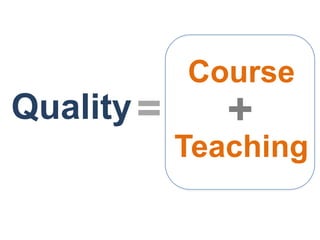
Course
Quality =      +
            Teaching
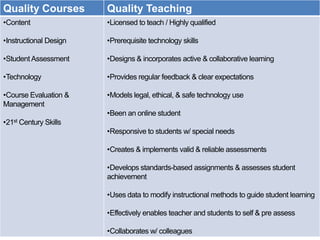
Quality Courses          Quality Teaching
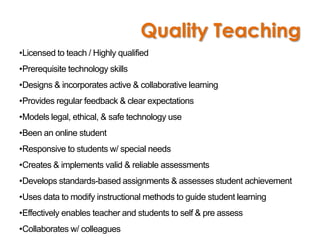
•Content                 •Licensed to teach / Highly qualified

•Instructional Design    •Prerequisite technology skills

•Student Assessment      •Designs & incorporates active & collaborative learning

•Technology              •Provides regular feedback & clear expectations

•Course Evaluation &     •Models legal, ethical, & safe technology use
Management
                         •Been an online student
•21st   Century Skills
                         •Responsive to students w/ special needs

                         •Creates & implements valid & reliable assessments

                         •Develops standards-based assignments & assesses student
                         achievement

                         •Uses data to modify instructional methods to guide student learning

                         •Effectively enables teacher and students to self & pre assess

                         •Collaborates w/ colleagues
Quality Teaching
•Licensed to teach / Highly qualified
•Prerequisite technology skills
•Designs & incorporates active & collaborative learning
•Provides regular feedback & clear expectations
•Models legal, ethical, & safe technology use
•Been an online student
•Responsive to students w/ special needs
•Creates & implements valid & reliable assessments
•Develops standards-based assignments & assesses student achievement
•Uses data to modify instructional methods to guide student learning
•Effectively enables teacher and students to self & pre assess
•Collaborates w/ colleagues
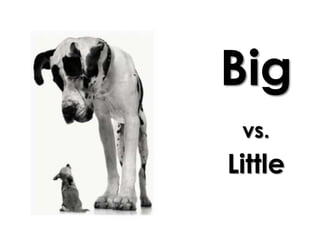
Big
 vs.
Little
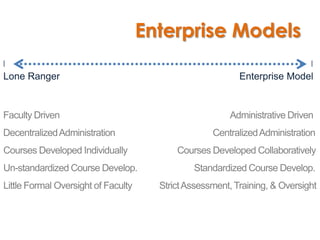
Enterprise Models
|                                                                            |

Lone Ranger                                                Enterprise Model


Faculty Driven                                          Administrative Driven
Decentralized Administration                        Centralized Administration
Courses Developed Individually             Courses Developed Collaboratively
Un-standardized Course Develop.                Standardized Course Develop.
Little Formal Oversight of Faculty     Strict Assessment, Training, & Oversight
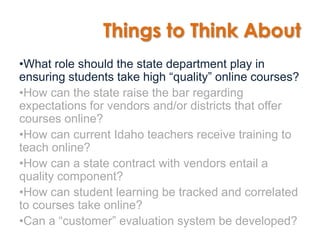
Things to Think About
•What role should the state department play in
ensuring students take high “quality” online courses?
•How can the state raise the bar regarding
expectations for vendors and/or districts that offer
courses online?
•How can current Idaho teachers receive training to
teach online?
•How can a state contract with vendors entail a
quality component?
•How can student learning be tracked and correlated
to courses take online?
•Can a “customer” evaluation system be developed?
Things to Think About
•What role should the state department play in
ensuring students take high “quality” online courses?
•How can the state raise the bar regarding
expectations for vendors and/or districts that offer
courses online?
•How can current Idaho teachers receive training to
teach online?
•How can a state contract with vendors entail a
quality component?
•How can student learning be tracked and correlated
to courses take online?
•Can a “customer” evaluation system be developed?
Things to Think About
•What role should the state department play in
ensuring students take high “quality” online courses?
•How can the state raise the bar regarding
expectations for vendors and/or districts that offer
courses online?
•How can current Idaho teachers receive training to
teach online?
•How can a state contract with vendors entail a
quality component?
•How can student learning be tracked and correlated
to courses take online?
•Can a “customer” evaluation system be developed?
Things to Think About
•What role should the state department play in
ensuring students take high “quality” online courses?
•How can the state raise the bar regarding
expectations for vendors and/or districts that offer
courses online?
•How can current Idaho teachers receive training to
teach online?
•How can a state contract with vendors entail a
quality component?
•How can student learning be tracked and correlated
to courses take online?
•Can a “customer” evaluation system be developed?
Things to Think About
•What role should the state department play in
ensuring students take high “quality” online courses?
•How can the state raise the bar regarding
expectations for vendors and/or districts that offer
courses online?
•How can current Idaho teachers receive training to
teach online?
•How can a state contract with vendors entail a
quality component?
•How can student learning be tracked and correlated
to courses take online?
•Can a “customer” evaluation system be developed?
Things to Think About
•What role should the state department play in
ensuring students take high “quality” online courses?
•How can the state raise the bar regarding
expectations for vendors and/or districts that offer
courses online?
•How can current Idaho teachers receive training to
teach online?
•How can a state contract with vendors entail a
quality component?
•How can student learning be tracked and correlated
to courses take online?
•Can a “customer” evaluation system be developed?
Patrick Lowenthal
patricklowenthal@boisestate.edu

Quality Online Learning

  • 1.
    High Quality Online Courses Patrick R. Lowenthal Boise State University University of Colorado Denver slides @ www.patricklowenthal.com
  • 2.
    Senate Bill No.1184 “…the legislature finds that in order to better provide students with the skills that they will need to be successful as students, employees, entrepreneurs, and parents in the future, more exposure is needed in online learning and informational environments…”
  • 3.
  • 4.
    Growth of OnlineLearning 5.6 million post-secondary students Source: Class Differences: Online Education in the United States, 2010
  • 5.
    Growth of OnlineLearning + 4 million K12 5 + million post-secondary Millions of online learners Source: http://www.inacol.org/press/docs/nacol_fast_facts.pdf
  • 6.
    Growth of OnlineLearning Source: Class Differences: Online Education in the United States, 2010
  • 7.
    Growth of OnlineLearning Source: Class Differences: Online Education in the United States, 2010
  • 8.
    Growth of OnlineLearning 50 % High school courses online by 2019 Source: http://www.inacol.org/press/docs/nacol_fast_facts.pdf
  • 9.
  • 10.
    Online vs. Face-to-Face Comparisonstudies suggest there is no significant difference between online & face- to-face learning
  • 11.
  • 12.
    It Depends… Higher Ed. Corporate K-12 / Industry
  • 13.
    … on a# of Variables Teachers & Context Media Learners Formality Instructor Role Setting Curriculum Fit Multimedia Cohort Group Synch. / Asynch. Pacing Student % Online Collaboration Class Size Teacher Development Preparation Model 3-D Virtual Student Diversity Targeted Worlds Learning Class Size Subject Area
  • 14.
    Quality Framework Curriculum Teaching and Learning Design Facilitation Experience Instructional Web Course Design Design Presentation
  • 15.
  • 16.
    Standards / Guidelines Earlyassumptions & focus were that: High High Quality Quality = Learning Course Experience
  • 17.
    Standards National Standards forQuality Online Learning by International Association for K-12 Online Learning (iNACOL) Quality Online Quality Programs Quality Online Online Courses Teaching Quality Learning Experience
  • 18.
    Standards National Standards forOnline Course Quality by International Association for K-12 Online Learning (iNACOL) “National Standards for Online Course Content Quality is designed to provide states, districts, online programs, and other Instructional Design organizations with a set of quality guidelines for online course content, instructional design, technology, student Student Assessment assessment, and course management.” Technology “These guidelines should be Course Evaluation and implemented and monitored by each Management district or organization, as they reserve the right to apply the guidelines 21st Century Skills according to the best interest of the population for which they serve.”
  • 19.
  • 20.
  • 21.
    Quality Courses Quality Teaching •Content •Licensed to teach / Highly qualified •Instructional Design •Prerequisite technology skills •Student Assessment •Designs & incorporates active & collaborative learning •Technology •Provides regular feedback & clear expectations •Course Evaluation & •Models legal, ethical, & safe technology use Management •Been an online student •21st Century Skills •Responsive to students w/ special needs •Creates & implements valid & reliable assessments •Develops standards-based assignments & assesses student achievement •Uses data to modify instructional methods to guide student learning •Effectively enables teacher and students to self & pre assess •Collaborates w/ colleagues
  • 22.
    Quality Teaching •Licensed toteach / Highly qualified •Prerequisite technology skills •Designs & incorporates active & collaborative learning •Provides regular feedback & clear expectations •Models legal, ethical, & safe technology use •Been an online student •Responsive to students w/ special needs •Creates & implements valid & reliable assessments •Develops standards-based assignments & assesses student achievement •Uses data to modify instructional methods to guide student learning •Effectively enables teacher and students to self & pre assess •Collaborates w/ colleagues
  • 23.
  • 24.
    Enterprise Models | | Lone Ranger Enterprise Model Faculty Driven Administrative Driven Decentralized Administration Centralized Administration Courses Developed Individually Courses Developed Collaboratively Un-standardized Course Develop. Standardized Course Develop. Little Formal Oversight of Faculty Strict Assessment, Training, & Oversight
  • 25.
    Things to ThinkAbout •What role should the state department play in ensuring students take high “quality” online courses? •How can the state raise the bar regarding expectations for vendors and/or districts that offer courses online? •How can current Idaho teachers receive training to teach online? •How can a state contract with vendors entail a quality component? •How can student learning be tracked and correlated to courses take online? •Can a “customer” evaluation system be developed?
  • 26.
    Things to ThinkAbout •What role should the state department play in ensuring students take high “quality” online courses? •How can the state raise the bar regarding expectations for vendors and/or districts that offer courses online? •How can current Idaho teachers receive training to teach online? •How can a state contract with vendors entail a quality component? •How can student learning be tracked and correlated to courses take online? •Can a “customer” evaluation system be developed?
  • 27.
    Things to ThinkAbout •What role should the state department play in ensuring students take high “quality” online courses? •How can the state raise the bar regarding expectations for vendors and/or districts that offer courses online? •How can current Idaho teachers receive training to teach online? •How can a state contract with vendors entail a quality component? •How can student learning be tracked and correlated to courses take online? •Can a “customer” evaluation system be developed?
  • 28.
    Things to ThinkAbout •What role should the state department play in ensuring students take high “quality” online courses? •How can the state raise the bar regarding expectations for vendors and/or districts that offer courses online? •How can current Idaho teachers receive training to teach online? •How can a state contract with vendors entail a quality component? •How can student learning be tracked and correlated to courses take online? •Can a “customer” evaluation system be developed?
  • 29.
    Things to ThinkAbout •What role should the state department play in ensuring students take high “quality” online courses? •How can the state raise the bar regarding expectations for vendors and/or districts that offer courses online? •How can current Idaho teachers receive training to teach online? •How can a state contract with vendors entail a quality component? •How can student learning be tracked and correlated to courses take online? •Can a “customer” evaluation system be developed?
  • 30.
    Things to ThinkAbout •What role should the state department play in ensuring students take high “quality” online courses? •How can the state raise the bar regarding expectations for vendors and/or districts that offer courses online? •How can current Idaho teachers receive training to teach online? •How can a state contract with vendors entail a quality component? •How can student learning be tracked and correlated to courses take online? •Can a “customer” evaluation system be developed?
  • 31.

Editor's Notes

  • #2 Hi everyone!My name is Patrick LowenthalI appreciate the opportunity to be here today.I was asked to come talk about high quality online courses.I presented this earlier to the online learning sub committee – for those who have seen this before, I apologize that you have to sit through it again.So a little about me… I have been involved in online learning for the past 10 years. I have taken online courses, I have designed and developed online courses, I have taught online courses, and I have managed online programs. On top of this, I have been researching and writing about online learning for years now and if all goes well I will complete my doctorate in December which is focused on online learning.
  • #4 But perhaps the #1 reason, I support legislation like this is because of my girls. I have two girls. My oldest daughter Jordan is junior high. She will be going to college in about 5 years and possibly entering the work force in 10 or so years. Think back about what the world was like 10 years ago…
  • #5 In the fall of 2009, 5.6 million students took at least one online course according to Sloan-C
  • #6 In 2010, estimated 4 million K12 students participated in an online learning programhttp://www.inacol.org/press/docs/nacol_fast_facts.pdfIn 2009, estimated 5+ million college enrollmentshttp://sloanconsortium.org/publications/survey/class_differencesSo what does this mean, well it means that we have millions of students learning online already
  • #7 But let’s look at the growth of online learning in higher education
  • #8 In 2009 there was 21% growth and online enrollments were nearly a 1/3 of total enrollment
  • #9 It is predicted that 50% of high school courses will be offered online by 2019.
  • #10 So back to my girls. Online learning isn’t going away and I want them to go to college and be successful and all the indicators suggest that online learning will be a part of their future. Sure there will likely always (or at least for years to come) be institutions of higher education that specialize in either only offering courses online or only offering them face-to-face. But even the Harvard’s and Princeton’s of the world are using Learning Management Systems more and more and their students could benefit from the skills learned from taking courses online.So for me, I can’t think of a better time or place to help prepare our children to be able to learn online successfully than when they are in high school and still living at home and still have all the supports that a high school and one’s family can provide.
  • #11 However, I know I don’t want my children to be required to take low quality washed down versions of courses they could take face-to-face.While critics like to argue that online learning is always somehow inferior to f2f, research suggests otherwise. Nearly every comparison study has shown that there is no significant difference between online learning and f2f. However that doesn’t mean that all online courses are good and all f2f courses are good. In my experience many of the people who are skeptical of learning have never taken a course online before.But sure, I have met people who have taken a few courses online and had bad experiences. But those same people probably have had a number of bad F2F learning experiences.http://www2.ed.gov/rschstat/eval/tech/evidence-based-practices/finalreport.pdf
  • #12 So what does a quality online course look like?
  • #13 First, if we just talk in general terms, online learning looks very different across different spaces. For instance, while online learning in higher education tends to be teacher led asynchronous courses, in corporate education and industry, they often use synchronous webinar like online learning experiences or self-paced asynchronous courses (e.g., Compliance training like sexual harassment training).
  • #14 But I argue however that it is much more complicated than this. Some colleagues and I developed a typology of the online learning landscape to show some of the different ways online learning can vary depending on the context. The following chart is just an summary of the typology.http://patricklowenthal.com/publications/AECT2009TypologyOnlineLearning.pdf
  • #15 But back to the question, what does quality look like.Well this is one of manyframeworks found in the literature talking about the different components of high quality online learning.
  • #16 http://www.csuchico.edu/tlp/resources/rubric/rubric.pdfhttp://sloanconsortium.org/5pillarsBut despite all of these variables, there are things you can do to improve the quality of nearly any online course.At some level good teaching is good teaching. However, the reality is that teaching online is different than teaching face-to-face.Early on standards focused mostly on course design. The assumption was that a high quality course = high quality learning experience
  • #17 Early on standards focused mostly on course design. The assumption was that a high quality course = high quality learning experience
  • #18 http://www.inacol.org/research/nationalstandards/NACOL%20Standards%20Quality%20Online%20Teaching.pdfhttp://www.inacol.org/research/nationalstandards/NACOL%20Standards%20Quality%20Online%20Programs.pdfhttp://www.inacol.org/research/nationalstandards/NACOL%20Standards%20Quality%20Online%20Courses%202007.pdf
  • #19 http://www.inacol.org/research/nationalstandards/NACOL%20Standards%20Quality%20Online%20Courses%202007.pdfNew as of Oct 2011: http://www.inacol.org/research/nationalstandards/iNACOL_CourseStandards_2011.pdf
  • #20 http://www.inacol.org/research/nationalstandards/NACOL%20Standards%20Quality%20Online%20Courses%202007.pdfNew as of Oct 2011: http://www.inacol.org/research/nationalstandards/iNACOL_CourseStandards_2011.pdf
  • #21 So according to INACOL, quality = high quality courses and high quality teaching
  • #22 So according to INACOL, quality = high quality courses and high quality teaching
  • #24 So given all of these elements the question becomes can districts continue to provide this type of high quality online learning on their own ~ perhaps! But smaller districts with smaller resources might struggle to do the same as the larger districts as demands increase. There has been a lot of talk about the increase demand with students being required to take two online courses but there doesn’t seem to be much talk about what will happen when a small percentage of students chose to take a larger amount of courses online now that they will have the right to do so.
  • #25 Local control is a great thing but centralized models of online course development and delivery have some benefits that must be considered. A number of years ago I worked at Regis University. Regis is a Jesuit university but the College for Professional Studies runs very similar to a for-profit institution. They described their centralized model of designing, developing, and delivering online courses an enterprise model. So this is a diagram I created for a paper I wrote a while back with a colleague trying to differentiate enterprise models from traditional “lone ranger” types of approaches in higher education. You can see a number of the differences between the two different types of approaches. This shouldn’t be seen as either or but rather as a continuum. I am not advocating for an enterprise approach – in fact, I have been openly critical of parts of these types of models – but I think it’s important to think about how easier it might be to ensure quality if certain aspects of accountability were done at the state level.