© R R INSTITUTIONS , BANGALORE
RR COLLEGE OF PHARMACY
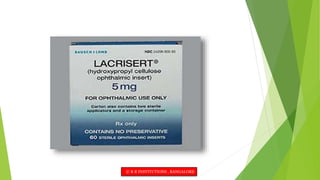
Lacrisert
SUBMITTED BY: SUBMITTED TO:
PAVAN KUMAR Dr. A. GEETHA LAKSHMI
1ST SEM , M.PHARMACY PROF. & HOD
DEPARTMENT OF PHARMACEUTICS
CONTENTS
© R R INSTITUTIONS , BANGALORE
INTRODUCTION
CONTENT OF LACRISERT
PHYSICAL & CHEMICAL CHARACTERISTICS
MECHANISM OF ACTION
HOW TO USE LACRISERT
USE
DISADVANTAGE
SIDE EFFECT
REFERRENCE
INRODUCTION
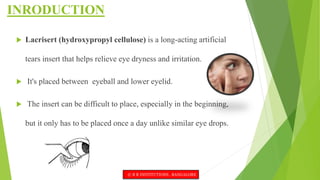
 Lacrisert (hydroxypropyl cellulose) is a long-acting artificial
tears insert that helps relieve eye dryness and irritation.
 It's placed between eyeball and lower eyelid.
 The insert can be difficult to place, especially in the beginning,
but it only has to be placed once a day unlike similar eye drops.
© R R INSTITUTIONS , BANGALORE
IT CONSIST OF :
 Hydroxypropyl cellulose
 It is a derivative of cellulose that is soluble in both water and organic
solvents.
 It is particularly good at trapping water and producing a film that serves as
a barrier to water loss.
 Hydroxypropyl cellulose possesses good surface activity but does not gel
as it forms open helical coils.
 In general Hydroxypropyl cellulose is a water-soluble thickener,
emulsifier and film-former often used in tablet coating.
© R R INSTITUTIONS , BANGALORE
PHYSICAL AND CHEMICAL
CHARECTERSTICS
 The chemical name for hydroxypropyl cellulose is cellulose, 2-
hydroxypropyl ether.
 It is a tasteless, odorless, and physiologically inert substance, and is
soluble in water below 38°C.
 The ophthalmic inserts are sterile and translucent rods measuring
1.27 mm in diameter and 3.5 mm long.
 Each insert contains 5 mg of hydroxypropyl cellulose, with no
preservatives or any other ingredients.
© R R INSTITUTIONS , BANGALORE
MECHANISM OF ACTION
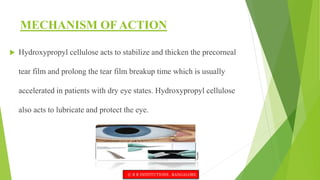
 Hydroxypropyl cellulose acts to stabilize and thicken the precorneal
tear film and prolong the tear film breakup time which is usually
accelerated in patients with dry eye states. Hydroxypropyl cellulose
also acts to lubricate and protect the eye.
© R R INSTITUTIONS , BANGALORE
How to use Lacrisert?
 First, rinse the soft and flexible applicator with
hot water. Shake off the excess. Then pick up the
LACRISERT® insert by lightly touching it with
the grooved tip of the applicator.
© R R INSTITUTIONS , BANGALORE
VIDEO
© R R INSTITUTIONS , BANGALORE
USES:
 In the treatment of Dry eye syndrome is a multifactorial disease of
the tears and ocular surface that results in symptoms of discomfort,
burning, itching, foreign body sensation, dryness, pain.
 photophobia, hyperemia, visual disturbance, and tear film
instability, with potential damage to the ocular surface.
© R R INSTITUTIONS , BANGALORE
DISADVANTAGES
 Minimum rate of patient acceptance
 Need of expert during every insert
SIDE EFFECTS:
 Temporary blurring of vision
 Discomfort
 Irritation or redness in the eye
 Sticky eyelashes
 Eye sensitivity to light
 Swelling of eyelid
© R R INSTITUTIONS , BANGALORE
REFRENCES
 Vyas SP, Khar KR. Targeted and controlled drug delivery system.
1st ed. Delhi: CBS publishers and distributors; 2002.
 Remington G. The science and practice of pharmacy.1st ed.
Pennsylvania: Mack publication Company: 1563-1567.
 Tangri P, khurana S. Basis of ocular drug delivery system. Int J
Pharm Biomed Res [Internet]. 2011 Oct [cited 2014 Jul 05];
2(4):1540-1541.Available
from:http://www.ijrpbsonline.com/files/RV15.pdf
 Patel V, Agarwal YK, Current status and advanced approaches in
ocular drug delivery system. J Global Trends Pharm. Sci
[internet]. 2011 Apr [cited 2014 July 14]; 2(2):131-48. Available
from : http://www.jgtps.com/Patel.pdf
 www.google.com
© R R INSTITUTIONS , BANGALORE

Lacrisert.pptx

  • 1.
    © R RINSTITUTIONS , BANGALORE RR COLLEGE OF PHARMACY Lacrisert SUBMITTED BY: SUBMITTED TO: PAVAN KUMAR Dr. A. GEETHA LAKSHMI 1ST SEM , M.PHARMACY PROF. & HOD DEPARTMENT OF PHARMACEUTICS
  • 2.
    CONTENTS © R RINSTITUTIONS , BANGALORE INTRODUCTION CONTENT OF LACRISERT PHYSICAL & CHEMICAL CHARACTERISTICS MECHANISM OF ACTION HOW TO USE LACRISERT USE DISADVANTAGE SIDE EFFECT REFERRENCE
  • 3.
    INRODUCTION  Lacrisert (hydroxypropylcellulose) is a long-acting artificial tears insert that helps relieve eye dryness and irritation.  It's placed between eyeball and lower eyelid.  The insert can be difficult to place, especially in the beginning, but it only has to be placed once a day unlike similar eye drops. © R R INSTITUTIONS , BANGALORE
  • 4.
    © R RINSTITUTIONS , BANGALORE
  • 5.
    IT CONSIST OF:  Hydroxypropyl cellulose  It is a derivative of cellulose that is soluble in both water and organic solvents.  It is particularly good at trapping water and producing a film that serves as a barrier to water loss.  Hydroxypropyl cellulose possesses good surface activity but does not gel as it forms open helical coils.  In general Hydroxypropyl cellulose is a water-soluble thickener, emulsifier and film-former often used in tablet coating. © R R INSTITUTIONS , BANGALORE
  • 6.
    PHYSICAL AND CHEMICAL CHARECTERSTICS The chemical name for hydroxypropyl cellulose is cellulose, 2- hydroxypropyl ether.  It is a tasteless, odorless, and physiologically inert substance, and is soluble in water below 38°C.  The ophthalmic inserts are sterile and translucent rods measuring 1.27 mm in diameter and 3.5 mm long.  Each insert contains 5 mg of hydroxypropyl cellulose, with no preservatives or any other ingredients. © R R INSTITUTIONS , BANGALORE
  • 7.
    MECHANISM OF ACTION Hydroxypropyl cellulose acts to stabilize and thicken the precorneal tear film and prolong the tear film breakup time which is usually accelerated in patients with dry eye states. Hydroxypropyl cellulose also acts to lubricate and protect the eye. © R R INSTITUTIONS , BANGALORE
  • 8.
    How to useLacrisert?  First, rinse the soft and flexible applicator with hot water. Shake off the excess. Then pick up the LACRISERT® insert by lightly touching it with the grooved tip of the applicator. © R R INSTITUTIONS , BANGALORE
  • 9.
    VIDEO © R RINSTITUTIONS , BANGALORE
  • 10.
    USES:  In thetreatment of Dry eye syndrome is a multifactorial disease of the tears and ocular surface that results in symptoms of discomfort, burning, itching, foreign body sensation, dryness, pain.  photophobia, hyperemia, visual disturbance, and tear film instability, with potential damage to the ocular surface. © R R INSTITUTIONS , BANGALORE
  • 11.
    DISADVANTAGES  Minimum rateof patient acceptance  Need of expert during every insert SIDE EFFECTS:  Temporary blurring of vision  Discomfort  Irritation or redness in the eye  Sticky eyelashes  Eye sensitivity to light  Swelling of eyelid © R R INSTITUTIONS , BANGALORE
  • 12.
    © R RINSTITUTIONS , BANGALORE
  • 13.
    REFRENCES  Vyas SP,Khar KR. Targeted and controlled drug delivery system. 1st ed. Delhi: CBS publishers and distributors; 2002.  Remington G. The science and practice of pharmacy.1st ed. Pennsylvania: Mack publication Company: 1563-1567.  Tangri P, khurana S. Basis of ocular drug delivery system. Int J Pharm Biomed Res [Internet]. 2011 Oct [cited 2014 Jul 05]; 2(4):1540-1541.Available from:http://www.ijrpbsonline.com/files/RV15.pdf  Patel V, Agarwal YK, Current status and advanced approaches in ocular drug delivery system. J Global Trends Pharm. Sci [internet]. 2011 Apr [cited 2014 July 14]; 2(2):131-48. Available from : http://www.jgtps.com/Patel.pdf  www.google.com © R R INSTITUTIONS , BANGALORE
  • 14.
    © R RINSTITUTIONS , BANGALORE