
Classifications drugs
(For nursing)
S. Parasuraman M.Pharm., Ph.D.,
Senior Lecturer, Faculty of Pharmacy,
AIMST University,
Bedong 08100, Malaysia.
Classifications drugs
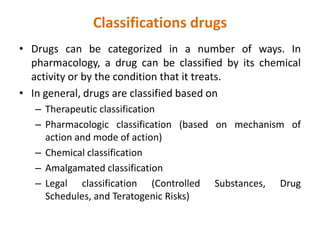
• Drugs can be categorized in a number of ways. In
pharmacology, a drug can be classified by its chemical
activity or by the condition that it treats.
• In general, drugs are classified based on
– Therapeutic classification
– Pharmacologic classification (based on mechanism of
action and mode of action)
– Chemical classification
– Amalgamated classification
– Legal classification (Controlled Substances, Drug
Schedules, and Teratogenic Risks)
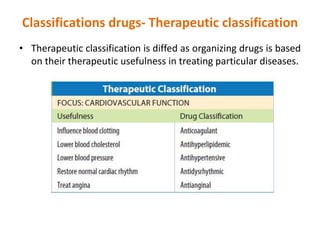
Classifications drugs- Therapeutic classification
• Therapeutic classification is diffed as organizing drugs is based
on their therapeutic usefulness in treating particular diseases.
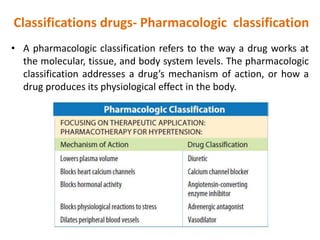
Classifications drugs- Pharmacologic classification
• A pharmacologic classification refers to the way a drug works at
the molecular, tissue, and body system levels. The pharmacologic
classification addresses a drug’s mechanism of action, or how a
drug produces its physiological effect in the body.
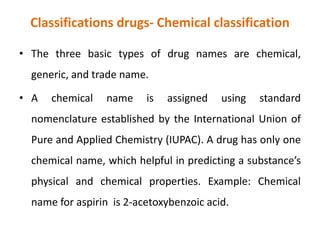
Classifications drugs- Chemical classification
• The three basic types of drug names are chemical,
generic, and trade name.
• A chemical name is assigned using standard
nomenclature established by the International Union of
Pure and Applied Chemistry (IUPAC). A drug has only one
chemical name, which helpful in predicting a substance’s
physical and chemical properties. Example: Chemical
name for aspirin is 2-acetoxybenzoic acid.
Classifications drugs- Chemical classification
• The generic name of a drug is assigned by the U.S.
Adopted Name Council. Generic names are less
complicated and easier to remember than chemical
names. The Food and Drug Administration (FDA), the
official Pharmacopoeia, and the World Health
Organization (WHO), routinely describe a medication by
its generic name.
Classifications drugs- Chemical classification
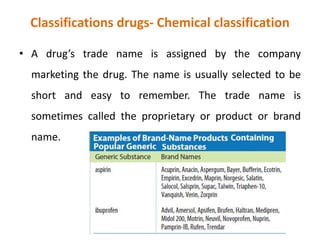
• A drug’s trade name is assigned by the company
marketing the drug. The name is usually selected to be
short and easy to remember. The trade name is
sometimes called the proprietary or product or brand
name.
Classifications drugs- Controlled Substances,
Drug Schedules, and Teratogenic Risks
• Some drugs are frequently abused or have a high potential for
addiction.
• According to law, drugs that have a significant potential for
abuse are placed into five categories called schedules. These
scheduled drugs are classified according to their potential for
abuse:
– Schedule I drugs have the highest potential for abuse
– Schedule V drugs have the lowest potential for abuse
Classifications drugs- Controlled Substances,
Drug Schedules, and Teratogenic Risks
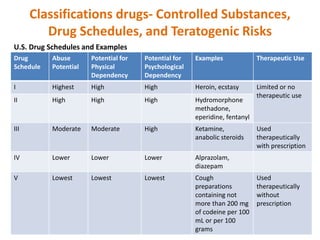
Drug
Schedule
Abuse
Potential
Potential for
Physical
Dependency
Potential for
Psychological
Dependency
Examples Therapeutic Use
I Highest High High Heroin, ecstasy Limited or no
therapeutic use
II High High High Hydromorphone
methadone,
eperidine, fentanyl
III Moderate Moderate High Ketamine,
anabolic steroids
Used
therapeutically
with prescription
IV Lower Lower Lower Alprazolam,
diazepam
V Lowest Lowest Lowest Cough
preparations
containing not
more than 200 mg
of codeine per 100
mL or per 100
grams
Used
therapeutically
without
prescription
U.S. Drug Schedules and Examples
Classifications drugs- Controlled Substances,
Drug Schedules, and Teratogenic Risks
• A teratogen is a substance that has the potential to cause a
defect in an unborn child during pregnancy. A small number
of drugs have been shown to be teratogenic, either in humans
or in laboratory animals. Classification of teratogenic risk
places drugs into categories A, B, C, D, and X.
Classifications drugs- Controlled Substances,
Drug Schedules, and Teratogenic Risks
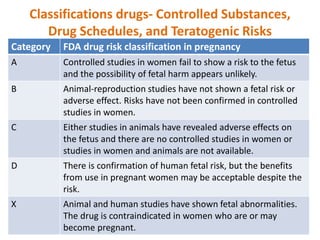
Category FDA drug risk classification in pregnancy
A Controlled studies in women fail to show a risk to the fetus
and the possibility of fetal harm appears unlikely.
B Animal-reproduction studies have not shown a fetal risk or
adverse effect. Risks have not been confirmed in controlled
studies in women.
C Either studies in animals have revealed adverse effects on
the fetus and there are no controlled studies in women or
studies in women and animals are not available.
D There is confirmation of human fetal risk, but the benefits
from use in pregnant women may be acceptable despite the
risk.
X Animal and human studies have shown fetal abnormalities.
The drug is contraindicated in women who are or may
become pregnant.
Classifications drugs- Anatomical Therapeutic
Chemical Classification System with Defined
Daily Doses (ATC/DDD)
• The purpose of the ATC/DDD system is to serve as a tool for
drug utilization research in order to improve quality of drug
use.
• In the ATC classification system, the drugs are divided into
different groups according to the organ or system on which
they act and their chemical, pharmacological and therapeutic
properties.
Classifications drugs- Anatomical Therapeutic
Chemical Classification System with Defined
Daily Doses (ATC/DDD)
Thank you

Drug classification

  • 1.
    Classifications drugs (For nursing) S.Parasuraman M.Pharm., Ph.D., Senior Lecturer, Faculty of Pharmacy, AIMST University, Bedong 08100, Malaysia.
  • 2.
    Classifications drugs • Drugscan be categorized in a number of ways. In pharmacology, a drug can be classified by its chemical activity or by the condition that it treats. • In general, drugs are classified based on – Therapeutic classification – Pharmacologic classification (based on mechanism of action and mode of action) – Chemical classification – Amalgamated classification – Legal classification (Controlled Substances, Drug Schedules, and Teratogenic Risks)
  • 3.
    Classifications drugs- Therapeuticclassification • Therapeutic classification is diffed as organizing drugs is based on their therapeutic usefulness in treating particular diseases.
  • 4.
    Classifications drugs- Pharmacologicclassification • A pharmacologic classification refers to the way a drug works at the molecular, tissue, and body system levels. The pharmacologic classification addresses a drug’s mechanism of action, or how a drug produces its physiological effect in the body.
  • 5.
    Classifications drugs- Chemicalclassification • The three basic types of drug names are chemical, generic, and trade name. • A chemical name is assigned using standard nomenclature established by the International Union of Pure and Applied Chemistry (IUPAC). A drug has only one chemical name, which helpful in predicting a substance’s physical and chemical properties. Example: Chemical name for aspirin is 2-acetoxybenzoic acid.
  • 6.
    Classifications drugs- Chemicalclassification • The generic name of a drug is assigned by the U.S. Adopted Name Council. Generic names are less complicated and easier to remember than chemical names. The Food and Drug Administration (FDA), the official Pharmacopoeia, and the World Health Organization (WHO), routinely describe a medication by its generic name.
  • 7.
    Classifications drugs- Chemicalclassification • A drug’s trade name is assigned by the company marketing the drug. The name is usually selected to be short and easy to remember. The trade name is sometimes called the proprietary or product or brand name.
  • 8.
    Classifications drugs- ControlledSubstances, Drug Schedules, and Teratogenic Risks • Some drugs are frequently abused or have a high potential for addiction. • According to law, drugs that have a significant potential for abuse are placed into five categories called schedules. These scheduled drugs are classified according to their potential for abuse: – Schedule I drugs have the highest potential for abuse – Schedule V drugs have the lowest potential for abuse
  • 9.
    Classifications drugs- ControlledSubstances, Drug Schedules, and Teratogenic Risks Drug Schedule Abuse Potential Potential for Physical Dependency Potential for Psychological Dependency Examples Therapeutic Use I Highest High High Heroin, ecstasy Limited or no therapeutic use II High High High Hydromorphone methadone, eperidine, fentanyl III Moderate Moderate High Ketamine, anabolic steroids Used therapeutically with prescription IV Lower Lower Lower Alprazolam, diazepam V Lowest Lowest Lowest Cough preparations containing not more than 200 mg of codeine per 100 mL or per 100 grams Used therapeutically without prescription U.S. Drug Schedules and Examples
  • 10.
    Classifications drugs- ControlledSubstances, Drug Schedules, and Teratogenic Risks • A teratogen is a substance that has the potential to cause a defect in an unborn child during pregnancy. A small number of drugs have been shown to be teratogenic, either in humans or in laboratory animals. Classification of teratogenic risk places drugs into categories A, B, C, D, and X.
  • 11.
    Classifications drugs- ControlledSubstances, Drug Schedules, and Teratogenic Risks Category FDA drug risk classification in pregnancy A Controlled studies in women fail to show a risk to the fetus and the possibility of fetal harm appears unlikely. B Animal-reproduction studies have not shown a fetal risk or adverse effect. Risks have not been confirmed in controlled studies in women. C Either studies in animals have revealed adverse effects on the fetus and there are no controlled studies in women or studies in women and animals are not available. D There is confirmation of human fetal risk, but the benefits from use in pregnant women may be acceptable despite the risk. X Animal and human studies have shown fetal abnormalities. The drug is contraindicated in women who are or may become pregnant.
  • 12.
    Classifications drugs- AnatomicalTherapeutic Chemical Classification System with Defined Daily Doses (ATC/DDD) • The purpose of the ATC/DDD system is to serve as a tool for drug utilization research in order to improve quality of drug use. • In the ATC classification system, the drugs are divided into different groups according to the organ or system on which they act and their chemical, pharmacological and therapeutic properties.
  • 13.
    Classifications drugs- AnatomicalTherapeutic Chemical Classification System with Defined Daily Doses (ATC/DDD)
  • 14.