KNOW ABOUT YOUR DRUGS
PRESENTED BY
SANI SINGH
M. PHARM (PHARMACEUTICS)
DRUG
CLASSIFICATION
 Legal Classification
 Pharmacological Classification
 Therapeutic Classification
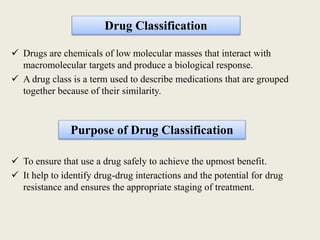
 Drugs are chemicals of low molecular masses that interact with
macromolecular targets and produce a biological response.
 A drug class is a term used to describe medications that are grouped
together because of their similarity.
 To ensure that use a drug safely to achieve the upmost benefit.
 It help to identify drug-drug interactions and the potential for drug
resistance and ensures the appropriate staging of treatment.
Drug Classification
Purpose of Drug Classification
Legal
Classification
Anatomical Therapeutic
Chemical (ATC)
Classification System
Controlled
Substance Act
(CSA)
Misuse of Drugs Act
USP Medicare
Model Guidelines
(USP MMG)
ATC Classification System
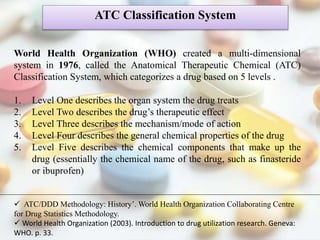
World Health Organization (WHO) created a multi-dimensional
system in 1976, called the Anatomical Therapeutic Chemical (ATC)
Classification System, which categorizes a drug based on 5 levels .
1. Level One describes the organ system the drug treats
2. Level Two describes the drug’s therapeutic effect
3. Level Three describes the mechanism/mode of action
4. Level Four describes the general chemical properties of the drug
5. Level Five describes the chemical components that make up the
drug (essentially the chemical name of the drug, such as finasteride
or ibuprofen)
 ATC/DDD Methodology: History’. World Health Organization Collaborating Centre
for Drug Statistics Methodology.
 World Health Organization (2003). Introduction to drug utilization research. Geneva:
WHO. p. 33.
 The ATC system is able to classify the active ingredient of a drug
under a strict hierarchy so that it is appropriately used and not mistaken
for another drug.
 It controlled by the World Health Organization Collaborating Centre
for Drug Statistics Methodology (WHOCC).
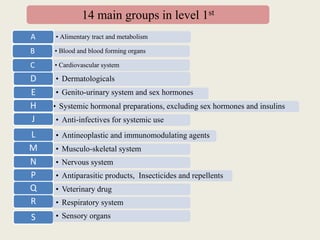
 The drugs are divided into 14 main groups in 1st level.
 2nd, 3rd and 4th level are often used to identify pharmacological
subgroups when that is considered more appropriate than therapeutic or
chemical subgroups.
• Alimentary tract and metabolismA
• Blood and blood forming organsB
• Cardiovascular systemC
• Dermatologicals
• Systemic hormonal preparations, excluding sex hormones and insulins
• Antineoplastic and immunomodulating agents
• Anti-infectives for systemic use
• Genito-urinary system and sex hormones
D
E
H
J
• Musculo-skeletal system
• Antiparasitic products, Insecticides and repellents
• Nervous system
• Veterinary drug
L
M
P
N
Q
R
S
• Respiratory system
• Sensory organs
14 main groups in level 1st
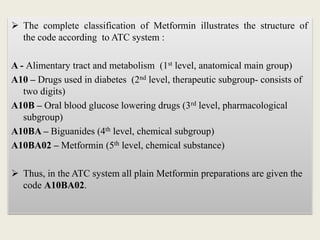
 The complete classification of Metformin illustrates the structure of
the code according to ATC system :
A - Alimentary tract and metabolism (1st level, anatomical main group)
A10 – Drugs used in diabetes (2nd level, therapeutic subgroup- consists of
two digits)
A10B – Oral blood glucose lowering drugs (3rd level, pharmacological
subgroup)
A10BA – Biguanides (4th level, chemical subgroup)
A10BA02 – Metformin (5th level, chemical substance)
 Thus, in the ATC system all plain Metformin preparations are given the
code A10BA02.
US Legal Classification
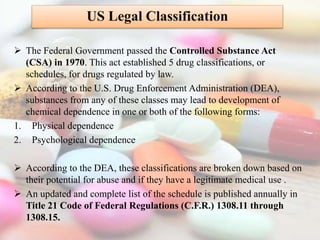
 The Federal Government passed the Controlled Substance Act
(CSA) in 1970. This act established 5 drug classifications, or
schedules, for drugs regulated by law.
 According to the U.S. Drug Enforcement Administration (DEA),
substances from any of these classes may lead to development of
chemical dependence in one or both of the following forms:
1. Physical dependence
2. Psychological dependence
 According to the DEA, these classifications are broken down based on
their potential for abuse and if they have a legitimate medical use .
 An updated and complete list of the schedule is published annually in
Title 21 Code of Federal Regulations (C.F.R.) 1308.11 through
1308.15.
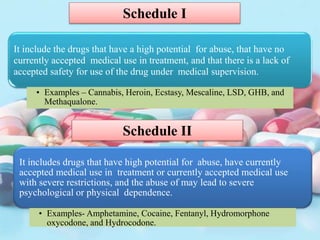
It include the drugs that have a high potential for abuse, that have no
currently accepted medical use in treatment, and that there is a lack of
accepted safety for use of the drug under medical supervision.
• Examples – Cannabis, Heroin, Ecstasy, Mescaline, LSD, GHB, and
Methaqualone.
Schedule I
Schedule II
It includes drugs that have high potential for abuse, have currently
accepted medical use in treatment or currently accepted medical use
with severe restrictions, and the abuse of may lead to severe
psychological or physical dependence.
• Examples- Amphetamine, Cocaine, Fentanyl, Hydromorphone
oxycodone, and Hydrocodone.
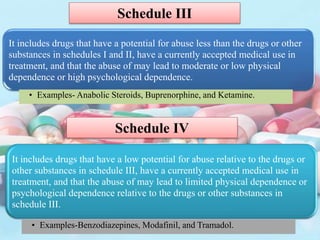
Schedule III
It includes drugs that have a potential for abuse less than the drugs or other
substances in schedules I and II, have a currently accepted medical use in
treatment, and that the abuse of may lead to moderate or low physical
dependence or high psychological dependence.
• Examples- Anabolic Steroids, Buprenorphine, and Ketamine.
Schedule IV
It includes drugs that have a low potential for abuse relative to the drugs or
other substances in schedule III, have a currently accepted medical use in
treatment, and that the abuse of may lead to limited physical dependence or
psychological dependence relative to the drugs or other substances in
schedule III.
• Examples-Benzodiazepines, Modafinil, and Tramadol.
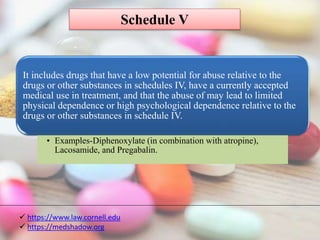
Schedule V
It includes drugs that have a low potential for abuse relative to the
drugs or other substances in schedules IV, have a currently accepted
medical use in treatment, and that the abuse of may lead to limited
physical dependence or high psychological dependence relative to the
drugs or other substances in schedule IV.
• Examples-Diphenoxylate (in combination with atropine),
Lacosamide, and Pregabalin.
 https://www.law.cornell.edu
 https://medshadow.org
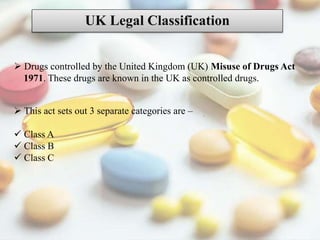
UK Legal Classification
 Drugs controlled by the United Kingdom (UK) Misuse of Drugs Act
1971. These drugs are known in the UK as controlled drugs.
 This act sets out 3 separate categories are –
 Class A
 Class B
 Class C
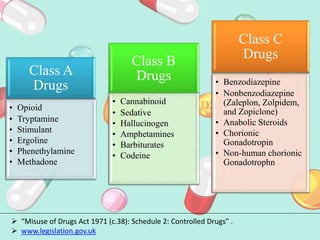
Class A
Drugs
• Opioid
• Tryptamine
• Stimulant
• Ergoline
• Phenethylamine
• Methadone
Class B
Drugs
• Cannabinoid
• Sedative
• Hallucinogen
• Amphetamines
• Barbiturates
• Codeine
Class C
Drugs
• Benzodiazepine
• Nonbenzodiazepine
(Zaleplon, Zolpidem,
and Zopiclone)
• Anabolic Steroids
• Chorionic
Gonadotropin
• Non-human chorionic
Gonadotrophn
 “Misuse of Drugs Act 1971 (c.38): Schedule 2: Controlled Drugs” .
 www.legislation.gov.uk
USP Drug Classification
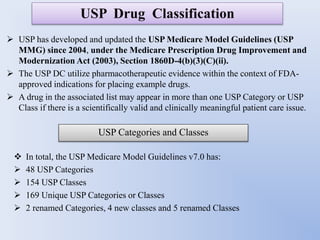
 USP has developed and updated the USP Medicare Model Guidelines (USP
MMG) since 2004, under the Medicare Prescription Drug Improvement and
Modernization Act (2003), Section 1860D-4(b)(3)(C)(ii).
 The USP DC utilize pharmacotherapeutic evidence within the context of FDA-
approved indications for placing example drugs.
 A drug in the associated list may appear in more than one USP Category or USP
Class if there is a scientifically valid and clinically meaningful patient care issue.
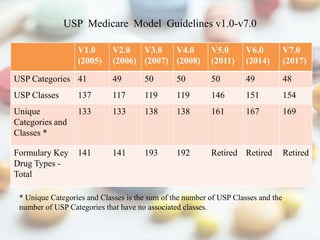
 In total, the USP Medicare Model Guidelines v7.0 has:
 48 USP Categories
 154 USP Classes
 169 Unique USP Categories or Classes
 2 renamed Categories, 4 new classes and 5 renamed Classes
USP Categories and Classes
USP Medicare Model Guidelines v1.0-v7.0
V1.0
(2005)
V2.0
(2006)
V3.0
(2007)
V4.0
(2008)
V5.0
(2011)
V6.0
(2014)
V7.0
(2017)
USP Categories 41 49 50 50 50 49 48
USP Classes 137 117 119 119 146 151 154
Unique
Categories and
Classes *
133 133 138 138 161 167 169
Formulary Key
Drug Types -
Total
141 141 193 192 Retired Retired Retired
* Unique Categories and Classes is the sum of the number of USP Classes and the
number of USP Categories that have no associated classes.
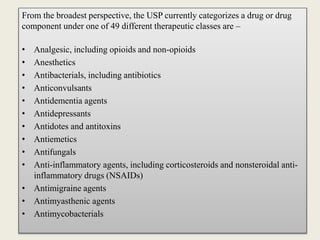
From the broadest perspective, the USP currently categorizes a drug or drug
component under one of 49 different therapeutic classes are –
• Analgesic, including opioids and non-opioids
• Anesthetics
• Antibacterials, including antibiotics
• Anticonvulsants
• Antidementia agents
• Antidepressants
• Antidotes and antitoxins
• Antiemetics
• Antifungals
• Anti-inflammatory agents, including corticosteroids and nonsteroidal anti-
inflammatory drugs (NSAIDs)
• Antimigraine agents
• Antimyasthenic agents
• Antimycobacterials
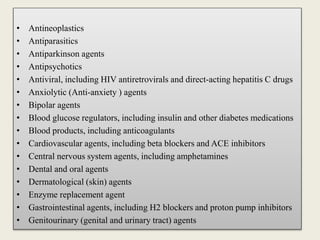
• Antineoplastics
• Antiparasitics
• Antiparkinson agents
• Antipsychotics
• Antiviral, including HIV antiretrovirals and direct-acting hepatitis C drugs
• Anxiolytic (Anti-anxiety ) agents
• Bipolar agents
• Blood glucose regulators, including insulin and other diabetes medications
• Blood products, including anticoagulants
• Cardiovascular agents, including beta blockers and ACE inhibitors
• Central nervous system agents, including amphetamines
• Dental and oral agents
• Dermatological (skin) agents
• Enzyme replacement agent
• Gastrointestinal agents, including H2 blockers and proton pump inhibitors
• Genitourinary (genital and urinary tract) agents
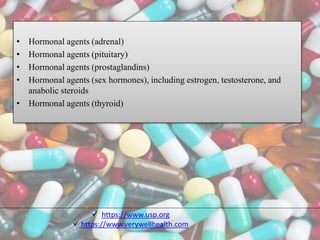
• Hormonal agents (adrenal)
• Hormonal agents (pituitary)
• Hormonal agents (prostaglandins)
• Hormonal agents (sex hormones), including estrogen, testosterone, and
anabolic steroids
• Hormonal agents (thyroid)
 https://www.usp.org
 https://www.verywellhealth.com
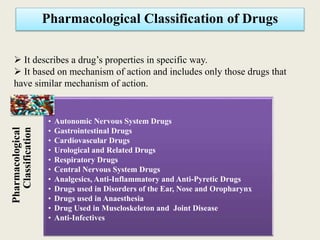
Pharmacological Classification of Drugs
 It describes a drug’s properties in specific way.
 It based on mechanism of action and includes only those drugs that
have similar mechanism of action.
Pharmacological
Classification
• Autonomic Nervous System Drugs
• Gastrointestinal Drugs
• Cardiovascular Drugs
• Urological and Related Drugs
• Respiratory Drugs
• Central Nervous System Drugs
• Analgesics, Anti-Inflammatory and Anti-Pyretic Drugs
• Drugs used in Disorders of the Ear, Nose and Oropharynx
• Drugs used in Anaesthesia
• Drug Used in Muscloskeleton and Joint Disease
• Anti-Infectives
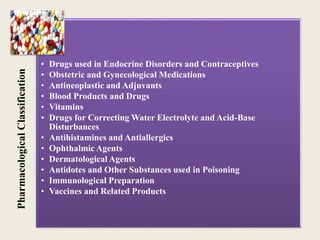
PharmacologicalClassification
• Drugs used in Endocrine Disorders and Contraceptives
• Obstetric and Gynecological Medications
• Antineoplastic and Adjuvants
• Blood Products and Drugs
• Vitamins
• Drugs for Correcting Water Electrolyte and Acid-Base
Disturbances
• Antihistamines and Antiallergics
• Ophthalmic Agents
• Dermatological Agents
• Antidotes and Other Substances used in Poisoning
• Immunological Preparation
• Vaccines and Related Products
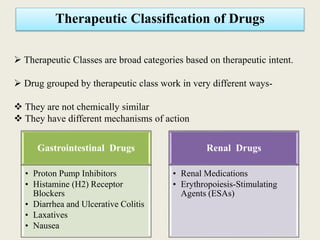
Therapeutic Classification of Drugs
 Therapeutic Classes are broad categories based on therapeutic intent.
 Drug grouped by therapeutic class work in very different ways-
 They are not chemically similar
 They have different mechanisms of action
Gastrointestinal Drugs
• Proton Pump Inhibitors
• Histamine (H2) Receptor
Blockers
• Diarrhea and Ulcerative Colitis
• Laxatives
• Nausea
Renal Drugs
• Renal Medications
• Erythropoiesis-Stimulating
Agents (ESAs)
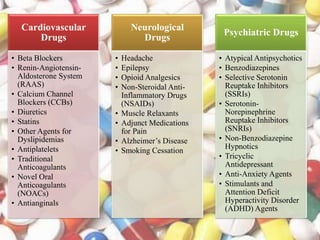
Cardiovascular
Drugs
• Beta Blockers
• Renin-Angiotensin-
Aldosterone System
(RAAS)
• Calcium Channel
Blockers (CCBs)
• Diuretics
• Statins
• Other Agents for
Dyslipidemias
• Antiplatelets
• Traditional
Anticoagulants
• Novel Oral
Anticoagulants
(NOACs)
• Antianginals
Neurological
Drugs
• Headache
• Epilepsy
• Opioid Analgesics
• Non-Steroidal Anti-
Inflammatory Drugs
(NSAIDs)
• Muscle Relaxants
• Adjunct Medications
for Pain
• Alzheimer’s Disease
• Smoking Cessation
Psychiatric Drugs
• Atypical Antipsychotics
• Benzodiazepines
• Selective Serotonin
Reuptake Inhibitors
(SSRIs)
• Serotonin-
Norepinephrine
Reuptake Inhibitors
(SNRIs)
• Non-Benzodiazepine
Hypnotics
• Tricyclic
Antidepressant
• Anti-Anxiety Agents
• Stimulants and
Attention Deficit
Hyperactivity Disorder
(ADHD) Agents
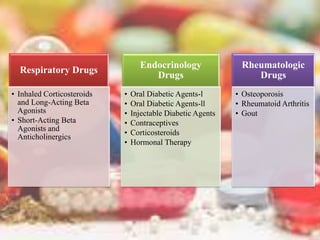
Respiratory Drugs
• Inhaled Corticosteroids
and Long-Acting Beta
Agonists
• Short-Acting Beta
Agonists and
Anticholinergics
Endocrinology
Drugs
• Oral Diabetic Agents-l
• Oral Diabetic Agents-ll
• Injectable Diabetic Agents
• Contraceptives
• Corticosteroids
• Hormonal Therapy
Rheumatologic
Drugs
• Osteoporosis
• Rheumatoid Arthritis
• Gout
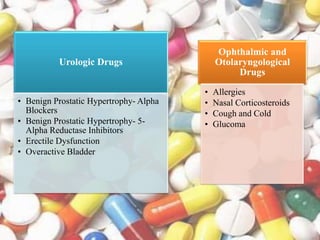
Urologic Drugs
• Benign Prostatic Hypertrophy- Alpha
Blockers
• Benign Prostatic Hypertrophy- 5-
Alpha Reductase Inhibitors
• Erectile Dysfunction
• Overactive Bladder
Ophthalmic and
Otolaryngological
Drugs
• Allergies
• Nasal Corticosteroids
• Cough and Cold
• Glucoma
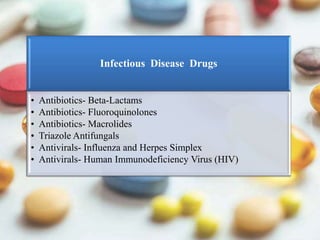
Infectious Disease Drugs
• Antibiotics- Beta-Lactams
• Antibiotics- Fluoroquinolones
• Antibiotics- Macrolides
• Triazole Antifungals
• Antivirals- Influenza and Herpes Simplex
• Antivirals- Human Immunodeficiency Virus (HIV)
References
1. ATC/DDD Methodology: History’. World Health Organization Collaborating Centre
for Drug Statistics Methodology.
2. World Health Organization (2003). Introduction to drug utilization research.
Geneva: WHO. p. 33.
3. www.verywellhealth.com
4. https://www.usp.org
5. https://medshadow.org
6. “Misuse of Drugs Act 1971 (c.38): Schedule 2: Controlled Drugs”
7. www.legislation.gov.uk
8. https://www.law.cornell.edu
9. http://clincalc.com/academy
 Detail study of Legal Classification, visit official website of
respective regulatory authority or guidelines.
Thanks You

Know About Your Drugs

  • 1.
    KNOW ABOUT YOURDRUGS PRESENTED BY SANI SINGH M. PHARM (PHARMACEUTICS) DRUG CLASSIFICATION
  • 2.
     Legal Classification Pharmacological Classification  Therapeutic Classification
  • 3.
     Drugs arechemicals of low molecular masses that interact with macromolecular targets and produce a biological response.  A drug class is a term used to describe medications that are grouped together because of their similarity.  To ensure that use a drug safely to achieve the upmost benefit.  It help to identify drug-drug interactions and the potential for drug resistance and ensures the appropriate staging of treatment. Drug Classification Purpose of Drug Classification
  • 4.
    Legal Classification Anatomical Therapeutic Chemical (ATC) ClassificationSystem Controlled Substance Act (CSA) Misuse of Drugs Act USP Medicare Model Guidelines (USP MMG)
  • 5.
    ATC Classification System WorldHealth Organization (WHO) created a multi-dimensional system in 1976, called the Anatomical Therapeutic Chemical (ATC) Classification System, which categorizes a drug based on 5 levels . 1. Level One describes the organ system the drug treats 2. Level Two describes the drug’s therapeutic effect 3. Level Three describes the mechanism/mode of action 4. Level Four describes the general chemical properties of the drug 5. Level Five describes the chemical components that make up the drug (essentially the chemical name of the drug, such as finasteride or ibuprofen)  ATC/DDD Methodology: History’. World Health Organization Collaborating Centre for Drug Statistics Methodology.  World Health Organization (2003). Introduction to drug utilization research. Geneva: WHO. p. 33.
  • 6.
     The ATCsystem is able to classify the active ingredient of a drug under a strict hierarchy so that it is appropriately used and not mistaken for another drug.  It controlled by the World Health Organization Collaborating Centre for Drug Statistics Methodology (WHOCC).  The drugs are divided into 14 main groups in 1st level.  2nd, 3rd and 4th level are often used to identify pharmacological subgroups when that is considered more appropriate than therapeutic or chemical subgroups.
  • 7.
    • Alimentary tractand metabolismA • Blood and blood forming organsB • Cardiovascular systemC • Dermatologicals • Systemic hormonal preparations, excluding sex hormones and insulins • Antineoplastic and immunomodulating agents • Anti-infectives for systemic use • Genito-urinary system and sex hormones D E H J • Musculo-skeletal system • Antiparasitic products, Insecticides and repellents • Nervous system • Veterinary drug L M P N Q R S • Respiratory system • Sensory organs 14 main groups in level 1st
  • 8.
     The completeclassification of Metformin illustrates the structure of the code according to ATC system : A - Alimentary tract and metabolism (1st level, anatomical main group) A10 – Drugs used in diabetes (2nd level, therapeutic subgroup- consists of two digits) A10B – Oral blood glucose lowering drugs (3rd level, pharmacological subgroup) A10BA – Biguanides (4th level, chemical subgroup) A10BA02 – Metformin (5th level, chemical substance)  Thus, in the ATC system all plain Metformin preparations are given the code A10BA02.
  • 9.
    US Legal Classification The Federal Government passed the Controlled Substance Act (CSA) in 1970. This act established 5 drug classifications, or schedules, for drugs regulated by law.  According to the U.S. Drug Enforcement Administration (DEA), substances from any of these classes may lead to development of chemical dependence in one or both of the following forms: 1. Physical dependence 2. Psychological dependence  According to the DEA, these classifications are broken down based on their potential for abuse and if they have a legitimate medical use .  An updated and complete list of the schedule is published annually in Title 21 Code of Federal Regulations (C.F.R.) 1308.11 through 1308.15.
  • 10.
    It include thedrugs that have a high potential for abuse, that have no currently accepted medical use in treatment, and that there is a lack of accepted safety for use of the drug under medical supervision. • Examples – Cannabis, Heroin, Ecstasy, Mescaline, LSD, GHB, and Methaqualone. Schedule I Schedule II It includes drugs that have high potential for abuse, have currently accepted medical use in treatment or currently accepted medical use with severe restrictions, and the abuse of may lead to severe psychological or physical dependence. • Examples- Amphetamine, Cocaine, Fentanyl, Hydromorphone oxycodone, and Hydrocodone.
  • 11.
    Schedule III It includesdrugs that have a potential for abuse less than the drugs or other substances in schedules I and II, have a currently accepted medical use in treatment, and that the abuse of may lead to moderate or low physical dependence or high psychological dependence. • Examples- Anabolic Steroids, Buprenorphine, and Ketamine. Schedule IV It includes drugs that have a low potential for abuse relative to the drugs or other substances in schedule III, have a currently accepted medical use in treatment, and that the abuse of may lead to limited physical dependence or psychological dependence relative to the drugs or other substances in schedule III. • Examples-Benzodiazepines, Modafinil, and Tramadol.
  • 12.
    Schedule V It includesdrugs that have a low potential for abuse relative to the drugs or other substances in schedules IV, have a currently accepted medical use in treatment, and that the abuse of may lead to limited physical dependence or high psychological dependence relative to the drugs or other substances in schedule IV. • Examples-Diphenoxylate (in combination with atropine), Lacosamide, and Pregabalin.  https://www.law.cornell.edu  https://medshadow.org
  • 13.
    UK Legal Classification Drugs controlled by the United Kingdom (UK) Misuse of Drugs Act 1971. These drugs are known in the UK as controlled drugs.  This act sets out 3 separate categories are –  Class A  Class B  Class C
  • 14.
    Class A Drugs • Opioid •Tryptamine • Stimulant • Ergoline • Phenethylamine • Methadone Class B Drugs • Cannabinoid • Sedative • Hallucinogen • Amphetamines • Barbiturates • Codeine Class C Drugs • Benzodiazepine • Nonbenzodiazepine (Zaleplon, Zolpidem, and Zopiclone) • Anabolic Steroids • Chorionic Gonadotropin • Non-human chorionic Gonadotrophn  “Misuse of Drugs Act 1971 (c.38): Schedule 2: Controlled Drugs” .  www.legislation.gov.uk
  • 15.
    USP Drug Classification USP has developed and updated the USP Medicare Model Guidelines (USP MMG) since 2004, under the Medicare Prescription Drug Improvement and Modernization Act (2003), Section 1860D-4(b)(3)(C)(ii).  The USP DC utilize pharmacotherapeutic evidence within the context of FDA- approved indications for placing example drugs.  A drug in the associated list may appear in more than one USP Category or USP Class if there is a scientifically valid and clinically meaningful patient care issue.  In total, the USP Medicare Model Guidelines v7.0 has:  48 USP Categories  154 USP Classes  169 Unique USP Categories or Classes  2 renamed Categories, 4 new classes and 5 renamed Classes USP Categories and Classes
  • 16.
    USP Medicare ModelGuidelines v1.0-v7.0 V1.0 (2005) V2.0 (2006) V3.0 (2007) V4.0 (2008) V5.0 (2011) V6.0 (2014) V7.0 (2017) USP Categories 41 49 50 50 50 49 48 USP Classes 137 117 119 119 146 151 154 Unique Categories and Classes * 133 133 138 138 161 167 169 Formulary Key Drug Types - Total 141 141 193 192 Retired Retired Retired * Unique Categories and Classes is the sum of the number of USP Classes and the number of USP Categories that have no associated classes.
  • 17.
    From the broadestperspective, the USP currently categorizes a drug or drug component under one of 49 different therapeutic classes are – • Analgesic, including opioids and non-opioids • Anesthetics • Antibacterials, including antibiotics • Anticonvulsants • Antidementia agents • Antidepressants • Antidotes and antitoxins • Antiemetics • Antifungals • Anti-inflammatory agents, including corticosteroids and nonsteroidal anti- inflammatory drugs (NSAIDs) • Antimigraine agents • Antimyasthenic agents • Antimycobacterials
  • 18.
    • Antineoplastics • Antiparasitics •Antiparkinson agents • Antipsychotics • Antiviral, including HIV antiretrovirals and direct-acting hepatitis C drugs • Anxiolytic (Anti-anxiety ) agents • Bipolar agents • Blood glucose regulators, including insulin and other diabetes medications • Blood products, including anticoagulants • Cardiovascular agents, including beta blockers and ACE inhibitors • Central nervous system agents, including amphetamines • Dental and oral agents • Dermatological (skin) agents • Enzyme replacement agent • Gastrointestinal agents, including H2 blockers and proton pump inhibitors • Genitourinary (genital and urinary tract) agents
  • 19.
    • Hormonal agents(adrenal) • Hormonal agents (pituitary) • Hormonal agents (prostaglandins) • Hormonal agents (sex hormones), including estrogen, testosterone, and anabolic steroids • Hormonal agents (thyroid)  https://www.usp.org  https://www.verywellhealth.com
  • 20.
    Pharmacological Classification ofDrugs  It describes a drug’s properties in specific way.  It based on mechanism of action and includes only those drugs that have similar mechanism of action. Pharmacological Classification • Autonomic Nervous System Drugs • Gastrointestinal Drugs • Cardiovascular Drugs • Urological and Related Drugs • Respiratory Drugs • Central Nervous System Drugs • Analgesics, Anti-Inflammatory and Anti-Pyretic Drugs • Drugs used in Disorders of the Ear, Nose and Oropharynx • Drugs used in Anaesthesia • Drug Used in Muscloskeleton and Joint Disease • Anti-Infectives
  • 21.
    PharmacologicalClassification • Drugs usedin Endocrine Disorders and Contraceptives • Obstetric and Gynecological Medications • Antineoplastic and Adjuvants • Blood Products and Drugs • Vitamins • Drugs for Correcting Water Electrolyte and Acid-Base Disturbances • Antihistamines and Antiallergics • Ophthalmic Agents • Dermatological Agents • Antidotes and Other Substances used in Poisoning • Immunological Preparation • Vaccines and Related Products
  • 22.
    Therapeutic Classification ofDrugs  Therapeutic Classes are broad categories based on therapeutic intent.  Drug grouped by therapeutic class work in very different ways-  They are not chemically similar  They have different mechanisms of action Gastrointestinal Drugs • Proton Pump Inhibitors • Histamine (H2) Receptor Blockers • Diarrhea and Ulcerative Colitis • Laxatives • Nausea Renal Drugs • Renal Medications • Erythropoiesis-Stimulating Agents (ESAs)
  • 23.
    Cardiovascular Drugs • Beta Blockers •Renin-Angiotensin- Aldosterone System (RAAS) • Calcium Channel Blockers (CCBs) • Diuretics • Statins • Other Agents for Dyslipidemias • Antiplatelets • Traditional Anticoagulants • Novel Oral Anticoagulants (NOACs) • Antianginals Neurological Drugs • Headache • Epilepsy • Opioid Analgesics • Non-Steroidal Anti- Inflammatory Drugs (NSAIDs) • Muscle Relaxants • Adjunct Medications for Pain • Alzheimer’s Disease • Smoking Cessation Psychiatric Drugs • Atypical Antipsychotics • Benzodiazepines • Selective Serotonin Reuptake Inhibitors (SSRIs) • Serotonin- Norepinephrine Reuptake Inhibitors (SNRIs) • Non-Benzodiazepine Hypnotics • Tricyclic Antidepressant • Anti-Anxiety Agents • Stimulants and Attention Deficit Hyperactivity Disorder (ADHD) Agents
  • 24.
    Respiratory Drugs • InhaledCorticosteroids and Long-Acting Beta Agonists • Short-Acting Beta Agonists and Anticholinergics Endocrinology Drugs • Oral Diabetic Agents-l • Oral Diabetic Agents-ll • Injectable Diabetic Agents • Contraceptives • Corticosteroids • Hormonal Therapy Rheumatologic Drugs • Osteoporosis • Rheumatoid Arthritis • Gout
  • 25.
    Urologic Drugs • BenignProstatic Hypertrophy- Alpha Blockers • Benign Prostatic Hypertrophy- 5- Alpha Reductase Inhibitors • Erectile Dysfunction • Overactive Bladder Ophthalmic and Otolaryngological Drugs • Allergies • Nasal Corticosteroids • Cough and Cold • Glucoma
  • 26.
    Infectious Disease Drugs •Antibiotics- Beta-Lactams • Antibiotics- Fluoroquinolones • Antibiotics- Macrolides • Triazole Antifungals • Antivirals- Influenza and Herpes Simplex • Antivirals- Human Immunodeficiency Virus (HIV)
  • 27.
    References 1. ATC/DDD Methodology:History’. World Health Organization Collaborating Centre for Drug Statistics Methodology. 2. World Health Organization (2003). Introduction to drug utilization research. Geneva: WHO. p. 33. 3. www.verywellhealth.com 4. https://www.usp.org 5. https://medshadow.org 6. “Misuse of Drugs Act 1971 (c.38): Schedule 2: Controlled Drugs” 7. www.legislation.gov.uk 8. https://www.law.cornell.edu 9. http://clincalc.com/academy  Detail study of Legal Classification, visit official website of respective regulatory authority or guidelines.
  • 28.