
PRESENTED BY,
NIMISHA.K
MSC FST 2ND SEM
KUFOS
WHAT IS PASTEURIZATION ??
Pasteurization is a heat treatment involves heating food to a
temperature that kills disease causing micro organisms and
substantially reduces the levels of spoilage organisms
Pasteurization is not intended to kill all micro organisms in the
food. Instead pasteurization aims to reduce the number of viable
pathogens so they are unlikely to cause disease
The heating may be by means of steam, hot water, dry heat, or
electric currents, and the products are cooled promptly after the
heat treatment
Heating also destroy enzymes that make milk spoil, so
pasteurized milk drinkable for long time
HISTORYOF PASTEURIZATION
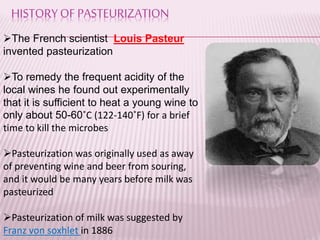
The French scientist Louis Pasteur
invented pasteurization
To remedy the frequent acidity of the
local wines he found out experimentally
that it is sufficient to heat a young wine to
only about 50-60˚C (122-140˚F) for a brief
time to kill the microbes
Pasteurization was originally used as away
of preventing wine and beer from souring,
and it would be many years before milk was
pasteurized
Pasteurization of milk was suggested by
Franz von soxhlet in 1886
FOODS USED FOR PASTEURIZATION
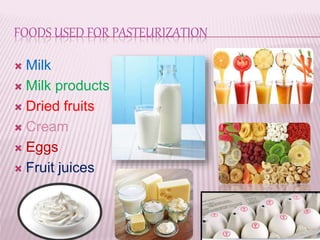
 Milk
 Milk products
 Dried fruits
 Cream
 Eggs
 Fruit juices
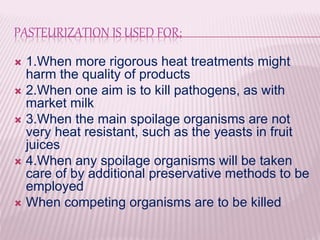
PASTEURIZATION IS USED FOR;
 1.When more rigorous heat treatments might
harm the quality of products
 2.When one aim is to kill pathogens, as with
market milk
 3.When the main spoilage organisms are not
very heat resistant, such as the yeasts in fruit
juices
 4.When any spoilage organisms will be taken
care of by additional preservative methods to be
employed
 When competing organisms are to be killed
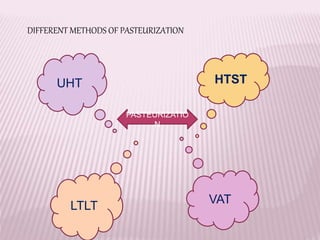
DIFFERENT METHODS OF PASTEURIZATION
PASTEURIZATIO
N
HTSTUHT
LTLT
VAT
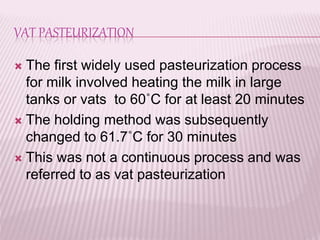
VAT PASTEURIZATION
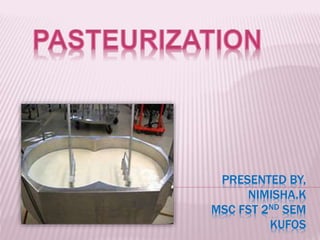
 The first widely used pasteurization process
for milk involved heating the milk in large
tanks or vats to 60˚C for at least 20 minutes
 The holding method was subsequently
changed to 61.7˚C for 30 minutes
 This was not a continuous process and was
referred to as vat pasteurization
ULTRA HIGH TEMPERATURE (UHT)
 Heat treatment processes in excess of
pasteurization for milk and milk products
have been designated as very high
temperature (VHT) and ultra high
temperature (UHT)
 UHT processes usually refer to
pasteurization techniques with temperature
of at least 130˚C in a continuous flow, with
holding times of approximately 1 sec.
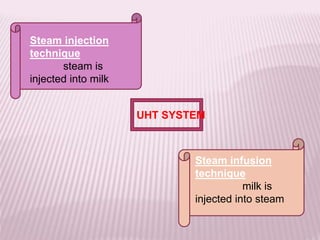
UHT SYSTEM
Steam injection
technique
steam is
injected into milk
Steam infusion
technique
milk is
injected into steam
BATCH PASTEURIZATION (LTLT)
 Milk is heated at 63˚C for 30 minutes
 Can heat milk in vat or outside the vat
 Here milk is heated in plate heat exchanger and send
to the vat
 Agitator is provided in the vat to prevent cream
formation and to ensure uniform heat distribution
 Then the milk is cooled and again passed through
the plate heat exchanger and cooled using chilled
water
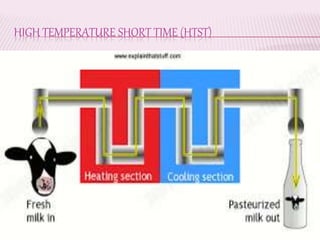
HIGH TEMPERATURE SHORT TIME (HTST)
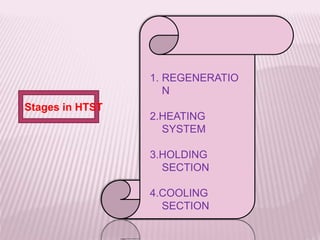
Stages in HTST
1. REGENERATIO
N
2.HEATING
SYSTEM
3.HOLDING
SECTION
4.COOLING
SECTION
PROCESS
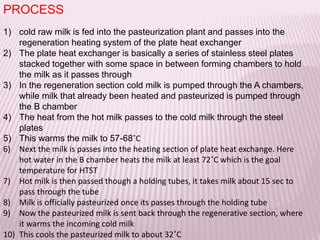
1) cold raw milk is fed into the pasteurization plant and passes into the
regeneration heating system of the plate heat exchanger
2) The plate heat exchanger is basically a series of stainless steel plates
stacked together with some space in between forming chambers to hold
the milk as it passes through
3) In the regeneration section cold milk is pumped through the A chambers,
while milk that already been heated and pasteurized is pumped through
the B chamber
4) The heat from the hot milk passes to the cold milk through the steel
plates
5) This warms the milk to 57-68˚C
6) Next the milk is passes into the heating section of plate heat exchange. Here
hot water in the B chamber heats the milk at least 72˚C which is the goal
temperature for HTST
7) Hot milk is then passed though a holding tubes, it takes milk about 15 sec to
pass through the tube
8) Milk is officially pasteurized once its passes through the holding tube
9) Now the pasteurized milk is sent back through the regenerative section, where
it warms the incoming cold milk
10) This cools the pasteurized milk to about 32˚C
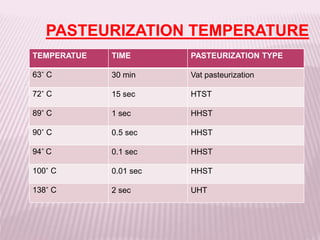
TEMPERATUE TIME PASTEURIZATION TYPE
63˚ C 30 min Vat pasteurization
72˚ C 15 sec HTST
89˚ C 1 sec HHST
90˚ C 0.5 sec HHST
94˚ C 0.1 sec HHST
100˚ C 0.01 sec HHST
138˚ C 2 sec UHT
PASTEURIZATION TEMPERATURE
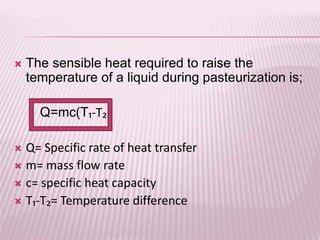
 The sensible heat required to raise the
temperature of a liquid during pasteurization is;
Q=mc(T₁-T₂)
 Q= Specific rate of heat transfer
 m= mass flow rate
 c= specific heat capacity
 T₁-T₂= Temperature difference
Pasteurization- Nimisha Kaikkolante

Pasteurization- Nimisha Kaikkolante

  • 1.
  • 2.
    WHAT IS PASTEURIZATION?? Pasteurization is a heat treatment involves heating food to a temperature that kills disease causing micro organisms and substantially reduces the levels of spoilage organisms Pasteurization is not intended to kill all micro organisms in the food. Instead pasteurization aims to reduce the number of viable pathogens so they are unlikely to cause disease The heating may be by means of steam, hot water, dry heat, or electric currents, and the products are cooled promptly after the heat treatment Heating also destroy enzymes that make milk spoil, so pasteurized milk drinkable for long time
  • 3.
    HISTORYOF PASTEURIZATION The Frenchscientist Louis Pasteur invented pasteurization To remedy the frequent acidity of the local wines he found out experimentally that it is sufficient to heat a young wine to only about 50-60˚C (122-140˚F) for a brief time to kill the microbes Pasteurization was originally used as away of preventing wine and beer from souring, and it would be many years before milk was pasteurized Pasteurization of milk was suggested by Franz von soxhlet in 1886
  • 4.
    FOODS USED FORPASTEURIZATION  Milk  Milk products  Dried fruits  Cream  Eggs  Fruit juices
  • 5.
    PASTEURIZATION IS USEDFOR;  1.When more rigorous heat treatments might harm the quality of products  2.When one aim is to kill pathogens, as with market milk  3.When the main spoilage organisms are not very heat resistant, such as the yeasts in fruit juices  4.When any spoilage organisms will be taken care of by additional preservative methods to be employed  When competing organisms are to be killed
  • 7.
    DIFFERENT METHODS OFPASTEURIZATION PASTEURIZATIO N HTSTUHT LTLT VAT
  • 8.
    VAT PASTEURIZATION  Thefirst widely used pasteurization process for milk involved heating the milk in large tanks or vats to 60˚C for at least 20 minutes  The holding method was subsequently changed to 61.7˚C for 30 minutes  This was not a continuous process and was referred to as vat pasteurization
  • 9.
    ULTRA HIGH TEMPERATURE(UHT)  Heat treatment processes in excess of pasteurization for milk and milk products have been designated as very high temperature (VHT) and ultra high temperature (UHT)  UHT processes usually refer to pasteurization techniques with temperature of at least 130˚C in a continuous flow, with holding times of approximately 1 sec.
  • 10.
    UHT SYSTEM Steam injection technique steamis injected into milk Steam infusion technique milk is injected into steam
  • 11.
    BATCH PASTEURIZATION (LTLT) Milk is heated at 63˚C for 30 minutes  Can heat milk in vat or outside the vat  Here milk is heated in plate heat exchanger and send to the vat  Agitator is provided in the vat to prevent cream formation and to ensure uniform heat distribution  Then the milk is cooled and again passed through the plate heat exchanger and cooled using chilled water
  • 12.
  • 13.
    Stages in HTST 1.REGENERATIO N 2.HEATING SYSTEM 3.HOLDING SECTION 4.COOLING SECTION
  • 14.
    PROCESS 1) cold rawmilk is fed into the pasteurization plant and passes into the regeneration heating system of the plate heat exchanger 2) The plate heat exchanger is basically a series of stainless steel plates stacked together with some space in between forming chambers to hold the milk as it passes through 3) In the regeneration section cold milk is pumped through the A chambers, while milk that already been heated and pasteurized is pumped through the B chamber 4) The heat from the hot milk passes to the cold milk through the steel plates 5) This warms the milk to 57-68˚C 6) Next the milk is passes into the heating section of plate heat exchange. Here hot water in the B chamber heats the milk at least 72˚C which is the goal temperature for HTST 7) Hot milk is then passed though a holding tubes, it takes milk about 15 sec to pass through the tube 8) Milk is officially pasteurized once its passes through the holding tube 9) Now the pasteurized milk is sent back through the regenerative section, where it warms the incoming cold milk 10) This cools the pasteurized milk to about 32˚C
  • 15.
    TEMPERATUE TIME PASTEURIZATIONTYPE 63˚ C 30 min Vat pasteurization 72˚ C 15 sec HTST 89˚ C 1 sec HHST 90˚ C 0.5 sec HHST 94˚ C 0.1 sec HHST 100˚ C 0.01 sec HHST 138˚ C 2 sec UHT PASTEURIZATION TEMPERATURE
  • 16.
     The sensibleheat required to raise the temperature of a liquid during pasteurization is; Q=mc(T₁-T₂)  Q= Specific rate of heat transfer  m= mass flow rate  c= specific heat capacity  T₁-T₂= Temperature difference