FSSAI, CFSO
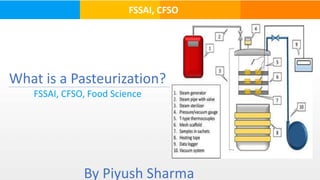
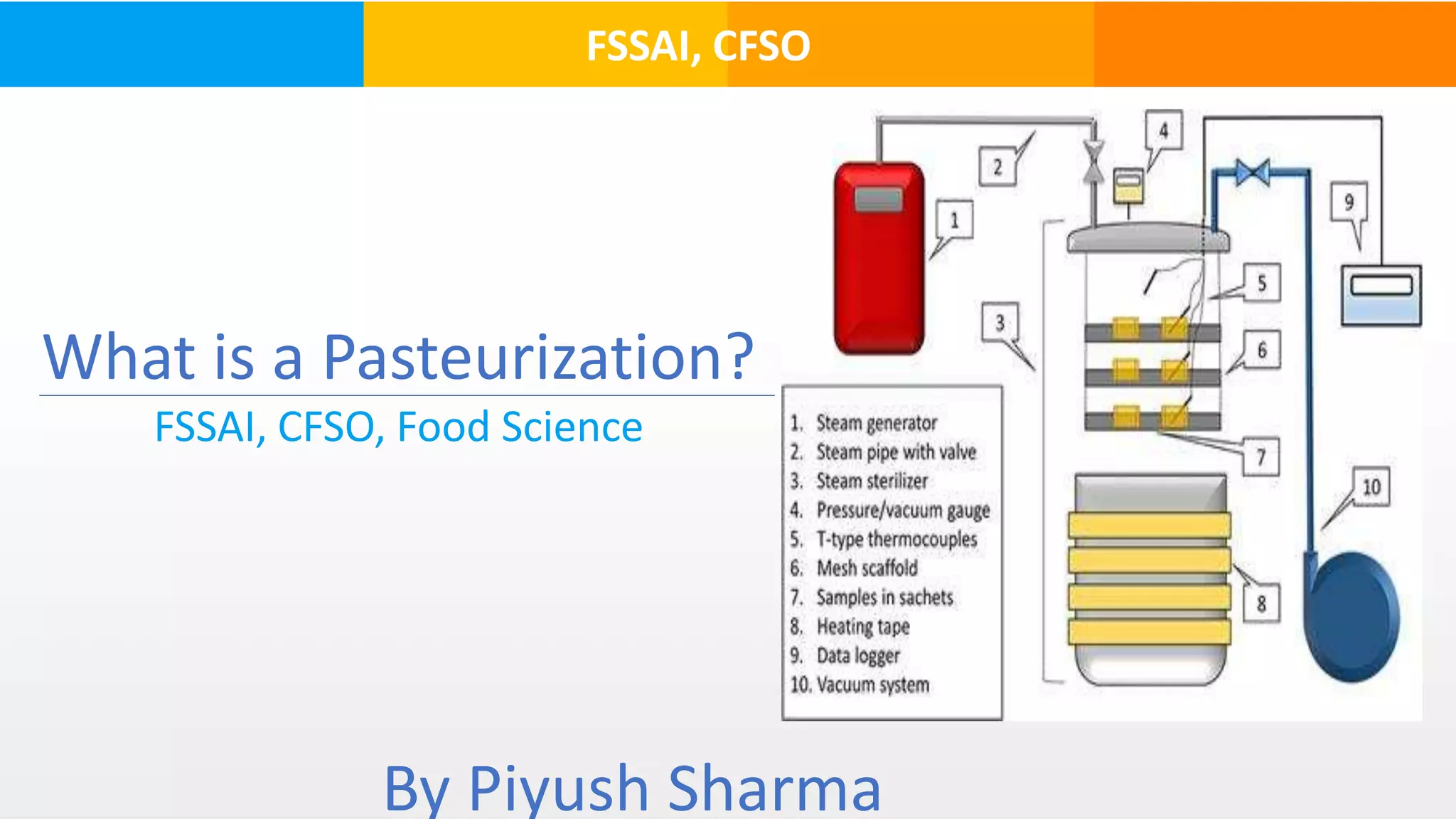
What is a Pasteurization?
FSSAI, CFSO, Food Science
By Piyush Sharma
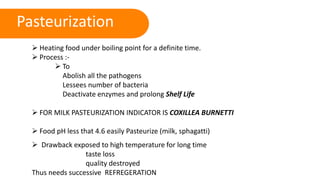
Pasteurization
 Heating food under boiling point for a definite time.
 Process :-
 To
Abolish all the pathogens
Lessees number of bacteria
Deactivate enzymes and prolong Shelf Life
 FOR MILK PASTEURIZATION INDICATOR IS COXILLEA BURNETTI
 Food pH less that 4.6 easily Pasteurize (milk, sphagatti)
 Drawback exposed to high temperature for long time
taste loss
quality destroyed
Thus needs successive REFREGERATION
History
Louis Pasteur, French scientist, invent
Pasteurization
(prevents wine, bear souring)
Franz von Soxhlet (1886)
MILK PASTEURIZATION
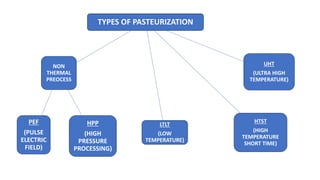
TYPES OF PASTEURIZATION
UHT
(ULTRA HIGH
TEMPERATURE)
LTLT
(LOW
TEMPERATURE)
HTST
(HIGH
TEMPERATURE
SHORT TIME)
NON
THERMAL
PREOCESS
HPP
(HIGH
PRESSURE
PROCESSING)
PEF
(PULSE
ELECTRIC
FIELD)
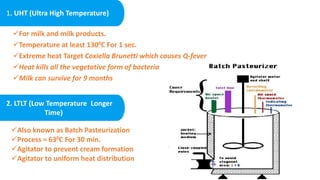
1. UHT (Ultra High Temperature)
For milk and milk products.
Temperature at least 1300C For 1 sec.
Extreme heat Target Coxiella Brunetti which causes Q-fever
Heat kills all the vegetative form of bacteria
Milk can survive for 9 months
2. LTLT (Low Temperature Longer
Time)
Also known as Batch Pasteurization
Process = 630C For 30 min.
Agitator to prevent cream formation
Agitator to uniform heat distribution
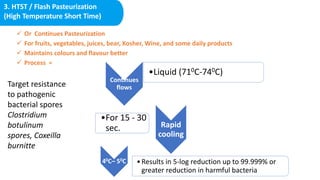
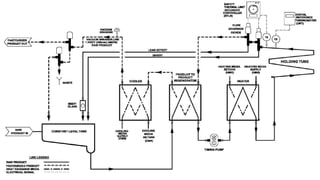
3. HTST / Flash Pasteurization
(High Temperature Short Time)
 Or Continues Pasteurization
 For fruits, vegetables, juices, bear, Kosher, Wine, and some daily products
 Maintains colours and flavour better
 Process =
Continues
flows
•Liquid (710C-740C)
Rapid
cooling
•For 15 - 30
sec.
40C– 50C •Results in 5-log reduction up to 99.999% or
greater reduction in harmful bacteria
Target resistance
to pathogenic
bacterial spores
Clostridium
botulinum
spores, Coxeilla
burnitte
Other Pasteurization
Water Bath Pasteurization
Continuous Steam or Water Spray Pasteurizer
Tunnel Pasteurization
Pasteurization of Unpacked Liquids
Long Hold or Vat Pasteurizing
Heat Exchanger Pasteurizer
Flash Pasteurization
Vacreator
Ultra Pasteurization
Steam Pasteurization
Irradiation Pasteurization
Pasteurization Testing
ALP
In 1990 new rapid enzymatic assay designed to confirm Pasteurization
This test involves the use of an automated instrument and a fluorometric assay.
Alkaline phosphatase (ALP) is an enzyme naturally present in raw milk, which is used as an indicator for proper
milk pasteurization.
Non-pasteurized or raw milk contains ALP, which causes intra-abdominal bacterial infection after drinking the
milk, whereas after pasteurization, ALP is denatured.
ALP testing, unlike the colorimetric method, can be used to confirm pasteurization of many different products,
including bovine, sheep, and goat milk; flavored and cultured products; and cheeses.
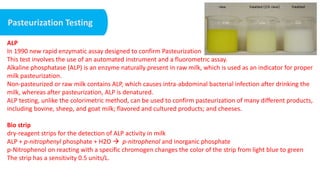
Bio strip
dry-reagent strips for the detection of ALP activity in milk
ALP + p-nitrophenyl phosphate + H2O  p-nitrophenol and inorganic phosphate
p-Nitrophenol on reacting with a specific chromogen changes the color of the strip from light blue to green
The strip has a sensitivity 0.5 units/L.

Milk pasteurization

  • 1.
    FSSAI, CFSO What isa Pasteurization? FSSAI, CFSO, Food Science By Piyush Sharma
  • 2.
    Pasteurization  Heating foodunder boiling point for a definite time.  Process :-  To Abolish all the pathogens Lessees number of bacteria Deactivate enzymes and prolong Shelf Life  FOR MILK PASTEURIZATION INDICATOR IS COXILLEA BURNETTI  Food pH less that 4.6 easily Pasteurize (milk, sphagatti)  Drawback exposed to high temperature for long time taste loss quality destroyed Thus needs successive REFREGERATION
  • 3.
    History Louis Pasteur, Frenchscientist, invent Pasteurization (prevents wine, bear souring) Franz von Soxhlet (1886) MILK PASTEURIZATION
  • 4.
    TYPES OF PASTEURIZATION UHT (ULTRAHIGH TEMPERATURE) LTLT (LOW TEMPERATURE) HTST (HIGH TEMPERATURE SHORT TIME) NON THERMAL PREOCESS HPP (HIGH PRESSURE PROCESSING) PEF (PULSE ELECTRIC FIELD)
  • 5.
    1. UHT (UltraHigh Temperature) For milk and milk products. Temperature at least 1300C For 1 sec. Extreme heat Target Coxiella Brunetti which causes Q-fever Heat kills all the vegetative form of bacteria Milk can survive for 9 months 2. LTLT (Low Temperature Longer Time) Also known as Batch Pasteurization Process = 630C For 30 min. Agitator to prevent cream formation Agitator to uniform heat distribution
  • 6.
    3. HTST /Flash Pasteurization (High Temperature Short Time)  Or Continues Pasteurization  For fruits, vegetables, juices, bear, Kosher, Wine, and some daily products  Maintains colours and flavour better  Process = Continues flows •Liquid (710C-740C) Rapid cooling •For 15 - 30 sec. 40C– 50C •Results in 5-log reduction up to 99.999% or greater reduction in harmful bacteria Target resistance to pathogenic bacterial spores Clostridium botulinum spores, Coxeilla burnitte
  • 8.
    Other Pasteurization Water BathPasteurization Continuous Steam or Water Spray Pasteurizer Tunnel Pasteurization Pasteurization of Unpacked Liquids Long Hold or Vat Pasteurizing Heat Exchanger Pasteurizer Flash Pasteurization Vacreator Ultra Pasteurization Steam Pasteurization Irradiation Pasteurization
  • 9.
    Pasteurization Testing ALP In 1990new rapid enzymatic assay designed to confirm Pasteurization This test involves the use of an automated instrument and a fluorometric assay. Alkaline phosphatase (ALP) is an enzyme naturally present in raw milk, which is used as an indicator for proper milk pasteurization. Non-pasteurized or raw milk contains ALP, which causes intra-abdominal bacterial infection after drinking the milk, whereas after pasteurization, ALP is denatured. ALP testing, unlike the colorimetric method, can be used to confirm pasteurization of many different products, including bovine, sheep, and goat milk; flavored and cultured products; and cheeses. Bio strip dry-reagent strips for the detection of ALP activity in milk ALP + p-nitrophenyl phosphate + H2O  p-nitrophenol and inorganic phosphate p-Nitrophenol on reacting with a specific chromogen changes the color of the strip from light blue to green The strip has a sensitivity 0.5 units/L.