 Pasteurization is a process that kills microbes (mainly
bacteria) in food and drink, such as milk, juice, canned food, and
others.
 Pasteurization involves heating food to a temperature that
kills disease causing microorganism and substantially reduces
the levels of spoilage organisms.
 Pasteurization is not intended to kill all micro-organisms in
the food.
 Instead pasteurization aims to reduce the number of viable
pathogens so they are unlikely to cause disease (assuming the
pasteurized product is stored as indicated and consumed before
its expiration date).
 Heat also destroy enzymes that make milk spoil, so
pasteurized milk drinkable for longer time.
4/6/2022 Milk Process - Pasteurization - Dr.L.Grs 2
 It was invented by French scientist Louis Pasteur during
the 19th century.
 In 1864 Pasteur discovered that heating beer and wine
was enough to kill most of the bacteria that caused spoilage,
preventing these beverages from turning sour.
 The process achieves this by eliminating pathogenic
microbes and lowering microbial numbers to prolong the
quality of the beverage.
 Today, pasteurization is used widely in the dairy industry and
other food processing industries to achieve food preservation
and food safety.
4/6/2022 Milk Process - Pasteurization - Dr.L.Grs 3
• To Kill all the pathogens that may enter the milk & be
transmitted to people.
• To Improve the keeping quality of milk.
• To Increase the shelf-life of products.
• To destroy microorganisms that would interfere with
the activities of desirable organisms.
4/6/2022 Milk Process - Pasteurization - Dr.L.Grs 4
The % of reduction of numbers of
microorganisms in milk depends on:
• Temperature of pasteurization.
• The holding time.
• The total number of microbial load that are
spore formers or thermoduric organisms.
4/6/2022 Milk Process - Pasteurization - Dr.L.Grs 5
Milk Pasteurization:
There are four common types of milk pasteurization
that vary with temperature and time the milk is held
at that temperature.
1) Vat Pasteurization:
2) High Temperature/Short Time (HTST)
3) Ultra-pasteurization (UP)
4) Ultra-High-Temperature (UHT)
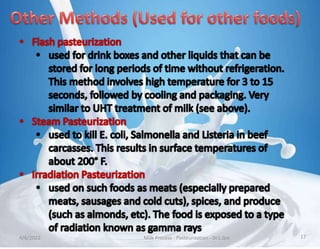
Other Methods (Used for other foods)
1) Flash pasteurization
2) Steam Pasteurization
3) Irradiation Pasteurization
4/6/2022 Milk Process - Pasteurization - Dr.L.Grs 6
Four common types of pasteurization techniques
used for pasteurizing milk are:
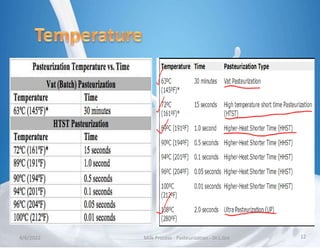
1. Low Temperature Long Time (LTLT) – 63 °C / 145
°F for 30 minutes
2. High Temperature Short Time (HTST) – 72 °C / 161
°F for 15 seconds
3. Ultra-pasteurization (UP) - 138 ºC (280 ºF) for 2
seconds
4. Ultra Heat Treatment (UHT) -- 140 °C / 284 °F
for 1 to 4 seconds
4/6/2022 Milk Process - Pasteurization - Dr.L.Grs 7
1. Low Temperature Long Time (LTLT) / holder
method/ Vat pasteurisation:
• A less conventional and typically for home
pasteurization method is to heat milk at 63 °C
(145 °F) for 30 minutes.
• It is then quickly cooled to 39 °C.
4/6/2022 Milk Process - Pasteurization - Dr.L.Grs 8
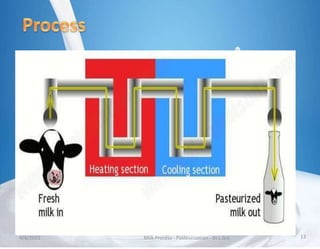
2. High Temperature Short Time (HTST):
• The process of pasteurisation involves
heating milk to 71.7°C for at least 15 seconds.
• Then rapidly cooled to 10 °C.
• HTST milk is forced between metal plates or
through pipes heated on the outside by hot
water.
• It is a high-tech commercially used dairy
pasteurization method.
• Milk simply labeled "pasteurized" is usually
treated with the HTST method.
4/6/2022 Milk Process - Pasteurization - Dr.L.Grs 9
3. Ultra-pasteurization (UP)
• The milk is heated to 138 ºC (280 ºF) for 2
seconds.
• Note this is above boiling, which means that
high pressure must be applied to the milk to
achieve this temperature, and is destructive to
its nutritional quality.
• This method is used because it extends the
refrigerated shelf-life of the milk to 60 - 90 days,
and is the method of choice for national or
regional milk brands because it allows time for
warehousing and shipment of milk.
4/6/2022 Milk Process - Pasteurization - Dr.L.Grs 10
4. Ultra Heat Treatment (UHT):
• UHT, also known as ultra-heat-treating, processing
holds the milk at a temperature of 140 °C (284 °F)
for 4 seconds.
• This process lets consumers store milk for several
months without refrigeration.
• Milk labeled "ultra-pasteurized" or simply "UHT"
has been treated with the UHT method.
• Most commercial milk brands used this form of
pasteurization since it is the quickest and cheapest.
4/6/2022 Milk Process - Pasteurization - Dr.L.Grs 11
4/6/2022 Milk Process - Pasteurization - Dr.L.Grs 12
4/6/2022 Milk Process - Pasteurization - Dr.L.Grs 13
Milk born disease:
A joint FAO/WHO Expert Committee on milk hygiene classified milk borne
diseases as under:
Infections of animals that can be transmitted toHuman:
Primary importance:
☻Tuberculosis
☻Brucellosis
☻Streptococcal infections
☻Staphylococcal enterotoxin poisoning
☻Salmonellosis
☻Q fever
Lesser importance:
☻Cox-pox
☻Foot and mouth disease
☻Anthrax
☻Leptospirosis
☻Tick-borne encephalitis
4/6/2022 Milk Process - Pasteurization - Dr.L.Grs 14
CONTINUE…
Infections primary to Human that can be transmitted through
milk:
• ☻Typhoid and paratyphoidfevers
• ☻Shigellosis
• ☻Cholera
• ☻Enteropathogenic Escherichia coli
Non-diarrhoeal diseases:
• ☻Streptococcal infections
• ☻Staphylococcal food poising
• ☻Diphtheria
• ☻Tuberculosis
• ☻Entero viruses
• ☻Viral hepatitis
4/6/2022 Milk Process - Pasteurization - Dr.L.Grs 15
☻Water
☻Infected animals
☻Intestinal tract and feces
☻Human handler
☻Secreta and excreta (saliva, sneezing, coughing, stool,
urine, etc.) of infected or carriers handlers.
☻Environment e.g. contaminated vessel, polluted water,
flies, dust, soil etc.
4/6/2022 Milk Process - Pasteurization - Dr.L.Grs 16
4/6/2022 Milk Process - Pasteurization - Dr.L.Grs 17
4/6/2022 Milk Process - Pasteurization - Dr.L.Grs 18
4/6/2022 Milk Process - Pasteurization - Dr.L.Grs 19
4/6/2022 Milk Process - Pasteurization - Dr.L.Grs 20

Pasteurization

  • 2.
     Pasteurization isa process that kills microbes (mainly bacteria) in food and drink, such as milk, juice, canned food, and others.  Pasteurization involves heating food to a temperature that kills disease causing microorganism and substantially reduces the levels of spoilage organisms.  Pasteurization is not intended to kill all micro-organisms in the food.  Instead pasteurization aims to reduce the number of viable pathogens so they are unlikely to cause disease (assuming the pasteurized product is stored as indicated and consumed before its expiration date).  Heat also destroy enzymes that make milk spoil, so pasteurized milk drinkable for longer time. 4/6/2022 Milk Process - Pasteurization - Dr.L.Grs 2
  • 3.
     It wasinvented by French scientist Louis Pasteur during the 19th century.  In 1864 Pasteur discovered that heating beer and wine was enough to kill most of the bacteria that caused spoilage, preventing these beverages from turning sour.  The process achieves this by eliminating pathogenic microbes and lowering microbial numbers to prolong the quality of the beverage.  Today, pasteurization is used widely in the dairy industry and other food processing industries to achieve food preservation and food safety. 4/6/2022 Milk Process - Pasteurization - Dr.L.Grs 3
  • 4.
    • To Killall the pathogens that may enter the milk & be transmitted to people. • To Improve the keeping quality of milk. • To Increase the shelf-life of products. • To destroy microorganisms that would interfere with the activities of desirable organisms. 4/6/2022 Milk Process - Pasteurization - Dr.L.Grs 4
  • 5.
    The % ofreduction of numbers of microorganisms in milk depends on: • Temperature of pasteurization. • The holding time. • The total number of microbial load that are spore formers or thermoduric organisms. 4/6/2022 Milk Process - Pasteurization - Dr.L.Grs 5
  • 6.
    Milk Pasteurization: There arefour common types of milk pasteurization that vary with temperature and time the milk is held at that temperature. 1) Vat Pasteurization: 2) High Temperature/Short Time (HTST) 3) Ultra-pasteurization (UP) 4) Ultra-High-Temperature (UHT) Other Methods (Used for other foods) 1) Flash pasteurization 2) Steam Pasteurization 3) Irradiation Pasteurization 4/6/2022 Milk Process - Pasteurization - Dr.L.Grs 6
  • 7.
    Four common typesof pasteurization techniques used for pasteurizing milk are: 1. Low Temperature Long Time (LTLT) – 63 °C / 145 °F for 30 minutes 2. High Temperature Short Time (HTST) – 72 °C / 161 °F for 15 seconds 3. Ultra-pasteurization (UP) - 138 ºC (280 ºF) for 2 seconds 4. Ultra Heat Treatment (UHT) -- 140 °C / 284 °F for 1 to 4 seconds 4/6/2022 Milk Process - Pasteurization - Dr.L.Grs 7
  • 8.
    1. Low TemperatureLong Time (LTLT) / holder method/ Vat pasteurisation: • A less conventional and typically for home pasteurization method is to heat milk at 63 °C (145 °F) for 30 minutes. • It is then quickly cooled to 39 °C. 4/6/2022 Milk Process - Pasteurization - Dr.L.Grs 8
  • 9.
    2. High TemperatureShort Time (HTST): • The process of pasteurisation involves heating milk to 71.7°C for at least 15 seconds. • Then rapidly cooled to 10 °C. • HTST milk is forced between metal plates or through pipes heated on the outside by hot water. • It is a high-tech commercially used dairy pasteurization method. • Milk simply labeled "pasteurized" is usually treated with the HTST method. 4/6/2022 Milk Process - Pasteurization - Dr.L.Grs 9
  • 10.
    3. Ultra-pasteurization (UP) •The milk is heated to 138 ºC (280 ºF) for 2 seconds. • Note this is above boiling, which means that high pressure must be applied to the milk to achieve this temperature, and is destructive to its nutritional quality. • This method is used because it extends the refrigerated shelf-life of the milk to 60 - 90 days, and is the method of choice for national or regional milk brands because it allows time for warehousing and shipment of milk. 4/6/2022 Milk Process - Pasteurization - Dr.L.Grs 10
  • 11.
    4. Ultra HeatTreatment (UHT): • UHT, also known as ultra-heat-treating, processing holds the milk at a temperature of 140 °C (284 °F) for 4 seconds. • This process lets consumers store milk for several months without refrigeration. • Milk labeled "ultra-pasteurized" or simply "UHT" has been treated with the UHT method. • Most commercial milk brands used this form of pasteurization since it is the quickest and cheapest. 4/6/2022 Milk Process - Pasteurization - Dr.L.Grs 11
  • 12.
    4/6/2022 Milk Process- Pasteurization - Dr.L.Grs 12
  • 13.
    4/6/2022 Milk Process- Pasteurization - Dr.L.Grs 13
  • 14.
    Milk born disease: Ajoint FAO/WHO Expert Committee on milk hygiene classified milk borne diseases as under: Infections of animals that can be transmitted toHuman: Primary importance: ☻Tuberculosis ☻Brucellosis ☻Streptococcal infections ☻Staphylococcal enterotoxin poisoning ☻Salmonellosis ☻Q fever Lesser importance: ☻Cox-pox ☻Foot and mouth disease ☻Anthrax ☻Leptospirosis ☻Tick-borne encephalitis 4/6/2022 Milk Process - Pasteurization - Dr.L.Grs 14
  • 15.
    CONTINUE… Infections primary toHuman that can be transmitted through milk: • ☻Typhoid and paratyphoidfevers • ☻Shigellosis • ☻Cholera • ☻Enteropathogenic Escherichia coli Non-diarrhoeal diseases: • ☻Streptococcal infections • ☻Staphylococcal food poising • ☻Diphtheria • ☻Tuberculosis • ☻Entero viruses • ☻Viral hepatitis 4/6/2022 Milk Process - Pasteurization - Dr.L.Grs 15
  • 16.
    ☻Water ☻Infected animals ☻Intestinal tractand feces ☻Human handler ☻Secreta and excreta (saliva, sneezing, coughing, stool, urine, etc.) of infected or carriers handlers. ☻Environment e.g. contaminated vessel, polluted water, flies, dust, soil etc. 4/6/2022 Milk Process - Pasteurization - Dr.L.Grs 16
  • 17.
    4/6/2022 Milk Process- Pasteurization - Dr.L.Grs 17
  • 18.
    4/6/2022 Milk Process- Pasteurization - Dr.L.Grs 18
  • 19.
    4/6/2022 Milk Process- Pasteurization - Dr.L.Grs 19
  • 20.
    4/6/2022 Milk Process- Pasteurization - Dr.L.Grs 20