PASTEURIZATION
SUBMITTED BY:-
Sumit Bansal
B.Tech(Final Year)
DEFINITION
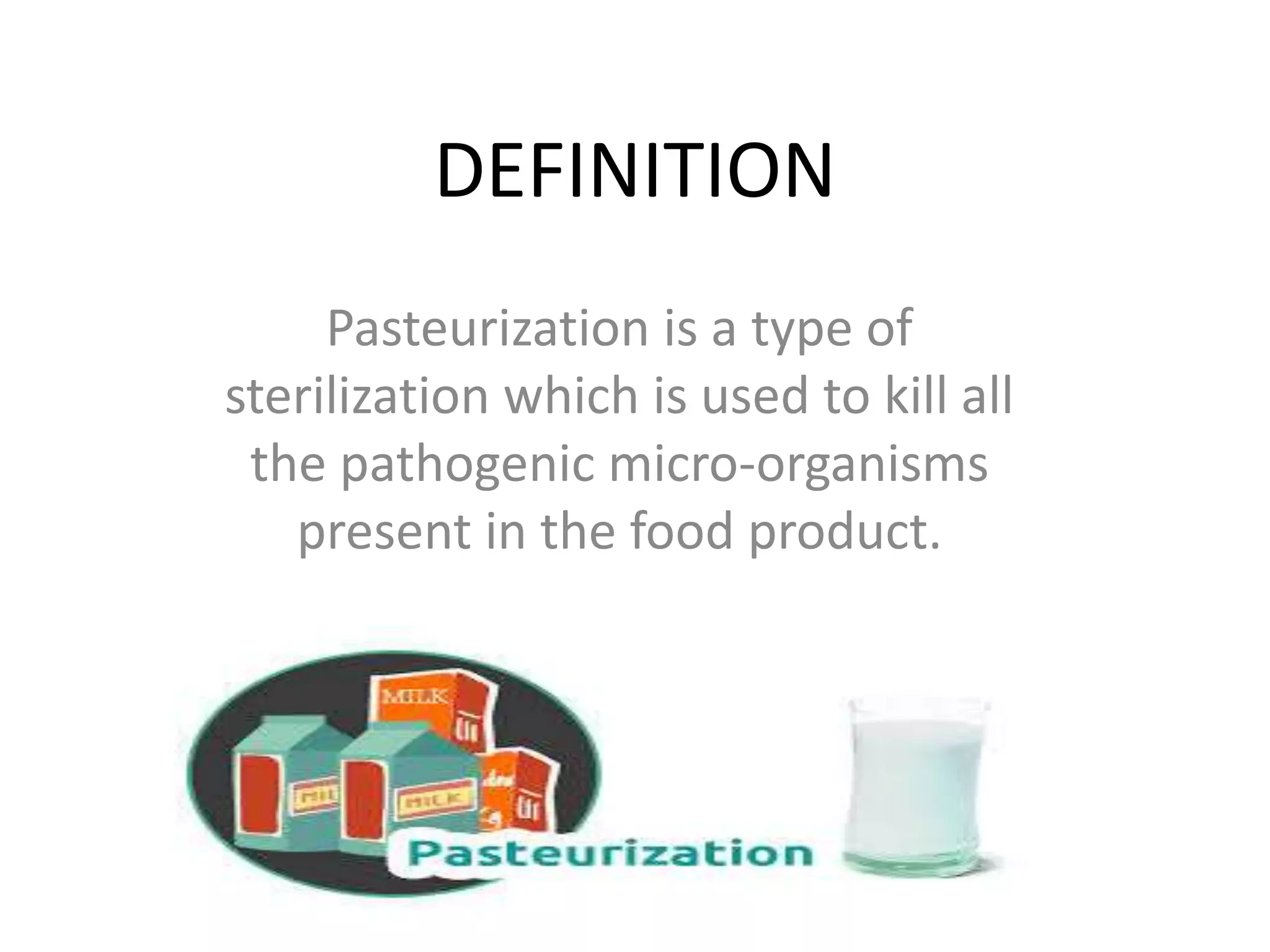
Pasteurization is a type of
sterilization which is used to kill all
the pathogenic micro-organisms
present in the food product.
HISTORY OF PASTEURIZATION
• It was invented by French scientist Louis Pasteur during
the nineteenth century. In 1864 Pasteur discovered
that heating beer and wine was enough to kill most of
the bacteria that caused spoilage, preventing these
beverages from turning sour. The process achieves this
by eliminating pathogenic microbes and lowering
microbial numbers to prolong the quality of the
beverage. Today, pasteurization is used widely in
the dairy industry and other food processing industries
to achieve food preservation and food safety.
METHOD OF PASTEURIZATION
HTST (High Temperature Short Time )
LTLT(Low Temperature long time)
UHT(Ultra High Temperature)
LTST
The batch method uses a vat pasteurizer which
consists of a jacketed vat surrounded by either
circulating water, steam or heating coils of water or
steam. In the batch method, fluid milk is placed in a vat
pasteurizer, which consists of a vat surrounded by
either circulating water, steam or heating coils of water
or steam. To cool the milk, either the milk is allowed to
cool in the vat or the milk is removed from the vat..
 The batch or low-temp-long-time or holder
pasteurization (LTLT) process is the traditional method
of pasteurizing milk
 In the vat the milk is heated to 62.8 C and held for
30 minutes followed by rapid cooling.
HTST
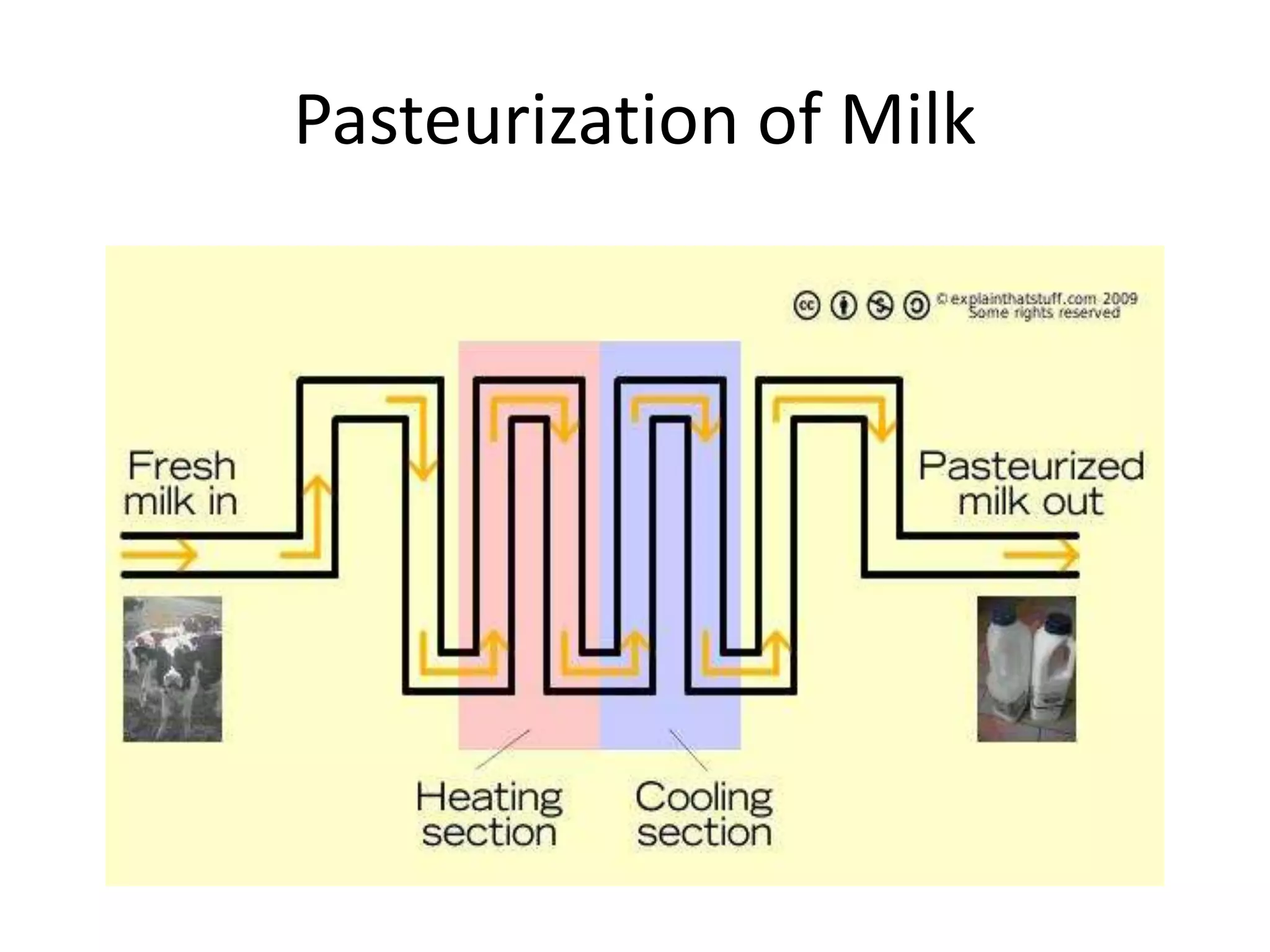
In the continuous flow for high temperature, short time is
flash-heating milk is forced between metal plates or through
pipes heated on the outside by hot water. While flowing under
pressure, the milk is held at 72°C for at least 15 seconds.
Before being chilled back to 4°C or cooler, it flows through a
heat exchanger to pre-warm cold milk just entering the system.
(HTST) pasteurized milk typically has a refrigerated shelf of
two to three weeks (HTST) cause less damage to the nutrient
composition and sensory characteristics of foods than do the
low-temperature, long-time treatments.
This is better than the old way at preserving the nutrients and
quality of foods
HTST plate pasteurizer from 72°C (162°F) to 95°C (203°F)
For 15 seconds..
UHT
• Ultra-high temperature processing (UHT)
sterilizes food by heating it above 135 °C
(275 °F) – the temperature required to
kill spores in milk – for 1 to 2 seconds.UHT is
most commonly used in milk production, but
the process is also used for fruit juices, cream,
soy milk, yogurt, wine, soups, honey, and
stews.UHT milk was first developed in the
1960s and became generally available for
consumption in the 1970s.
OTHER PROCESSES USED TO
PASTEURIZED FOODS
• Ultra pasteurization - This involves the heating of milk and
cream to at least 280° F (138° C) for at least 2 seconds, but
because of less stringent packaging, they must be
refrigerated. The shelf life of milk is extended 60 to 90
days.
• Steam Pasteurization- This system used a chamber that
exposes the beef to pressurized steam for approximately 6
to 8 seconds. The steam raises the surface temperature of
the carcasses to 190° to 200° F (88° to 93°C).
• Irradiation Pasteurization - Foods, such as poultry, red meat,
spices, and fruits and vegetables, are subjected to small
amounts of gamma rays. This process effectively controls
vegetative bacteria and parasitic foodborne pathogens and
increases the storage time of foods.
Different types of foods pasteurization
• Dried Eggs - If eggs are sold dried, the egg white with the
glucose removed is normally heat-treated in the container
by holding it for 7 days in a hot room at a minimum
temperature of 130°F (54°C).
• Whole Eggs Pasteurized in the Shell - Traditionally, eggs
sold to customers in the shell have not been pasteurized.
Egg whites coagulate at 140°F (60°C). Therefore, heating
an egg above 140°F would cook the egg.
• Milk - Pasteurization improves the quality of milk and milk
products and gives them a longer shelf life by destroying
undesirable enzymes and spoilage bacteria. For example,
the liquid is heated to 145°F (63°C) for at least 30 minutes
or at least 161°F (72°C) for 15 seconds.
Pasteurization of Milk
Pasteurization of Fruit Juice
• Pasteurization is a process by which foods are heated to a specific
temperature for a specific amount of time to kill (or deactivate) a
target number of potentially harmful bacteria. Many different
products sold in the supermarket may be pasteurized, including
milk, fruit juices, almonds, cider, and beer.
• The United States Food and Drug Administration (FDA), through its
Center for Food Safety and Applied Nutrition (CFSAN), sets detailed
guidelines for the pasteurization of fruit juices. For example, for
apple juices with a pH level of 4.0 or lower, the FDA recommends
heating processes that "achieve a 5-log reduction for oocysts of
Cryptosporidium parvum ." These heating processes vary in length
of time from 0.3 to 6.0 seconds, with heating temperatures
between 160-180°F.
PASTEURIZATION OF EGG
Pasteurized eggs are eggs that have
been pasteurized in order to reduce the risk of
food-borne illness in dishes that are not
cooked or are only lightly cooked. They may
be sold as liquid egg products
or pasteurized in the shell.
PASTEURIZATION OF CURD
• The cheeses that were characterized by the
scalding of curd in hot whey were
manufactured from raw or pasteurized milk
and the curds were scalded in hot whey at 60,
70, 80 or 90 °C. Differences in the levels of pH
4.6-soluble nitrogen between cheeses were
significant (P < 0.05) after 30 days of ripening
CONSUMER ACCEPTANCE
• Although pasteurization has been practiced for a
long time, some consumers contend that they
should have the right to buy and sell
unpasteurized milk if they want to.
• Some consumers also point out that government-
enforced pasteurization law has been used as a
tool for large business to shut out competition
from smaller producers. See the case of the FDA's
shut down of Good flow Juice in 2008
PRODUCTS THAT ARE COMMONLY
PASTEURIZED
• BEER
• EGG
• WINE
• MEAT
• VINEGAR
• JUICE
• WATER
• DIARY PRODUCT
• SYRUP
THANK
YOU


Pasteurization of various food products

  • 1.
  • 2.
    DEFINITION Pasteurization is atype of sterilization which is used to kill all the pathogenic micro-organisms present in the food product.
  • 3.
    HISTORY OF PASTEURIZATION •It was invented by French scientist Louis Pasteur during the nineteenth century. In 1864 Pasteur discovered that heating beer and wine was enough to kill most of the bacteria that caused spoilage, preventing these beverages from turning sour. The process achieves this by eliminating pathogenic microbes and lowering microbial numbers to prolong the quality of the beverage. Today, pasteurization is used widely in the dairy industry and other food processing industries to achieve food preservation and food safety.
  • 4.
    METHOD OF PASTEURIZATION HTST(High Temperature Short Time ) LTLT(Low Temperature long time) UHT(Ultra High Temperature)
  • 5.
    LTST The batch methoduses a vat pasteurizer which consists of a jacketed vat surrounded by either circulating water, steam or heating coils of water or steam. In the batch method, fluid milk is placed in a vat pasteurizer, which consists of a vat surrounded by either circulating water, steam or heating coils of water or steam. To cool the milk, either the milk is allowed to cool in the vat or the milk is removed from the vat..  The batch or low-temp-long-time or holder pasteurization (LTLT) process is the traditional method of pasteurizing milk  In the vat the milk is heated to 62.8 C and held for 30 minutes followed by rapid cooling.
  • 6.
    HTST In the continuousflow for high temperature, short time is flash-heating milk is forced between metal plates or through pipes heated on the outside by hot water. While flowing under pressure, the milk is held at 72°C for at least 15 seconds. Before being chilled back to 4°C or cooler, it flows through a heat exchanger to pre-warm cold milk just entering the system. (HTST) pasteurized milk typically has a refrigerated shelf of two to three weeks (HTST) cause less damage to the nutrient composition and sensory characteristics of foods than do the low-temperature, long-time treatments. This is better than the old way at preserving the nutrients and quality of foods HTST plate pasteurizer from 72°C (162°F) to 95°C (203°F) For 15 seconds..
  • 7.
    UHT • Ultra-high temperatureprocessing (UHT) sterilizes food by heating it above 135 °C (275 °F) – the temperature required to kill spores in milk – for 1 to 2 seconds.UHT is most commonly used in milk production, but the process is also used for fruit juices, cream, soy milk, yogurt, wine, soups, honey, and stews.UHT milk was first developed in the 1960s and became generally available for consumption in the 1970s.
  • 8.
    OTHER PROCESSES USEDTO PASTEURIZED FOODS • Ultra pasteurization - This involves the heating of milk and cream to at least 280° F (138° C) for at least 2 seconds, but because of less stringent packaging, they must be refrigerated. The shelf life of milk is extended 60 to 90 days. • Steam Pasteurization- This system used a chamber that exposes the beef to pressurized steam for approximately 6 to 8 seconds. The steam raises the surface temperature of the carcasses to 190° to 200° F (88° to 93°C). • Irradiation Pasteurization - Foods, such as poultry, red meat, spices, and fruits and vegetables, are subjected to small amounts of gamma rays. This process effectively controls vegetative bacteria and parasitic foodborne pathogens and increases the storage time of foods.
  • 9.
    Different types offoods pasteurization • Dried Eggs - If eggs are sold dried, the egg white with the glucose removed is normally heat-treated in the container by holding it for 7 days in a hot room at a minimum temperature of 130°F (54°C). • Whole Eggs Pasteurized in the Shell - Traditionally, eggs sold to customers in the shell have not been pasteurized. Egg whites coagulate at 140°F (60°C). Therefore, heating an egg above 140°F would cook the egg. • Milk - Pasteurization improves the quality of milk and milk products and gives them a longer shelf life by destroying undesirable enzymes and spoilage bacteria. For example, the liquid is heated to 145°F (63°C) for at least 30 minutes or at least 161°F (72°C) for 15 seconds.
  • 10.
  • 11.
    Pasteurization of FruitJuice • Pasteurization is a process by which foods are heated to a specific temperature for a specific amount of time to kill (or deactivate) a target number of potentially harmful bacteria. Many different products sold in the supermarket may be pasteurized, including milk, fruit juices, almonds, cider, and beer. • The United States Food and Drug Administration (FDA), through its Center for Food Safety and Applied Nutrition (CFSAN), sets detailed guidelines for the pasteurization of fruit juices. For example, for apple juices with a pH level of 4.0 or lower, the FDA recommends heating processes that "achieve a 5-log reduction for oocysts of Cryptosporidium parvum ." These heating processes vary in length of time from 0.3 to 6.0 seconds, with heating temperatures between 160-180°F.
  • 12.
    PASTEURIZATION OF EGG Pasteurizedeggs are eggs that have been pasteurized in order to reduce the risk of food-borne illness in dishes that are not cooked or are only lightly cooked. They may be sold as liquid egg products or pasteurized in the shell.
  • 13.
    PASTEURIZATION OF CURD •The cheeses that were characterized by the scalding of curd in hot whey were manufactured from raw or pasteurized milk and the curds were scalded in hot whey at 60, 70, 80 or 90 °C. Differences in the levels of pH 4.6-soluble nitrogen between cheeses were significant (P < 0.05) after 30 days of ripening
  • 14.
    CONSUMER ACCEPTANCE • Althoughpasteurization has been practiced for a long time, some consumers contend that they should have the right to buy and sell unpasteurized milk if they want to. • Some consumers also point out that government- enforced pasteurization law has been used as a tool for large business to shut out competition from smaller producers. See the case of the FDA's shut down of Good flow Juice in 2008
  • 15.
    PRODUCTS THAT ARECOMMONLY PASTEURIZED • BEER • EGG • WINE • MEAT • VINEGAR • JUICE • WATER • DIARY PRODUCT • SYRUP
  • 16.