PASTEURIZATION
Modern legislation and development of
pasteurization
Microbes are found
all around us and
even inside our
bodies
The category
microbes includes a
variety of organisms
like bacteria , fungi,
viruses, algae etc
• Microbes are important in human culture
and health in many ways
Ferment foods
Treat sewage
Produce fuel, enzymes and
other bioactive compounds
Although many organisms are beneficial and
necessary for human well being, microbial activities
may have undesirable consequences such as food
spoilage and diseases
Therefore it is essential to be able to kill
microorganisms or inhibit their growth to
minimize their destructive effects
Microbial growth can be controlled either by
using physical or chemical agents
Heat is an excellent physical agent that controls
microbial growth
Many substances like milk are treated with
controlled heating at temperatures well below
boiling, a process known as pasteurization
WHAT IS PASTEURIZATION
 The heat treatment process that destroys
pathogenic microorganisms in certain
foods and beverages
It is named in honor of its developer
LOUIS PASTEUR
HISTORY
In 1860s French wine industry was plagued by the
problem of wine spoilage
Pasteur examined this spoiled wine under microscope
Microorganisms similar to the bacteria responsible for
lactic acid and acetic acid fermentations
Pasteur then discovered that a brief heating at 55- 600 C would
destroy these microorganisms and preserve wine for long periods
 In 1886 German chemist V.H.
and F.Soxhlet adapted the
technique for preserving milk and
reduce milk transmissible
diseases
WHY FOODS HAVE TO BE
PASTEURISED?
• It is necessary to protect the safety of our food supply by
eliminating some pathogens causing infection .
• To ensure a longer shelf life for the food
PASTEURIZATION OF MILK AND
MILK PRODUCTS
Due to moderate pH , good quality of nutrients, high
water content etc make milk an excellent nutrient for the
microbial growth
• The milk drawn from animals always contain
microorganisms
• Most bacteria came from dairy utensils, milking
machines, milk handlers and other similar sources
• The bacteria include streptococci, coliform etc
Pasteurization of milk kills harmful bacteria that
can lead to many diseases
In addition it retards the growth of spoilage
organisms, thereby increasing the shelf life
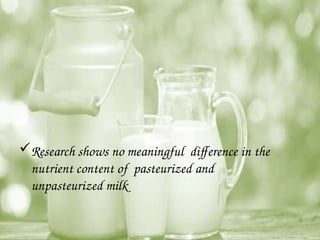
Research shows no meaningful difference in the
nutrient content of pasteurized and
unpasteurized milk
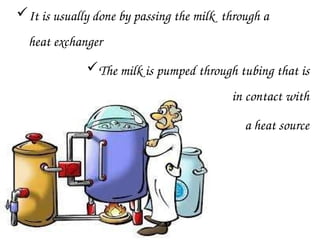
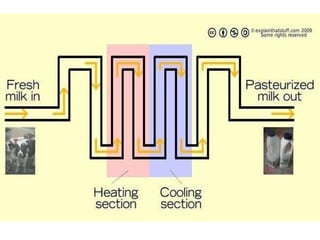
It is usually done by passing the milk through a
heat exchanger
The milk is pumped through tubing that is
in contact with
a heat source
LOW TEMPERATURE LONG
TIME PASEURIZATION (LTLT)
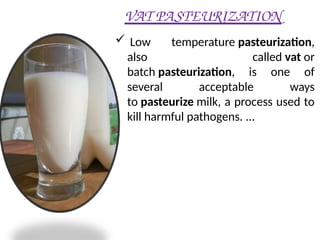
VAT PASTEURIZATION
 Low temperature pasteurization,
also called vat or
batch pasteurization, is one of
several acceptable ways
to pasteurize milk, a process used to
kill harmful pathogens. ...
• It’s clearly a safer choice than raw (unpasteurized) milk, which has
been the source of numerous outbreaks of foodborne illness over
the years.
• In regular pasteurization—the standard method used by large
dairy operations—milk is heated to high temperature for a short
time (161°F for 15 seconds).
• In vat pasteurization, milk is heated in small batches to a lower
temperature for a longer time (145°F for 30 minutes) and then
rapidly cooled. Flavor is better preserved, and usually the milk is
not homogenized, so that a layer of cream coats the top.
• Proponents of vat-pasteurized milk tout it as a healthier choice
than regular pasteurized milk because the processing is “gentler”
and thus preserves more potentially beneficial substances. It’s true
that heat can damage some proteins and other substances in milk.
• But according to Purdue University Cooperative Extension Service,
some milk proteins (including whey and casein) and bovine
lactoferrin (which has antibacterial properties) are heat-stable and
thus not affected by pasteurization.
• And any nutrient losses from any pasteurization, whether high-heat
or low-heat, are negligible.
• Such milk is used to prepare milk for culturing (cheese, yogurt,
etc), as it is the least destructive to milk’s proteins
• Average shelf life is 7 - 10 days.
•
HIGH TEMPERATURE/SHORT
TIME (HTST)
Also known as FLASH
PASTEURIZATION
 This is the most common form of pasteurization in
the dairy industry with about the same shelf life as
vat process.
 Treats foods and liquids at high temperatures for a
short amount of time
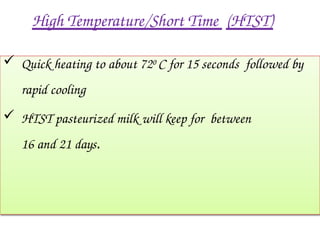
High Temperature/Short Time (HTST)
 Quick heating to about 720 C for 15 seconds followed by
rapid cooling
 HTST pasteurized milk will keep for between
16 and 21 days.
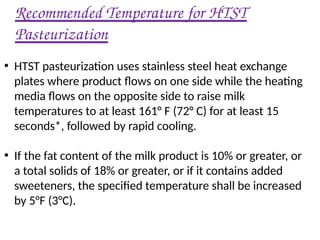
Recommended Temperature for HTST
Pasteurization
• HTST pasteurization uses stainless steel heat exchange
plates where product flows on one side while the heating
media flows on the opposite side to raise milk
temperatures to at least 161° F (72° C) for at least 15
seconds*, followed by rapid cooling.
• If the fat content of the milk product is 10% or greater, or
a total solids of 18% or greater, or if it contains added
sweeteners, the specified temperature shall be increased
by 5°F (3°C).
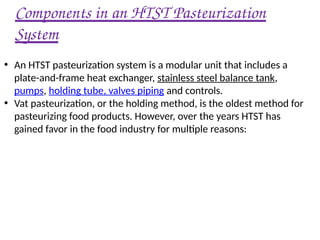
Components in an HTST Pasteurization
System
• An HTST pasteurization system is a modular unit that includes a
plate-and-frame heat exchanger, stainless steel balance tank,
pumps, holding tube, valves piping and controls.
• Vat pasteurization, or the holding method, is the oldest method for
pasteurizing food products. However, over the years HTST has
gained favor in the food industry for multiple reasons:
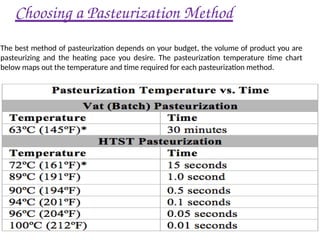
Choosing a Pasteurization Method
The best method of pasteurization depends on your budget, the volume of product you are
pasteurizing and the heating pace you desire. The pasteurization temperature time chart
below maps out the temperature and time required for each pasteurization method.
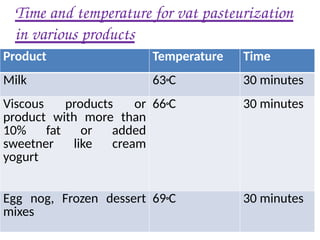
Time and temperature for vat pasteurization
in various products
Product Temperature Time
Milk 63°C 30 minutes
Viscous products or
product with more than
10% fat or added
sweetner like cream
yogurt
66°C 30 minutes
Egg nog, Frozen dessert
mixes
69°C 30 minutes
EQUIPMENT FOR HTST
PASTEURIZATION
ULTRA HIGH TEMPERATURE
PASTEURIZATION (UHT)
ULTRA HIGH TEMPERATURE
PASTEURIZATION
UTH processed milk does not require
refrigeration
Can be stored at room temperature for about 2
months without flavor changes
Heating at 140-1500 C for 1 -3 seconds
The product is packaged into sterile containers
This require maintaining a sterile environment
between processing and packaging adding complexity
to both the equipments and the plant
Steam Pasteurization
 Extremely effective at reducing or eliminating Pathogens,
Bacteria, and other food-borne sources of illness.
A special distribution plate that fluidizes the product to be
pasteurized, allowing all product surfaces to be treated equally.
Steam then condenses on the surface of the product, and the
condensation energy transfer kills unwanted pathogen or
bacteria.
RAW AND PASTEURIZED MILK
• Raw milk can come from cows, buffalo, sheep, and goats, although
the largest volume comes from cows. Pasteurized or market milk
includes whole, skim, low fat, and flavored milks, as well as cream,
which are heat treated (pasteurized) according to regulatory
specifications. Milk is high in proteins and carbohydrates (lactose),
which many microorganisms can utilize for growth. Because both
raw milk and pasteurized milk contain many types of bacteria as
predominant microorganisms, they are refrigerated; yet they have
limited shelf life.
• In raw milk, microorganisms come from inside the udder, animal
body surfaces, feed, air, water, and equipment used for milking and
storage. The predominant types from inside a healthy udder are
Micrococcus, Streptococcus, and Corynebacterium.
• Normally, raw milk contains <103
microorganisms/ml.
• If a cow has mastitis, Streptococcus agalactiae, Sta. aureus,
coliforms, and Pseudomonas can be excreted in relatively high
numbers. Contaminants from animals, feed, soil, and water
predominantly have lactic acid bacteria; coliforms;
Micrococcus, Staphylococcus, Enterococcus, Bacillus, and
Clostridium spores; and Gram-negative rods.
• Pathogens such as Salmonella, Lis. monocytogenes, Yer.
enterocolitica, and Cam. jejuni can also come from some of
these sources. Equipment can be a major source of
Gramnegative rods such as Pseudomonas, Alcaligenes, and
Flavobacterium, as well as Gram-positive Micrococcus and
Enterococcus.
• During refrigerated storage (at dairy farms and
processing plants) before pasteurization, only
psychrotrophs can grow in raw milk.

• They include Pseudomonas,Flavobacterium,
Alcaligenes, and some coliforms and Bacillus spp. They
can affect the acceptance quality of raw milk (e.g., by
making flavor and texture undesirable).
• Some of them can produce heat-stable enzymes
(proteinases and lipases), which can also affect the
product quality, even after pasteurization of raw milk
Psychrotrophic pathogens (Lis. monocytogenes and Yer.
enterocolitica) can multiply in refrigerated raw milk
during storage.
• Microbiological quality of raw and pasteurized milk is
monitored in many countries by regulatory agencies.
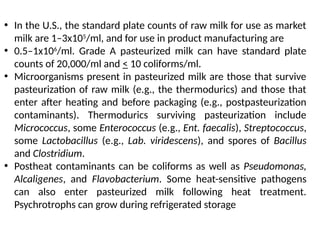
• In the U.S., the standard plate counts of raw milk for use as market
milk are 1–3x10⁵
/ml, and for use in product manufacturing are
• 0.5–1x10⁶
/ml. Grade A pasteurized milk can have standard plate
counts of 20,000/ml and < 10 coliforms/ml.
• Microorganisms present in pasteurized milk are those that survive
pasteurization of raw milk (e.g., the thermodurics) and those that
enter after heating and before packaging (e.g., postpasteurization
contaminants). Thermodurics surviving pasteurization include
Micrococcus, some Enterococcus (e.g., Ent. faecalis), Streptococcus,
some Lactobacillus (e.g., Lab. viridescens), and spores of Bacillus
and Clostridium.
• Postheat contaminants can be coliforms as well as Pseudomonas,
Alcaligenes, and Flavobacterium. Some heat-sensitive pathogens
can also enter pasteurized milk following heat treatment.
Psychrotrophs can grow during refrigerated storage
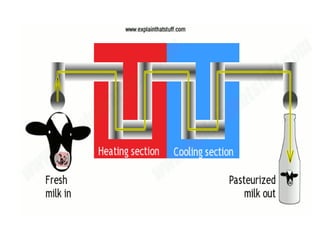
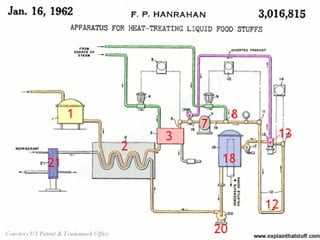
1. Cool raw milk enters through the float tank (1, yellow) on the left at a temperature of about
4–5°C (40°F).
2. It flows through a heat exchanger called a regenerator (2, gray), passing close to pasteurized
milk that's flowing outward. The two milk pipes exchange their heat: the incoming milk is
warmed up to about 38°C (100°F), the outgoing milk is cooled down.
3. The now-warmed milk passes through a pre-heater (red, 3), fed by one of the steam pipes
(green), and warms to 54°C (130°F).
4. Now the milk enters the pasteurizing loop (marked out by 7, 8, 12, and 13). It's moved along
by a pump (7), more steam is injected (8) to heat it to 72°C (161°F), and it flows around a
long loop (12) for 15 seconds to keep it at that temperature long enough for pasteurization
to occur.
5. At point 13, a valve detects whether the milk is hot enough for pasteurization. If not, it's
diverted up around the purple loop and back around the circuit until it is.
6. Once the milk has been successfully pasteurized, it flows into a separator (18), still at 72°C,
161°F, where it's flash cooled to about 53°C (128°F) and deodorized.
7. A pump (20) sends the partly cooled milk through the regenerator (2), so it cools further to
7°C (45°F) as it gives up its heat to incoming milk.
8. A refrigeration unit (21) chills it to its final temperature for bottling and/or longer-term
storage.
THANK YOU

lec 2.pasteurization.pdf pasteurization 1234ion

  • 1.
    PASTEURIZATION Modern legislation anddevelopment of pasteurization
  • 2.
    Microbes are found allaround us and even inside our bodies The category microbes includes a variety of organisms like bacteria , fungi, viruses, algae etc
  • 3.
    • Microbes areimportant in human culture and health in many ways Ferment foods Treat sewage Produce fuel, enzymes and other bioactive compounds
  • 4.
    Although many organismsare beneficial and necessary for human well being, microbial activities may have undesirable consequences such as food spoilage and diseases
  • 5.
    Therefore it isessential to be able to kill microorganisms or inhibit their growth to minimize their destructive effects Microbial growth can be controlled either by using physical or chemical agents
  • 6.
    Heat is anexcellent physical agent that controls microbial growth Many substances like milk are treated with controlled heating at temperatures well below boiling, a process known as pasteurization
  • 7.
    WHAT IS PASTEURIZATION The heat treatment process that destroys pathogenic microorganisms in certain foods and beverages It is named in honor of its developer LOUIS PASTEUR
  • 8.
    HISTORY In 1860s Frenchwine industry was plagued by the problem of wine spoilage Pasteur examined this spoiled wine under microscope Microorganisms similar to the bacteria responsible for lactic acid and acetic acid fermentations
  • 9.
    Pasteur then discoveredthat a brief heating at 55- 600 C would destroy these microorganisms and preserve wine for long periods  In 1886 German chemist V.H. and F.Soxhlet adapted the technique for preserving milk and reduce milk transmissible diseases
  • 12.
    WHY FOODS HAVETO BE PASTEURISED? • It is necessary to protect the safety of our food supply by eliminating some pathogens causing infection . • To ensure a longer shelf life for the food
  • 13.
    PASTEURIZATION OF MILKAND MILK PRODUCTS Due to moderate pH , good quality of nutrients, high water content etc make milk an excellent nutrient for the microbial growth
  • 14.
    • The milkdrawn from animals always contain microorganisms • Most bacteria came from dairy utensils, milking machines, milk handlers and other similar sources • The bacteria include streptococci, coliform etc
  • 15.
    Pasteurization of milkkills harmful bacteria that can lead to many diseases In addition it retards the growth of spoilage organisms, thereby increasing the shelf life
  • 16.
    Research shows nomeaningful difference in the nutrient content of pasteurized and unpasteurized milk
  • 17.
    It is usuallydone by passing the milk through a heat exchanger The milk is pumped through tubing that is in contact with a heat source
  • 20.
    LOW TEMPERATURE LONG TIMEPASEURIZATION (LTLT)
  • 21.
    VAT PASTEURIZATION  Lowtemperature pasteurization, also called vat or batch pasteurization, is one of several acceptable ways to pasteurize milk, a process used to kill harmful pathogens. ...
  • 22.
    • It’s clearlya safer choice than raw (unpasteurized) milk, which has been the source of numerous outbreaks of foodborne illness over the years. • In regular pasteurization—the standard method used by large dairy operations—milk is heated to high temperature for a short time (161°F for 15 seconds). • In vat pasteurization, milk is heated in small batches to a lower temperature for a longer time (145°F for 30 minutes) and then rapidly cooled. Flavor is better preserved, and usually the milk is not homogenized, so that a layer of cream coats the top.
  • 23.
    • Proponents ofvat-pasteurized milk tout it as a healthier choice than regular pasteurized milk because the processing is “gentler” and thus preserves more potentially beneficial substances. It’s true that heat can damage some proteins and other substances in milk. • But according to Purdue University Cooperative Extension Service, some milk proteins (including whey and casein) and bovine lactoferrin (which has antibacterial properties) are heat-stable and thus not affected by pasteurization. • And any nutrient losses from any pasteurization, whether high-heat or low-heat, are negligible. • Such milk is used to prepare milk for culturing (cheese, yogurt, etc), as it is the least destructive to milk’s proteins • Average shelf life is 7 - 10 days. •
  • 24.
  • 25.
    Also known asFLASH PASTEURIZATION  This is the most common form of pasteurization in the dairy industry with about the same shelf life as vat process.  Treats foods and liquids at high temperatures for a short amount of time
  • 26.
    High Temperature/Short Time(HTST)  Quick heating to about 720 C for 15 seconds followed by rapid cooling  HTST pasteurized milk will keep for between 16 and 21 days.
  • 27.
    Recommended Temperature forHTST Pasteurization • HTST pasteurization uses stainless steel heat exchange plates where product flows on one side while the heating media flows on the opposite side to raise milk temperatures to at least 161° F (72° C) for at least 15 seconds*, followed by rapid cooling. • If the fat content of the milk product is 10% or greater, or a total solids of 18% or greater, or if it contains added sweeteners, the specified temperature shall be increased by 5°F (3°C).
  • 28.
    Components in anHTST Pasteurization System • An HTST pasteurization system is a modular unit that includes a plate-and-frame heat exchanger, stainless steel balance tank, pumps, holding tube, valves piping and controls. • Vat pasteurization, or the holding method, is the oldest method for pasteurizing food products. However, over the years HTST has gained favor in the food industry for multiple reasons:
  • 29.
    Choosing a PasteurizationMethod The best method of pasteurization depends on your budget, the volume of product you are pasteurizing and the heating pace you desire. The pasteurization temperature time chart below maps out the temperature and time required for each pasteurization method.
  • 30.
    Time and temperaturefor vat pasteurization in various products Product Temperature Time Milk 63°C 30 minutes Viscous products or product with more than 10% fat or added sweetner like cream yogurt 66°C 30 minutes Egg nog, Frozen dessert mixes 69°C 30 minutes
  • 31.
  • 32.
  • 33.
    ULTRA HIGH TEMPERATURE PASTEURIZATION UTHprocessed milk does not require refrigeration Can be stored at room temperature for about 2 months without flavor changes Heating at 140-1500 C for 1 -3 seconds
  • 34.
    The product ispackaged into sterile containers This require maintaining a sterile environment between processing and packaging adding complexity to both the equipments and the plant
  • 35.
    Steam Pasteurization  Extremelyeffective at reducing or eliminating Pathogens, Bacteria, and other food-borne sources of illness. A special distribution plate that fluidizes the product to be pasteurized, allowing all product surfaces to be treated equally. Steam then condenses on the surface of the product, and the condensation energy transfer kills unwanted pathogen or bacteria.
  • 36.
    RAW AND PASTEURIZEDMILK • Raw milk can come from cows, buffalo, sheep, and goats, although the largest volume comes from cows. Pasteurized or market milk includes whole, skim, low fat, and flavored milks, as well as cream, which are heat treated (pasteurized) according to regulatory specifications. Milk is high in proteins and carbohydrates (lactose), which many microorganisms can utilize for growth. Because both raw milk and pasteurized milk contain many types of bacteria as predominant microorganisms, they are refrigerated; yet they have limited shelf life. • In raw milk, microorganisms come from inside the udder, animal body surfaces, feed, air, water, and equipment used for milking and storage. The predominant types from inside a healthy udder are Micrococcus, Streptococcus, and Corynebacterium.
  • 37.
    • Normally, rawmilk contains <103 microorganisms/ml. • If a cow has mastitis, Streptococcus agalactiae, Sta. aureus, coliforms, and Pseudomonas can be excreted in relatively high numbers. Contaminants from animals, feed, soil, and water predominantly have lactic acid bacteria; coliforms; Micrococcus, Staphylococcus, Enterococcus, Bacillus, and Clostridium spores; and Gram-negative rods. • Pathogens such as Salmonella, Lis. monocytogenes, Yer. enterocolitica, and Cam. jejuni can also come from some of these sources. Equipment can be a major source of Gramnegative rods such as Pseudomonas, Alcaligenes, and Flavobacterium, as well as Gram-positive Micrococcus and Enterococcus.
  • 38.
    • During refrigeratedstorage (at dairy farms and processing plants) before pasteurization, only psychrotrophs can grow in raw milk. • They include Pseudomonas,Flavobacterium, Alcaligenes, and some coliforms and Bacillus spp. They can affect the acceptance quality of raw milk (e.g., by making flavor and texture undesirable). • Some of them can produce heat-stable enzymes (proteinases and lipases), which can also affect the product quality, even after pasteurization of raw milk Psychrotrophic pathogens (Lis. monocytogenes and Yer. enterocolitica) can multiply in refrigerated raw milk during storage. • Microbiological quality of raw and pasteurized milk is monitored in many countries by regulatory agencies.
  • 39.
    • In theU.S., the standard plate counts of raw milk for use as market milk are 1–3x10⁵ /ml, and for use in product manufacturing are • 0.5–1x10⁶ /ml. Grade A pasteurized milk can have standard plate counts of 20,000/ml and < 10 coliforms/ml. • Microorganisms present in pasteurized milk are those that survive pasteurization of raw milk (e.g., the thermodurics) and those that enter after heating and before packaging (e.g., postpasteurization contaminants). Thermodurics surviving pasteurization include Micrococcus, some Enterococcus (e.g., Ent. faecalis), Streptococcus, some Lactobacillus (e.g., Lab. viridescens), and spores of Bacillus and Clostridium. • Postheat contaminants can be coliforms as well as Pseudomonas, Alcaligenes, and Flavobacterium. Some heat-sensitive pathogens can also enter pasteurized milk following heat treatment. Psychrotrophs can grow during refrigerated storage
  • 42.
    1. Cool rawmilk enters through the float tank (1, yellow) on the left at a temperature of about 4–5°C (40°F). 2. It flows through a heat exchanger called a regenerator (2, gray), passing close to pasteurized milk that's flowing outward. The two milk pipes exchange their heat: the incoming milk is warmed up to about 38°C (100°F), the outgoing milk is cooled down. 3. The now-warmed milk passes through a pre-heater (red, 3), fed by one of the steam pipes (green), and warms to 54°C (130°F). 4. Now the milk enters the pasteurizing loop (marked out by 7, 8, 12, and 13). It's moved along by a pump (7), more steam is injected (8) to heat it to 72°C (161°F), and it flows around a long loop (12) for 15 seconds to keep it at that temperature long enough for pasteurization to occur. 5. At point 13, a valve detects whether the milk is hot enough for pasteurization. If not, it's diverted up around the purple loop and back around the circuit until it is. 6. Once the milk has been successfully pasteurized, it flows into a separator (18), still at 72°C, 161°F, where it's flash cooled to about 53°C (128°F) and deodorized. 7. A pump (20) sends the partly cooled milk through the regenerator (2), so it cools further to 7°C (45°F) as it gives up its heat to incoming milk. 8. A refrigeration unit (21) chills it to its final temperature for bottling and/or longer-term storage.
  • 43.