PRINCIPLES OF FOOD
PRESERVATION
Dr Vandana Mahajani
1
Importance of food preservation
1 Elimination of microbes
2 Increasing shelf life of food
3 Making seasonal fruits available to them
throughout the year
4 Adding variety to the diet
5 Saving time and energy
6 Improving nutritional value of foods
7 Controlling prices
2
All foods undergo
deterioration/ spoilage
after harvest to some
degree
Role of food sciences is
to minimize negative
changes to the extent
possible
3
Factors affecting microbial spoilage
Intrinsic factors (Factors related
to the food itself)
Extrinsic factors
(Environmental conditions where
the food is stored)
4
Intrinsic factors
.pH
.Moisture content
.Water activity
.Oxidation-reduction
potential
.Physical structure of
the food
.Available nutrients
.Presence of 5
Extrinsic factors
.Temperature
.Relative humidity
.Gases (CO2, O2) present
.Types and numbers of
microorganisms
present in the food
6
Principles of food preservation
Preventing entry of microbes can be done by
1 Asepsis- packaging the food in cans or airtight
containers
2 Filteration- used to filter liquids like juices water
and alcoholic beverages
3 creating conditions by which the microbes in the
food do not grow like freezing, drying etc.
7
Microorganisms in Food
 Water availability
– in general, lower water activity inhibits microbial
growth
– water activity lowered by:
• drying
• addition of salt or sugar
– osmophilic microorganisms
• prefer high osmotic pressure
– xerophilic microorganisms
• prefer low water activity
8
Techniques of food preservation
1. Physical preservation- heat and radiation are
used to control the growth of microbes
2. Chemical preservation- potassium meta bi
sulphite and sodium benzoate , salt, sugar ,
lemon and vinegar are used to carry out
chemical reaction in food to retard microbial
action
3. Biological preservation- microbial growth is
encouraged so as to carry out fermentation to
preserve foods 9
Microorganisms in Food
 Antimicrobial substances
– coumarins – fruits and vegetables
– lysozyme – cow’s milk and eggs
– aldehydic and phenolic compounds –
herbs and spices
– allicin – garlic
– polyphenols – green and black teas
10
Extrinsic Factors
 temperature
– lower temperatures retard microbial growth
 relative humidity
– higher levels promote microbial growth
 atmosphere
– oxygen promotes growth
– modified atmosphere packaging (MAP)
• use of shrink wrap and vacuum technologies to
package food in controlled atmospheres
11
Methods of Food Preservation
Heat
most bacteria are killed at 82-93o
C, but
spores are not
121o
C wet heat for 15 minutes is required
to ensure sterility
high acid foods require less heat
in milk, only disease-causing organisms
are killed to reduce the severity of heat
required 12
 Pasteurization
– kills pathogens and substantially reduces
number of spoilage organisms
– different pasteurization procedures heat for
different lengths of time
– shorter heating times result in improved
flavor
13
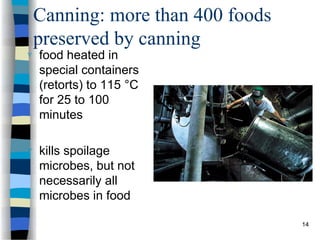
Canning: more than 400 foods
preserved by canning
 food heated in
special containers
(retorts) to 115 °C
for 25 to 100
minutes
 kills spoilage
microbes, but not
necessarily all
microbes in food
14
Syrups and Brine
 Helps fill spaces between canned foods
and adds flavour to foods.
 Principle sugars used are sucrose and
dextorse
 Dilute salt solution with 1-2% salt is
used in canneries for vegetables
15
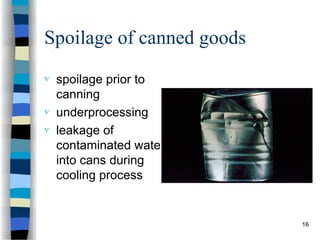
Spoilage of canned goods
 spoilage prior to
canning
 underprocessing
 leakage of
contaminated water
into cans during
cooling process
16
Blanching
 Hot water or
steam scald is
given.
 Drives out gases
and surface
material
17
Preservation Techniques…...
Cold
under 10o
C, microbial growth is slow
frozen food (<-10o
C) usually does not have
any free water
frozen food also benefits from low water
activity to help protect against microbial growth
freezing may kill some, but not all
microorganisms, but growth is slowed or
stopped
18
Food Preservation
 Low Temperature
– refrigeration at 5°C retards but does not
stop microbial growth
– microorganisms can still cause spoilage
with extended spoilage
– growth at temperatures below -10°C has
been observed
– Food should not be re-frozen after thawing
19
Preservation Techniques…...
Drying
dehydrating food also dehydrates the
microorganisms which contain approx. 80%
moisture
Mostly used for meat, however fruits and
vegetables also dried.
Cutting veg, blanching or
scalding( inactivates the enzymes), drying
( steam, air , vaccum or inert gas) and
packing.
20
Preservation Techniques…...
Sugar & Salt
Addition of either to a food item
increases the affinity of the food
for water, thereby removing
water from the microorganism
through osmosis
21
Preservation Techniques…...
Acidification
acids may be in foods naturally,
produced by fermentation, or added
artificially
as pH decreases, heat required for
sterilization is reduced
Lactic acid fermentation used in
preparation of cheese ripening, corn,
pickles, peas, beans, olives
22
Preservation Techniques…...
Smoke
Contains formaldehyde and other
preservatives
Heat will help reduce microbial
populations and somewhat dries
the food
23
Preservation Techniques…...
Atmosphere
Exclude air (O2) for control of
aerobes
Provide air (O2) for control of
anaerobes
Add CO2
Add N2
24
Food Preservation
 Removal of Microorganisms
– usually achieved by filtration
– commonly used for water, beer, wine,
juices, soft drinks, and other liquids
25
Chemical preservatives
 Propionates of calcium and sodium
 Added to dough to prevent growth of
mould and increase shelf life of food
 Sorbates potassium salt of sorbic acids
added to acidic food to control growth of
fungi or yeasts in apple juice. Wrappers
of cheese also made of this.
26
 Benzoates used to preserve acid
products just like sorbates
 Citric, lactic, acetic and phosphoric
acids. They are used a s acidulants in
food . Acetic acid and lactic acids have
the greatest preserving power
 Sodium chloride salt is added to presrve
meats specially
27
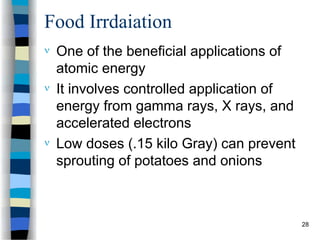
Food Irrdaiation
 One of the beneficial applications of
atomic energy
 It involves controlled application of
energy from gamma rays, X rays, and
accelerated electrons
 Low doses (.15 kilo Gray) can prevent
sprouting of potatoes and onions
28
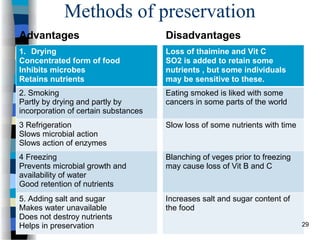
Methods of preservation
Advantages
1. Drying
Concentrated form of food
Inhibits microbes
Retains nutrients
2. Smoking
Partly by drying and partly by
incorporation of certain substances
3 Refrigeration
Slows microbial action
Slows action of enzymes
4 Freezing
Prevents microbial growth and
availability of water
Good retention of nutrients
5. Adding salt and sugar
Makes water unavailable
Does not destroy nutrients
Helps in preservation
Disadvantages
Loss of thaimine and Vit C
SO2 is added to retain some
nutrients , but some individuals
may be sensitive to these.
Eating smoked is liked with some
cancers in some parts of the world
Slow loss of some nutrients with time
Blanching of veges prior to freezing
may cause loss of Vit B and C
Increases salt and sugar content of
the food
29
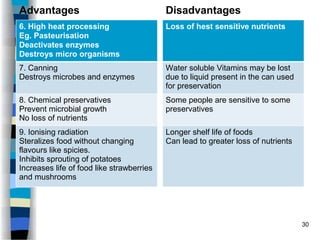
Advantages
6. High heat processing
Eg. Pasteurisation
Deactivates enzymes
Destroys micro organisms
7. Canning
Destroys microbes and enzymes
8. Chemical preservatives
Prevent microbial growth
No loss of nutrients
9. Ionising radiation
Steralizes food without changing
flavours like spicies.
Inhibits sprouting of potatoes
Increases life of food like strawberries
and mushrooms
Disadvantages
Loss of hest sensitive nutrients
Water soluble Vitamins may be lost
due to liquid present in the can used
for preservation
Some people are sensitive to some
preservatives
Longer shelf life of foods
Can lead to greater loss of nutrients
30

Food preservation

  • 1.
  • 2.
    Importance of foodpreservation 1 Elimination of microbes 2 Increasing shelf life of food 3 Making seasonal fruits available to them throughout the year 4 Adding variety to the diet 5 Saving time and energy 6 Improving nutritional value of foods 7 Controlling prices 2
  • 3.
    All foods undergo deterioration/spoilage after harvest to some degree Role of food sciences is to minimize negative changes to the extent possible 3
  • 4.
    Factors affecting microbialspoilage Intrinsic factors (Factors related to the food itself) Extrinsic factors (Environmental conditions where the food is stored) 4
  • 5.
    Intrinsic factors .pH .Moisture content .Wateractivity .Oxidation-reduction potential .Physical structure of the food .Available nutrients .Presence of 5
  • 6.
    Extrinsic factors .Temperature .Relative humidity .Gases(CO2, O2) present .Types and numbers of microorganisms present in the food 6
  • 7.
    Principles of foodpreservation Preventing entry of microbes can be done by 1 Asepsis- packaging the food in cans or airtight containers 2 Filteration- used to filter liquids like juices water and alcoholic beverages 3 creating conditions by which the microbes in the food do not grow like freezing, drying etc. 7
  • 8.
    Microorganisms in Food Water availability – in general, lower water activity inhibits microbial growth – water activity lowered by: • drying • addition of salt or sugar – osmophilic microorganisms • prefer high osmotic pressure – xerophilic microorganisms • prefer low water activity 8
  • 9.
    Techniques of foodpreservation 1. Physical preservation- heat and radiation are used to control the growth of microbes 2. Chemical preservation- potassium meta bi sulphite and sodium benzoate , salt, sugar , lemon and vinegar are used to carry out chemical reaction in food to retard microbial action 3. Biological preservation- microbial growth is encouraged so as to carry out fermentation to preserve foods 9
  • 10.
    Microorganisms in Food Antimicrobial substances – coumarins – fruits and vegetables – lysozyme – cow’s milk and eggs – aldehydic and phenolic compounds – herbs and spices – allicin – garlic – polyphenols – green and black teas 10
  • 11.
    Extrinsic Factors  temperature –lower temperatures retard microbial growth  relative humidity – higher levels promote microbial growth  atmosphere – oxygen promotes growth – modified atmosphere packaging (MAP) • use of shrink wrap and vacuum technologies to package food in controlled atmospheres 11
  • 12.
    Methods of FoodPreservation Heat most bacteria are killed at 82-93o C, but spores are not 121o C wet heat for 15 minutes is required to ensure sterility high acid foods require less heat in milk, only disease-causing organisms are killed to reduce the severity of heat required 12
  • 13.
     Pasteurization – killspathogens and substantially reduces number of spoilage organisms – different pasteurization procedures heat for different lengths of time – shorter heating times result in improved flavor 13
  • 14.
    Canning: more than400 foods preserved by canning  food heated in special containers (retorts) to 115 °C for 25 to 100 minutes  kills spoilage microbes, but not necessarily all microbes in food 14
  • 15.
    Syrups and Brine Helps fill spaces between canned foods and adds flavour to foods.  Principle sugars used are sucrose and dextorse  Dilute salt solution with 1-2% salt is used in canneries for vegetables 15
  • 16.
    Spoilage of cannedgoods  spoilage prior to canning  underprocessing  leakage of contaminated water into cans during cooling process 16
  • 17.
    Blanching  Hot wateror steam scald is given.  Drives out gases and surface material 17
  • 18.
    Preservation Techniques…... Cold under 10o C,microbial growth is slow frozen food (<-10o C) usually does not have any free water frozen food also benefits from low water activity to help protect against microbial growth freezing may kill some, but not all microorganisms, but growth is slowed or stopped 18
  • 19.
    Food Preservation  LowTemperature – refrigeration at 5°C retards but does not stop microbial growth – microorganisms can still cause spoilage with extended spoilage – growth at temperatures below -10°C has been observed – Food should not be re-frozen after thawing 19
  • 20.
    Preservation Techniques…... Drying dehydrating foodalso dehydrates the microorganisms which contain approx. 80% moisture Mostly used for meat, however fruits and vegetables also dried. Cutting veg, blanching or scalding( inactivates the enzymes), drying ( steam, air , vaccum or inert gas) and packing. 20
  • 21.
    Preservation Techniques…... Sugar &Salt Addition of either to a food item increases the affinity of the food for water, thereby removing water from the microorganism through osmosis 21
  • 22.
    Preservation Techniques…... Acidification acids maybe in foods naturally, produced by fermentation, or added artificially as pH decreases, heat required for sterilization is reduced Lactic acid fermentation used in preparation of cheese ripening, corn, pickles, peas, beans, olives 22
  • 23.
    Preservation Techniques…... Smoke Contains formaldehydeand other preservatives Heat will help reduce microbial populations and somewhat dries the food 23
  • 24.
    Preservation Techniques…... Atmosphere Exclude air(O2) for control of aerobes Provide air (O2) for control of anaerobes Add CO2 Add N2 24
  • 25.
    Food Preservation  Removalof Microorganisms – usually achieved by filtration – commonly used for water, beer, wine, juices, soft drinks, and other liquids 25
  • 26.
    Chemical preservatives  Propionatesof calcium and sodium  Added to dough to prevent growth of mould and increase shelf life of food  Sorbates potassium salt of sorbic acids added to acidic food to control growth of fungi or yeasts in apple juice. Wrappers of cheese also made of this. 26
  • 27.
     Benzoates usedto preserve acid products just like sorbates  Citric, lactic, acetic and phosphoric acids. They are used a s acidulants in food . Acetic acid and lactic acids have the greatest preserving power  Sodium chloride salt is added to presrve meats specially 27
  • 28.
    Food Irrdaiation  Oneof the beneficial applications of atomic energy  It involves controlled application of energy from gamma rays, X rays, and accelerated electrons  Low doses (.15 kilo Gray) can prevent sprouting of potatoes and onions 28
  • 29.
    Methods of preservation Advantages 1.Drying Concentrated form of food Inhibits microbes Retains nutrients 2. Smoking Partly by drying and partly by incorporation of certain substances 3 Refrigeration Slows microbial action Slows action of enzymes 4 Freezing Prevents microbial growth and availability of water Good retention of nutrients 5. Adding salt and sugar Makes water unavailable Does not destroy nutrients Helps in preservation Disadvantages Loss of thaimine and Vit C SO2 is added to retain some nutrients , but some individuals may be sensitive to these. Eating smoked is liked with some cancers in some parts of the world Slow loss of some nutrients with time Blanching of veges prior to freezing may cause loss of Vit B and C Increases salt and sugar content of the food 29
  • 30.
    Advantages 6. High heatprocessing Eg. Pasteurisation Deactivates enzymes Destroys micro organisms 7. Canning Destroys microbes and enzymes 8. Chemical preservatives Prevent microbial growth No loss of nutrients 9. Ionising radiation Steralizes food without changing flavours like spicies. Inhibits sprouting of potatoes Increases life of food like strawberries and mushrooms Disadvantages Loss of hest sensitive nutrients Water soluble Vitamins may be lost due to liquid present in the can used for preservation Some people are sensitive to some preservatives Longer shelf life of foods Can lead to greater loss of nutrients 30