Pasteurization
is
good or bad.
SUBMITTED TO:
DEPARTMENT OF ZOOLOGY
SUBMITTED BY:
• NAME:DEVARSH KUMAR
1
PASTEURIZATION
 Pasteurization is the process of heating usually
to less than 100 °C (212 °F), and then rapidly
cooling, liquids or food in order to reduce the
number of microbes that may expedite their
spoilage or cause disease.
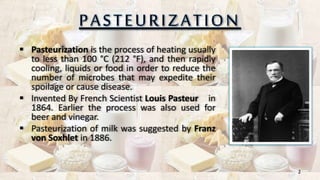
 Invented By French Scientist Louis Pasteur in
1864. Earlier the process was also used for
beer and vinegar.
 Pasteurization of milk was suggested by Franz
von Soxhlet in 1886.
2
MAJOR PASTEURIZATION
TECHNIQUES
LTLT
LOW TEMPERATURE
L O N G T I M E
H T S T
HIGH TEMPERATURE
S H O R T T I M E
U H T
U L T R A H I G H
T E M P E R A T U R E
U L T R A
PASTEURIZATION
Also known as batch or
vat Pasteurization.
Milk is heated up to
62.8˚C for 30 min
followed by cooling
rapidly
Prolong holding of milk
alter its structure and
makes it suitable for
making yogurt.
•Milk is heated between
138˚C to 150 ˚C for 1-2
seconds , immediately chilled
and aseptically packed in an
air tight container.
•Can cause maillard browning
and alter taste and smell of
dairy products
• Also used for fruit juice,
cream , honey, soy milk,
yogurt etc
•Shelf life is about 6 to 9
months without refrigeration
Milk is heated for 138˚C for
2-4 seconds and chilled
immediately with less
stringent packing, they must
be refrigerated.
Shelf life is about 2-3
months.
Also known as Flash
Pasteurization.
Involves heating of milk at
71.7˚C(or 71-74˚C) for 15(15-
20)seconds and cooled to 4-
5.5˚C.
Used in pasteurizing fruit
juice, beers, wine, etc. the
juice is generally rapidly
heated to 197 °F for about 40
seconds.
It increases shelf life of milk
for 16 to 21 days.
3
Other PASTEURIZATION
TECHNIQUES
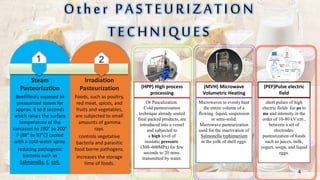
Steam
Pasteurization
Beef(flesh) exposed to
pressurized steam for
approx. 6 to 8 seconds
which raises the surface
temperature of the
carcasses to 190° to 200°
F (88° to 93°C) cooled
with a cold-water spray.
reducing pathogenic
bacteria such as
Salmonella, E. coli.
Irradiation
Pasteurization
Foods, such as poultry,
red meat, spices, and
fruits and vegetables,
are subjected to small
amounts of gamma
rays.
controls vegetative
bacteria and parasitic
food borne pathogens.
increases the storage
time of foods.
1 2
(HPP) High process
processing
Or Pascalization.
Cold pasteurization
technique already sealed
final packed products, are
introduced into a vessel
and subjected to
a high level of
isostatic pressure
(300–600MPa) for few
seconds to 20 mins.
transmitted by water.
(MVH) Microwave
Volumetric Heating
Microwaves to evenly heat
the entire volume of a
flowing liquid, suspension
or semi-solid.
Microwave pasteurization
used for the inactivation of
Salmonella typhimurium
in the yolk of shell eggs.
(PEF)Pulse electric
field
short pulses of high
electric fields for μs to
ms and intensity in the
order of 10-80 kV/cm ,
between a set of
electrodes.
pasteurization of foods
such as juices, milk,
yogurt, soups, and liquid
eggs.
4
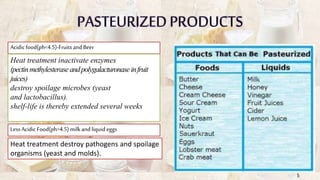
PASTEURIZED PRODUCTS
Acidicfood(ph<4.5)-Fruitsand Beer
Heat treatment inactivate enzymes
(pectinmethylesteraseandpolygalacturonaseinfruit
juices)
destroy spoilage microbes (yeast
and lactobacillus).
shelf-life is thereby extended several weeks
LessAcidicFood(ph>4.5) milkand liquid eggs
Heat treatment destroy pathogens and spoilage
organisms (yeast and molds).
5
Positive Effects
 It Prevents Diseases like typhoid, Salmonellosis , Q fever(Coxilla burnetti ) ,
Tuberculosis, etc.
 Increases shelf life of the products.
 Prevents spoilage of food products.
 Pasteurized water used to disinfect respiratory and anesthesia equipment.
 Elimination of volatile aroma compounds from certain foods.
 Exposure of fruits and vegetables to radiation slows their rate of ripening .
 HPP organoleptic properties that can be compromised when the food is heat treated.
 Inactivates enzymes like phosphatase and lipase which affect milk quality.
 Does not produce unpleasant cooked flavour.
 Helps in preservation of canned food.
6
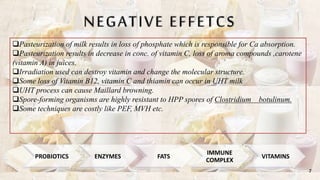
NEGATIVE EFFETCS
Pasteurization of milk results in loss of phosphate which is responsible for Ca absorption.
Pasteurization results in decrease in conc. of vitamin C, loss of aroma compounds ,carotene
(vitamin A) in juices.
Irradiation used can destroy vitamin and change the molecular structure.
Some loss of Vitamin B12, vitamin C and thiamin can occur in UHT milk
UHT process can cause Maillard browning.
Spore-forming organisms are highly resistant to HPP spores of Clostridium botulinum.
Some techniques are costly like PEF, MVH etc.
7
PROBIOTICS ENZYMES FATS
IMMUNE
COMPLEX
VITAMINS
Conclusion
• Pasteurization protects from many diseases.
• Preservation technique in dairy industry, brewing industry,etc.
• Increases shelf life of the products.
• Different techniques are used for different products.
• Some techniques are costly.
• Some important constituent are lost like proteins in milk (folacin).
• Pasteurization does not have significanteffect on food products.
• Raw products can cause diseases.
• Meet the demands.
8
BIBLIOGRAPHY
• https://www.verywellhealth.com/got-pasteurized-milk-1958876
• https://en.wikipedia.org/wiki/Pasteurization
• https://medicalyukti.blogspot.com/2019/07/milk-pasteurization-methods-
steps.html
• https://www.dairyknowledge.in/article/pasteurization
• http://www.ouat.nic.in/sites/default/files/5-
pasteurisation_of_milk_dairy_and_food_engineering.pdf
• https://www.uoguelph.ca/foodscience/book/export/html/1912
9
10

pasteurization

  • 1.
    Pasteurization is good or bad. SUBMITTEDTO: DEPARTMENT OF ZOOLOGY SUBMITTED BY: • NAME:DEVARSH KUMAR 1
  • 2.
    PASTEURIZATION  Pasteurization isthe process of heating usually to less than 100 °C (212 °F), and then rapidly cooling, liquids or food in order to reduce the number of microbes that may expedite their spoilage or cause disease.  Invented By French Scientist Louis Pasteur in 1864. Earlier the process was also used for beer and vinegar.  Pasteurization of milk was suggested by Franz von Soxhlet in 1886. 2
  • 3.
    MAJOR PASTEURIZATION TECHNIQUES LTLT LOW TEMPERATURE LO N G T I M E H T S T HIGH TEMPERATURE S H O R T T I M E U H T U L T R A H I G H T E M P E R A T U R E U L T R A PASTEURIZATION Also known as batch or vat Pasteurization. Milk is heated up to 62.8˚C for 30 min followed by cooling rapidly Prolong holding of milk alter its structure and makes it suitable for making yogurt. •Milk is heated between 138˚C to 150 ˚C for 1-2 seconds , immediately chilled and aseptically packed in an air tight container. •Can cause maillard browning and alter taste and smell of dairy products • Also used for fruit juice, cream , honey, soy milk, yogurt etc •Shelf life is about 6 to 9 months without refrigeration Milk is heated for 138˚C for 2-4 seconds and chilled immediately with less stringent packing, they must be refrigerated. Shelf life is about 2-3 months. Also known as Flash Pasteurization. Involves heating of milk at 71.7˚C(or 71-74˚C) for 15(15- 20)seconds and cooled to 4- 5.5˚C. Used in pasteurizing fruit juice, beers, wine, etc. the juice is generally rapidly heated to 197 °F for about 40 seconds. It increases shelf life of milk for 16 to 21 days. 3
  • 4.
    Other PASTEURIZATION TECHNIQUES Steam Pasteurization Beef(flesh) exposedto pressurized steam for approx. 6 to 8 seconds which raises the surface temperature of the carcasses to 190° to 200° F (88° to 93°C) cooled with a cold-water spray. reducing pathogenic bacteria such as Salmonella, E. coli. Irradiation Pasteurization Foods, such as poultry, red meat, spices, and fruits and vegetables, are subjected to small amounts of gamma rays. controls vegetative bacteria and parasitic food borne pathogens. increases the storage time of foods. 1 2 (HPP) High process processing Or Pascalization. Cold pasteurization technique already sealed final packed products, are introduced into a vessel and subjected to a high level of isostatic pressure (300–600MPa) for few seconds to 20 mins. transmitted by water. (MVH) Microwave Volumetric Heating Microwaves to evenly heat the entire volume of a flowing liquid, suspension or semi-solid. Microwave pasteurization used for the inactivation of Salmonella typhimurium in the yolk of shell eggs. (PEF)Pulse electric field short pulses of high electric fields for μs to ms and intensity in the order of 10-80 kV/cm , between a set of electrodes. pasteurization of foods such as juices, milk, yogurt, soups, and liquid eggs. 4
  • 5.
    PASTEURIZED PRODUCTS Acidicfood(ph<4.5)-Fruitsand Beer Heattreatment inactivate enzymes (pectinmethylesteraseandpolygalacturonaseinfruit juices) destroy spoilage microbes (yeast and lactobacillus). shelf-life is thereby extended several weeks LessAcidicFood(ph>4.5) milkand liquid eggs Heat treatment destroy pathogens and spoilage organisms (yeast and molds). 5
  • 6.
    Positive Effects  ItPrevents Diseases like typhoid, Salmonellosis , Q fever(Coxilla burnetti ) , Tuberculosis, etc.  Increases shelf life of the products.  Prevents spoilage of food products.  Pasteurized water used to disinfect respiratory and anesthesia equipment.  Elimination of volatile aroma compounds from certain foods.  Exposure of fruits and vegetables to radiation slows their rate of ripening .  HPP organoleptic properties that can be compromised when the food is heat treated.  Inactivates enzymes like phosphatase and lipase which affect milk quality.  Does not produce unpleasant cooked flavour.  Helps in preservation of canned food. 6
  • 7.
    NEGATIVE EFFETCS Pasteurization ofmilk results in loss of phosphate which is responsible for Ca absorption. Pasteurization results in decrease in conc. of vitamin C, loss of aroma compounds ,carotene (vitamin A) in juices. Irradiation used can destroy vitamin and change the molecular structure. Some loss of Vitamin B12, vitamin C and thiamin can occur in UHT milk UHT process can cause Maillard browning. Spore-forming organisms are highly resistant to HPP spores of Clostridium botulinum. Some techniques are costly like PEF, MVH etc. 7 PROBIOTICS ENZYMES FATS IMMUNE COMPLEX VITAMINS
  • 8.
    Conclusion • Pasteurization protectsfrom many diseases. • Preservation technique in dairy industry, brewing industry,etc. • Increases shelf life of the products. • Different techniques are used for different products. • Some techniques are costly. • Some important constituent are lost like proteins in milk (folacin). • Pasteurization does not have significanteffect on food products. • Raw products can cause diseases. • Meet the demands. 8
  • 9.
    BIBLIOGRAPHY • https://www.verywellhealth.com/got-pasteurized-milk-1958876 • https://en.wikipedia.org/wiki/Pasteurization •https://medicalyukti.blogspot.com/2019/07/milk-pasteurization-methods- steps.html • https://www.dairyknowledge.in/article/pasteurization • http://www.ouat.nic.in/sites/default/files/5- pasteurisation_of_milk_dairy_and_food_engineering.pdf • https://www.uoguelph.ca/foodscience/book/export/html/1912 9
  • 10.