SURAJ MISHRA
M.Sc. I Sem
DEPARTMENT OF
BIOTECHNOLOGY
BARKATULLAH
UNIVERSITY
BHOPAL
I NTRODUCTI ON
 According to International Dairy
Federation (IDF) pasteurization can be
defined as-
“ Pasteurization is the process applied to
a product with the objective of
minimizing possible health hazards
arising from pathogenic
microorganisms associated with the
product which is consistent with
minimal chemical , physical and
organoleptic changes the product.”
https://www.dairyknowledge.in/article/pasteurization
BRIEF HISTORY
 1117 AD China Preserve wine.
 1768 Lazzaro Spallanzani (Italian biologist),
heat meat broth then sealed.
 1795 French chef Nicolas Appert (Inventor)
sealed foods in glass jars immersed them in
boiling water to preserve them.
 1810 Peter Durand had done similar method.
 1864 French Scientist Louis Pasteur work on
wine prevent from souring.
 1886 Franz Von Soxhlet (German chemist),
Suggested Pasteurization of milk.
www.kumc.edu/dc/pc/s.html
https://paintingvalley.com/
louis-pasteur-sketch
https://www.thoughtco.com/what-is-pasteurization-4177326
WHY WE NEED MILK
PASTEURIZATION
 Pasteurization ensures the safety and greatly enhance the shelf life of
the product.
 Pasteurization renders milk for consumption.
 It destroys all the common disease producing organism e.g.
Salmonella ,Yersinia,Staphylococcus etc
 Keeping quality is improved faciliating easy transport of milk over
long distances.
 Natural flavour of milk is not affected by Pasteurization.
 It destroys lipase enzyme which is responsible for rancidity of milk.
Modi,(2009)
Common pathogens in Milk
 Pathogenic bacteria are transmissible to humans through milk
and milk products.Recently, attention is focused on milk,
cheese and ice cream contaminated with pathogenic bacteria
 These pathogens and illnesses caused by bacteria which are as
follows-
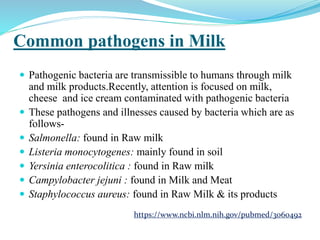
 Salmonella: found in Raw milk
 Listeria monocytogenes: mainly found in soil
 Yersinia enterocolitica : found in Raw milk
 Campylobacter jejuni : found in Milk and Meat
 Staphylococcus aureus: found in Raw Milk & its products
https://www.ncbi.nlm.nih.gov/pubmed/3060492
TYPES OF PASTEURIZATION
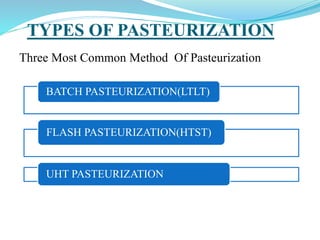
BATCH PASTEURIZATION(LTLT)
FLASH PASTEURIZATION(HTST)
UHT PASTEURIZATION
Three Most Common Method Of Pasteurization
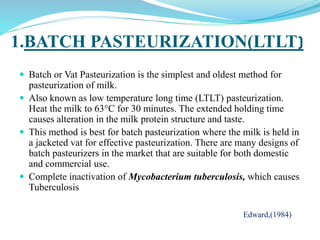
1.BATCH PASTEURIZATION(LTLT)
 Batch or Vat Pasteurization is the simplest and oldest method for
pasteurization of milk.
 Also known as low temperature long time (LTLT) pasteurization.
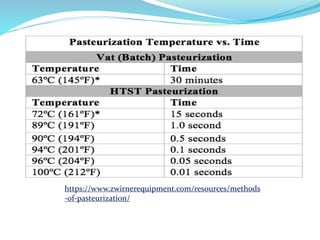
Heat the milk to 63°C for 30 minutes. The extended holding time
causes alteration in the milk protein structure and taste.
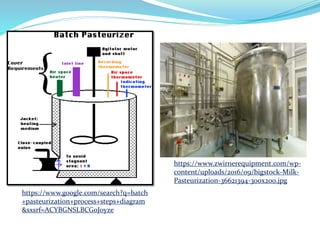
 This method is best for batch pasteurization where the milk is held in
a jacketed vat for effective pasteurization. There are many designs of
batch pasteurizers in the market that are suitable for both domestic
and commercial use.
 Complete inactivation of Mycobacterium tuberculosis, which causes
Tuberculosis
Edward,(1984)
https://www.zwirnerequipment.com/wp-
content/uploads/2016/09/bigstock-Milk-
Pasteurization-36621394-300x200.jpg
https://www.google.com/search?q=batch
+pasteurization+process+steps+diagram
&sxsrf=ACYBGNSLBCGoJ0yze
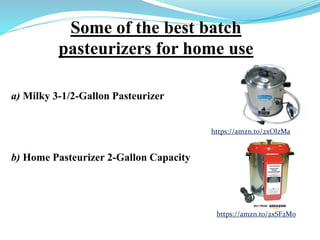
Some of the best batch
pasteurizers for home use
a) Milky 3-1/2-Gallon Pasteurizer
b) Home Pasteurizer 2-Gallon Capacity
https://amzn.to/2xOlzMa
https://amzn.to/2xSF2M0
2. FLASH
PASTEURIZATION(HTST)
 Flash pasteurization involves heating milk to 71.7°C for 15
seconds to kill Coxiella burnetii, which causes
Q-fever is the most heat resistant pathogen in raw milk
 This is most common method these days specially for Higher
volume processing in Continuous pasteurization systems.
 This method is faster and more energy efficient than Batch
pasteurization.
 Flash pasteurized milk can be kept for between 16 to 21 days.
https://dairytechnologist.com/mil
k-pasteurization/
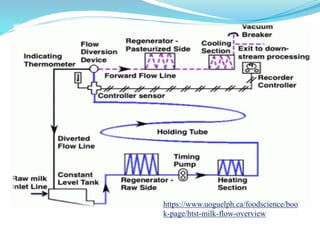
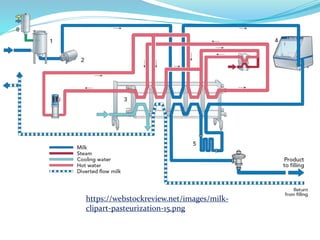
How HTST pasteurization works
A standard milk pasteurization system consists of the following parts:
 Balance tank
 Milk feed pump
 Flow control system
 Filters and clarifiers
 Homogenizer
 PHE with regeneration, heating, holding and cooling sections
 Flow diversion valves
 Instrumentation and control equipment
 Peripheral sources of utilities such as steam, air, and water
 Conduits/piping system
https://dairytechnologist.com/milk-pasteurization/
https://www.uoguelph.ca/foodscience/boo
k-page/htst-milk-flow-overview
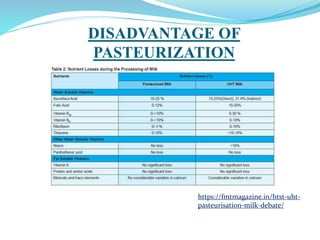
Disadvantages of high temperature
pasteurization
 There is a possibility of alteration of milk proteins. This can
affect the properties of such milk when used to make other
food products.
 High temperatures inactivate the enzymes that protect the
product increasing the risk of spoilage.
 Elevated temperatures cause Maillard reaction, which
discolors the product making it undesirable to consumers.
 High temperatures alter the protein structure and imparts a
cooked flavor to the milk.
https://dairytechnologist.com/milk-pasteurization/
https://www.zwirnerequipment.com/resources/methods
-of-pasteurization/
3. Ultra high temperature(UHT)
 It involves heating milk or cream to between 135°C to 150°C
for one to two seconds, then chilling it immediately and
aseptically packaging it in a hermetic (air-tight) container for
storage.
 Despite the risk of Millard browning, UHT pasteurization
remains the most popular milk preservation method for safe
and stable milk.
 UHT is very deadly process for bacteria and the resulting
product is actually sterilised not just pasteurized.
 UHT milk can keep for nine months without refrigeration.
https://dairytechnologist.com/milk-
pasteurization/
https://webstockreview.net/images/milk-
clipart-pasteurization-15.png
DISADVANTAGE OF
PASTEURIZATION
https://fmtmagazine.in/htst-uht-
pasteurisation-milk-debate/
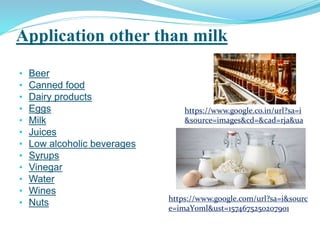
Application other than milk
• Beer
• Canned food
• Dairy products
• Eggs
• Milk
• Juices
• Low alcoholic beverages
• Syrups
• Vinegar
• Water
• Wines
• Nuts
https://www.google.co.in/url?sa=i
&source=images&cd=&cad=rja&ua
ct
https://www.google.com/url?sa=i&sourc
e=imaY0ml&ust=1574675250207901
High-Temperature Short-Time
Pasteurization System for Donor Milk
in a Human Milk Bank Setting
11 May 2018
Diana Escuder-Vieco1, Irene Espinosa-Martos 2, Juan M. Rodríguez 3,
Nieves Corzo4,
Antonia Montilla5, Pablo Siegfried6, Carmen R. Pallás-Alonso7
Leonides Fernandez 8
Banco Regional de Leche Materna, Hospital Universitario , Instituto de Investigación Madrid,
Spain1,2,3,
Probisearch S.L., Tres Cantos, Spain1,2,3,4,, Departamento de Nutrición, Bromatología
Tecnología de los Alimentos, Universidad Complutense de Madrid, Madrid, Spain1,2,3,4,5,
Departamento de Bioactividad Análisis de Alimentos, Instituto de Investigación en Ciencias de
la Alimentación, CIAL (CSIC-UAM), Madrid, Spain1,2,3,4,5,6,
Sive Fluid Systems S.L., Alcalá de Henares,Spain1,2,3,4,5,6,7,
Servicio de Neonatología, Hospital Universitario , Instituto de Investigación
Complutense de Madrid, Madrid, Spain1,2,3,4,5,6,7,8
REFERENCES
 Edward A.I.,(1984),Microbiology of Milk & Dairy Products, In: “
Fundamental of Microbiology ’’,4th Ed.,The Benjamin/Cummings
Company, Inc.,Bridge Parkway, pp 749-754
 Modi H.A.,(2009),Pasteurization and Sterilization of Milk, In: “ Dairy
Microbiology ’’, Aavishkar Publishers Jaipur, pp 34-44
 Vieco D.E., Martos E.I., Rodriguez J.M., Corzo N.,Montilla A., Siegfried P.,
Alonsa R.C.,Fernandez L.,(2019), High temperature short-time
pasteurization system for donor milk in a human milk bank setting,
Frontiers in Microbiology, 9:pp 1-16
 Vasavada P.C.,(2014),Pathogenic Bacteria in Milk, Journal of Dairy Science
,71:(1-8)
WEB REFERENCES
01/11/2019 https://paintingvalley.com/louis-pasteur-sketch/05/11/2019
22/06/2012/www.kumc.edu/dc/pc/s.html/08/11/2019
11/05/2019/https://www.google.com/search?q=batch+pasteurization+process+steps+diagra
m&sxsrf=ACYBGNSLBCGoJ0yze/08/11/2019
18/09/2019/https://amzn.to/2xOlzMa/10/11/2019
07/02/2019/ https://fmtmagazine.in/htst-uht-pasteurisation-milk-debate//10/11/2019
17/10/2019/https://www.zwirnerequipment.com/resources/methods-of-
pasteurization//10/11/2019
16/01/2019/https://www.uoguelph.ca/foodscience/book-page/htst-milk-flow-
overview/11/11/2019
16/05/2019https://www.dairyknowledge.in/article/pasteurization/12/11/2019
14/10/2019/http/s://www.thoughtco.com/what-is-pasteurization-4177326/17/11/2019
21/05/2019/https://www.ncbi.nlm.nih.gov/pubmed/3060492/17/11/2019
22/07/2019https://dairytechnologist.com/milk-pasteurization/18/11/2019
05/11/2019https://www.google.com/url?sa=i&source=imaY0ml&ust=15746752502079
01/11/11/2019
05/11/2019/https://www.google.co.in/url?sa=i&source=images&cd=&cad=rja&uact
/10/11/2019
03/11/2019/ https://webstockreview.net/images/milk-clipart-pasteurization-15.png/
13/11/2019
17/10/2019/https://www.zwirnerequipment.com/wp-content/uploads/2016/09/bigstock-
Milk-Pasteurization-36621394-300x200.jpg/16/11/2019
Pasteurization(suraj)

Pasteurization(suraj)

  • 1.
    SURAJ MISHRA M.Sc. ISem DEPARTMENT OF BIOTECHNOLOGY BARKATULLAH UNIVERSITY BHOPAL
  • 2.
    I NTRODUCTI ON According to International Dairy Federation (IDF) pasteurization can be defined as- “ Pasteurization is the process applied to a product with the objective of minimizing possible health hazards arising from pathogenic microorganisms associated with the product which is consistent with minimal chemical , physical and organoleptic changes the product.” https://www.dairyknowledge.in/article/pasteurization
  • 3.
    BRIEF HISTORY  1117AD China Preserve wine.  1768 Lazzaro Spallanzani (Italian biologist), heat meat broth then sealed.  1795 French chef Nicolas Appert (Inventor) sealed foods in glass jars immersed them in boiling water to preserve them.  1810 Peter Durand had done similar method.  1864 French Scientist Louis Pasteur work on wine prevent from souring.  1886 Franz Von Soxhlet (German chemist), Suggested Pasteurization of milk. www.kumc.edu/dc/pc/s.html https://paintingvalley.com/ louis-pasteur-sketch https://www.thoughtco.com/what-is-pasteurization-4177326
  • 4.
    WHY WE NEEDMILK PASTEURIZATION  Pasteurization ensures the safety and greatly enhance the shelf life of the product.  Pasteurization renders milk for consumption.  It destroys all the common disease producing organism e.g. Salmonella ,Yersinia,Staphylococcus etc  Keeping quality is improved faciliating easy transport of milk over long distances.  Natural flavour of milk is not affected by Pasteurization.  It destroys lipase enzyme which is responsible for rancidity of milk. Modi,(2009)
  • 5.
    Common pathogens inMilk  Pathogenic bacteria are transmissible to humans through milk and milk products.Recently, attention is focused on milk, cheese and ice cream contaminated with pathogenic bacteria  These pathogens and illnesses caused by bacteria which are as follows-  Salmonella: found in Raw milk  Listeria monocytogenes: mainly found in soil  Yersinia enterocolitica : found in Raw milk  Campylobacter jejuni : found in Milk and Meat  Staphylococcus aureus: found in Raw Milk & its products https://www.ncbi.nlm.nih.gov/pubmed/3060492
  • 6.
    TYPES OF PASTEURIZATION BATCHPASTEURIZATION(LTLT) FLASH PASTEURIZATION(HTST) UHT PASTEURIZATION Three Most Common Method Of Pasteurization
  • 7.
    1.BATCH PASTEURIZATION(LTLT)  Batchor Vat Pasteurization is the simplest and oldest method for pasteurization of milk.  Also known as low temperature long time (LTLT) pasteurization. Heat the milk to 63°C for 30 minutes. The extended holding time causes alteration in the milk protein structure and taste.  This method is best for batch pasteurization where the milk is held in a jacketed vat for effective pasteurization. There are many designs of batch pasteurizers in the market that are suitable for both domestic and commercial use.  Complete inactivation of Mycobacterium tuberculosis, which causes Tuberculosis Edward,(1984)
  • 8.
  • 9.
    Some of thebest batch pasteurizers for home use a) Milky 3-1/2-Gallon Pasteurizer b) Home Pasteurizer 2-Gallon Capacity https://amzn.to/2xOlzMa https://amzn.to/2xSF2M0
  • 10.
    2. FLASH PASTEURIZATION(HTST)  Flashpasteurization involves heating milk to 71.7°C for 15 seconds to kill Coxiella burnetii, which causes Q-fever is the most heat resistant pathogen in raw milk  This is most common method these days specially for Higher volume processing in Continuous pasteurization systems.  This method is faster and more energy efficient than Batch pasteurization.  Flash pasteurized milk can be kept for between 16 to 21 days. https://dairytechnologist.com/mil k-pasteurization/
  • 11.
    How HTST pasteurizationworks A standard milk pasteurization system consists of the following parts:  Balance tank  Milk feed pump  Flow control system  Filters and clarifiers  Homogenizer  PHE with regeneration, heating, holding and cooling sections  Flow diversion valves  Instrumentation and control equipment  Peripheral sources of utilities such as steam, air, and water  Conduits/piping system https://dairytechnologist.com/milk-pasteurization/
  • 12.
  • 13.
    Disadvantages of hightemperature pasteurization  There is a possibility of alteration of milk proteins. This can affect the properties of such milk when used to make other food products.  High temperatures inactivate the enzymes that protect the product increasing the risk of spoilage.  Elevated temperatures cause Maillard reaction, which discolors the product making it undesirable to consumers.  High temperatures alter the protein structure and imparts a cooked flavor to the milk. https://dairytechnologist.com/milk-pasteurization/
  • 14.
  • 15.
    3. Ultra hightemperature(UHT)  It involves heating milk or cream to between 135°C to 150°C for one to two seconds, then chilling it immediately and aseptically packaging it in a hermetic (air-tight) container for storage.  Despite the risk of Millard browning, UHT pasteurization remains the most popular milk preservation method for safe and stable milk.  UHT is very deadly process for bacteria and the resulting product is actually sterilised not just pasteurized.  UHT milk can keep for nine months without refrigeration. https://dairytechnologist.com/milk- pasteurization/
  • 16.
  • 17.
  • 18.
    Application other thanmilk • Beer • Canned food • Dairy products • Eggs • Milk • Juices • Low alcoholic beverages • Syrups • Vinegar • Water • Wines • Nuts https://www.google.co.in/url?sa=i &source=images&cd=&cad=rja&ua ct https://www.google.com/url?sa=i&sourc e=imaY0ml&ust=1574675250207901
  • 19.
    High-Temperature Short-Time Pasteurization Systemfor Donor Milk in a Human Milk Bank Setting 11 May 2018 Diana Escuder-Vieco1, Irene Espinosa-Martos 2, Juan M. Rodríguez 3, Nieves Corzo4, Antonia Montilla5, Pablo Siegfried6, Carmen R. Pallás-Alonso7 Leonides Fernandez 8 Banco Regional de Leche Materna, Hospital Universitario , Instituto de Investigación Madrid, Spain1,2,3, Probisearch S.L., Tres Cantos, Spain1,2,3,4,, Departamento de Nutrición, Bromatología Tecnología de los Alimentos, Universidad Complutense de Madrid, Madrid, Spain1,2,3,4,5, Departamento de Bioactividad Análisis de Alimentos, Instituto de Investigación en Ciencias de la Alimentación, CIAL (CSIC-UAM), Madrid, Spain1,2,3,4,5,6, Sive Fluid Systems S.L., Alcalá de Henares,Spain1,2,3,4,5,6,7, Servicio de Neonatología, Hospital Universitario , Instituto de Investigación Complutense de Madrid, Madrid, Spain1,2,3,4,5,6,7,8
  • 20.
    REFERENCES  Edward A.I.,(1984),Microbiologyof Milk & Dairy Products, In: “ Fundamental of Microbiology ’’,4th Ed.,The Benjamin/Cummings Company, Inc.,Bridge Parkway, pp 749-754  Modi H.A.,(2009),Pasteurization and Sterilization of Milk, In: “ Dairy Microbiology ’’, Aavishkar Publishers Jaipur, pp 34-44  Vieco D.E., Martos E.I., Rodriguez J.M., Corzo N.,Montilla A., Siegfried P., Alonsa R.C.,Fernandez L.,(2019), High temperature short-time pasteurization system for donor milk in a human milk bank setting, Frontiers in Microbiology, 9:pp 1-16  Vasavada P.C.,(2014),Pathogenic Bacteria in Milk, Journal of Dairy Science ,71:(1-8)
  • 21.
    WEB REFERENCES 01/11/2019 https://paintingvalley.com/louis-pasteur-sketch/05/11/2019 22/06/2012/www.kumc.edu/dc/pc/s.html/08/11/2019 11/05/2019/https://www.google.com/search?q=batch+pasteurization+process+steps+diagra m&sxsrf=ACYBGNSLBCGoJ0yze/08/11/2019 18/09/2019/https://amzn.to/2xOlzMa/10/11/2019 07/02/2019/https://fmtmagazine.in/htst-uht-pasteurisation-milk-debate//10/11/2019 17/10/2019/https://www.zwirnerequipment.com/resources/methods-of- pasteurization//10/11/2019 16/01/2019/https://www.uoguelph.ca/foodscience/book-page/htst-milk-flow- overview/11/11/2019 16/05/2019https://www.dairyknowledge.in/article/pasteurization/12/11/2019 14/10/2019/http/s://www.thoughtco.com/what-is-pasteurization-4177326/17/11/2019 21/05/2019/https://www.ncbi.nlm.nih.gov/pubmed/3060492/17/11/2019 22/07/2019https://dairytechnologist.com/milk-pasteurization/18/11/2019
  • 22.