Name: Nikunj Bhatti
Roll no.:17
M.A. Semester: 3
Enrollment No.: 14101005
Year: 2014-16
Paper no.: 12
Email id.: nikunjbhatti332@gmail.com
Submitted to: Department of English
Maharaja Krishnakumarsinhji Bhavnagar University
Topic: Sociolinguistic
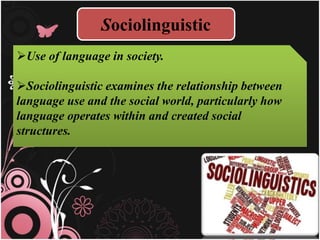
Sociolinguistic
Use of language in society.
Sociolinguistic examines the relationship between
language use and the social world, particularly how
language operates within and created social
structures.
Sociolinguistic studies have looked at
speech communication based on social
categories such as age, gender,
profession…….
Sociolinguistics is the study of the
effect of any and all aspects of society,
including cultural norms, expectations,
and the way language is used.
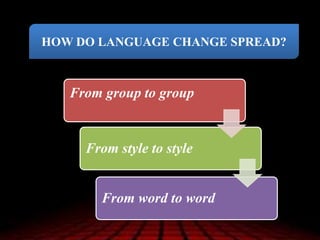
HOW DO LANGUAGE CHANGE SPREAD?
From group to group
From style to style
From word to word
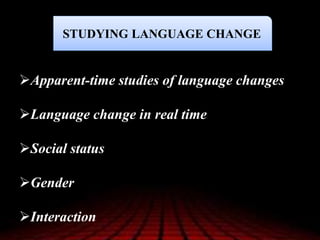
STUDYING LANGUAGE CHANGE
Apparent-time studies of language changes
Language change in real time
Social status
Gender
Interaction
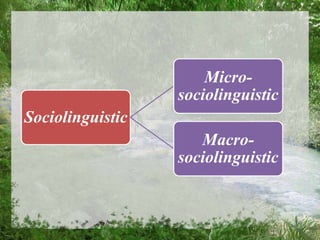
Sociolinguistic
Micro-
sociolinguistic
Macro-
sociolinguistic
Micro-sociolinguistics as a linguistics
dimension of society. micro-
sociolinguistics refers to research with
a linguistic slant, often focusing on
dialect and stylistic  register variation.
Micro-sociolinguistics
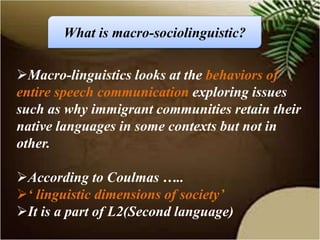
Macro-linguistics looks at the behaviors of
entire speech communication exploring issues
such as why immigrant communities retain their
native languages in some contexts but not in
other.
According to Coulmas …..
‘ linguistic dimensions of society’
It is a part of L2(Second language)
What is macro-sociolinguistic?
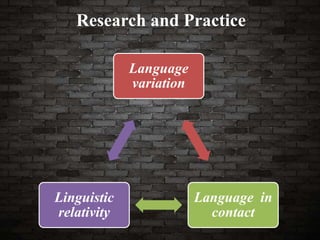
Research and Practice
Language
variation
Language in
contact
Linguistic
relativity
How does a language change.
Language variation research has focused increasingly on issues of
social context.
Pidginisation Process
Pidginisation process is a process that result from contact of two or
more language
Creolisation Process
Speaker develops an elaborated code that can accommodate the full
range of life’s functions.
Language variation
•For Example :
“Da Vinci Code”
The novel reflect the secret and life
of Jesus Christ. to learn language
has a particular code.
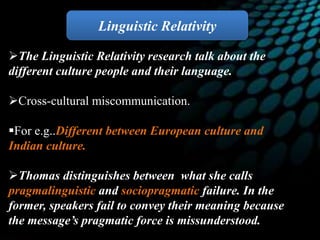
The Linguistic Relativity research talk about the
different culture people and their language.
Cross-cultural miscommunication.
For e.g..Different between European culture and
Indian culture.
Thomas distinguishes between what she calls
pragmalinguistic and sociopragmatic failure. In the
former, speakers fail to convey their meaning because
the message’s pragmatic force is missunderstood.
Linguistic Relativity
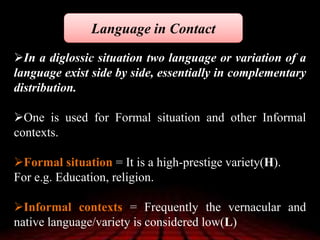
In a diglossic situation two language or variation of a
language exist side by side, essentially in complementary
distribution.
One is used for Formal situation and other Informal
contexts.
Formal situation = It is a high-prestige variety(H).
For e.g. Education, religion.
Informal contexts = Frequently the vernacular and
native language/variety is considered low(L)
Language in Contact

Sociolinguistics

  • 1.
    Name: Nikunj Bhatti Rollno.:17 M.A. Semester: 3 Enrollment No.: 14101005 Year: 2014-16 Paper no.: 12 Email id.: nikunjbhatti332@gmail.com Submitted to: Department of English Maharaja Krishnakumarsinhji Bhavnagar University Topic: Sociolinguistic
  • 2.
    Sociolinguistic Use of languagein society. Sociolinguistic examines the relationship between language use and the social world, particularly how language operates within and created social structures.
  • 3.
    Sociolinguistic studies havelooked at speech communication based on social categories such as age, gender, profession……. Sociolinguistics is the study of the effect of any and all aspects of society, including cultural norms, expectations, and the way language is used.
  • 4.
    HOW DO LANGUAGECHANGE SPREAD? From group to group From style to style From word to word
  • 6.
    STUDYING LANGUAGE CHANGE Apparent-timestudies of language changes Language change in real time Social status Gender Interaction
  • 7.
  • 8.
    Micro-sociolinguistics as alinguistics dimension of society. micro- sociolinguistics refers to research with a linguistic slant, often focusing on dialect and stylistic register variation. Micro-sociolinguistics
  • 9.
    Macro-linguistics looks atthe behaviors of entire speech communication exploring issues such as why immigrant communities retain their native languages in some contexts but not in other. According to Coulmas ….. ‘ linguistic dimensions of society’ It is a part of L2(Second language) What is macro-sociolinguistic?
  • 10.
    Research and Practice Language variation Languagein contact Linguistic relativity
  • 11.
    How does alanguage change. Language variation research has focused increasingly on issues of social context. Pidginisation Process Pidginisation process is a process that result from contact of two or more language Creolisation Process Speaker develops an elaborated code that can accommodate the full range of life’s functions. Language variation
  • 12.
    •For Example : “DaVinci Code” The novel reflect the secret and life of Jesus Christ. to learn language has a particular code.
  • 13.
    The Linguistic Relativityresearch talk about the different culture people and their language. Cross-cultural miscommunication. For e.g..Different between European culture and Indian culture. Thomas distinguishes between what she calls pragmalinguistic and sociopragmatic failure. In the former, speakers fail to convey their meaning because the message’s pragmatic force is missunderstood. Linguistic Relativity
  • 14.
    In a diglossicsituation two language or variation of a language exist side by side, essentially in complementary distribution. One is used for Formal situation and other Informal contexts. Formal situation = It is a high-prestige variety(H). For e.g. Education, religion. Informal contexts = Frequently the vernacular and native language/variety is considered low(L) Language in Contact