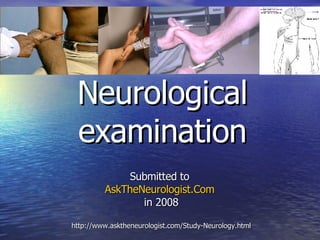
Neurological examination Submitted to  AskTheNeurologist.Com   in 2008 http://www.asktheneurologist.com/Study-Neurology.html
3 questions of neurological diagnosis Is there a lesion ? - Presence of neurological abnormality Where is the lesion ? - Location of problem - Requires knowledge of neuroanatomy What is the lesion ?
Why perform the neurological examination Detect the presence of neurological abnormality Localise the abnormality within the nervous system ( may later be confirmed by investigations)
Systematic approach to weakness e.g. bilateral leg weakness Muscle NMJ Nerve Nerve roots Spinal cord  Brainstem Cerebrum
Basic Plan General examination ( vital signs etc) Conscious state Cognition Meningeal signs Cranial nerves Motor Sensory Cerebellum Extrapyramidal
DON’T DO EVERYTHING! Screening tests vs detailed testing Problem orientated approach Screen all systems Concentrate on systems relevant to complaint Formal cognitive testing may be skipped if patient is cognitively intact during history and problem seems unrelated E.g. foot-drop
Conscious state Glasgow coma scale Eyes /4 Verbal /5 Motor /6 Normal = 15 Created to reflect measure of global brain function Limited value in neurological patients - Many processes selectively affect components above - e.g. aphasia in a fully “ conscious” patient Therefore best to record functions individually
Cognition MMSE  Score out of 30 Broad screening test of cognitive function including attention, memory, language Good for diagnosing / monitoring certain types of dementia especially A.D. Other types of dementia / cognitive problems require different tests
Cognition 2 “  Frontal functions” Attention & concentration ( digit span )  Abstraction ( explain proverb ) Judgment  child lost in street..what would you do? Planning  How to plan a holiday Draw a clock
Cognition 3 Frontal release signs Glabellar tap Pouting Rooting Sucking Grasp Palmomental
Other cognitive functions Neglect:  Failure to pay attention to area of space Usually due to right parietal lesions where neglect left-sided space Praxis:  ability to perform learned action - e.g. dressing , combing hair
Meningeal signs Neck stiffness Brudzinski Kernig Most frequently found in patients with meningitis or SAH
Cranial nerves (a) I  - smell II  - Acuity ( Snellen chart) Fundi Fields ( confrontation) Pupil resting state and reaction to light Direct Consensual Swinging flashlight test Pupil reaction to accommodation
Cranial Nerves (b) III, IV, VI Ptosis? Pupils (already examined) Movement ( H and X) Saccades and smooth pursuit ? Diplopia ? Nystagmus
Cranial nerves (c)  V Facial sensation Muscles of mastication Jaw jerk Corneal reflex  Afferent = V Efferent = VII
VII Muscles of facial expression Taste ant 2/3 tongue Tensor Tympani  Cranial nerves (d)
Cranial nerves (e) VIII Nystagmus already noted Hearing IX, X Say ahh (X) Gag reflex  Afferent = IX Efferent = X
Cranial nerves (f) XI sternocleidomastoid & trapezius XII ( tongue motor examination) Observation ( atrophy, fasciculations) Midline protrusion ( ? Deviation) Power  Dexterity ( fast movement side-to-side)
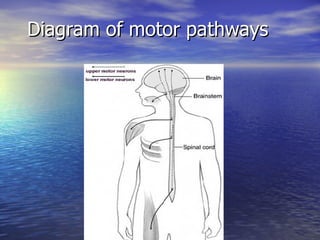
Upper motor neuron  Cell body within motor cortex  (prefrontal gyrus) Axon terminates : Cranial nerve motor nucleus  “ corticobulbar” Anterior horn of spinal cord “ corticospinal”
Lower Motor Neuron Cell body of  Motor cranial nerve nucleus Anterior horn cell Axon terminates Motor end plate ( skeletal muscle) AKA Neuromuscular junction ( NMJ)
Diagram of motor pathways
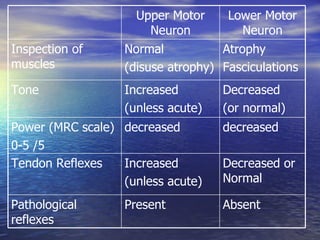
Absent Present Pathological reflexes Decreased or Normal Increased (unless acute) Tendon Reflexes decreased decreased Power (MRC scale)  0-5 /5  Decreased (or normal) Increased  (unless acute) Tone Atrophy Fasciculations Normal (disuse atrophy) Inspection of muscles Lower Motor Neuron Upper Motor Neuron
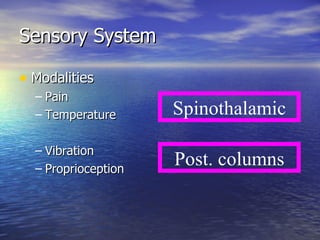
Sensory System Modalities Pain Temperature Vibration Proprioception Spinothalamic Post. columns
Sensory examination II Problem orientated approach Left vs Right Spinal sensory level Radicular / dermatomal Nerve distribution Distal vs Proximal
Which method would you concentrate on? Sudden onset of dysphasia and right sided weakness Numbness and paraesthesia in feet with absent ankle jerks Acute bilateral leg weakness with loss of sphincter control Drop foot
Symptoms and signs of cerebellar disease (VANISH’D) Vertigo Ataxia - usually falls towards lesion Nystagmus – increased with gaze towards lesion Intention Tremor Scanning speech Hypotonia Dysdiadochokinesia + Dysmetria
Stability and Gait Check ability to stand straight with eyes open Check ability to stand straight with eyes closed If significantly worse than with eyes open = positive Romberg sign Usually signifies defect in pathways involved in proprioception May signify vestibular disease Check gait
Extrapyramidal “ TRAP” Tremor ( rest, pill-rolling) Rigidity ( lead-pipe, cog-wheel) Akinesia / bradykinesia Postural instability
Normal examination Patient fully conscious, orientated in time and place with no meningeal signs PEARLA, Fundi intact, ( acuity and visual fields intact) Eye movements normal Facial sensation normal Face symmetrical (Hearing normal) Palate / uvula rises  symmetrically Gag preserved bilaterally Tongue central
Normal examination 2 No atrophy / fasciculations  (muscle inspection) Tone preserved Power 5/5 in all 4 limbs Reflexes symmetrical No pyramidal signs
Normal examination 3 Sensation preserved No cerebellar signs Romberg negative Gait normal
How to present Keep to order Mention all abnormalities Include “ core” points ( just described) Mention all “ important negative points” Leg weakness… “no sensory level” History of MS with optic neuritis… “ no RAPD” Complains of difficulty chewing Mention power of masticatory muscles
THE END

Neurological Examination

  • 1.
    Neurological examination Submittedto AskTheNeurologist.Com in 2008 http://www.asktheneurologist.com/Study-Neurology.html
  • 2.
    3 questions ofneurological diagnosis Is there a lesion ? - Presence of neurological abnormality Where is the lesion ? - Location of problem - Requires knowledge of neuroanatomy What is the lesion ?
  • 3.
    Why perform theneurological examination Detect the presence of neurological abnormality Localise the abnormality within the nervous system ( may later be confirmed by investigations)
  • 4.
    Systematic approach toweakness e.g. bilateral leg weakness Muscle NMJ Nerve Nerve roots Spinal cord Brainstem Cerebrum
  • 5.
    Basic Plan Generalexamination ( vital signs etc) Conscious state Cognition Meningeal signs Cranial nerves Motor Sensory Cerebellum Extrapyramidal
  • 6.
    DON’T DO EVERYTHING!Screening tests vs detailed testing Problem orientated approach Screen all systems Concentrate on systems relevant to complaint Formal cognitive testing may be skipped if patient is cognitively intact during history and problem seems unrelated E.g. foot-drop
  • 7.
    Conscious state Glasgowcoma scale Eyes /4 Verbal /5 Motor /6 Normal = 15 Created to reflect measure of global brain function Limited value in neurological patients - Many processes selectively affect components above - e.g. aphasia in a fully “ conscious” patient Therefore best to record functions individually
  • 8.
    Cognition MMSE Score out of 30 Broad screening test of cognitive function including attention, memory, language Good for diagnosing / monitoring certain types of dementia especially A.D. Other types of dementia / cognitive problems require different tests
  • 9.
    Cognition 2 “ Frontal functions” Attention & concentration ( digit span ) Abstraction ( explain proverb ) Judgment child lost in street..what would you do? Planning How to plan a holiday Draw a clock
  • 10.
    Cognition 3 Frontalrelease signs Glabellar tap Pouting Rooting Sucking Grasp Palmomental
  • 11.
    Other cognitive functionsNeglect: Failure to pay attention to area of space Usually due to right parietal lesions where neglect left-sided space Praxis: ability to perform learned action - e.g. dressing , combing hair
  • 12.
    Meningeal signs Neckstiffness Brudzinski Kernig Most frequently found in patients with meningitis or SAH
  • 13.
    Cranial nerves (a)I - smell II - Acuity ( Snellen chart) Fundi Fields ( confrontation) Pupil resting state and reaction to light Direct Consensual Swinging flashlight test Pupil reaction to accommodation
  • 14.
    Cranial Nerves (b)III, IV, VI Ptosis? Pupils (already examined) Movement ( H and X) Saccades and smooth pursuit ? Diplopia ? Nystagmus
  • 15.
    Cranial nerves (c) V Facial sensation Muscles of mastication Jaw jerk Corneal reflex Afferent = V Efferent = VII
  • 16.
    VII Muscles offacial expression Taste ant 2/3 tongue Tensor Tympani Cranial nerves (d)
  • 17.
    Cranial nerves (e)VIII Nystagmus already noted Hearing IX, X Say ahh (X) Gag reflex Afferent = IX Efferent = X
  • 18.
    Cranial nerves (f)XI sternocleidomastoid & trapezius XII ( tongue motor examination) Observation ( atrophy, fasciculations) Midline protrusion ( ? Deviation) Power Dexterity ( fast movement side-to-side)
  • 19.
    Upper motor neuron Cell body within motor cortex (prefrontal gyrus) Axon terminates : Cranial nerve motor nucleus “ corticobulbar” Anterior horn of spinal cord “ corticospinal”
  • 20.
    Lower Motor NeuronCell body of Motor cranial nerve nucleus Anterior horn cell Axon terminates Motor end plate ( skeletal muscle) AKA Neuromuscular junction ( NMJ)
  • 21.
  • 22.
    Absent Present Pathologicalreflexes Decreased or Normal Increased (unless acute) Tendon Reflexes decreased decreased Power (MRC scale) 0-5 /5 Decreased (or normal) Increased (unless acute) Tone Atrophy Fasciculations Normal (disuse atrophy) Inspection of muscles Lower Motor Neuron Upper Motor Neuron
  • 23.
    Sensory System ModalitiesPain Temperature Vibration Proprioception Spinothalamic Post. columns
  • 24.
    Sensory examination IIProblem orientated approach Left vs Right Spinal sensory level Radicular / dermatomal Nerve distribution Distal vs Proximal
  • 25.
    Which method wouldyou concentrate on? Sudden onset of dysphasia and right sided weakness Numbness and paraesthesia in feet with absent ankle jerks Acute bilateral leg weakness with loss of sphincter control Drop foot
  • 26.
    Symptoms and signsof cerebellar disease (VANISH’D) Vertigo Ataxia - usually falls towards lesion Nystagmus – increased with gaze towards lesion Intention Tremor Scanning speech Hypotonia Dysdiadochokinesia + Dysmetria
  • 27.
    Stability and GaitCheck ability to stand straight with eyes open Check ability to stand straight with eyes closed If significantly worse than with eyes open = positive Romberg sign Usually signifies defect in pathways involved in proprioception May signify vestibular disease Check gait
  • 28.
    Extrapyramidal “ TRAP”Tremor ( rest, pill-rolling) Rigidity ( lead-pipe, cog-wheel) Akinesia / bradykinesia Postural instability
  • 29.
    Normal examination Patientfully conscious, orientated in time and place with no meningeal signs PEARLA, Fundi intact, ( acuity and visual fields intact) Eye movements normal Facial sensation normal Face symmetrical (Hearing normal) Palate / uvula rises symmetrically Gag preserved bilaterally Tongue central
  • 30.
    Normal examination 2No atrophy / fasciculations (muscle inspection) Tone preserved Power 5/5 in all 4 limbs Reflexes symmetrical No pyramidal signs
  • 31.
    Normal examination 3Sensation preserved No cerebellar signs Romberg negative Gait normal
  • 32.
    How to presentKeep to order Mention all abnormalities Include “ core” points ( just described) Mention all “ important negative points” Leg weakness… “no sensory level” History of MS with optic neuritis… “ no RAPD” Complains of difficulty chewing Mention power of masticatory muscles
  • 33.