What is funduscopy?
And…
Why is it important to you?
By/Mohamed Ahmed El –Shafie
Assistant Lecturer in ophthalmology department KafrELShiekh University
E-mail: Shaf3y_h@hotmail.com
facebook/shafie eye clinic
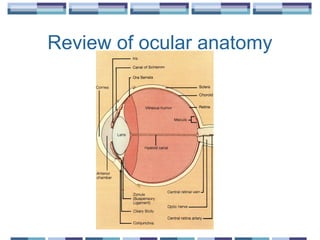
Review of ocular anatomy
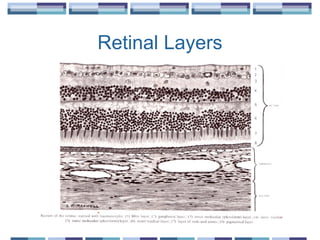
Retinal Layers
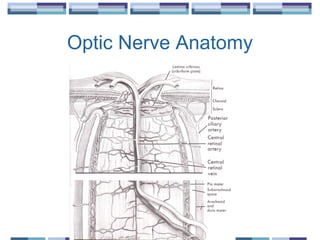
Optic Nerve Anatomy
Funduscopy
Techniques/instruments
Direct Ophthalmoscopy
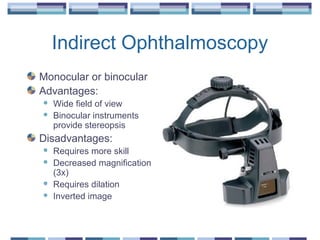
Indirect Ophthalmoscopy
Fundus Biomicroscopy
Fundus Contact Lens
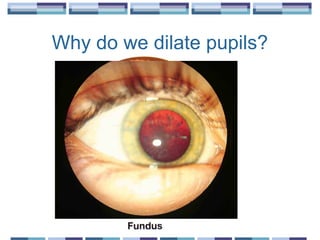
Why do we dilate pupils?
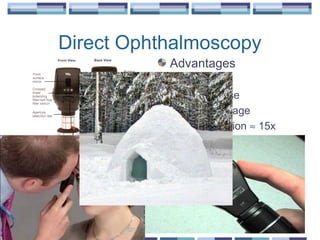
Direct Ophthalmoscopy
Advantages
 Portable
 Easy to use
 Upright image
 Magnification ≈ 15x
 Can use w/o dilation
Disadvantages
 Small field of view
 Lack of stereopsis
 Media opacities can
degrade image
Indirect Ophthalmoscopy
Monocular or binocular
Advantages:
 Wide field of view
 Binocular instruments
provide stereopsis
Disadvantages:
 Requires more skill
 Decreased magnification
(3x)
 Requires dilation
 Inverted image
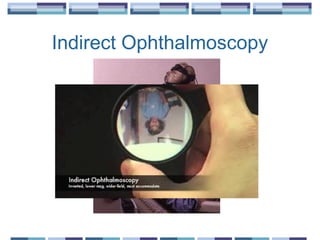
Indirect Ophthalmoscopy
Fundus Biomicroscopy
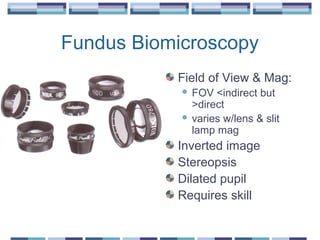
Field of View & Mag:
 FOV <indirect but
>direct
 varies w/lens & slit
lamp mag
Inverted image
Stereopsis
Dilated pupil
Requires skill
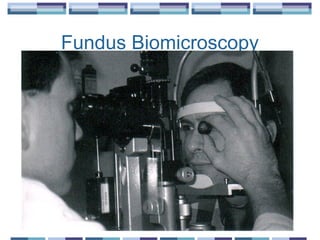
Fundus Biomicroscopy
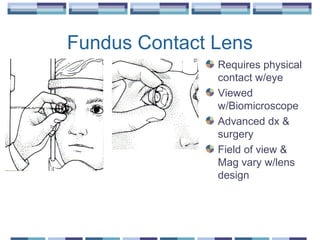
Fundus Contact Lens
Requires physical
contact w/eye
Viewed
w/Biomicroscope
Advanced dx &
surgery
Field of view &
Mag vary w/lens
design
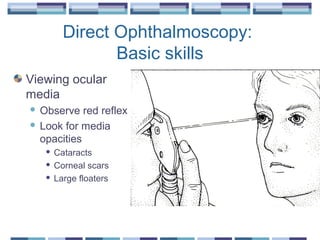
Direct Ophthalmoscopy:
Basic skills
Viewing ocular
media
 Observe red reflex
 Look for media
opacities
 Cataracts
 Corneal scars
 Large floaters
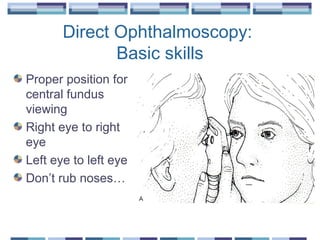
Direct Ophthalmoscopy:
Basic skills
Proper position for
central fundus
viewing
Right eye to right
eye
Left eye to left eye
Don’t rub noses…
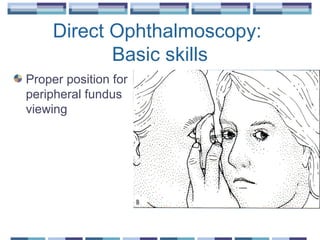
Direct Ophthalmoscopy:
Basic skills
Proper position for
peripheral fundus
viewing
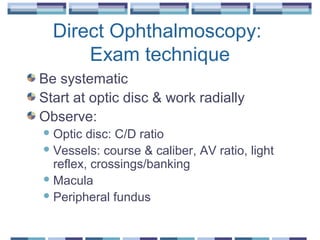
Direct Ophthalmoscopy:
Exam technique
Be systematic
Start at optic disc & work radially
Observe:
Optic disc: C/D ratio
Vessels: course & caliber, AV ratio, light
reflex, crossings/banking
Macula
Peripheral fundus
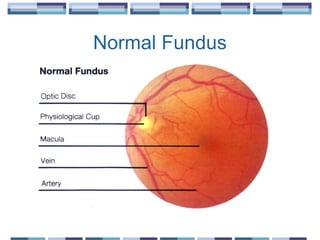
Normal Fundus
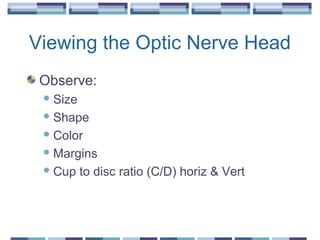
Viewing the Optic Nerve Head
Observe:
Size
Shape
Color
Margins
Cup to disc ratio (C/D) horiz & Vert
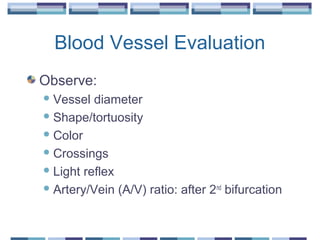
Blood Vessel Evaluation
Observe:
Vessel diameter
Shape/tortuosity
Color
Crossings
Light reflex
Artery/Vein (A/V) ratio: after 2nd
bifurcation
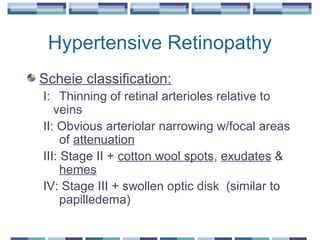
Hypertensive Retinopathy
Scheie classification:
I: Thinning of retinal arterioles relative to
veins
II: Obvious arteriolar narrowing w/focal areas
of attenuation
III: Stage II + cotton wool spots, exudates &
hemes
IV: Stage III + swollen optic disk (similar to
papilledema)
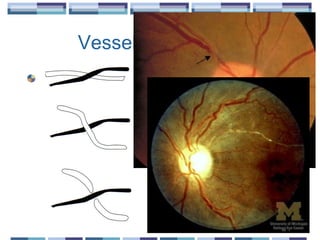
Vessel “Crossings”
Normal crossing
Direction change
“banking’” or “nipping”
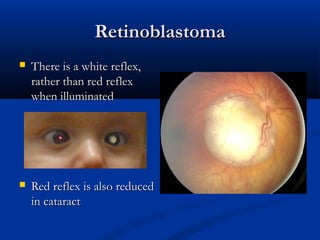
RetinoblastomaRetinoblastoma
 There is a white reflex,There is a white reflex,
rather than red reflexrather than red reflex
when illuminatedwhen illuminated
 Red reflex is also reducedRed reflex is also reduced
in cataractin cataract
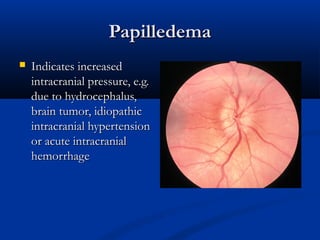
PapilledemaPapilledema
 Indicates increasedIndicates increased
intracranial pressure, e.g.intracranial pressure, e.g.
due to hydrocephalus,due to hydrocephalus,
brain tumor, idiopathicbrain tumor, idiopathic
intracranial hypertensionintracranial hypertension
or acute intracranialor acute intracranial
hemorrhagehemorrhage
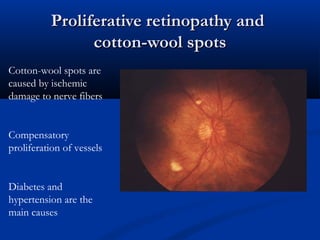
Proliferative retinopathy andProliferative retinopathy and
cotton-wool spotscotton-wool spots
Cotton-wool spots are
caused by ischemic
damage to nerve fibers
Compensatory
proliferation of vessels
Diabetes and
hypertension are the
main causes
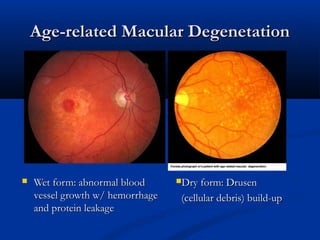
Age-related Macular DegenetationAge-related Macular Degenetation
 Wet form: abnormal bloodWet form: abnormal blood
vessel growth w/ hemorrhagevessel growth w/ hemorrhage
and protein leakageand protein leakage
Dry form: DrusenDry form: Drusen
(cellular debris) build-up(cellular debris) build-up
Direct & indirect ophthalmoscope

Direct & indirect ophthalmoscope

Editor's Notes

  • #5 Point out Lamina as indicator of depth Taken from Adler’s physiology of the eye
  • #15 Start about a foot away with +6.00 - +10.00 d lens in lens wheel and about 15-20 degrees off center and observe red reflex
  • #16 Reduce plus in lens wheel and come in toward patient
  • #17 Have patient turn eye to view peripheral fundus
  • #18 Light reflex should be 1/3 Vessels should be about 2/3 or 4/5 Look at vessels about 2 bifurcations away from disk away from disk
  • #22 narrowing of arteries, AV ratio changed Scattered flame shaped hemes Cotton wool spots Compression of viens at Vessel crossings Increasing tortuosity of vessels