‫تامین‬ ‫زنجیره‬ ‫عملیاتی‬ ‫مرجع‬ ‫مدل‬
‫ملکی‬ ‫میثم‬ ‫دکتر‬
Supply Chain Operations Reference Model (SCOR)
maleki@gmail.com
‫مدل‬SCOR‫تامین‬ ‫زنجیره‬ ‫طراحی‬ ‫در‬
‫تامین‬ ‫زنجیره‬ ‫عملیات‬ ‫مرجع‬ ‫مدل‬SCOR: Supply Chain Operations Reference Model
•SCOR‫در‬ ‫گیری‬ ‫تصمیم‬ ‫های‬ ‫فعالیت‬ ‫از‬ ‫بسیاری‬ ‫مرجع‬ ‫عنوان‬ ‫به‬ ‫فراگیر‬ ‫شکل‬ ‫به‬SCM‫قرار‬ ‫پذیرش‬ ‫مورد‬
‫است‬ ‫گرفته‬.
•SCOR‫م‬ ‫وصل‬ ‫بهم‬ ‫را‬ ‫تامین‬ ‫زنجیره‬ ‫های‬ ‫مشخصه‬ ‫و‬ ‫ها‬ ‫تکنیک‬ ‫بهترین‬ ،‫ها‬ ‫شاخص‬ ،‫فرآیند‬ ‫اجزای‬‫کند‬ ‫ی‬.
•SCOR‫افقی‬ ‫انداز‬ ‫چشم‬(‫فرآیندی‬ ‫بین‬)‫عمودی‬ ‫و‬(‫مراتبی‬ ‫سلسله‬)‫دهد‬ ‫می‬ ‫ارائه‬.
•SCOR‫کند‬ ‫می‬ ‫فراهم‬ ‫را‬ ‫مجدد‬ ‫بندی‬ ‫پیکره‬ ‫قابلیت‬ ‫که‬ ‫شده‬ ‫طراحی‬ ‫ای‬ ‫گونه‬ ‫به‬.
•SCOR‫فرآی‬ ‫اجزای‬ ‫از‬ ‫استاندارد‬ ‫های‬ ‫توصیف‬ ‫و‬ ‫عمومی‬ ‫نامه‬ ‫واژه‬ ‫یک‬ ‫با‬ ‫که‬ ‫دهد‬ ‫می‬ ‫اجازه‬ ‫سازمانها‬ ‫به‬‫ند‬
‫کنند‬ ‫برقرار‬ ‫ارتباط‬ ‫یکدیگر‬ ‫با‬.
•SCOR‫م‬ ‫ترسیم‬ ‫را‬ ‫باشد‬ ‫باید‬ ‫که‬ ‫مطلوبی‬ ‫ی‬ ‫آینده‬ ‫و‬ ‫مشخص‬ ‫واقعی‬ ‫بطور‬ ‫را‬ ‫فرآیندها‬ ‫وضعیت‬‫کند‬ ‫ی‬.
‫مدل‬ ‫تاریخچه‬SCOR
•‫ای‬ ‫مشاوره‬ ‫شرکت‬ ‫توسط‬PRTM‫است‬ ‫یافته‬ ‫توسعه‬.
•‫توسط‬Supply Chain Council (SCC)‫است‬ ‫شده‬ ‫توصیه‬ ‫مرجع‬ ‫مدل‬ ‫عنوان‬ ‫به‬.
•‫مدل‬ ‫ویرایش‬ ‫آخرین‬SCOR‫نسخه‬11‫سال‬ ‫در‬ ‫که‬ ‫است‬2012‫شد‬ ‫ارائه‬.
•‫مدل‬ ‫توسعه‬ ‫در‬ ‫که‬ ‫هایی‬ ‫شرکت‬ ‫از‬ ‫تعدادی‬SCOR‫از‬ ‫عبارتند‬ ‫اند‬ ‫داشته‬ ‫نقش‬:
ABB
ADVAAG Optical Networking
Air Products and Chemicals Inc.
Akzo Nobel
Cisco Systems
IBM Corporation
Massachusetts Institute of Technology
Microsoft Corporation
Mitsubishi Aircraft Corporation
Saab AB
Unilever Plc
Volvo AB
‫مدل‬ ‫ساختاری‬ ‫چهارچوب‬SCOR
.1‫دهند‬ ‫می‬ ‫شکل‬ ‫را‬ ‫زنجیره‬ ‫های‬ ‫فرآیند‬ ‫که‬ ‫عناصری‬ ‫از‬ ‫استاندارد‬ ‫تشریح‬.
.2‫عملکرد‬ ‫کلیدی‬ ‫های‬ ‫شاخص‬ ‫از‬ ‫استاندارد‬ ‫تعاریف‬
.3‫فرآیند‬ ‫جز‬ ‫هر‬ ‫با‬ ‫همراه‬ ‫اقدامات‬ ‫بهترین‬ ‫تشریح‬
.4‫دارند‬ ‫پی‬ ‫در‬ ‫را‬ ‫اقدامات‬ ‫بهترین‬ ‫که‬ ،‫افزاری‬ ‫نرم‬ ‫های‬ ‫کاربری‬ ‫شناسایی‬.
‫مدل‬ ‫معرفی‬ ‫زمان‬ ‫از‬SCOR‫سال‬ ‫در‬1996‫تجدید‬ ‫بار‬ ‫چند‬ ،‫کنون‬ ‫تا‬
‫است‬ ‫گرفته‬ ‫صورت‬ ‫آن‬ ‫در‬ ‫عملیاتی‬ ‫نیازهای‬ ‫با‬ ‫متناسب‬ ‫نظر‬.
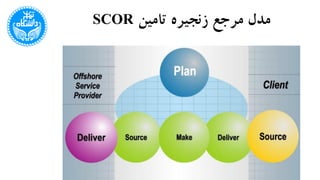
‫تامین‬ ‫زنجیره‬ ‫مرجع‬ ‫مدل‬SCOR
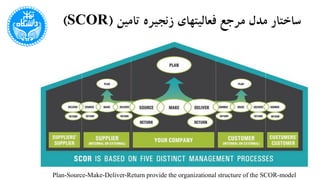
‫تامین‬ ‫زنجیره‬ ‫فعالیتهای‬ ‫مرجع‬ ‫مدل‬ ‫ساختار‬(SCOR)
Plan-Source-Make-Deliver-Return provide the organizational structure of the SCOR-model
SCOR‫مباحث‬ ‫این‬ ‫وارد‬‫شود‬ ‫نمی‬
•‫سازمان‬ ‫داخل‬ ‫ریز‬ ‫های‬ ‫فعالیت‬
•‫بازاریابی‬ ‫و‬ ‫فروش‬
•‫محصول‬ ‫یا‬ ‫صنعت‬ ‫توسعه‬
•‫اداری‬ ‫بروکراسی‬
•IT
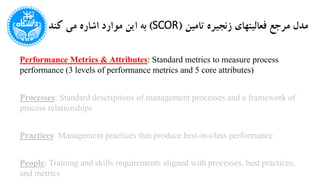
‫تامین‬ ‫زنجیره‬ ‫فعالیتهای‬ ‫مرجع‬ ‫مدل‬(SCOR)‫کند‬ ‫می‬ ‫اشاره‬ ‫موارد‬ ‫این‬ ‫به‬
Performance Metrics & Attributes: Standard metrics to measure process
performance
Processes: Standard descriptions of management processes and a framework of
process relationships
Practices: Management practices that produce best-in-class performance
People: Training and skills requirements aligned with processes, best practices,
and metrics
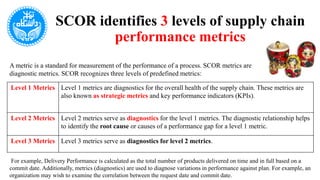
‫تامین‬ ‫زنجیره‬ ‫فعالیتهای‬ ‫مرجع‬ ‫مدل‬(SCOR)‫کند‬ ‫می‬ ‫اشاره‬ ‫موارد‬ ‫این‬ ‫به‬
Performance Metrics & Attributes: Standard metrics to measure process
performance (3 levels of performance metrics and 5 core attributes)
Processes: Standard descriptions of management processes and a framework of
process relationships
Practices: Management practices that produce best-in-class performance
People: Training and skills requirements aligned with processes, best practices,
and metrics
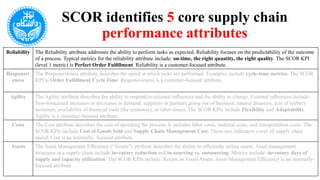
Level 1 Metrics Level 1 metrics are diagnostics for the overall health of the supply chain. These metrics are
also known as strategic metrics and key performance indicators (KPIs).
Level 2 Metrics Level 2 metrics serve as diagnostics for the level 1 metrics. The diagnostic relationship helps
to identify the root cause or causes of a performance gap for a level 1 metric.
Level 3 Metrics Level 3 metrics serve as diagnostics for level 2 metrics.
A metric is a standard for measurement of the performance of a process. SCOR metrics are
diagnostic metrics. SCOR recognizes three levels of predefined metrics:
SCOR identifies 3 levels of supply chain
performance metrics
For example, Delivery Performance is calculated as the total number of products delivered on time and in full based on a
commit date. Additionally, metrics (diagnostics) are used to diagnose variations in performance against plan. For example, an
organization may wish to examine the correlation between the request date and commit date.
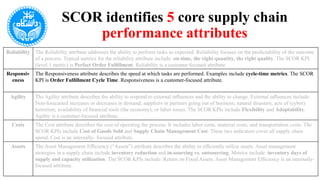
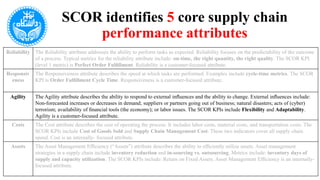
SCOR identifies 5 core supply chain
performance attributes
Reliability The Reliability attribute addresses the ability to perform tasks as expected. Reliability focuses on the predictability of the outcome
of a process. Typical metrics for the reliability attribute include: on-time, the right quantity, the right quality. The SCOR KPI
(level 1 metric) is Perfect Order Fulfillment. Reliability is a customer-focused attribute.
Responsiv
eness
The Responsiveness attribute describes the speed at which tasks are performed. Examples include cycle-time metrics. The SCOR
KPI is Order Fulfillment Cycle Time. Responsiveness is a customer-focused attribute.
Agility The Agility attribute describes the ability to respond to external influences and the ability to change. External influences include:
Non-forecasted increases or decreases in demand; suppliers or partners going out of business; natural disasters; acts of (cyber)
terrorism; availability of financial tools (the economy); or labor issues. The SCOR KPIs include Flexibility and Adaptability.
Agility is a customer-focused attribute.
Costs The Cost attribute describes the cost of operating the process. It includes labor costs, material costs, and transportation costs. The
SCOR KPIs include Cost of Goods Sold and Supply Chain Management Cost. These two indicators cover all supply chain
spend. Cost is an internally- focused attribute.
Assets The Asset Management Efficiency (“Assets”) attribute describes the ability to efficiently utilize assets. Asset management
strategies in a supply chain include inventory reduction and in-sourcing vs. outsourcing. Metrics include: inventory days of
supply and capacity utilization. The SCOR KPIs include: Return on Fixed Assets. Asset Management Efficiency is an internally-
focused attribute.
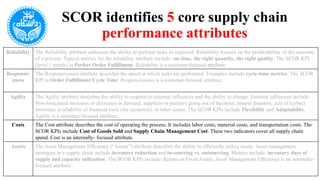
SCOR identifies 5 core supply chain
performance attributes
Reliability The Reliability attribute addresses the ability to perform tasks as expected. Reliability focuses on the predictability of the outcome
of a process. Typical metrics for the reliability attribute include: on-time, the right quantity, the right quality. The SCOR KPI
(level 1 metric) is Perfect Order Fulfillment. Reliability is a customer-focused attribute.
Responsiv
eness
The Responsiveness attribute describes the speed at which tasks are performed. Examples include cycle-time metrics. The SCOR
KPI is Order Fulfillment Cycle Time. Responsiveness is a customer-focused attribute.
Agility The Agility attribute describes the ability to respond to external influences and the ability to change. External influences include:
Non-forecasted increases or decreases in demand; suppliers or partners going out of business; natural disasters; acts of (cyber)
terrorism; availability of financial tools (the economy); or labor issues. The SCOR KPIs include Flexibility and Adaptability.
Agility is a customer-focused attribute.
Costs The Cost attribute describes the cost of operating the process. It includes labor costs, material costs, and transportation costs. The
SCOR KPIs include Cost of Goods Sold and Supply Chain Management Cost. These two indicators cover all supply chain
spend. Cost is an internally- focused attribute.
Assets The Asset Management Efficiency (“Assets”) attribute describes the ability to efficiently utilize assets. Asset management
strategies in a supply chain include inventory reduction and in-sourcing vs. outsourcing. Metrics include: inventory days of
supply and capacity utilization. The SCOR KPIs include: Return on Fixed Assets. Asset Management Efficiency is an internally-
focused attribute.
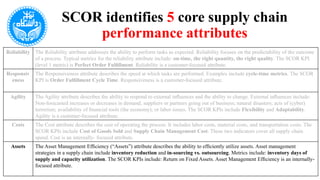
SCOR identifies 5 core supply chain
performance attributes
Reliability The Reliability attribute addresses the ability to perform tasks as expected. Reliability focuses on the predictability of the outcome
of a process. Typical metrics for the reliability attribute include: on-time, the right quantity, the right quality. The SCOR KPI
(level 1 metric) is Perfect Order Fulfillment. Reliability is a customer-focused attribute.
Responsiv
eness
The Responsiveness attribute describes the speed at which tasks are performed. Examples include cycle-time metrics. The SCOR
KPI is Order Fulfillment Cycle Time. Responsiveness is a customer-focused attribute.
Agility The Agility attribute describes the ability to respond to external influences and the ability to change. External influences include:
Non-forecasted increases or decreases in demand; suppliers or partners going out of business; natural disasters; acts of (cyber)
terrorism; availability of financial tools (the economy); or labor issues. The SCOR KPIs include Flexibility and Adaptability.
Agility is a customer-focused attribute.
Costs The Cost attribute describes the cost of operating the process. It includes labor costs, material costs, and transportation costs. The
SCOR KPIs include Cost of Goods Sold and Supply Chain Management Cost. These two indicators cover all supply chain
spend. Cost is an internally- focused attribute.
Assets The Asset Management Efficiency (“Assets”) attribute describes the ability to efficiently utilize assets. Asset management
strategies in a supply chain include inventory reduction and in-sourcing vs. outsourcing. Metrics include: inventory days of
supply and capacity utilization. The SCOR KPIs include: Return on Fixed Assets. Asset Management Efficiency is an internally-
focused attribute.
SCOR identifies 5 core supply chain
performance attributes
Reliability The Reliability attribute addresses the ability to perform tasks as expected. Reliability focuses on the predictability of the outcome
of a process. Typical metrics for the reliability attribute include: on-time, the right quantity, the right quality. The SCOR KPI
(level 1 metric) is Perfect Order Fulfillment. Reliability is a customer-focused attribute.
Responsiv
eness
The Responsiveness attribute describes the speed at which tasks are performed. Examples include cycle-time metrics. The SCOR
KPI is Order Fulfillment Cycle Time. Responsiveness is a customer-focused attribute.
Agility The Agility attribute describes the ability to respond to external influences and the ability to change. External influences include:
Non-forecasted increases or decreases in demand; suppliers or partners going out of business; natural disasters; acts of (cyber)
terrorism; availability of financial tools (the economy); or labor issues. The SCOR KPIs include Flexibility and Adaptability.
Agility is a customer-focused attribute.
Costs The Cost attribute describes the cost of operating the process. It includes labor costs, material costs, and transportation costs. The
SCOR KPIs include Cost of Goods Sold and Supply Chain Management Cost. These two indicators cover all supply chain
spend. Cost is an internally- focused attribute.
Assets The Asset Management Efficiency (“Assets”) attribute describes the ability to efficiently utilize assets. Asset management
strategies in a supply chain include inventory reduction and in-sourcing vs. outsourcing. Metrics include: inventory days of
supply and capacity utilization. The SCOR KPIs include: Return on Fixed Assets. Asset Management Efficiency is an internally-
focused attribute.
SCOR identifies 5 core supply chain
performance attributes
Reliability The Reliability attribute addresses the ability to perform tasks as expected. Reliability focuses on the predictability of the outcome
of a process. Typical metrics for the reliability attribute include: on-time, the right quantity, the right quality. The SCOR KPI
(level 1 metric) is Perfect Order Fulfillment. Reliability is a customer-focused attribute.
Responsiv
eness
The Responsiveness attribute describes the speed at which tasks are performed. Examples include cycle-time metrics. The SCOR
KPI is Order Fulfillment Cycle Time. Responsiveness is a customer-focused attribute.
Agility The Agility attribute describes the ability to respond to external influences and the ability to change. External influences include:
Non-forecasted increases or decreases in demand; suppliers or partners going out of business; natural disasters; acts of (cyber)
terrorism; availability of financial tools (the economy); or labor issues. The SCOR KPIs include Flexibility and Adaptability.
Agility is a customer-focused attribute.
Costs The Cost attribute describes the cost of operating the process. It includes labor costs, material costs, and transportation costs. The
SCOR KPIs include Cost of Goods Sold and Supply Chain Management Cost. These two indicators cover all supply chain
spend. Cost is an internally- focused attribute.
Assets The Asset Management Efficiency (“Assets”) attribute describes the ability to efficiently utilize assets. Asset management
strategies in a supply chain include inventory reduction and in-sourcing vs. outsourcing. Metrics include: inventory days of
supply and capacity utilization. The SCOR KPIs include: Return on Fixed Assets. Asset Management Efficiency is an internally-
focused attribute.
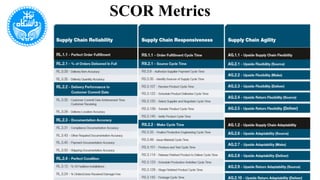
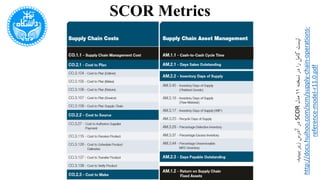
SCOR Metrics
SCOR Metrics
‫نسخنه‬‫در‬‫را‬‫کامل‬‫لیست‬11‫مدل‬SCOR‫ببینید‬‫زیر‬‫آدرس‬‫در‬.
http://docs.huihoo.com/scm/supply-chain-operations-
reference-model-r11.0.pdf
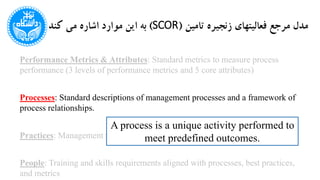
‫تامین‬ ‫زنجیره‬ ‫فعالیتهای‬ ‫مرجع‬ ‫مدل‬(SCOR)‫کند‬ ‫می‬ ‫اشاره‬ ‫موارد‬ ‫این‬ ‫به‬
Performance Metrics & Attributes: Standard metrics to measure process
performance (3 levels of performance metrics and 5 core attributes)
Processes: Standard descriptions of management processes and a framework of
process relationships.
Practices: Management practices that produce best-in-class performance
People: Training and skills requirements aligned with processes, best practices,
and metrics
A process is a unique activity performed to
meet predefined outcomes.
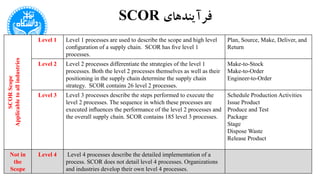
‫فرآیندهای‬SCOR
SCORScope
Applicabletoallindustries
Level 1 Level 1 processes are used to describe the scope and high level
configuration of a supply chain. SCOR has five level 1
processes.
Plan, Source, Make, Deliver, and
Return
Level 2 Level 2 processes differentiate the strategies of the level 1
processes. Both the level 2 processes themselves as well as their
positioning in the supply chain determine the supply chain
strategy. SCOR contains 26 level 2 processes.
Make-to-Stock
Make-to-Order
Engineer-to-Order
Level 3 Level 3 processes describe the steps performed to execute the
level 2 processes. The sequence in which these processes are
executed influences the performance of the level 2 processes and
the overall supply chain. SCOR contains 185 level 3 processes.
Schedule Production Activities
Issue Product
Produce and Test
Package
Stage
Dispose Waste
Release Product
Not in
the
Scope
Level 4 Level 4 processes describe the detailed implementation of a
process. SCOR does not detail level 4 processes. Organizations
and industries develop their own level 4 processes.
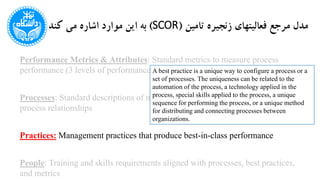
‫تامین‬ ‫زنجیره‬ ‫فعالیتهای‬ ‫مرجع‬ ‫مدل‬(SCOR)‫کند‬ ‫می‬ ‫اشاره‬ ‫موارد‬ ‫این‬ ‫به‬
Performance Metrics & Attributes: Standard metrics to measure process
performance (3 levels of performance metrics and 5 core attributes)
Processes: Standard descriptions of management processes and a framework of
process relationships
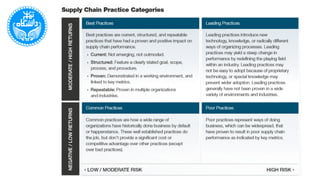
Practices: Management practices that produce best-in-class performance
People: Training and skills requirements aligned with processes, best practices,
and metrics
A best practice is a unique way to configure a process or a
set of processes. The uniqueness can be related to the
automation of the process, a technology applied in the
process, special skills applied to the process, a unique
sequence for performing the process, or a unique method
for distributing and connecting processes between
organizations.
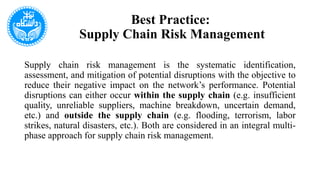
Best Practice:
Supply Chain Risk Management
Supply chain risk management is the systematic identification,
assessment, and mitigation of potential disruptions with the objective to
reduce their negative impact on the network’s performance. Potential
disruptions can either occur within the supply chain (e.g. insufficient
quality, unreliable suppliers, machine breakdown, uncertain demand,
etc.) and outside the supply chain (e.g. flooding, terrorism, labor
strikes, natural disasters, etc.). Both are considered in an integral multi-
phase approach for supply chain risk management.
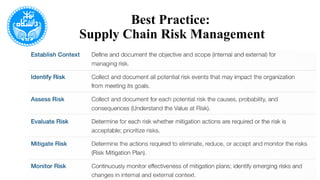
Best Practice:
Supply Chain Risk Management
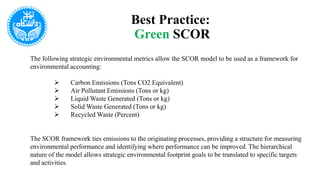
Best Practice:
Green SCOR
The following strategic environmental metrics allow the SCOR model to be used as a framework for
environmental accounting:
 Carbon Emissions (Tons CO2 Equivalent)
 Air Pollutant Emissions (Tons or kg)
 Liquid Waste Generated (Tons or kg)
 Solid Waste Generated (Tons or kg)
 Recycled Waste (Percent)
The SCOR framework ties emissions to the originating processes, providing a structure for measuring
environmental performance and identifying where performance can be improved. The hierarchical
nature of the model allows strategic environmental footprint goals to be translated to specific targets
and activities.
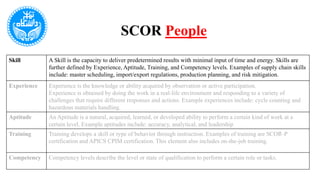
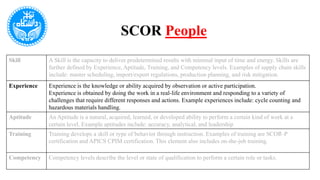
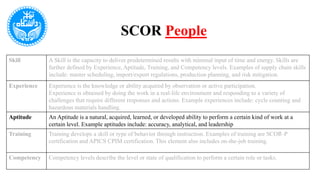
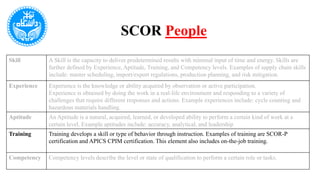
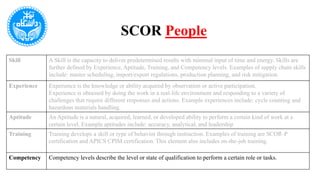
SCOR People
Skill A Skill is the capacity to deliver predetermined results with minimal input of time and energy. Skills are
further defined by Experience, Aptitude, Training, and Competency levels. Examples of supply chain skills
include: master scheduling, import/export regulations, production planning, and risk mitigation.
Experience Experience is the knowledge or ability acquired by observation or active participation.
Experience is obtained by doing the work in a real-life environment and responding to a variety of
challenges that require different responses and actions. Example experiences include: cycle counting and
hazardous materials handling.
Aptitude An Aptitude is a natural, acquired, learned, or developed ability to perform a certain kind of work at a
certain level. Example aptitudes include: accuracy, analytical, and leadership
Training Training develops a skill or type of behavior through instruction. Examples of training are SCOR-P
certification and APICS CPIM certification. This element also includes on-the-job training.
Competency Competency levels describe the level or state of qualification to perform a certain role or tasks.
SCOR People
Skill A Skill is the capacity to deliver predetermined results with minimal input of time and energy. Skills are
further defined by Experience, Aptitude, Training, and Competency levels. Examples of supply chain skills
include: master scheduling, import/export regulations, production planning, and risk mitigation.
Experience Experience is the knowledge or ability acquired by observation or active participation.
Experience is obtained by doing the work in a real-life environment and responding to a variety of
challenges that require different responses and actions. Example experiences include: cycle counting and
hazardous materials handling.
Aptitude An Aptitude is a natural, acquired, learned, or developed ability to perform a certain kind of work at a
certain level. Example aptitudes include: accuracy, analytical, and leadership
Training Training develops a skill or type of behavior through instruction. Examples of training are SCOR-P
certification and APICS CPIM certification. This element also includes on-the-job training.
Competency Competency levels describe the level or state of qualification to perform a certain role or tasks.
SCOR People
Skill A Skill is the capacity to deliver predetermined results with minimal input of time and energy. Skills are
further defined by Experience, Aptitude, Training, and Competency levels. Examples of supply chain skills
include: master scheduling, import/export regulations, production planning, and risk mitigation.
Experience Experience is the knowledge or ability acquired by observation or active participation.
Experience is obtained by doing the work in a real-life environment and responding to a variety of
challenges that require different responses and actions. Example experiences include: cycle counting and
hazardous materials handling.
Aptitude An Aptitude is a natural, acquired, learned, or developed ability to perform a certain kind of work at a
certain level. Example aptitudes include: accuracy, analytical, and leadership
Training Training develops a skill or type of behavior through instruction. Examples of training are SCOR-P
certification and APICS CPIM certification. This element also includes on-the-job training.
Competency Competency levels describe the level or state of qualification to perform a certain role or tasks.
SCOR People
Skill A Skill is the capacity to deliver predetermined results with minimal input of time and energy. Skills are
further defined by Experience, Aptitude, Training, and Competency levels. Examples of supply chain skills
include: master scheduling, import/export regulations, production planning, and risk mitigation.
Experience Experience is the knowledge or ability acquired by observation or active participation.
Experience is obtained by doing the work in a real-life environment and responding to a variety of
challenges that require different responses and actions. Example experiences include: cycle counting and
hazardous materials handling.
Aptitude An Aptitude is a natural, acquired, learned, or developed ability to perform a certain kind of work at a
certain level. Example aptitudes include: accuracy, analytical, and leadership
Training Training develops a skill or type of behavior through instruction. Examples of training are SCOR-P
certification and APICS CPIM certification. This element also includes on-the-job training.
Competency Competency levels describe the level or state of qualification to perform a certain role or tasks.
SCOR People
Skill A Skill is the capacity to deliver predetermined results with minimal input of time and energy. Skills are
further defined by Experience, Aptitude, Training, and Competency levels. Examples of supply chain skills
include: master scheduling, import/export regulations, production planning, and risk mitigation.
Experience Experience is the knowledge or ability acquired by observation or active participation.
Experience is obtained by doing the work in a real-life environment and responding to a variety of
challenges that require different responses and actions. Example experiences include: cycle counting and
hazardous materials handling.
Aptitude An Aptitude is a natural, acquired, learned, or developed ability to perform a certain kind of work at a
certain level. Example aptitudes include: accuracy, analytical, and leadership
Training Training develops a skill or type of behavior through instruction. Examples of training are SCOR-P
certification and APICS CPIM certification. This element also includes on-the-job training.
Competency Competency levels describe the level or state of qualification to perform a certain role or tasks.
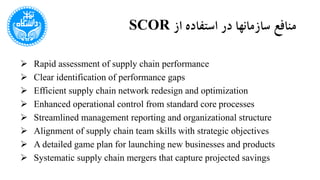
‫از‬ ‫استفاده‬ ‫در‬ ‫سازمانها‬ ‫منافع‬SCOR
 Rapid assessment of supply chain performance
 Clear identification of performance gaps
 Efficient supply chain network redesign and optimization
 Enhanced operational control from standard core processes
 Streamlined management reporting and organizational structure
 Alignment of supply chain team skills with strategic objectives
 A detailed game plan for launching new businesses and products
 Systematic supply chain mergers that capture projected savings
‫بیشتر‬ ‫مطالعه‬SCOR v 11.0
http://docs.huihoo.com/scm/supply-chain-operations-reference-model-r11.0.pdf

SCOR: Supply Chain Operations Reference Model

  • 1.
    ‫تامین‬ ‫زنجیره‬ ‫عملیاتی‬‫مرجع‬ ‫مدل‬ ‫ملکی‬ ‫میثم‬ ‫دکتر‬ Supply Chain Operations Reference Model (SCOR) maleki@gmail.com
  • 2.
    ‫مدل‬SCOR‫تامین‬ ‫زنجیره‬ ‫طراحی‬‫در‬ ‫تامین‬ ‫زنجیره‬ ‫عملیات‬ ‫مرجع‬ ‫مدل‬SCOR: Supply Chain Operations Reference Model •SCOR‫در‬ ‫گیری‬ ‫تصمیم‬ ‫های‬ ‫فعالیت‬ ‫از‬ ‫بسیاری‬ ‫مرجع‬ ‫عنوان‬ ‫به‬ ‫فراگیر‬ ‫شکل‬ ‫به‬SCM‫قرار‬ ‫پذیرش‬ ‫مورد‬ ‫است‬ ‫گرفته‬. •SCOR‫م‬ ‫وصل‬ ‫بهم‬ ‫را‬ ‫تامین‬ ‫زنجیره‬ ‫های‬ ‫مشخصه‬ ‫و‬ ‫ها‬ ‫تکنیک‬ ‫بهترین‬ ،‫ها‬ ‫شاخص‬ ،‫فرآیند‬ ‫اجزای‬‫کند‬ ‫ی‬. •SCOR‫افقی‬ ‫انداز‬ ‫چشم‬(‫فرآیندی‬ ‫بین‬)‫عمودی‬ ‫و‬(‫مراتبی‬ ‫سلسله‬)‫دهد‬ ‫می‬ ‫ارائه‬. •SCOR‫کند‬ ‫می‬ ‫فراهم‬ ‫را‬ ‫مجدد‬ ‫بندی‬ ‫پیکره‬ ‫قابلیت‬ ‫که‬ ‫شده‬ ‫طراحی‬ ‫ای‬ ‫گونه‬ ‫به‬. •SCOR‫فرآی‬ ‫اجزای‬ ‫از‬ ‫استاندارد‬ ‫های‬ ‫توصیف‬ ‫و‬ ‫عمومی‬ ‫نامه‬ ‫واژه‬ ‫یک‬ ‫با‬ ‫که‬ ‫دهد‬ ‫می‬ ‫اجازه‬ ‫سازمانها‬ ‫به‬‫ند‬ ‫کنند‬ ‫برقرار‬ ‫ارتباط‬ ‫یکدیگر‬ ‫با‬. •SCOR‫م‬ ‫ترسیم‬ ‫را‬ ‫باشد‬ ‫باید‬ ‫که‬ ‫مطلوبی‬ ‫ی‬ ‫آینده‬ ‫و‬ ‫مشخص‬ ‫واقعی‬ ‫بطور‬ ‫را‬ ‫فرآیندها‬ ‫وضعیت‬‫کند‬ ‫ی‬.
  • 3.
    ‫مدل‬ ‫تاریخچه‬SCOR •‫ای‬ ‫مشاوره‬‫شرکت‬ ‫توسط‬PRTM‫است‬ ‫یافته‬ ‫توسعه‬. •‫توسط‬Supply Chain Council (SCC)‫است‬ ‫شده‬ ‫توصیه‬ ‫مرجع‬ ‫مدل‬ ‫عنوان‬ ‫به‬. •‫مدل‬ ‫ویرایش‬ ‫آخرین‬SCOR‫نسخه‬11‫سال‬ ‫در‬ ‫که‬ ‫است‬2012‫شد‬ ‫ارائه‬. •‫مدل‬ ‫توسعه‬ ‫در‬ ‫که‬ ‫هایی‬ ‫شرکت‬ ‫از‬ ‫تعدادی‬SCOR‫از‬ ‫عبارتند‬ ‫اند‬ ‫داشته‬ ‫نقش‬: ABB ADVAAG Optical Networking Air Products and Chemicals Inc. Akzo Nobel Cisco Systems IBM Corporation Massachusetts Institute of Technology Microsoft Corporation Mitsubishi Aircraft Corporation Saab AB Unilever Plc Volvo AB
  • 4.
    ‫مدل‬ ‫ساختاری‬ ‫چهارچوب‬SCOR .1‫دهند‬‫می‬ ‫شکل‬ ‫را‬ ‫زنجیره‬ ‫های‬ ‫فرآیند‬ ‫که‬ ‫عناصری‬ ‫از‬ ‫استاندارد‬ ‫تشریح‬. .2‫عملکرد‬ ‫کلیدی‬ ‫های‬ ‫شاخص‬ ‫از‬ ‫استاندارد‬ ‫تعاریف‬ .3‫فرآیند‬ ‫جز‬ ‫هر‬ ‫با‬ ‫همراه‬ ‫اقدامات‬ ‫بهترین‬ ‫تشریح‬ .4‫دارند‬ ‫پی‬ ‫در‬ ‫را‬ ‫اقدامات‬ ‫بهترین‬ ‫که‬ ،‫افزاری‬ ‫نرم‬ ‫های‬ ‫کاربری‬ ‫شناسایی‬. ‫مدل‬ ‫معرفی‬ ‫زمان‬ ‫از‬SCOR‫سال‬ ‫در‬1996‫تجدید‬ ‫بار‬ ‫چند‬ ،‫کنون‬ ‫تا‬ ‫است‬ ‫گرفته‬ ‫صورت‬ ‫آن‬ ‫در‬ ‫عملیاتی‬ ‫نیازهای‬ ‫با‬ ‫متناسب‬ ‫نظر‬.
  • 5.
  • 6.
    ‫تامین‬ ‫زنجیره‬ ‫فعالیتهای‬‫مرجع‬ ‫مدل‬ ‫ساختار‬(SCOR) Plan-Source-Make-Deliver-Return provide the organizational structure of the SCOR-model
  • 7.
    SCOR‫مباحث‬ ‫این‬ ‫وارد‬‫شود‬‫نمی‬ •‫سازمان‬ ‫داخل‬ ‫ریز‬ ‫های‬ ‫فعالیت‬ •‫بازاریابی‬ ‫و‬ ‫فروش‬ •‫محصول‬ ‫یا‬ ‫صنعت‬ ‫توسعه‬ •‫اداری‬ ‫بروکراسی‬ •IT
  • 8.
    ‫تامین‬ ‫زنجیره‬ ‫فعالیتهای‬‫مرجع‬ ‫مدل‬(SCOR)‫کند‬ ‫می‬ ‫اشاره‬ ‫موارد‬ ‫این‬ ‫به‬ Performance Metrics & Attributes: Standard metrics to measure process performance Processes: Standard descriptions of management processes and a framework of process relationships Practices: Management practices that produce best-in-class performance People: Training and skills requirements aligned with processes, best practices, and metrics
  • 9.
    ‫تامین‬ ‫زنجیره‬ ‫فعالیتهای‬‫مرجع‬ ‫مدل‬(SCOR)‫کند‬ ‫می‬ ‫اشاره‬ ‫موارد‬ ‫این‬ ‫به‬ Performance Metrics & Attributes: Standard metrics to measure process performance (3 levels of performance metrics and 5 core attributes) Processes: Standard descriptions of management processes and a framework of process relationships Practices: Management practices that produce best-in-class performance People: Training and skills requirements aligned with processes, best practices, and metrics
  • 10.
    Level 1 MetricsLevel 1 metrics are diagnostics for the overall health of the supply chain. These metrics are also known as strategic metrics and key performance indicators (KPIs). Level 2 Metrics Level 2 metrics serve as diagnostics for the level 1 metrics. The diagnostic relationship helps to identify the root cause or causes of a performance gap for a level 1 metric. Level 3 Metrics Level 3 metrics serve as diagnostics for level 2 metrics. A metric is a standard for measurement of the performance of a process. SCOR metrics are diagnostic metrics. SCOR recognizes three levels of predefined metrics: SCOR identifies 3 levels of supply chain performance metrics For example, Delivery Performance is calculated as the total number of products delivered on time and in full based on a commit date. Additionally, metrics (diagnostics) are used to diagnose variations in performance against plan. For example, an organization may wish to examine the correlation between the request date and commit date.
  • 11.
    SCOR identifies 5core supply chain performance attributes Reliability The Reliability attribute addresses the ability to perform tasks as expected. Reliability focuses on the predictability of the outcome of a process. Typical metrics for the reliability attribute include: on-time, the right quantity, the right quality. The SCOR KPI (level 1 metric) is Perfect Order Fulfillment. Reliability is a customer-focused attribute. Responsiv eness The Responsiveness attribute describes the speed at which tasks are performed. Examples include cycle-time metrics. The SCOR KPI is Order Fulfillment Cycle Time. Responsiveness is a customer-focused attribute. Agility The Agility attribute describes the ability to respond to external influences and the ability to change. External influences include: Non-forecasted increases or decreases in demand; suppliers or partners going out of business; natural disasters; acts of (cyber) terrorism; availability of financial tools (the economy); or labor issues. The SCOR KPIs include Flexibility and Adaptability. Agility is a customer-focused attribute. Costs The Cost attribute describes the cost of operating the process. It includes labor costs, material costs, and transportation costs. The SCOR KPIs include Cost of Goods Sold and Supply Chain Management Cost. These two indicators cover all supply chain spend. Cost is an internally- focused attribute. Assets The Asset Management Efficiency (“Assets”) attribute describes the ability to efficiently utilize assets. Asset management strategies in a supply chain include inventory reduction and in-sourcing vs. outsourcing. Metrics include: inventory days of supply and capacity utilization. The SCOR KPIs include: Return on Fixed Assets. Asset Management Efficiency is an internally- focused attribute.
  • 12.
    SCOR identifies 5core supply chain performance attributes Reliability The Reliability attribute addresses the ability to perform tasks as expected. Reliability focuses on the predictability of the outcome of a process. Typical metrics for the reliability attribute include: on-time, the right quantity, the right quality. The SCOR KPI (level 1 metric) is Perfect Order Fulfillment. Reliability is a customer-focused attribute. Responsiv eness The Responsiveness attribute describes the speed at which tasks are performed. Examples include cycle-time metrics. The SCOR KPI is Order Fulfillment Cycle Time. Responsiveness is a customer-focused attribute. Agility The Agility attribute describes the ability to respond to external influences and the ability to change. External influences include: Non-forecasted increases or decreases in demand; suppliers or partners going out of business; natural disasters; acts of (cyber) terrorism; availability of financial tools (the economy); or labor issues. The SCOR KPIs include Flexibility and Adaptability. Agility is a customer-focused attribute. Costs The Cost attribute describes the cost of operating the process. It includes labor costs, material costs, and transportation costs. The SCOR KPIs include Cost of Goods Sold and Supply Chain Management Cost. These two indicators cover all supply chain spend. Cost is an internally- focused attribute. Assets The Asset Management Efficiency (“Assets”) attribute describes the ability to efficiently utilize assets. Asset management strategies in a supply chain include inventory reduction and in-sourcing vs. outsourcing. Metrics include: inventory days of supply and capacity utilization. The SCOR KPIs include: Return on Fixed Assets. Asset Management Efficiency is an internally- focused attribute.
  • 13.
    SCOR identifies 5core supply chain performance attributes Reliability The Reliability attribute addresses the ability to perform tasks as expected. Reliability focuses on the predictability of the outcome of a process. Typical metrics for the reliability attribute include: on-time, the right quantity, the right quality. The SCOR KPI (level 1 metric) is Perfect Order Fulfillment. Reliability is a customer-focused attribute. Responsiv eness The Responsiveness attribute describes the speed at which tasks are performed. Examples include cycle-time metrics. The SCOR KPI is Order Fulfillment Cycle Time. Responsiveness is a customer-focused attribute. Agility The Agility attribute describes the ability to respond to external influences and the ability to change. External influences include: Non-forecasted increases or decreases in demand; suppliers or partners going out of business; natural disasters; acts of (cyber) terrorism; availability of financial tools (the economy); or labor issues. The SCOR KPIs include Flexibility and Adaptability. Agility is a customer-focused attribute. Costs The Cost attribute describes the cost of operating the process. It includes labor costs, material costs, and transportation costs. The SCOR KPIs include Cost of Goods Sold and Supply Chain Management Cost. These two indicators cover all supply chain spend. Cost is an internally- focused attribute. Assets The Asset Management Efficiency (“Assets”) attribute describes the ability to efficiently utilize assets. Asset management strategies in a supply chain include inventory reduction and in-sourcing vs. outsourcing. Metrics include: inventory days of supply and capacity utilization. The SCOR KPIs include: Return on Fixed Assets. Asset Management Efficiency is an internally- focused attribute.
  • 14.
    SCOR identifies 5core supply chain performance attributes Reliability The Reliability attribute addresses the ability to perform tasks as expected. Reliability focuses on the predictability of the outcome of a process. Typical metrics for the reliability attribute include: on-time, the right quantity, the right quality. The SCOR KPI (level 1 metric) is Perfect Order Fulfillment. Reliability is a customer-focused attribute. Responsiv eness The Responsiveness attribute describes the speed at which tasks are performed. Examples include cycle-time metrics. The SCOR KPI is Order Fulfillment Cycle Time. Responsiveness is a customer-focused attribute. Agility The Agility attribute describes the ability to respond to external influences and the ability to change. External influences include: Non-forecasted increases or decreases in demand; suppliers or partners going out of business; natural disasters; acts of (cyber) terrorism; availability of financial tools (the economy); or labor issues. The SCOR KPIs include Flexibility and Adaptability. Agility is a customer-focused attribute. Costs The Cost attribute describes the cost of operating the process. It includes labor costs, material costs, and transportation costs. The SCOR KPIs include Cost of Goods Sold and Supply Chain Management Cost. These two indicators cover all supply chain spend. Cost is an internally- focused attribute. Assets The Asset Management Efficiency (“Assets”) attribute describes the ability to efficiently utilize assets. Asset management strategies in a supply chain include inventory reduction and in-sourcing vs. outsourcing. Metrics include: inventory days of supply and capacity utilization. The SCOR KPIs include: Return on Fixed Assets. Asset Management Efficiency is an internally- focused attribute.
  • 15.
    SCOR identifies 5core supply chain performance attributes Reliability The Reliability attribute addresses the ability to perform tasks as expected. Reliability focuses on the predictability of the outcome of a process. Typical metrics for the reliability attribute include: on-time, the right quantity, the right quality. The SCOR KPI (level 1 metric) is Perfect Order Fulfillment. Reliability is a customer-focused attribute. Responsiv eness The Responsiveness attribute describes the speed at which tasks are performed. Examples include cycle-time metrics. The SCOR KPI is Order Fulfillment Cycle Time. Responsiveness is a customer-focused attribute. Agility The Agility attribute describes the ability to respond to external influences and the ability to change. External influences include: Non-forecasted increases or decreases in demand; suppliers or partners going out of business; natural disasters; acts of (cyber) terrorism; availability of financial tools (the economy); or labor issues. The SCOR KPIs include Flexibility and Adaptability. Agility is a customer-focused attribute. Costs The Cost attribute describes the cost of operating the process. It includes labor costs, material costs, and transportation costs. The SCOR KPIs include Cost of Goods Sold and Supply Chain Management Cost. These two indicators cover all supply chain spend. Cost is an internally- focused attribute. Assets The Asset Management Efficiency (“Assets”) attribute describes the ability to efficiently utilize assets. Asset management strategies in a supply chain include inventory reduction and in-sourcing vs. outsourcing. Metrics include: inventory days of supply and capacity utilization. The SCOR KPIs include: Return on Fixed Assets. Asset Management Efficiency is an internally- focused attribute.
  • 16.
  • 17.
  • 18.
    ‫تامین‬ ‫زنجیره‬ ‫فعالیتهای‬‫مرجع‬ ‫مدل‬(SCOR)‫کند‬ ‫می‬ ‫اشاره‬ ‫موارد‬ ‫این‬ ‫به‬ Performance Metrics & Attributes: Standard metrics to measure process performance (3 levels of performance metrics and 5 core attributes) Processes: Standard descriptions of management processes and a framework of process relationships. Practices: Management practices that produce best-in-class performance People: Training and skills requirements aligned with processes, best practices, and metrics A process is a unique activity performed to meet predefined outcomes.
  • 19.
    ‫فرآیندهای‬SCOR SCORScope Applicabletoallindustries Level 1 Level1 processes are used to describe the scope and high level configuration of a supply chain. SCOR has five level 1 processes. Plan, Source, Make, Deliver, and Return Level 2 Level 2 processes differentiate the strategies of the level 1 processes. Both the level 2 processes themselves as well as their positioning in the supply chain determine the supply chain strategy. SCOR contains 26 level 2 processes. Make-to-Stock Make-to-Order Engineer-to-Order Level 3 Level 3 processes describe the steps performed to execute the level 2 processes. The sequence in which these processes are executed influences the performance of the level 2 processes and the overall supply chain. SCOR contains 185 level 3 processes. Schedule Production Activities Issue Product Produce and Test Package Stage Dispose Waste Release Product Not in the Scope Level 4 Level 4 processes describe the detailed implementation of a process. SCOR does not detail level 4 processes. Organizations and industries develop their own level 4 processes.
  • 20.
    ‫تامین‬ ‫زنجیره‬ ‫فعالیتهای‬‫مرجع‬ ‫مدل‬(SCOR)‫کند‬ ‫می‬ ‫اشاره‬ ‫موارد‬ ‫این‬ ‫به‬ Performance Metrics & Attributes: Standard metrics to measure process performance (3 levels of performance metrics and 5 core attributes) Processes: Standard descriptions of management processes and a framework of process relationships Practices: Management practices that produce best-in-class performance People: Training and skills requirements aligned with processes, best practices, and metrics A best practice is a unique way to configure a process or a set of processes. The uniqueness can be related to the automation of the process, a technology applied in the process, special skills applied to the process, a unique sequence for performing the process, or a unique method for distributing and connecting processes between organizations.
  • 22.
    Best Practice: Supply ChainRisk Management Supply chain risk management is the systematic identification, assessment, and mitigation of potential disruptions with the objective to reduce their negative impact on the network’s performance. Potential disruptions can either occur within the supply chain (e.g. insufficient quality, unreliable suppliers, machine breakdown, uncertain demand, etc.) and outside the supply chain (e.g. flooding, terrorism, labor strikes, natural disasters, etc.). Both are considered in an integral multi- phase approach for supply chain risk management.
  • 23.
  • 24.
    Best Practice: Green SCOR Thefollowing strategic environmental metrics allow the SCOR model to be used as a framework for environmental accounting:  Carbon Emissions (Tons CO2 Equivalent)  Air Pollutant Emissions (Tons or kg)  Liquid Waste Generated (Tons or kg)  Solid Waste Generated (Tons or kg)  Recycled Waste (Percent) The SCOR framework ties emissions to the originating processes, providing a structure for measuring environmental performance and identifying where performance can be improved. The hierarchical nature of the model allows strategic environmental footprint goals to be translated to specific targets and activities.
  • 25.
    SCOR People Skill ASkill is the capacity to deliver predetermined results with minimal input of time and energy. Skills are further defined by Experience, Aptitude, Training, and Competency levels. Examples of supply chain skills include: master scheduling, import/export regulations, production planning, and risk mitigation. Experience Experience is the knowledge or ability acquired by observation or active participation. Experience is obtained by doing the work in a real-life environment and responding to a variety of challenges that require different responses and actions. Example experiences include: cycle counting and hazardous materials handling. Aptitude An Aptitude is a natural, acquired, learned, or developed ability to perform a certain kind of work at a certain level. Example aptitudes include: accuracy, analytical, and leadership Training Training develops a skill or type of behavior through instruction. Examples of training are SCOR-P certification and APICS CPIM certification. This element also includes on-the-job training. Competency Competency levels describe the level or state of qualification to perform a certain role or tasks.
  • 26.
    SCOR People Skill ASkill is the capacity to deliver predetermined results with minimal input of time and energy. Skills are further defined by Experience, Aptitude, Training, and Competency levels. Examples of supply chain skills include: master scheduling, import/export regulations, production planning, and risk mitigation. Experience Experience is the knowledge or ability acquired by observation or active participation. Experience is obtained by doing the work in a real-life environment and responding to a variety of challenges that require different responses and actions. Example experiences include: cycle counting and hazardous materials handling. Aptitude An Aptitude is a natural, acquired, learned, or developed ability to perform a certain kind of work at a certain level. Example aptitudes include: accuracy, analytical, and leadership Training Training develops a skill or type of behavior through instruction. Examples of training are SCOR-P certification and APICS CPIM certification. This element also includes on-the-job training. Competency Competency levels describe the level or state of qualification to perform a certain role or tasks.
  • 27.
    SCOR People Skill ASkill is the capacity to deliver predetermined results with minimal input of time and energy. Skills are further defined by Experience, Aptitude, Training, and Competency levels. Examples of supply chain skills include: master scheduling, import/export regulations, production planning, and risk mitigation. Experience Experience is the knowledge or ability acquired by observation or active participation. Experience is obtained by doing the work in a real-life environment and responding to a variety of challenges that require different responses and actions. Example experiences include: cycle counting and hazardous materials handling. Aptitude An Aptitude is a natural, acquired, learned, or developed ability to perform a certain kind of work at a certain level. Example aptitudes include: accuracy, analytical, and leadership Training Training develops a skill or type of behavior through instruction. Examples of training are SCOR-P certification and APICS CPIM certification. This element also includes on-the-job training. Competency Competency levels describe the level or state of qualification to perform a certain role or tasks.
  • 28.
    SCOR People Skill ASkill is the capacity to deliver predetermined results with minimal input of time and energy. Skills are further defined by Experience, Aptitude, Training, and Competency levels. Examples of supply chain skills include: master scheduling, import/export regulations, production planning, and risk mitigation. Experience Experience is the knowledge or ability acquired by observation or active participation. Experience is obtained by doing the work in a real-life environment and responding to a variety of challenges that require different responses and actions. Example experiences include: cycle counting and hazardous materials handling. Aptitude An Aptitude is a natural, acquired, learned, or developed ability to perform a certain kind of work at a certain level. Example aptitudes include: accuracy, analytical, and leadership Training Training develops a skill or type of behavior through instruction. Examples of training are SCOR-P certification and APICS CPIM certification. This element also includes on-the-job training. Competency Competency levels describe the level or state of qualification to perform a certain role or tasks.
  • 29.
    SCOR People Skill ASkill is the capacity to deliver predetermined results with minimal input of time and energy. Skills are further defined by Experience, Aptitude, Training, and Competency levels. Examples of supply chain skills include: master scheduling, import/export regulations, production planning, and risk mitigation. Experience Experience is the knowledge or ability acquired by observation or active participation. Experience is obtained by doing the work in a real-life environment and responding to a variety of challenges that require different responses and actions. Example experiences include: cycle counting and hazardous materials handling. Aptitude An Aptitude is a natural, acquired, learned, or developed ability to perform a certain kind of work at a certain level. Example aptitudes include: accuracy, analytical, and leadership Training Training develops a skill or type of behavior through instruction. Examples of training are SCOR-P certification and APICS CPIM certification. This element also includes on-the-job training. Competency Competency levels describe the level or state of qualification to perform a certain role or tasks.
  • 30.
    ‫از‬ ‫استفاده‬ ‫در‬‫سازمانها‬ ‫منافع‬SCOR  Rapid assessment of supply chain performance  Clear identification of performance gaps  Efficient supply chain network redesign and optimization  Enhanced operational control from standard core processes  Streamlined management reporting and organizational structure  Alignment of supply chain team skills with strategic objectives  A detailed game plan for launching new businesses and products  Systematic supply chain mergers that capture projected savings
  • 31.
    ‫بیشتر‬ ‫مطالعه‬SCOR v11.0 http://docs.huihoo.com/scm/supply-chain-operations-reference-model-r11.0.pdf