Latest IT application in
managing supply chains
1
Presented by : Group 2, Sec – S3
Sweta Das – UM15181
Tuhina Mishra- UM15183
Alok Nanda – UM15188
Atish Dash – UM15196
2agenda
• Introduction
• IT Trends in Software
• IT Trends in Infrastructure
• IT Trends in Data collection and Integration
• Conclusion
3Introduction
• With Business changing at a faster pace, supply chain strategy needs to be re-invented.
• Digitally enhanced supply chain helps in
• Reinventing supply chain strategy
• Supply chain functions as a digital supply network (DSN) that unites physical flows, talent,
information and finance
• The IT applications in managing supply chains can be divided into three aspects: Software,
Infrastructure, Data Collection and Analytics.
Supply chain management software (SCMS) modules are used in executing supply chain
transactions, managing supplier relationships and controlling associated business processes.
Based on functionality :-
1.Customer requirement processing
2.Purchase order processing
3.Inventory management
4.Goods receipt and Warehouse management
5.Supplier Management/Sourcing
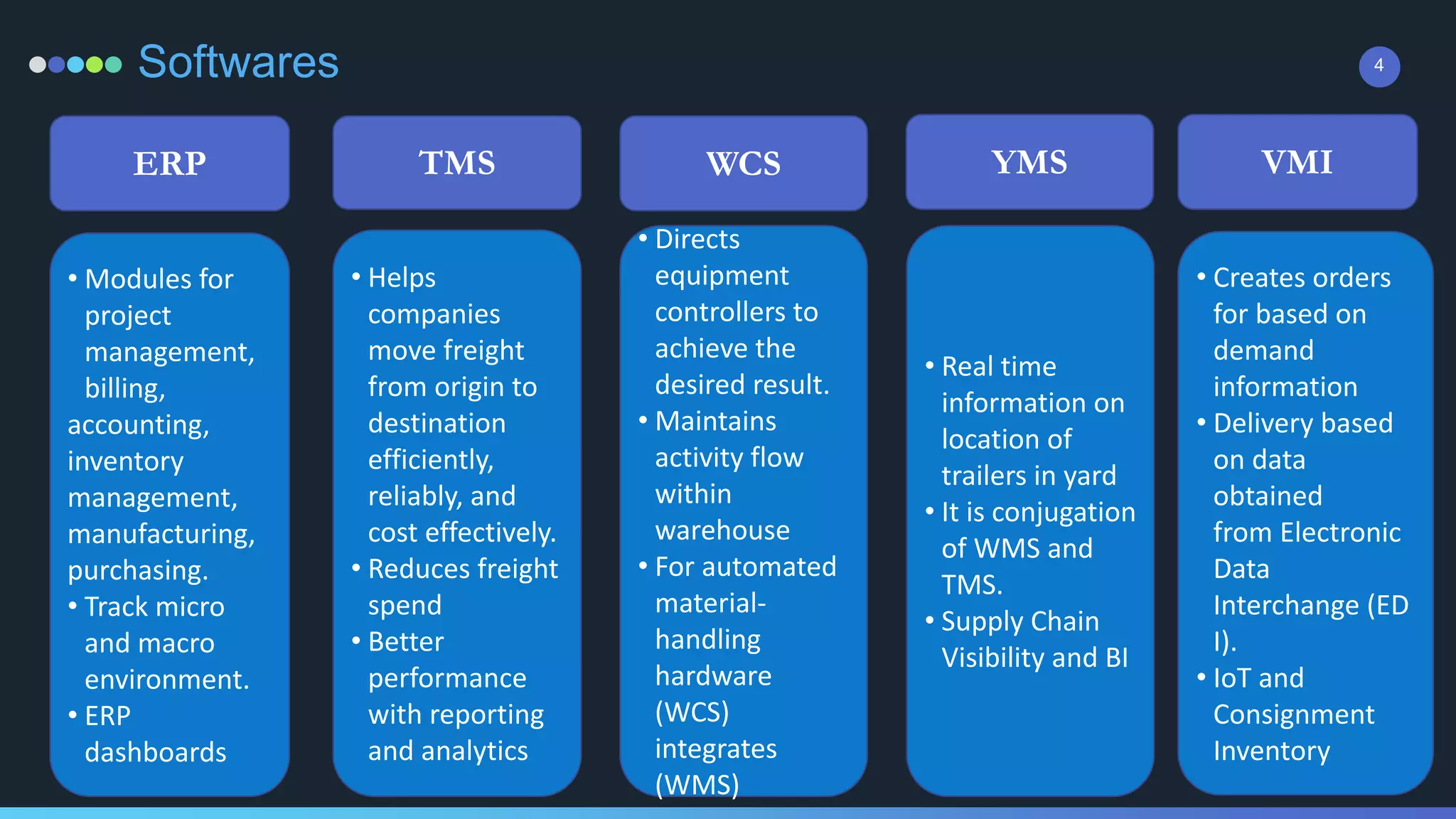
4Softwares
ERP TMS WCS
• Modules for
project
management,
billing,
accounting,
inventory
management,
manufacturing,
purchasing.
• Track micro
and macro
environment.
• ERP
dashboards
• Helps
companies
move freight
from origin to
destination
efficiently,
reliably, and
cost effectively.
• Reduces freight
spend
• Better
performance
with reporting
and analytics
• Directs
equipment
controllers to
achieve the
desired result.
• Maintains
activity flow
within
warehouse
• For automated
material-
handling
hardware
(WCS)
integrates
(WMS)
YMS
• Real time
information on
location of
trailers in yard
• It is conjugation
of WMS and
TMS.
• Supply Chain
Visibility and BI
VMI
• Creates orders
for based on
demand
information
• Delivery based
on data
obtained
from Electronic
Data
Interchange (ED
I).
• IoT and
Consignment
Inventory
Infrastructure 5
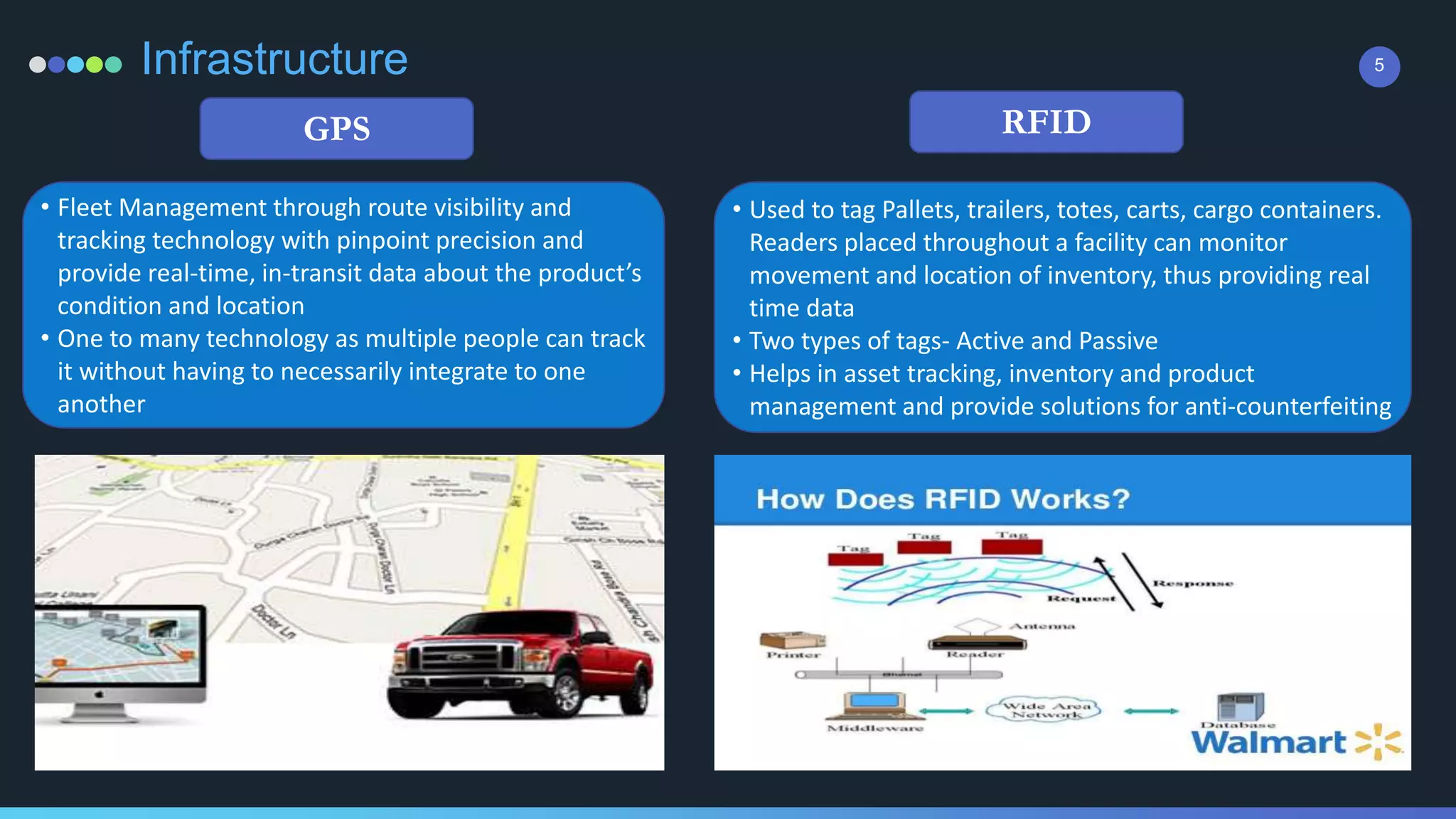
• Fleet Management through route visibility and
tracking technology with pinpoint precision and
provide real-time, in-transit data about the product’s
condition and location
• One to many technology as multiple people can track
it without having to necessarily integrate to one
another
GPS
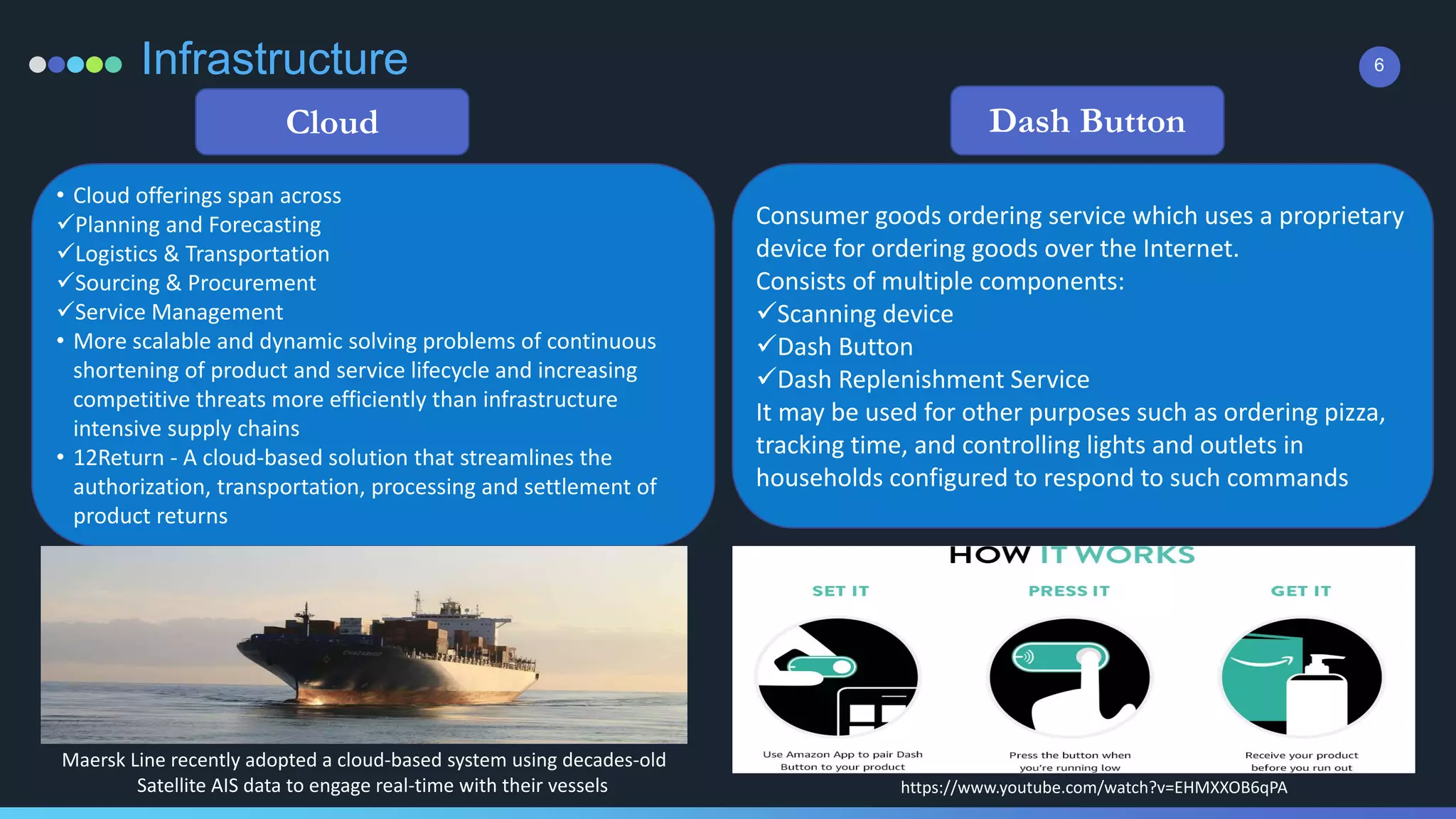
• Used to tag Pallets, trailers, totes, carts, cargo containers.
Readers placed throughout a facility can monitor
movement and location of inventory, thus providing real
time data
• Two types of tags- Active and Passive
• Helps in asset tracking, inventory and product
management and provide solutions for anti-counterfeiting
RFID
Infrastructure 6
• Cloud offerings span across
Planning and Forecasting
Logistics & Transportation
Sourcing & Procurement
Service Management
• More scalable and dynamic solving problems of continuous
shortening of product and service lifecycle and increasing
competitive threats more efficiently than infrastructure
intensive supply chains
• 12Return - A cloud-based solution that streamlines the
authorization, transportation, processing and settlement of
product returns
Cloud Dash Button
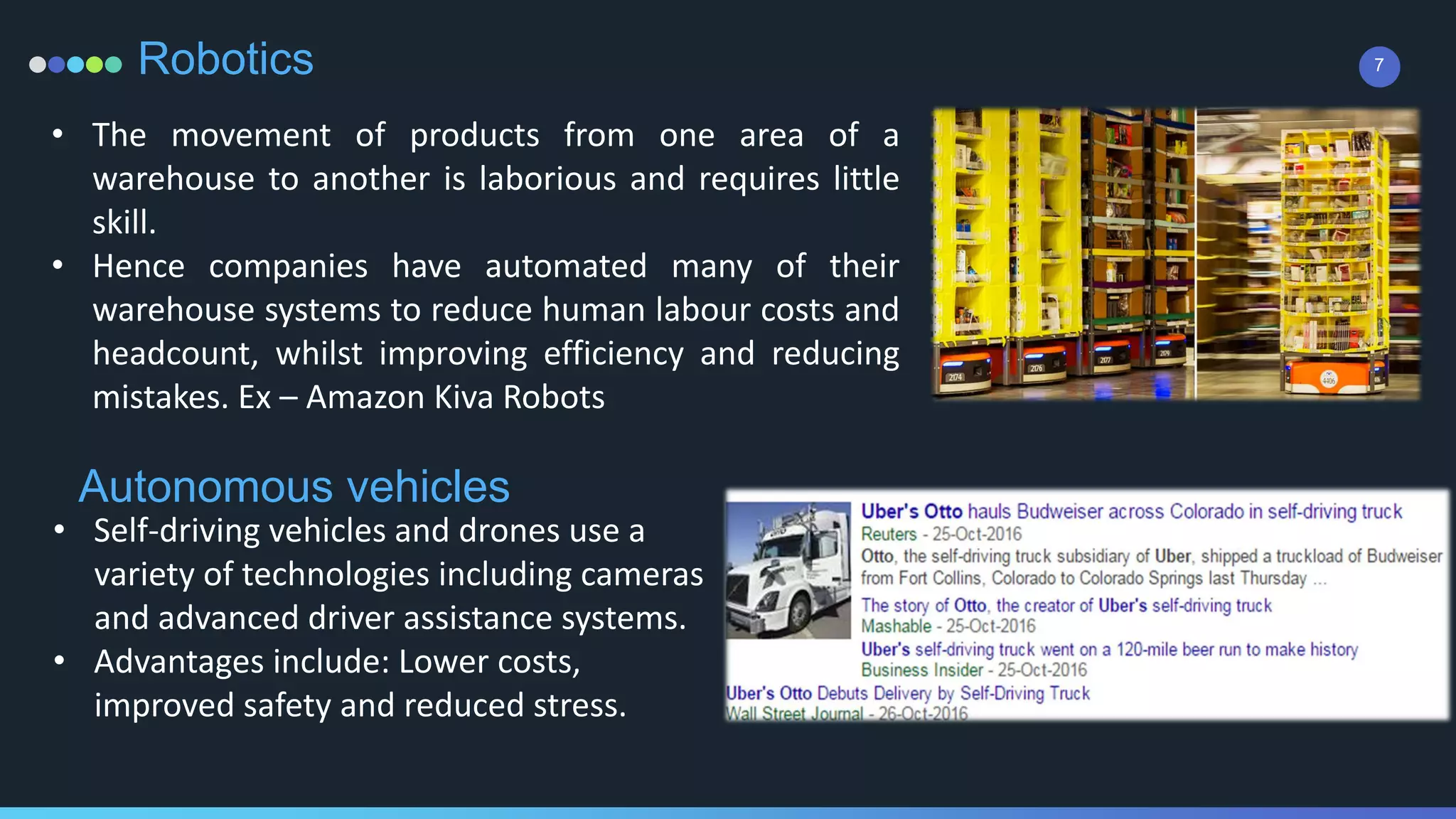
Consumer goods ordering service which uses a proprietary
device for ordering goods over the Internet.
Consists of multiple components:
Scanning device
Dash Button
Dash Replenishment Service
It may be used for other purposes such as ordering pizza,
tracking time, and controlling lights and outlets in
households configured to respond to such commands
https://www.youtube.com/watch?v=EHMXXOB6qPA
Maersk Line recently adopted a cloud-based system using decades-old
Satellite AIS data to engage real-time with their vessels
7Robotics
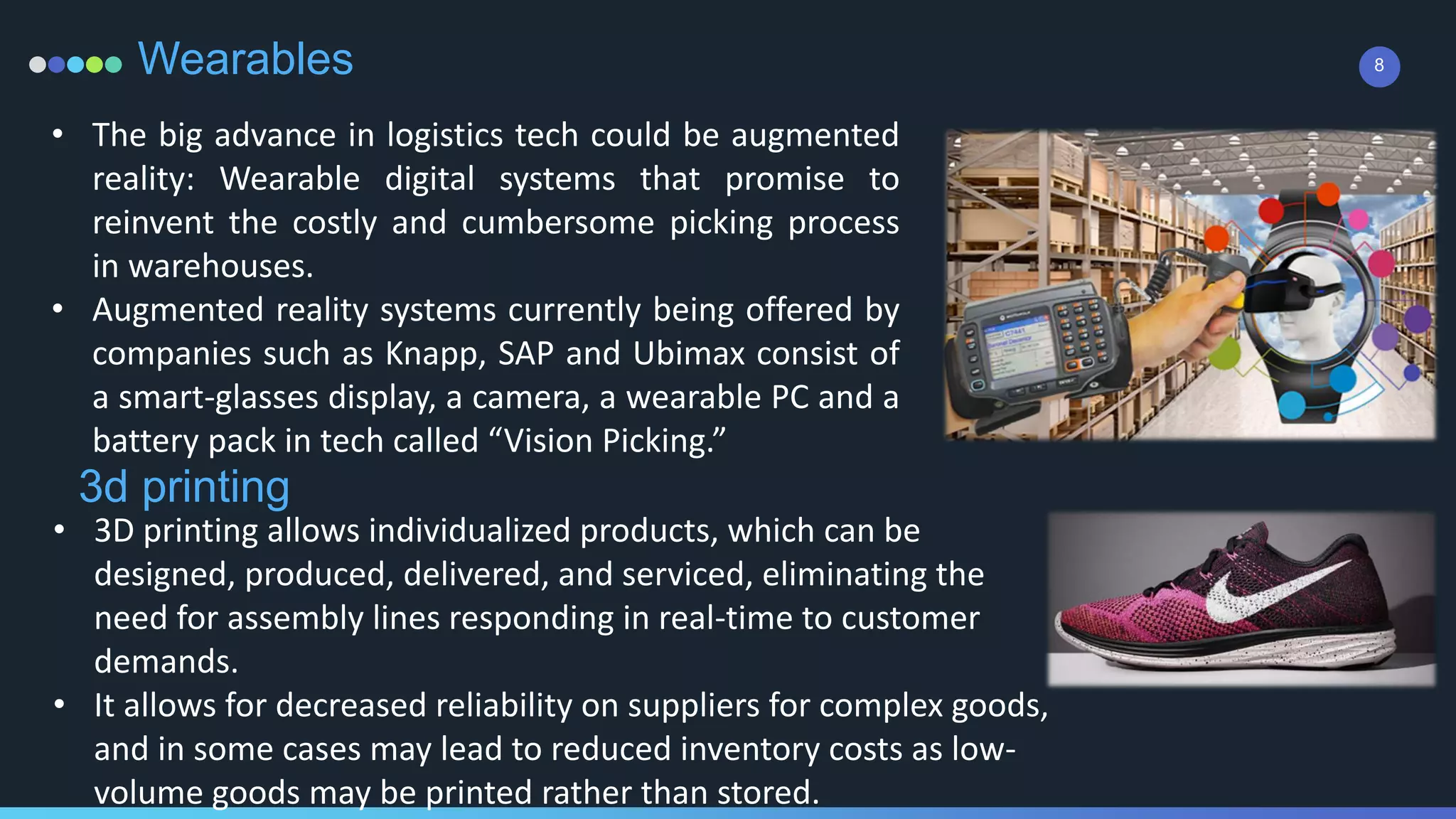
• The movement of products from one area of a
warehouse to another is laborious and requires little
skill.
• Hence companies have automated many of their
warehouse systems to reduce human labour costs and
headcount, whilst improving efficiency and reducing
mistakes. Ex – Amazon Kiva Robots
Autonomous vehicles
• Self-driving vehicles and drones use a
variety of technologies including cameras
and advanced driver assistance systems.
• Advantages include: Lower costs,
improved safety and reduced stress.
8Wearables
• The big advance in logistics tech could be augmented
reality: Wearable digital systems that promise to
reinvent the costly and cumbersome picking process
in warehouses.
• Augmented reality systems currently being offered by
companies such as Knapp, SAP and Ubimax consist of
a smart-glasses display, a camera, a wearable PC and a
battery pack in tech called “Vision Picking.”
3d printing
• 3D printing allows individualized products, which can be
designed, produced, delivered, and serviced, eliminating the
need for assembly lines responding in real-time to customer
demands.
• It allows for decreased reliability on suppliers for complex goods,
and in some cases may lead to reduced inventory costs as low-
volume goods may be printed rather than stored.
9Data - Collection
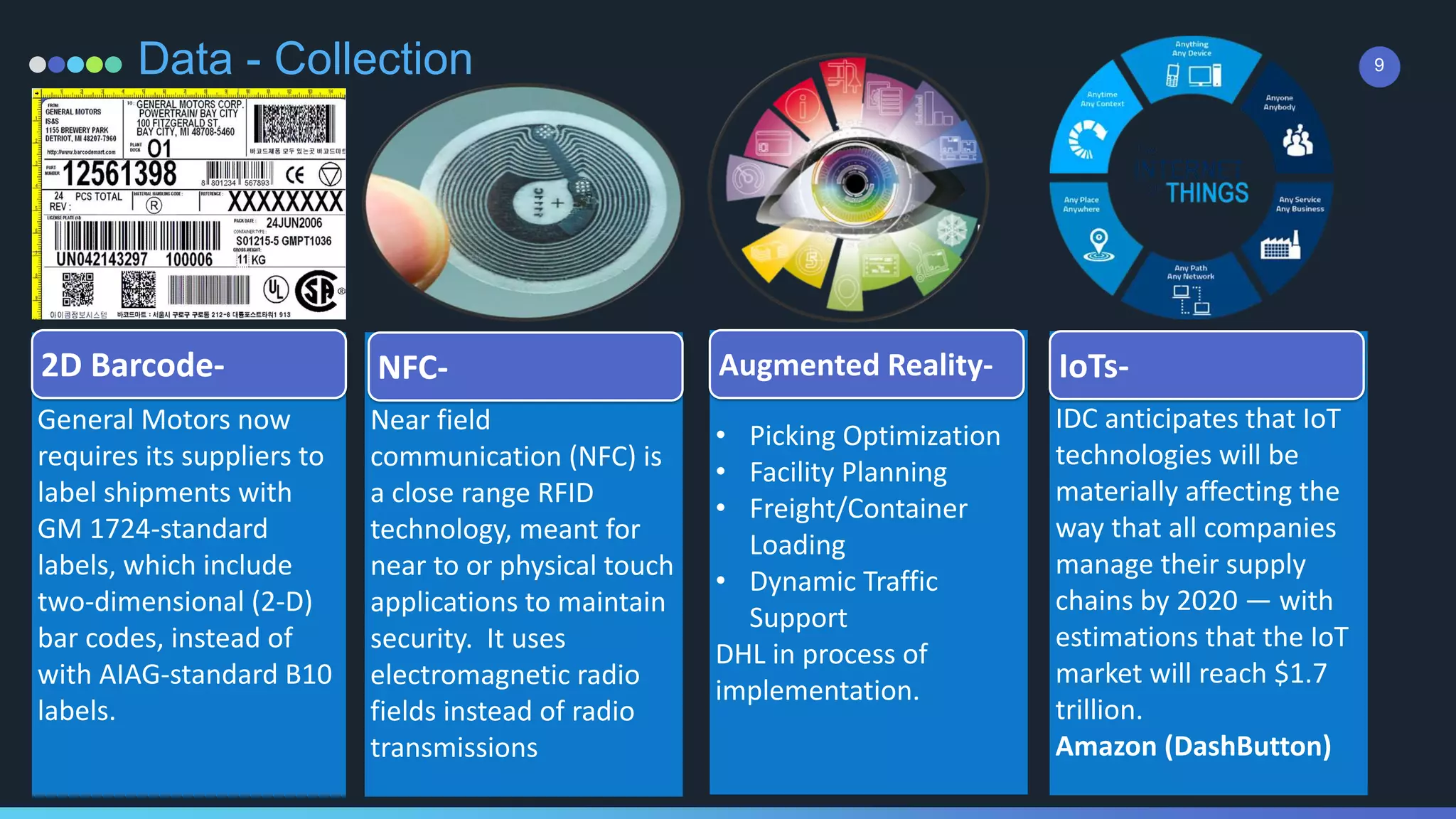
General Motors now
requires its suppliers to
label shipments with
GM 1724-standard
labels, which include
two-dimensional (2-D)
bar codes, instead of
with AIAG-standard B10
labels.
Near field
communication (NFC) is
a close range RFID
technology, meant for
near to or physical touch
applications to maintain
security. It uses
electromagnetic radio
fields instead of radio
transmissions
• Picking Optimization
• Facility Planning
• Freight/Container
Loading
• Dynamic Traffic
Support
DHL in process of
implementation.
IDC anticipates that IoT
technologies will be
materially affecting the
way that all companies
manage their supply
chains by 2020 — with
estimations that the IoT
market will reach $1.7
trillion.
Amazon (DashButton)
2D Barcode- NFC- Augmented Reality- IoTs-
10
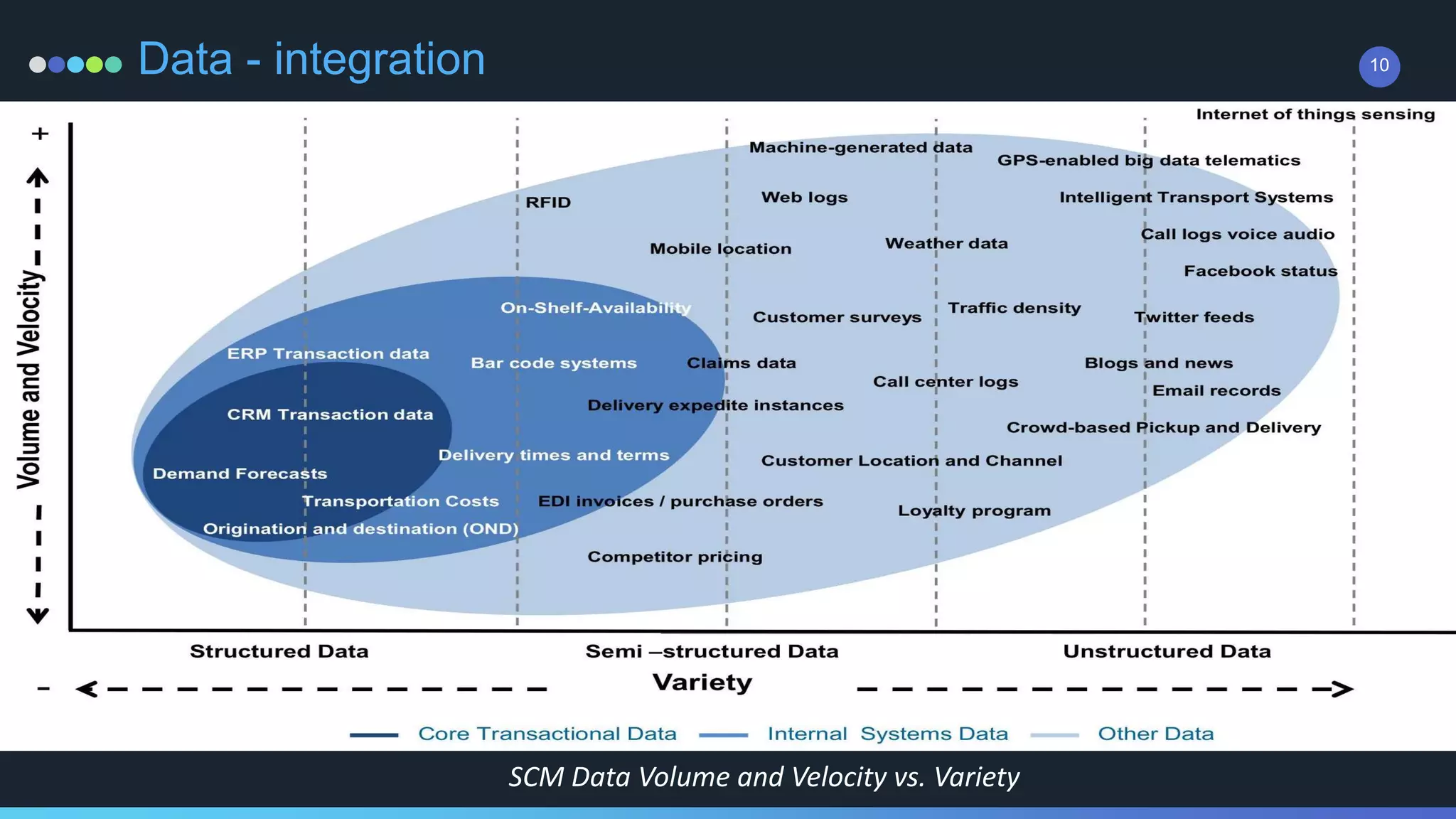
SCM Data Volume and Velocity vs. Variety
Data - integration
11
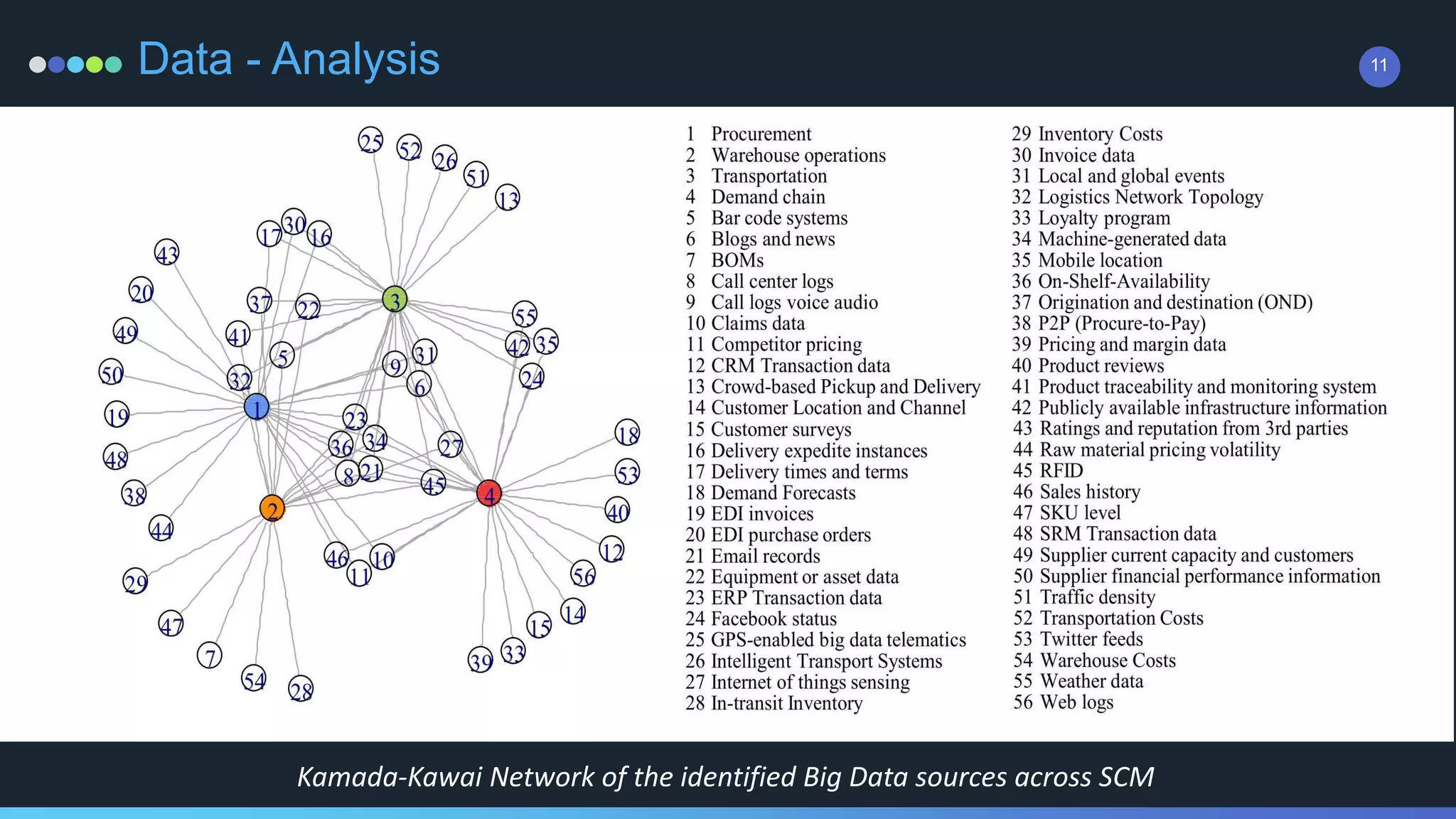
Kamada-Kawai Network of the identified Big Data sources across SCM
Data - Analysis
12conclusion
• Finally, three other key issues must be addressed in the quest to reach total adoption of
information sharing:
• Big Data and Key Insights
• Data Quality
• The breadth of anticipated supply chain network.
• Proper integration and analysis of data across different stages of supply chain will lead to a
better digital supply network.
• This will help in digital supply chain network becoming more Connected, Intelligent,
Scalable and Rapid.
References: 13
• http://www.genco.com/resources/logistics-article.php?aid=800509228
• http://juniperinnovations.co.uk/2011/is-there-a-future-for-nfc-devices-in-the-supply-chain
• V.R. Ivan, T. Benny,“Big data analytics in supply chain management: Trends and related research”, 6th International
Conference on Operations and Supply Chain Management, Bali, 2014
• http://www.computerweekly.com/news/4500278143/DHL-Asia-Pacific-Innovation-Centre-incubates-future-
logistics-technology
• http://news.elementum.com/4-ways-augmented-reality-can-transform-scm
• http://cerasis.com/transportation-technology/cerasis-rater-tms/
• https://www.linkedin.com/pulse/8-emerging-technologies-impact-future-supply-chains-frank-castiglia
• http://www.bizjournals.com/sanjose/news/2015/07/14/new-flextronics-technology-allows-quicker.html
• http://www.inboundlogistics.com/cms/article/what-effect-will-3d-printing-have-on-logistics-and-scm/
• http://www.rfgen.com/blog/3-companies-successfully-using-drones-in-the-supply-chain
• http://www.ey.com/Publication/vwLUAssets/Game-
Changing_Trends_in_Supply_Chain/$FILE/UT%20Game%20Changing%20Trends%20in%20SC_FINAL%20Online.pdf
• http://www.supplychaindigital.com/magazine/issue?id=12457835/39804272
• http://www.cio.com/article/2385117/supply-chain-management/how-cloud-technology-can-transform-supply-
chain-performance.html
• http://mhlnews.com/global-supply-chain/shape-supply-chain-things-come
• http://www.supplychainbrain.com/content/nc/videos/2015-videos/nldc-2015/real-life-applications-for-drones-in-
the-supply-chain/
Thank you !
14

Latest IT Application in managing Supply Chains

  • 1.
    Latest IT applicationin managing supply chains 1 Presented by : Group 2, Sec – S3 Sweta Das – UM15181 Tuhina Mishra- UM15183 Alok Nanda – UM15188 Atish Dash – UM15196
  • 2.
    2agenda • Introduction • ITTrends in Software • IT Trends in Infrastructure • IT Trends in Data collection and Integration • Conclusion
  • 3.
    3Introduction • With Businesschanging at a faster pace, supply chain strategy needs to be re-invented. • Digitally enhanced supply chain helps in • Reinventing supply chain strategy • Supply chain functions as a digital supply network (DSN) that unites physical flows, talent, information and finance • The IT applications in managing supply chains can be divided into three aspects: Software, Infrastructure, Data Collection and Analytics. Supply chain management software (SCMS) modules are used in executing supply chain transactions, managing supplier relationships and controlling associated business processes. Based on functionality :- 1.Customer requirement processing 2.Purchase order processing 3.Inventory management 4.Goods receipt and Warehouse management 5.Supplier Management/Sourcing
  • 4.
    4Softwares ERP TMS WCS •Modules for project management, billing, accounting, inventory management, manufacturing, purchasing. • Track micro and macro environment. • ERP dashboards • Helps companies move freight from origin to destination efficiently, reliably, and cost effectively. • Reduces freight spend • Better performance with reporting and analytics • Directs equipment controllers to achieve the desired result. • Maintains activity flow within warehouse • For automated material- handling hardware (WCS) integrates (WMS) YMS • Real time information on location of trailers in yard • It is conjugation of WMS and TMS. • Supply Chain Visibility and BI VMI • Creates orders for based on demand information • Delivery based on data obtained from Electronic Data Interchange (ED I). • IoT and Consignment Inventory
  • 5.
    Infrastructure 5 • FleetManagement through route visibility and tracking technology with pinpoint precision and provide real-time, in-transit data about the product’s condition and location • One to many technology as multiple people can track it without having to necessarily integrate to one another GPS • Used to tag Pallets, trailers, totes, carts, cargo containers. Readers placed throughout a facility can monitor movement and location of inventory, thus providing real time data • Two types of tags- Active and Passive • Helps in asset tracking, inventory and product management and provide solutions for anti-counterfeiting RFID
  • 6.
    Infrastructure 6 • Cloudofferings span across Planning and Forecasting Logistics & Transportation Sourcing & Procurement Service Management • More scalable and dynamic solving problems of continuous shortening of product and service lifecycle and increasing competitive threats more efficiently than infrastructure intensive supply chains • 12Return - A cloud-based solution that streamlines the authorization, transportation, processing and settlement of product returns Cloud Dash Button Consumer goods ordering service which uses a proprietary device for ordering goods over the Internet. Consists of multiple components: Scanning device Dash Button Dash Replenishment Service It may be used for other purposes such as ordering pizza, tracking time, and controlling lights and outlets in households configured to respond to such commands https://www.youtube.com/watch?v=EHMXXOB6qPA Maersk Line recently adopted a cloud-based system using decades-old Satellite AIS data to engage real-time with their vessels
  • 7.
    7Robotics • The movementof products from one area of a warehouse to another is laborious and requires little skill. • Hence companies have automated many of their warehouse systems to reduce human labour costs and headcount, whilst improving efficiency and reducing mistakes. Ex – Amazon Kiva Robots Autonomous vehicles • Self-driving vehicles and drones use a variety of technologies including cameras and advanced driver assistance systems. • Advantages include: Lower costs, improved safety and reduced stress.
  • 8.
    8Wearables • The bigadvance in logistics tech could be augmented reality: Wearable digital systems that promise to reinvent the costly and cumbersome picking process in warehouses. • Augmented reality systems currently being offered by companies such as Knapp, SAP and Ubimax consist of a smart-glasses display, a camera, a wearable PC and a battery pack in tech called “Vision Picking.” 3d printing • 3D printing allows individualized products, which can be designed, produced, delivered, and serviced, eliminating the need for assembly lines responding in real-time to customer demands. • It allows for decreased reliability on suppliers for complex goods, and in some cases may lead to reduced inventory costs as low- volume goods may be printed rather than stored.
  • 9.
    9Data - Collection GeneralMotors now requires its suppliers to label shipments with GM 1724-standard labels, which include two-dimensional (2-D) bar codes, instead of with AIAG-standard B10 labels. Near field communication (NFC) is a close range RFID technology, meant for near to or physical touch applications to maintain security. It uses electromagnetic radio fields instead of radio transmissions • Picking Optimization • Facility Planning • Freight/Container Loading • Dynamic Traffic Support DHL in process of implementation. IDC anticipates that IoT technologies will be materially affecting the way that all companies manage their supply chains by 2020 — with estimations that the IoT market will reach $1.7 trillion. Amazon (DashButton) 2D Barcode- NFC- Augmented Reality- IoTs-
  • 10.
    10 SCM Data Volumeand Velocity vs. Variety Data - integration
  • 11.
    11 Kamada-Kawai Network ofthe identified Big Data sources across SCM Data - Analysis
  • 12.
    12conclusion • Finally, threeother key issues must be addressed in the quest to reach total adoption of information sharing: • Big Data and Key Insights • Data Quality • The breadth of anticipated supply chain network. • Proper integration and analysis of data across different stages of supply chain will lead to a better digital supply network. • This will help in digital supply chain network becoming more Connected, Intelligent, Scalable and Rapid.
  • 13.
    References: 13 • http://www.genco.com/resources/logistics-article.php?aid=800509228 •http://juniperinnovations.co.uk/2011/is-there-a-future-for-nfc-devices-in-the-supply-chain • V.R. Ivan, T. Benny,“Big data analytics in supply chain management: Trends and related research”, 6th International Conference on Operations and Supply Chain Management, Bali, 2014 • http://www.computerweekly.com/news/4500278143/DHL-Asia-Pacific-Innovation-Centre-incubates-future- logistics-technology • http://news.elementum.com/4-ways-augmented-reality-can-transform-scm • http://cerasis.com/transportation-technology/cerasis-rater-tms/ • https://www.linkedin.com/pulse/8-emerging-technologies-impact-future-supply-chains-frank-castiglia • http://www.bizjournals.com/sanjose/news/2015/07/14/new-flextronics-technology-allows-quicker.html • http://www.inboundlogistics.com/cms/article/what-effect-will-3d-printing-have-on-logistics-and-scm/ • http://www.rfgen.com/blog/3-companies-successfully-using-drones-in-the-supply-chain • http://www.ey.com/Publication/vwLUAssets/Game- Changing_Trends_in_Supply_Chain/$FILE/UT%20Game%20Changing%20Trends%20in%20SC_FINAL%20Online.pdf • http://www.supplychaindigital.com/magazine/issue?id=12457835/39804272 • http://www.cio.com/article/2385117/supply-chain-management/how-cloud-technology-can-transform-supply- chain-performance.html • http://mhlnews.com/global-supply-chain/shape-supply-chain-things-come • http://www.supplychainbrain.com/content/nc/videos/2015-videos/nldc-2015/real-life-applications-for-drones-in- the-supply-chain/
  • 14.

Editor's Notes

  • #5 https://opensource.com/resources/top-4-open-source-erp-systems http://cerasis.com/2013/06/13/benefits-of-tms/ http://searchmanufacturingerp.techtarget.com/tip/SCM-systems-vs-ERP-systems http://www.supplychain247.com/article/the_power_of_yard_management_systems/trackx http://www.compudata.com/the-role-of-erp-in-supply-chain-management/
  • #10 Barcode- The new labels include all the information previously found in the B10 format, but the 2-D bar code provides additional capacity for new information for use by the producer, logistics provider, and GM. NFC-NFC has a very powerful yet simple user interface. NFC technology has a short readability range. It can be used in a supply chain to track and share inventory information.  “For instance, a delivery driver would only need to tap a smartphone against a pallet of inventory and the shipment information would be instantly ready to be sent to a customer or back to the distribution center.