DEPARTMENT OF MECHANICAL
ENGINEERING
-: PRESENTATION ON :-
SUPPLY CHAIN MANAGEMENT IN AUTOMOBILE INDUSTRY
1
SUBMITTED BY:
Aditya Bhattacharjee- Roll No: 27600712006
Akash Dutta- Roll No: 27600712008
Debasish Basak- Roll No: 27600712025
Monojit Chandra- Roll No: 27600712050
Nitesh Khaitan- Roll No: 27600712055
Prakash Sharma- Roll No: 27600712059
Mustaba Nayej- Roll No: 27600712062
INDEX
INTRODUCTION
SUPPLY CHAIN MANAGEMENT
LEAN SUPPLY CHAIN MANAGEMENT
AGILE SUPPLY CHAIN MANAGEMENT
LEAGILE SUPPLY CHAIN MANAGEMENT
CONCLUSION
2
INTRODUCTION:
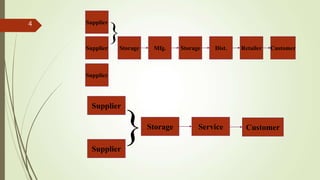
Supply Chain Management encompasses every effort involved in
producing and delivering a final product or service, from the
supplier’s supplier to the customer’s customer. Supply Chain
Management includes managing supply and demand, sourcing
raw materials and parts, manufacturing and assembly,
warehousing and inventory tracking, order entry and order
management, distribution across all channels, and delivery to the
customer.
3
4 Supplier
Supplier
Supplier
Storage
} Mfg. Dist. Retailer CustomerStorage
Supplier
Supplier
Storage
} Service Customer
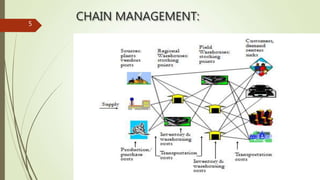
CHAIN MANAGEMENT:5
NECESSITY OF THE SUPPLY CHAIN MANAGEMENT:
 Strategic Advantage : It Can Drive Strategy
 Manufacturing is becoming more efficient.
 SCM offers opportunity for differentiation or cost reduction.
 Globalization : It covers the world
 Requires greater coordination of production and distribution.
 Increased risk of supply chain interruption.
 Increases need for robust and flexible supply chains.
 At the company level, supply chain management impacts.
 Cost :
 For many products, 20% to 40% of total product costs are controllable logistics costs.
 Service : For many products, performance factors such as inventory availability and speed of
delivery are critical to customer satisfaction.
6
OBJECTIVES OF SUPPLY CHAIN MANAGEMENT:
 Purchasing :
 Stable volume Requirements.
 Flexible delivery time.
 Little variation in mix.
 Large quantities.
 Manufacturing :
 Long run production.
 High quality.
 High Productivity.
 Low production cost
 Warehousing :
 Low inventory.
 Reduced transportation costs.
 Quick Replenishment capability.
 Customers :
 Short order lead time.
 High in stock.
 Enormous variety of products.
 Low prices.
7
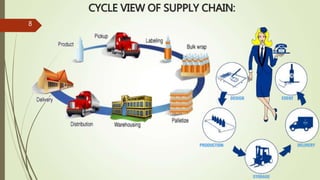
CYCLE VIEW OF SUPPLY CHAIN:
8
9
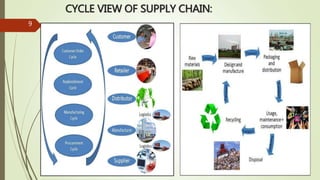
CYCLE VIEW OF SUPPLY CHAIN:
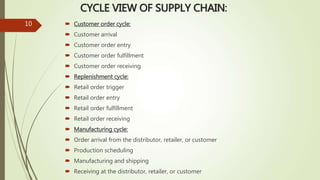
10  Customer order cycle:
 Customer arrival
 Customer order entry
 Customer order fulfillment
 Customer order receiving
 Replenishment cycle:
 Retail order trigger
 Retail order entry
 Retail order fulfillment
 Retail order receiving
 Manufacturing cycle:
 Order arrival from the distributor, retailer, or customer
 Production scheduling
 Manufacturing and shipping
 Receiving at the distributor, retailer, or customer
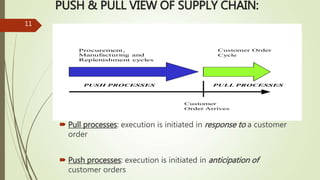
Procurement,
Manufacturing and
Replenishment cycles
Customer Order
Cycle
Customer
Order Arrives
PUSH PROCESSES PULL PROCESSES
PUSH & PULL VIEW OF SUPPLY CHAIN:
 Pull processes: execution is initiated in response to a customer
order
 Push processes: execution is initiated in anticipation of
customer orders
11
SUPPLY CHAIN DESIGN:
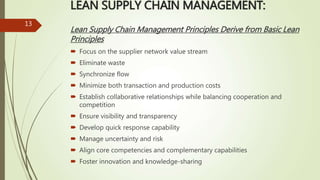
 Three Components:
 Insourcing/OutSourcing:
 The Make/Buy or Vertical Integration Decision
 Partner Selection:
 Choice of suppliers and partners for the chain
 The Contractual Relationship:
 Arm's length, joint venture, long-term contract, strategic alliance,
equity participation, etc.
.
12
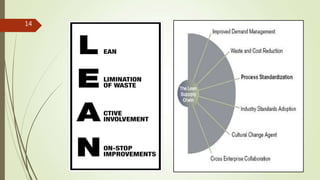
LEAN SUPPLY CHAIN MANAGEMENT:
Lean Supply Chain Management Principles Derive from Basic Lean
Principles
 Focus on the supplier network value stream
 Eliminate waste
 Synchronize flow
 Minimize both transaction and production costs
 Establish collaborative relationships while balancing cooperation and
competition
 Ensure visibility and transparency
 Develop quick response capability
 Manage uncertainty and risk
 Align core competencies and complementary capabilities
 Foster innovation and knowledge-sharing
13
14
15
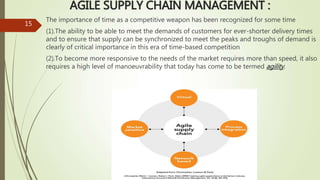
AGILE SUPPLY CHAIN MANAGEMENT :
The importance of time as a competitive weapon has been recognized for some time
(1).The ability to be able to meet the demands of customers for ever-shorter delivery times
and to ensure that supply can be synchronized to meet the peaks and troughs of demand is
clearly of critical importance in this era of time-based competition
(2).To become more responsive to the needs of the market requires more than speed, it also
requires a high level of manoeuvrability that today has come to be termed agility.
WHAT IS AGILITY:
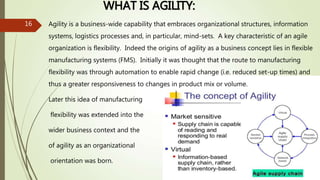
16 Agility is a business-wide capability that embraces organizational structures, information
systems, logistics processes and, in particular, mind-sets. A key characteristic of an agile
organization is flexibility. Indeed the origins of agility as a business concept lies in flexible
manufacturing systems (FMS). Initially it was thought that the route to manufacturing
flexibility was through automation to enable rapid change (i.e. reduced set-up times) and
thus a greater responsiveness to changes in product mix or volume.
Later this idea of manufacturing
flexibility was extended into the
wider business context and the
of agility as an organizational
orientation was born.
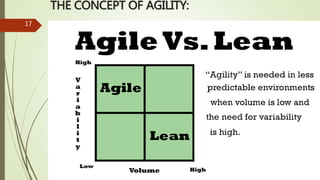
THE CONCEPT OF AGILITY:
17
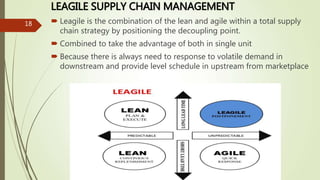
LEAGILE SUPPLY CHAIN MANAGEMENT
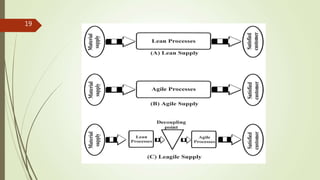
 Leagile is the combination of the lean and agile within a total supply
chain strategy by positioning the decoupling point.
 Combined to take the advantage of both in single unit
 Because there is always need to response to volatile demand in
downstream and provide level schedule in upstream from marketplace
18
19
CONCLUSION
Supply chain management is an exciting and important area of
study. Specialist companies like Exel are able to save the world’s
leading businesses large amounts of money, time and effort by
creating an effective supply chain. Next time you see a new VW
Beetle you will be better able to appreciate that the high quality of
the product and its value for money are not only a result of high
quality design and engineering, but also a direct result of lean
production, just-in-time methods and premium supply chain
management.
20
THANK YOU
21

PPT on SCM

  • 1.
    DEPARTMENT OF MECHANICAL ENGINEERING -:PRESENTATION ON :- SUPPLY CHAIN MANAGEMENT IN AUTOMOBILE INDUSTRY 1 SUBMITTED BY: Aditya Bhattacharjee- Roll No: 27600712006 Akash Dutta- Roll No: 27600712008 Debasish Basak- Roll No: 27600712025 Monojit Chandra- Roll No: 27600712050 Nitesh Khaitan- Roll No: 27600712055 Prakash Sharma- Roll No: 27600712059 Mustaba Nayej- Roll No: 27600712062
  • 2.
    INDEX INTRODUCTION SUPPLY CHAIN MANAGEMENT LEANSUPPLY CHAIN MANAGEMENT AGILE SUPPLY CHAIN MANAGEMENT LEAGILE SUPPLY CHAIN MANAGEMENT CONCLUSION 2
  • 3.
    INTRODUCTION: Supply Chain Managementencompasses every effort involved in producing and delivering a final product or service, from the supplier’s supplier to the customer’s customer. Supply Chain Management includes managing supply and demand, sourcing raw materials and parts, manufacturing and assembly, warehousing and inventory tracking, order entry and order management, distribution across all channels, and delivery to the customer. 3
  • 4.
    4 Supplier Supplier Supplier Storage } Mfg.Dist. Retailer CustomerStorage Supplier Supplier Storage } Service Customer
  • 5.
  • 6.
    NECESSITY OF THESUPPLY CHAIN MANAGEMENT:  Strategic Advantage : It Can Drive Strategy  Manufacturing is becoming more efficient.  SCM offers opportunity for differentiation or cost reduction.  Globalization : It covers the world  Requires greater coordination of production and distribution.  Increased risk of supply chain interruption.  Increases need for robust and flexible supply chains.  At the company level, supply chain management impacts.  Cost :  For many products, 20% to 40% of total product costs are controllable logistics costs.  Service : For many products, performance factors such as inventory availability and speed of delivery are critical to customer satisfaction. 6
  • 7.
    OBJECTIVES OF SUPPLYCHAIN MANAGEMENT:  Purchasing :  Stable volume Requirements.  Flexible delivery time.  Little variation in mix.  Large quantities.  Manufacturing :  Long run production.  High quality.  High Productivity.  Low production cost  Warehousing :  Low inventory.  Reduced transportation costs.  Quick Replenishment capability.  Customers :  Short order lead time.  High in stock.  Enormous variety of products.  Low prices. 7
  • 8.
    CYCLE VIEW OFSUPPLY CHAIN: 8
  • 9.
    9 CYCLE VIEW OFSUPPLY CHAIN:
  • 10.
    CYCLE VIEW OFSUPPLY CHAIN: 10  Customer order cycle:  Customer arrival  Customer order entry  Customer order fulfillment  Customer order receiving  Replenishment cycle:  Retail order trigger  Retail order entry  Retail order fulfillment  Retail order receiving  Manufacturing cycle:  Order arrival from the distributor, retailer, or customer  Production scheduling  Manufacturing and shipping  Receiving at the distributor, retailer, or customer
  • 11.
    Procurement, Manufacturing and Replenishment cycles CustomerOrder Cycle Customer Order Arrives PUSH PROCESSES PULL PROCESSES PUSH & PULL VIEW OF SUPPLY CHAIN:  Pull processes: execution is initiated in response to a customer order  Push processes: execution is initiated in anticipation of customer orders 11
  • 12.
    SUPPLY CHAIN DESIGN: Three Components:  Insourcing/OutSourcing:  The Make/Buy or Vertical Integration Decision  Partner Selection:  Choice of suppliers and partners for the chain  The Contractual Relationship:  Arm's length, joint venture, long-term contract, strategic alliance, equity participation, etc. . 12
  • 13.
    LEAN SUPPLY CHAINMANAGEMENT: Lean Supply Chain Management Principles Derive from Basic Lean Principles  Focus on the supplier network value stream  Eliminate waste  Synchronize flow  Minimize both transaction and production costs  Establish collaborative relationships while balancing cooperation and competition  Ensure visibility and transparency  Develop quick response capability  Manage uncertainty and risk  Align core competencies and complementary capabilities  Foster innovation and knowledge-sharing 13
  • 14.
  • 15.
    15 AGILE SUPPLY CHAINMANAGEMENT : The importance of time as a competitive weapon has been recognized for some time (1).The ability to be able to meet the demands of customers for ever-shorter delivery times and to ensure that supply can be synchronized to meet the peaks and troughs of demand is clearly of critical importance in this era of time-based competition (2).To become more responsive to the needs of the market requires more than speed, it also requires a high level of manoeuvrability that today has come to be termed agility.
  • 16.
    WHAT IS AGILITY: 16Agility is a business-wide capability that embraces organizational structures, information systems, logistics processes and, in particular, mind-sets. A key characteristic of an agile organization is flexibility. Indeed the origins of agility as a business concept lies in flexible manufacturing systems (FMS). Initially it was thought that the route to manufacturing flexibility was through automation to enable rapid change (i.e. reduced set-up times) and thus a greater responsiveness to changes in product mix or volume. Later this idea of manufacturing flexibility was extended into the wider business context and the of agility as an organizational orientation was born.
  • 17.
    THE CONCEPT OFAGILITY: 17
  • 18.
    LEAGILE SUPPLY CHAINMANAGEMENT  Leagile is the combination of the lean and agile within a total supply chain strategy by positioning the decoupling point.  Combined to take the advantage of both in single unit  Because there is always need to response to volatile demand in downstream and provide level schedule in upstream from marketplace 18
  • 19.
  • 20.
    CONCLUSION Supply chain managementis an exciting and important area of study. Specialist companies like Exel are able to save the world’s leading businesses large amounts of money, time and effort by creating an effective supply chain. Next time you see a new VW Beetle you will be better able to appreciate that the high quality of the product and its value for money are not only a result of high quality design and engineering, but also a direct result of lean production, just-in-time methods and premium supply chain management. 20
  • 21.