Conductors and insulators
When it comes to the flow of electric current, all materials fall into three categories:
When it comes to the flow of electric current, all materials fall into three categories: insulators
When it comes to the flow of electric current, all materials fall into three categories: insulators conductors
When it comes to the flow of electric current, all materials fall into three categories: insulators conductors resistors
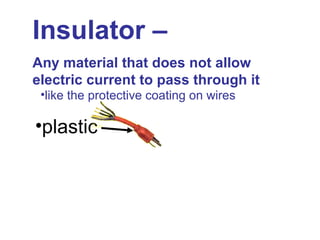
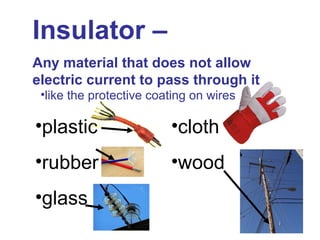
Insulator – Any material that does not allow electric current to pass through it plastic rubber glass like the protective coating on wires
Insulator – Any material that does not allow electric current to pass through it plastic cloth wood like the protective coating on wires
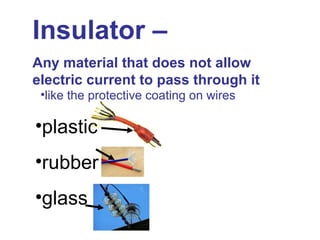
Insulator – Any material that does not allow electric current to pass through it plastic rubber glass cloth wood like the protective coating on wires
Insulators like plastic and rubber are used as a covering for electric wires.  This makes electric wires safer to handle because the insulator protects you from the current.
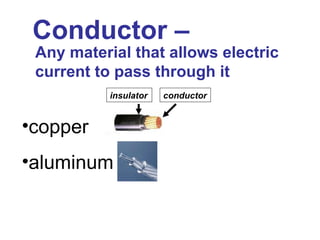
Conductor – insulator conductor Any material that allows electric current to pass through it
Conductor – copper insulator conductor Any material that allows electric current to pass through it
Conductor – copper aluminum insulator conductor Any material that allows electric current to pass through it
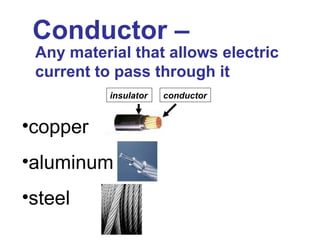
Conductor – copper aluminum steel insulator conductor Any material that allows electric current to pass through it
Conductor – copper aluminum steel any metal insulator conductor Any material that allows electric current to pass through it
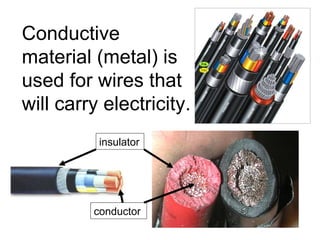
Conductive material (metal) is used for wires that will carry electricity. insulator conductor
A material or a device that allows some current to pass but converts some of the current to another form of energy.  Resistor Light energy Motion energy Heat energy Sound  energy
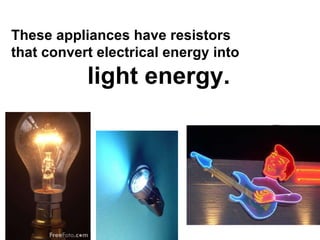
into light energy Motion energy eat energy Sound  energy These appliances have resistors  that convert electrical energy into  light energy.
Light energy Motion energy Heat energy Sound  energy These appliances have resistors that turn electrical energy into   motion energy.
Light energy Motion energy Heat energy Sound  energy These appliances have resistors that change electrical energy into   heat energy.
These appliances have resistors that convert electrical energy into  sound energy.
Useful electric current can only move through a path of conductive material.
Useful electric current can only move through a path of conductive material. This path is called a …..
Circuit A path for electric current
An electric circuit might be  open or closed. A path for electric current
Closed Circuit An unbroken path for electric current  (no gaps, current can flow). The light is on
Open Circuit A path for electric current that has a gap  (no current can flow). gap The light is off
Most electrical devices  have a  switch  in the circuit to make it easy to close (turn on) and open (turn off) the circuit.
Switch  A tool to open and close a circuit switch
A circuit can also be  opened and closed by touching two wires together. Open circuit Closed circuit No current can flow current can flow
A circuit can also be closed by touching those two wires to a conductor. ed circuit current can flow
 

Conductors and insulators

  • 1.
  • 2.
    When it comesto the flow of electric current, all materials fall into three categories:
  • 3.
    When it comesto the flow of electric current, all materials fall into three categories: insulators
  • 4.
    When it comesto the flow of electric current, all materials fall into three categories: insulators conductors
  • 5.
    When it comesto the flow of electric current, all materials fall into three categories: insulators conductors resistors
  • 6.
    Insulator – Anymaterial that does not allow electric current to pass through it plastic rubber glass like the protective coating on wires
  • 7.
    Insulator – Anymaterial that does not allow electric current to pass through it plastic cloth wood like the protective coating on wires
  • 8.
    Insulator – Anymaterial that does not allow electric current to pass through it plastic rubber glass cloth wood like the protective coating on wires
  • 9.
    Insulator – Anymaterial that does not allow electric current to pass through it plastic rubber glass cloth wood like the protective coating on wires
  • 10.
    Insulator – Anymaterial that does not allow electric current to pass through it plastic rubber glass cloth wood like the protective coating on wires
  • 11.
    Insulator – Anymaterial that does not allow electric current to pass through it plastic rubber glass cloth wood like the protective coating on wires
  • 12.
    Insulators like plasticand rubber are used as a covering for electric wires. This makes electric wires safer to handle because the insulator protects you from the current.
  • 13.
    Conductor – insulatorconductor Any material that allows electric current to pass through it
  • 14.
    Conductor – copperinsulator conductor Any material that allows electric current to pass through it
  • 15.
    Conductor – copperaluminum insulator conductor Any material that allows electric current to pass through it
  • 16.
    Conductor – copperaluminum steel insulator conductor Any material that allows electric current to pass through it
  • 17.
    Conductor – copperaluminum steel any metal insulator conductor Any material that allows electric current to pass through it
  • 18.
    Conductive material (metal)is used for wires that will carry electricity. insulator conductor
  • 19.
    A material ora device that allows some current to pass but converts some of the current to another form of energy. Resistor Light energy Motion energy Heat energy Sound energy
  • 20.
    into light energyMotion energy eat energy Sound energy These appliances have resistors that convert electrical energy into light energy.
  • 21.
    Light energy Motionenergy Heat energy Sound energy These appliances have resistors that turn electrical energy into motion energy.
  • 22.
    Light energy Motionenergy Heat energy Sound energy These appliances have resistors that change electrical energy into heat energy.
  • 23.
    These appliances haveresistors that convert electrical energy into sound energy.
  • 24.
    Useful electric currentcan only move through a path of conductive material.
  • 25.
    Useful electric currentcan only move through a path of conductive material. This path is called a …..
  • 26.
    Circuit A pathfor electric current
  • 27.
    An electric circuitmight be open or closed. A path for electric current
  • 28.
    Closed Circuit Anunbroken path for electric current (no gaps, current can flow). The light is on
  • 29.
    Open Circuit Apath for electric current that has a gap (no current can flow). gap The light is off
  • 30.
    Most electrical devices have a switch in the circuit to make it easy to close (turn on) and open (turn off) the circuit.
  • 31.
    Switch Atool to open and close a circuit switch
  • 32.
    A circuit canalso be opened and closed by touching two wires together. Open circuit Closed circuit No current can flow current can flow
  • 33.
    A circuit canalso be closed by touching those two wires to a conductor. ed circuit current can flow
  • 34.