Current Electricity Veronica August University of Phoenix CMP 555: Designing and Producing Educational Technology Instructor: Janet Luch June 20, 2008
Objectives Learn: Circuits must be complete in order for them to work properly. Do: Identify the components of a complete circuit. SIF: You can create a complete circuit by selecting different conductors.
Introduction to Current Electricity (Discovery Education, 2008)
Current Electricity Electricity runs many objects in our everyday life.  What are some objects that use current electricity? Current electricity is the flow of electrons through a conductor (Furgang, 2004). How would life be different if we didn’t have electricity?
Current Electricity is All Around Us (Discovery Education, 2008)
Circuits All current electricity flows through circuits.  Circuits are closed paths where the electrons can flow through (Furgang, 2004). If there is a break in the circuit the electrons will no longer flow. Draw a picture of a closed and open circuit.
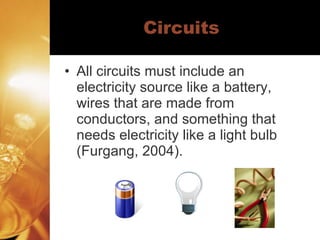
Circuits All circuits must include an electricity source like a battery, wires that are made from conductors, and something that needs electricity like a light bulb (Furgang, 2004).
Conductors Conductors allow energy to pass through freely.  Metals Water Heated Gases Human Body
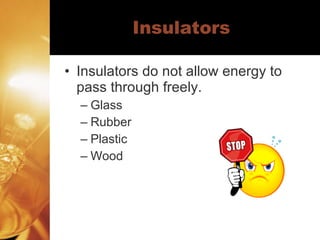
Insulators Insulators do not allow energy to pass through freely. Glass  Rubber Plastic Wood
Switches Why do we have light switches? How do you think they work? The job of a switch is to open or close a circuit. Let’s look inside to see what is happening.
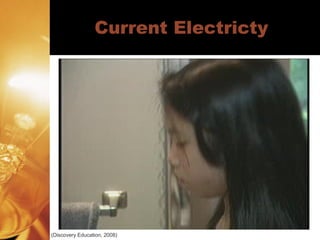
Current Electricty (Discovery Education, 2008)
Switches http://faraday.physics.utoronto.ca/PVB/Harrison/Flash/LightSwitch/LightSwitch.html
More Circuits Go to the following site and follow the directions on screen http://www.bbc.co.uk/schools/ks2bitesize/science/activities/conductors.shtml
What did you learn? Take the quiz to see what you have learned. http://www.bbc.co.uk/schools/ks2bitesize/science/tests/conductors.shtml
References An Introduction to Current Electricity. Discovery Education (2008). Retrieved June 27, 2008, from unitedstreaming: http://streaming.discoveryeducation.com/  CBBC. Science: Materials, circuits, and conductors interactive. Retrieved April 25, 2008, from http://www.bbc.co.uk/schools/ks2bitesize/science/activities/conductors.shtml CBBC. Science: Materials, circuits, and conductors online quiz. Retreived April 25,3008 http://www.bbc.co.uk/schools/ks2bitesize/science/tests/conductors.shtml Current Electricity. Discovery Education (2008). Retrieved June 27, 2008, from unitedstreaming: http://streaming.discoveryeducation.com/  Electricity is a Form of Energy All Around Us. Discovery Education (2008). Retrieved June 27, 2008, from unitedstreaming: http://streaming.discoveryeducation.com/  Furgang, K. (2004)  Working With Electricity and Magnetism.  New York, NY: Benchmark Education Company, LLC.   Harrison, D., M. (2007). Retrieved April 25, 2008, from  http://faraday.physics.utoronto.ca/PVB/Harrison/Flash/LightSwitch/LightSwitch.html

Electricity

  • 1.
    Current Electricity VeronicaAugust University of Phoenix CMP 555: Designing and Producing Educational Technology Instructor: Janet Luch June 20, 2008
  • 2.
    Objectives Learn: Circuitsmust be complete in order for them to work properly. Do: Identify the components of a complete circuit. SIF: You can create a complete circuit by selecting different conductors.
  • 3.
    Introduction to CurrentElectricity (Discovery Education, 2008)
  • 4.
    Current Electricity Electricityruns many objects in our everyday life. What are some objects that use current electricity? Current electricity is the flow of electrons through a conductor (Furgang, 2004). How would life be different if we didn’t have electricity?
  • 5.
    Current Electricity isAll Around Us (Discovery Education, 2008)
  • 6.
    Circuits All currentelectricity flows through circuits. Circuits are closed paths where the electrons can flow through (Furgang, 2004). If there is a break in the circuit the electrons will no longer flow. Draw a picture of a closed and open circuit.
  • 7.
    Circuits All circuitsmust include an electricity source like a battery, wires that are made from conductors, and something that needs electricity like a light bulb (Furgang, 2004).
  • 8.
    Conductors Conductors allowenergy to pass through freely. Metals Water Heated Gases Human Body
  • 9.
    Insulators Insulators donot allow energy to pass through freely. Glass Rubber Plastic Wood
  • 10.
    Switches Why dowe have light switches? How do you think they work? The job of a switch is to open or close a circuit. Let’s look inside to see what is happening.
  • 11.
  • 12.
  • 13.
    More Circuits Goto the following site and follow the directions on screen http://www.bbc.co.uk/schools/ks2bitesize/science/activities/conductors.shtml
  • 14.
    What did youlearn? Take the quiz to see what you have learned. http://www.bbc.co.uk/schools/ks2bitesize/science/tests/conductors.shtml
  • 15.
    References An Introductionto Current Electricity. Discovery Education (2008). Retrieved June 27, 2008, from unitedstreaming: http://streaming.discoveryeducation.com/ CBBC. Science: Materials, circuits, and conductors interactive. Retrieved April 25, 2008, from http://www.bbc.co.uk/schools/ks2bitesize/science/activities/conductors.shtml CBBC. Science: Materials, circuits, and conductors online quiz. Retreived April 25,3008 http://www.bbc.co.uk/schools/ks2bitesize/science/tests/conductors.shtml Current Electricity. Discovery Education (2008). Retrieved June 27, 2008, from unitedstreaming: http://streaming.discoveryeducation.com/ Electricity is a Form of Energy All Around Us. Discovery Education (2008). Retrieved June 27, 2008, from unitedstreaming: http://streaming.discoveryeducation.com/ Furgang, K. (2004) Working With Electricity and Magnetism. New York, NY: Benchmark Education Company, LLC. Harrison, D., M. (2007). Retrieved April 25, 2008, from http://faraday.physics.utoronto.ca/PVB/Harrison/Flash/LightSwitch/LightSwitch.html