
OMega TechEd
5
BUSINESS INTELLIGENCE
Types Of Mathematical Models
Mrs. Megha Sharma
M.Sc. Computer Science. B.Ed.
OMega TechEd
Mathematical
Models
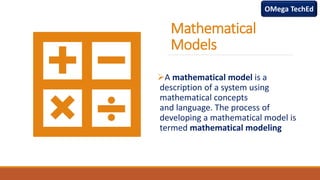
A mathematical model is a
description of a system using
mathematical concepts
and language. The process of
developing a mathematical model is
termed mathematical modeling
OMega TechEd
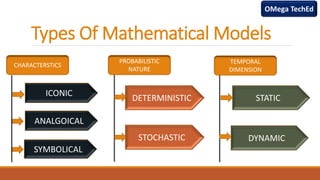
Types Of Mathematical Models
ICONIC
STOCHASTIC
DETERMINISTIC
ANALGOICAL
SYMBOLICAL
DYNAMIC
STATIC
CHARACTERSTICS
TEMPORAL
DIMENSION
PROBABILISTIC
NATURE
OMega TechEd
ICONIC
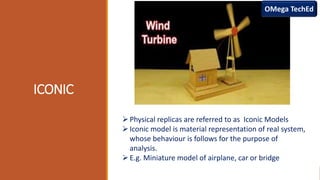
Physical replicas are referred to as Iconic Models
Iconic model is material representation of real system,
whose behaviour is follows for the purpose of
analysis.
E.g. Miniature model of airplane, car or bridge
OMega TechEd
ANALOGICAL
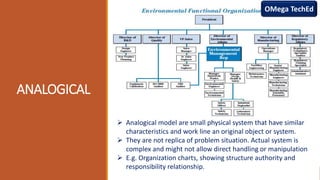
 Analogical model are small physical system that have similar
characteristics and work line an original object or system.
 They are not replica of problem situation. Actual system is
complex and might not allow direct handling or manipulation
 E.g. Organization charts, showing structure authority and
responsibility relationship.
OMega TechEd
SYMBOLICAL
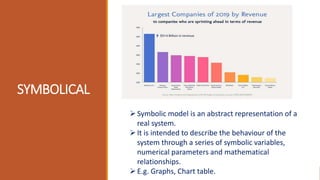
Symbolic model is an abstract representation of a
real system.
It is intended to describe the behaviour of the
system through a series of symbolic variables,
numerical parameters and mathematical
relationships.
E.g. Graphs, Chart table.
DETERMINISTIC
All data inputs are supposed to be known a prior with
certainty.
In this model everything is predefined, and results are
uncertain. Beneficial for a variety of management
problems.
a deterministic system is a system in which no
randomness is involved in the development of future
states of the system.
A deterministic model will thus always produce the same
output from a given starting condition or initial state
It can help to reach the right business based on an ideal
customer profile.
E.g. Calculation to determine selling price if cost price is
200 and profit is 20%
OMega TechEd
STOCHASTIC
A stochastic model is a tool for estimating probability
distributions of potential outcomes by allowing for random
variation in one or more inputs over time.
In this model some input information represents random
events and is therefore characterized by a probability
distribution.
In these models some inputs to the model are not known
with certainly.
Often used for strategic decision making involving an
organization relationship to its environment.
E.g. Predictive models, waiting line models.
OMega TechEd
STATIC
A static model describes the static structure of the
system being modeled, which is considered less likely to
change than the functions of the system.
Static model consider a given system and the related
decision-making processes within one single temporal
stage.
E.g. Regression Models.
OMega TechEd
DYNAMIC
The dynamic model represents the time–dependent
aspects of a system. It is concerned with the temporal
changes in the states of the objects in a system.
With a dynamic model processes are continuously
adjusted based on an analysis of context specific failures
and ensure that each step contributes to positive result.
E.g. An order interacts with inventory to determine
product availability.
OMega TechEd
Thanks For Watching.
Next Topic : Classes Of Models.
About the Channel
This channel helps you to prepare for BSc IT and BSc computer science subjects.
In this channel we will learn Business Intelligence , Digital Electronics,
Internet OF Things Python programming , Data-Structure etc.
Which is useful for upcoming university exams.
Gmail: omega.teched@gmail.com
Social Media Handles:
https://www.instagram.com/omega.teched/
https://twitter.com/megha_with
OMega TechED

Types of Mathematical Model.

  • 1.
  • 2.
    BUSINESS INTELLIGENCE Types OfMathematical Models Mrs. Megha Sharma M.Sc. Computer Science. B.Ed. OMega TechEd
  • 3.
    Mathematical Models A mathematical modelis a description of a system using mathematical concepts and language. The process of developing a mathematical model is termed mathematical modeling OMega TechEd
  • 4.
    Types Of MathematicalModels ICONIC STOCHASTIC DETERMINISTIC ANALGOICAL SYMBOLICAL DYNAMIC STATIC CHARACTERSTICS TEMPORAL DIMENSION PROBABILISTIC NATURE OMega TechEd
  • 5.
    ICONIC Physical replicas arereferred to as Iconic Models Iconic model is material representation of real system, whose behaviour is follows for the purpose of analysis. E.g. Miniature model of airplane, car or bridge OMega TechEd
  • 6.
    ANALOGICAL  Analogical modelare small physical system that have similar characteristics and work line an original object or system.  They are not replica of problem situation. Actual system is complex and might not allow direct handling or manipulation  E.g. Organization charts, showing structure authority and responsibility relationship. OMega TechEd
  • 7.
    SYMBOLICAL Symbolic model isan abstract representation of a real system. It is intended to describe the behaviour of the system through a series of symbolic variables, numerical parameters and mathematical relationships. E.g. Graphs, Chart table.
  • 8.
    DETERMINISTIC All data inputsare supposed to be known a prior with certainty. In this model everything is predefined, and results are uncertain. Beneficial for a variety of management problems. a deterministic system is a system in which no randomness is involved in the development of future states of the system. A deterministic model will thus always produce the same output from a given starting condition or initial state It can help to reach the right business based on an ideal customer profile. E.g. Calculation to determine selling price if cost price is 200 and profit is 20% OMega TechEd
  • 9.
    STOCHASTIC A stochastic modelis a tool for estimating probability distributions of potential outcomes by allowing for random variation in one or more inputs over time. In this model some input information represents random events and is therefore characterized by a probability distribution. In these models some inputs to the model are not known with certainly. Often used for strategic decision making involving an organization relationship to its environment. E.g. Predictive models, waiting line models. OMega TechEd
  • 10.
    STATIC A static modeldescribes the static structure of the system being modeled, which is considered less likely to change than the functions of the system. Static model consider a given system and the related decision-making processes within one single temporal stage. E.g. Regression Models. OMega TechEd
  • 11.
    DYNAMIC The dynamic modelrepresents the time–dependent aspects of a system. It is concerned with the temporal changes in the states of the objects in a system. With a dynamic model processes are continuously adjusted based on an analysis of context specific failures and ensure that each step contributes to positive result. E.g. An order interacts with inventory to determine product availability. OMega TechEd
  • 12.
    Thanks For Watching. NextTopic : Classes Of Models.
  • 13.
    About the Channel Thischannel helps you to prepare for BSc IT and BSc computer science subjects. In this channel we will learn Business Intelligence , Digital Electronics, Internet OF Things Python programming , Data-Structure etc. Which is useful for upcoming university exams. Gmail: omega.teched@gmail.com Social Media Handles: https://www.instagram.com/omega.teched/ https://twitter.com/megha_with OMega TechED