Liver Function Tests
Cavite State University – Main Campus
College of Nursing, Department of MedicalTechnology
Clinical Chemistry 2 Laboratory
Liver FunctionTests
• Storage
• Metabolism
– Carbohydrates, Lipids, Proteins
• Synthetic
– Synthetic site of plasma proteins
• Detoxification
– Ammonia
• Excretory and Secretory
– Biliary system
Biochemical Functions
Cavite State University – Main Campus
College of Nursing, Department of MedicalTechnology
Clinical Chemistry 2 Laboratory
Liver FunctionTests
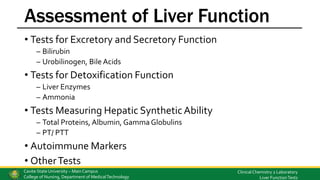
• Tests for Excretory and Secretory Function
– Bilirubin
– Urobilinogen, Bile Acids
• Tests for Detoxification Function
– Liver Enzymes
– Ammonia
• Tests Measuring Hepatic SyntheticAbility
– Total Proteins, Albumin, Gamma Globulins
– PT/ PTT
• Autoimmune Markers
• OtherTests
Assessment of Liver Function
Cavite State University – Main Campus
College of Nursing, Department of MedicalTechnology
Clinical Chemistry 2 Laboratory
Liver FunctionTests
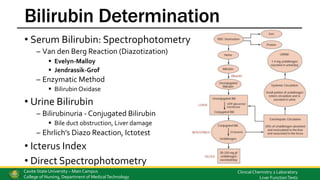
• Serum Bilirubin: Spectrophotometry
– Van den Berg Reaction (Diazotization)
 Evelyn-Malloy
 Jendrassik-Grof
– Enzymatic Method
 Bilirubin Oxidase
• Urine Bilirubin
– Bilirubinuria - Conjugated Bilirubin
 Bile duct obstruction, Liver damage
– Ehrlich’s Diazo Reaction, Ictotest
• Icterus Index
• Direct Spectrophotometry
Bilirubin Determination
Cavite State University – Main Campus
College of Nursing, Department of MedicalTechnology
Clinical Chemistry 2 Laboratory
Liver FunctionTests
RBCs breakdown: 120 days
Degraded by macrophages
releasing hemoglobin
molecules
HEMOGLOBIN
HEME
(Porphyrin
ring)
GLOBIN
BROKEN DOWN TO AMINO ACIDS
RE-ENTERS BLOOD FOR
ERYTHROPOIESIS
UNCONJUGATED
BILIRUBIN
IRON
ALBUMIN
RE-ENTERS BLOOD FOR
ERYTHROPOIESIS
 NOT RECYCLED
 YELLOWISH ORANGE COLOR
 LIPID SOLUBLE
BILIVERDIN
UNCONJUGATED
BILIRUBIN
CONJUGATED
BILIRUBIN
GLUCORONIC
ACID
UDP-GLUCORONYL
TRANSFERASE
GLUCORONIC
ACID
CONJUGATED
BILIRUBIN
(WATER SOLUBLE)
GLUCORONIC
ACID
EXCRETED BY
THE LIVER IN
BILE
CB
CB
BACTERIA
UROBILINOGEN
10-15% RE-ABSORB
BY THE BLOOD
BOUND TO ALBUMIN
BACTERIA
85-90% OXIDIZE BY
BACTERIA
FORMING
STERCOBILIN
UROBILINOGEN
5% WILL PARTICIPATE IN
ENTEROHEPATIC
UROBILINOGEN CYCLE
UROBILINOGEN
5% TRANSPORTED BY THE
BLOOD TO THE KIDNEYS
UROBILIN
UROBILINOGEN
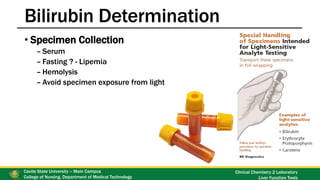
• Specimen Collection
– Serum
– Fasting ? - Lipemia
– Hemolysis
– Avoid specimen exposure from light
Bilirubin Determination
Cavite State University – Main Campus
College of Nursing, Department of Medical Technology
Clinical Chemistry 2 Laboratory
Liver Function Tests
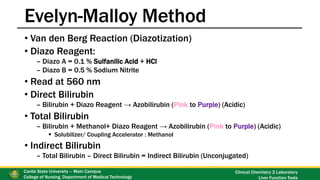
• Van den Berg Reaction (Diazotization)
• Diazo Reagent:
– Diazo A = 0.1 % Sulfanilic Acid + HCl
– Diazo B = 0.5 % Sodium Nitrite
• Read at 560 nm
• Direct Bilirubin
– Bilirubin + Diazo Reagent → Azobilirubin (Pink to Purple) (Acidic)
• Total Bilirubin
– Bilirubin + Methanol+ Diazo Reagent → Azobilirubin (Pink to Purple) (Acidic)
 Solubilizer/ Coupling Accelerator : Methanol
• Indirect Bilirubin
– Total Bilirubin – Direct Bilirubin = Indirect Bilirubin (Unconjugated)
Evelyn-Malloy Method
Cavite State University – Main Campus
College of Nursing, Department of Medical Technology
Clinical Chemistry 2 Laboratory
Liver Function Tests
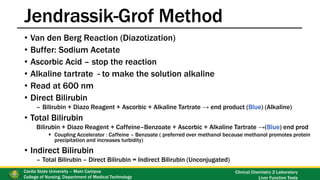
• Van den Berg Reaction (Diazotization)
• Buffer: Sodium Acetate
• Ascorbic Acid – stop the reaction
• Alkaline tartrate - to make the solution alkaline
• Read at 600 nm
• Direct Bilirubin
– Bilirubin + Diazo Reagent + Ascorbic + Alkaline Tartrate → end product (Blue) (Alkaline)
• Total Bilirubin
Bilirubin + Diazo Reagent + Caffeine–Benzoate + Ascorbic + Alkaline Tartrate →(Blue) end prod
 Coupling Accelerator : Caffeine – Benzoate ( preferred over methanol because methanol promotes protein
precipitation and increases turbidity)
• Indirect Bilirubin
– Total Bilirubin – Direct Bilirubin = Indirect Bilirubin (Unconjugated)
Jendrassik-Grof Method
Cavite State University – Main Campus
College of Nursing, Department of Medical Technology
Clinical Chemistry 2 Laboratory
Liver Function Tests
• Enzymatic Method
– pH 8.0: Total Bilirubin
Conjugated, Unconjugated, Delta Bilirubin Bilirubin Oxidase Biliverdin
– pH 4.5: Direct Bilirubin
Conjugated Bilirubin Bilirubin Oxidase Biliverdin
– Decrease in absorbance at 460 nm
Bilirubin Determination
Cavite State University – Main Campus
College of Nursing, Department of Medical Technology
Clinical Chemistry 2 Laboratory
Liver Function Tests
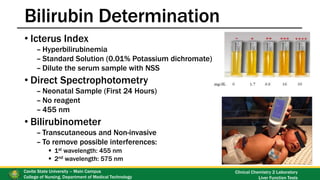
• Icterus Index
– Hyperbilirubinemia
– Standard Solution (0.01% Potassium dichromate)
– Dilute the serum sample with NSS
• Direct Spectrophotometry
– Neonatal Sample (First 24 Hours)
– No reagent
– 455 nm
• Bilirubinometer
– Transcutaneous and Non-invasive
– To remove possible interferences:
 1st wavelength: 455 nm
 2nd wavelength: 575 nm
Bilirubin Determination
Cavite State University – Main Campus
College of Nursing, Department of Medical Technology
Clinical Chemistry 2 Laboratory
Liver Function Tests
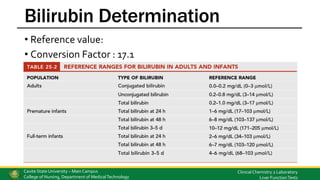
• Reference value:
• Conversion Factor : 17.1
Bilirubin Determination
Cavite State University – Main Campus
College of Nursing, Department of MedicalTechnology
Clinical Chemistry 2 Laboratory
Liver FunctionTests
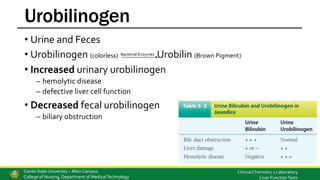
• Urine and Feces
• Urobilinogen (colorless) Bacterial Enzymes Urobilin (Brown Pigment)
• Increased urinary urobilinogen
– hemolytic disease
– defective liver cell function
• Decreased fecal urobilinogen
– biliary obstruction
Urobilinogen
Cavite State University – Main Campus
College of Nursing, Department of MedicalTechnology
Clinical Chemistry 2 Laboratory
Liver FunctionTests
• Ehrlich’s Reagent: p-dimethylaminobenzaldehyde (p-DAB)
• Urine Urobilinogen
– hour urine sample
– urobilinogen in urine + Ehrlich’s reagent red color (spectrophotometer)
– Reference value:
 0.1 to 1.0 Ehrlich unit every 2 hours
 0.5 to 4.0 Ehrlich units per day
• Fecal Urobilinogen
– Semi-quantitative determination
– aqueous extract of fresh feces
– Urobilin alkaline ferrous hydroxide urobilinogen + Ehrlich reagent red color
– Reference value:
 75 to 275 Ehrlich units per 100 grams of fresh feces
 75 to 400 Ehrlich units per 24-hour specimen
Ehrlich’s Test
Cavite State University – Main Campus
College of Nursing, Department of MedicalTechnology
Clinical Chemistry 2 Laboratory
Liver FunctionTests
• Increased Serum Bile Acids = Liver Disease
• Not Specific
• Ratio: Primary Bile Acids/Secondary BileAcids
– Cholic: Chenodeoxycholic acids
 High Ratio – Biliary Obstruction
 Low Ratio – Primary BiliaryCirrhosis
Serum Bile Acids
Cavite State University – Main Campus
College of Nursing, Department of MedicalTechnology
Clinical Chemistry 2 Laboratory
Liver FunctionTests
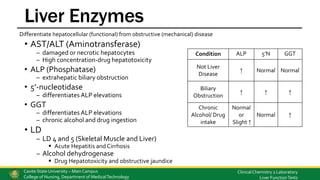
• AST/ALT (Aminotransferase)
– damaged or necrotic hepatocytes
– High concentration-drug hepatotoxicity
• ALP (Phosphatase)
– extrahepatic biliary obstruction
• 5’-nucleotidase
– differentiates ALP elevations
• GGT
– differentiates ALP elevations
– chronic alcohol and drug ingestion
• LD
– LD 4 and 5 (Skeletal Muscle and Liver)
 Acute Hepatitis and Cirrhosis
– Alcohol dehydrogenase
 Drug Hepatotoxicity and obstructive jaundice
Liver Enzymes
Cavite State University – Main Campus
College of Nursing, Department of MedicalTechnology
Clinical Chemistry 2 Laboratory
Liver FunctionTests
Condition ALP 5’N GGT
Not Liver
Disease
↑ Normal Normal
Biliary
Obstruction
↑ ↑ ↑
Chronic
Alcohol/ Drug
intake
Normal
or
Slight ↑
Normal ↑
Differentiate hepatocellular (functional) from obstructive (mechanical) disease
• ↑Ammonia = HepaticComa and advance liver disease
– For diagnosis of hepatic failure and Reye’s Syndrome
• Liver converts ammonia to urea
• Pre-Analytical:
– Plasma (EDTA or Heparin)
– Fasting Sample
– Avoid Hemolysis
– AvoidTourniquet, Fist Clenching
 Arterial is preferred
– No Exercise and Smoking
– Separate plasma and red cells –Transport on Ice
Ammonia
Cavite State University – Main Campus
College of Nursing, Department of MedicalTechnology
Clinical Chemistry 2 Laboratory
Liver FunctionTests
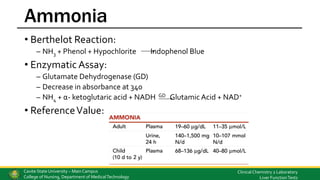
• Berthelot Reaction:
– NH3 + Phenol + Hypochlorite Indophenol Blue
• EnzymaticAssay:
– Glutamate Dehydrogenase (GD)
– Decrease in absorbance at 340
– NH4 + α- ketoglutaric acid + NADH GD Glutamic Acid + NAD+
• ReferenceValue:
Ammonia
Cavite State University – Main Campus
College of Nursing, Department of MedicalTechnology
Clinical Chemistry 2 Laboratory
Liver FunctionTests
• TPAG – Cirrhosis (Decrease)
• Albumin
• A/G ratio
• PT/ PTT
• Gamma globulins
– IgG and IgM
 Chronic active hepatitis
– IgM
 Biliary cirrhosis
– IgA
 Alcoholic Cirrhosis
Tests Measuring Hepatic Synthetic Activity
Cavite State University – Main Campus
College of Nursing, Department of MedicalTechnology
Clinical Chemistry 2 Laboratory
Liver FunctionTests
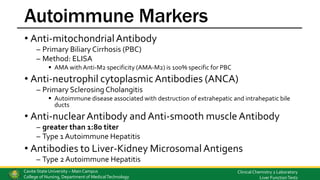
• Anti-mitochondrialAntibody
– Primary Biliary Cirrhosis (PBC)
– Method: ELISA
 AMA with Anti-M2 specificity (AMA-M2) is 100% specific for PBC
• Anti-neutrophil cytoplasmicAntibodies (ANCA)
– Primary Sclerosing Cholangitis
 Autoimmune disease associated with destruction of extrahepatic and intrahepatic bile
ducts
• Anti-nuclearAntibody and Anti-smooth muscle Antibody
– greater than 1:80 titer
– Type 1 Autoimmune Hepatitis
• Antibodies to Liver-Kidney Microsomal Antigens
– Type 2 Autoimmune Hepatitis
Autoimmune Markers
Cavite State University – Main Campus
College of Nursing, Department of MedicalTechnology
Clinical Chemistry 2 Laboratory
Liver FunctionTests
• Hepatitis Profile
• MELD Score (Model for End Stage Renal Disease)
– Bilirubin, INR (PT), Serum Creatinine
– Probability of survival of patients with liver disease
 TIPS –Transjugular Intrahepatic Post-systemic Shunt
 > 24 MELD Score =TIPS not recommended
• PGA Index
– ProthrombinTime (PT) - Prolonged
– Gamma glutamyl transferase (GGT) - Elevated
– Apo A1
 Increased –Alcoholic liver Hepatitis /Liver Injury
 Decreased - Cirrhosis
• A1 Anti-trypsin, Ceruloplasmin
– Excretory function of the liver
– Ceruloplasmin – Removed by the liver
– AAT- hereditary deficiency; associated with early cirrhosis
Other Tests
Cavite State University – Main Campus
College of Nursing, Department of MedicalTechnology
Clinical Chemistry 2 Laboratory
Liver FunctionTests
• Vitamin K ResponseTest
– Supplement –Vit. K
– Normal 2nd Test =Vit. K deficiency
• Hippuric Acid SynthesisTest
– Assess the detoxification function of the liver
– Normal liver = benzoate is detoxified into hippuric acid
– Normal Result: Hippuric Acid in the Urine
Other Tests
Cavite State University – Main Campus
College of Nursing, Department of MedicalTechnology
Clinical Chemistry 2 Laboratory
Liver FunctionTests
• Bishop, Fody, and Schoeff. ClinicalChemistry Principles,
Techniques, Correlations, Seventh Edition. 2013.
• McPherson, RichardA. and Pincus, Matthew. Henry’s
Clinical Diagnosis and Management by Laboratory Methods.
23rd Edition. Philadelphia: Elsevier Inc. 2017.
• Burtis, Ashwood, Bruns.Tietz Fundamentals of Clinical
Chemistry 6th edition. 2008
• Anderson and Cockayne. ClinicalChemistry Concepts and
Applications. 2003.
References
Cavite State University – Main Campus
College of Nursing, Department of MedicalTechnology
Clinical Chemistry 2 Laboratory
Liver FunctionTests
End of Presentation
Thank you and God Bless
Cavite State University – Main Campus
College of Nursing, Department of MedicalTechnology
Clinical Chemistry 2 Laboratory
Liver FunctionTests

Liver functrion tests

  • 1.
    Liver Function Tests CaviteState University – Main Campus College of Nursing, Department of MedicalTechnology Clinical Chemistry 2 Laboratory Liver FunctionTests
  • 2.
    • Storage • Metabolism –Carbohydrates, Lipids, Proteins • Synthetic – Synthetic site of plasma proteins • Detoxification – Ammonia • Excretory and Secretory – Biliary system Biochemical Functions Cavite State University – Main Campus College of Nursing, Department of MedicalTechnology Clinical Chemistry 2 Laboratory Liver FunctionTests
  • 3.
    • Tests forExcretory and Secretory Function – Bilirubin – Urobilinogen, Bile Acids • Tests for Detoxification Function – Liver Enzymes – Ammonia • Tests Measuring Hepatic SyntheticAbility – Total Proteins, Albumin, Gamma Globulins – PT/ PTT • Autoimmune Markers • OtherTests Assessment of Liver Function Cavite State University – Main Campus College of Nursing, Department of MedicalTechnology Clinical Chemistry 2 Laboratory Liver FunctionTests
  • 4.
    • Serum Bilirubin:Spectrophotometry – Van den Berg Reaction (Diazotization)  Evelyn-Malloy  Jendrassik-Grof – Enzymatic Method  Bilirubin Oxidase • Urine Bilirubin – Bilirubinuria - Conjugated Bilirubin  Bile duct obstruction, Liver damage – Ehrlich’s Diazo Reaction, Ictotest • Icterus Index • Direct Spectrophotometry Bilirubin Determination Cavite State University – Main Campus College of Nursing, Department of MedicalTechnology Clinical Chemistry 2 Laboratory Liver FunctionTests
  • 5.
    RBCs breakdown: 120days Degraded by macrophages releasing hemoglobin molecules HEMOGLOBIN HEME (Porphyrin ring) GLOBIN BROKEN DOWN TO AMINO ACIDS RE-ENTERS BLOOD FOR ERYTHROPOIESIS UNCONJUGATED BILIRUBIN IRON ALBUMIN RE-ENTERS BLOOD FOR ERYTHROPOIESIS  NOT RECYCLED  YELLOWISH ORANGE COLOR  LIPID SOLUBLE BILIVERDIN
  • 6.
  • 7.
    CONJUGATED BILIRUBIN (WATER SOLUBLE) GLUCORONIC ACID EXCRETED BY THELIVER IN BILE CB CB BACTERIA UROBILINOGEN 10-15% RE-ABSORB BY THE BLOOD BOUND TO ALBUMIN BACTERIA 85-90% OXIDIZE BY BACTERIA FORMING STERCOBILIN UROBILINOGEN 5% WILL PARTICIPATE IN ENTEROHEPATIC UROBILINOGEN CYCLE UROBILINOGEN 5% TRANSPORTED BY THE BLOOD TO THE KIDNEYS UROBILIN UROBILINOGEN
  • 8.
    • Specimen Collection –Serum – Fasting ? - Lipemia – Hemolysis – Avoid specimen exposure from light Bilirubin Determination Cavite State University – Main Campus College of Nursing, Department of Medical Technology Clinical Chemistry 2 Laboratory Liver Function Tests
  • 9.
    • Van denBerg Reaction (Diazotization) • Diazo Reagent: – Diazo A = 0.1 % Sulfanilic Acid + HCl – Diazo B = 0.5 % Sodium Nitrite • Read at 560 nm • Direct Bilirubin – Bilirubin + Diazo Reagent → Azobilirubin (Pink to Purple) (Acidic) • Total Bilirubin – Bilirubin + Methanol+ Diazo Reagent → Azobilirubin (Pink to Purple) (Acidic)  Solubilizer/ Coupling Accelerator : Methanol • Indirect Bilirubin – Total Bilirubin – Direct Bilirubin = Indirect Bilirubin (Unconjugated) Evelyn-Malloy Method Cavite State University – Main Campus College of Nursing, Department of Medical Technology Clinical Chemistry 2 Laboratory Liver Function Tests
  • 10.
    • Van denBerg Reaction (Diazotization) • Buffer: Sodium Acetate • Ascorbic Acid – stop the reaction • Alkaline tartrate - to make the solution alkaline • Read at 600 nm • Direct Bilirubin – Bilirubin + Diazo Reagent + Ascorbic + Alkaline Tartrate → end product (Blue) (Alkaline) • Total Bilirubin Bilirubin + Diazo Reagent + Caffeine–Benzoate + Ascorbic + Alkaline Tartrate →(Blue) end prod  Coupling Accelerator : Caffeine – Benzoate ( preferred over methanol because methanol promotes protein precipitation and increases turbidity) • Indirect Bilirubin – Total Bilirubin – Direct Bilirubin = Indirect Bilirubin (Unconjugated) Jendrassik-Grof Method Cavite State University – Main Campus College of Nursing, Department of Medical Technology Clinical Chemistry 2 Laboratory Liver Function Tests
  • 11.
    • Enzymatic Method –pH 8.0: Total Bilirubin Conjugated, Unconjugated, Delta Bilirubin Bilirubin Oxidase Biliverdin – pH 4.5: Direct Bilirubin Conjugated Bilirubin Bilirubin Oxidase Biliverdin – Decrease in absorbance at 460 nm Bilirubin Determination Cavite State University – Main Campus College of Nursing, Department of Medical Technology Clinical Chemistry 2 Laboratory Liver Function Tests
  • 12.
    • Icterus Index –Hyperbilirubinemia – Standard Solution (0.01% Potassium dichromate) – Dilute the serum sample with NSS • Direct Spectrophotometry – Neonatal Sample (First 24 Hours) – No reagent – 455 nm • Bilirubinometer – Transcutaneous and Non-invasive – To remove possible interferences:  1st wavelength: 455 nm  2nd wavelength: 575 nm Bilirubin Determination Cavite State University – Main Campus College of Nursing, Department of Medical Technology Clinical Chemistry 2 Laboratory Liver Function Tests
  • 13.
    • Reference value: •Conversion Factor : 17.1 Bilirubin Determination Cavite State University – Main Campus College of Nursing, Department of MedicalTechnology Clinical Chemistry 2 Laboratory Liver FunctionTests
  • 14.
    • Urine andFeces • Urobilinogen (colorless) Bacterial Enzymes Urobilin (Brown Pigment) • Increased urinary urobilinogen – hemolytic disease – defective liver cell function • Decreased fecal urobilinogen – biliary obstruction Urobilinogen Cavite State University – Main Campus College of Nursing, Department of MedicalTechnology Clinical Chemistry 2 Laboratory Liver FunctionTests
  • 15.
    • Ehrlich’s Reagent:p-dimethylaminobenzaldehyde (p-DAB) • Urine Urobilinogen – hour urine sample – urobilinogen in urine + Ehrlich’s reagent red color (spectrophotometer) – Reference value:  0.1 to 1.0 Ehrlich unit every 2 hours  0.5 to 4.0 Ehrlich units per day • Fecal Urobilinogen – Semi-quantitative determination – aqueous extract of fresh feces – Urobilin alkaline ferrous hydroxide urobilinogen + Ehrlich reagent red color – Reference value:  75 to 275 Ehrlich units per 100 grams of fresh feces  75 to 400 Ehrlich units per 24-hour specimen Ehrlich’s Test Cavite State University – Main Campus College of Nursing, Department of MedicalTechnology Clinical Chemistry 2 Laboratory Liver FunctionTests
  • 16.
    • Increased SerumBile Acids = Liver Disease • Not Specific • Ratio: Primary Bile Acids/Secondary BileAcids – Cholic: Chenodeoxycholic acids  High Ratio – Biliary Obstruction  Low Ratio – Primary BiliaryCirrhosis Serum Bile Acids Cavite State University – Main Campus College of Nursing, Department of MedicalTechnology Clinical Chemistry 2 Laboratory Liver FunctionTests
  • 17.
    • AST/ALT (Aminotransferase) –damaged or necrotic hepatocytes – High concentration-drug hepatotoxicity • ALP (Phosphatase) – extrahepatic biliary obstruction • 5’-nucleotidase – differentiates ALP elevations • GGT – differentiates ALP elevations – chronic alcohol and drug ingestion • LD – LD 4 and 5 (Skeletal Muscle and Liver)  Acute Hepatitis and Cirrhosis – Alcohol dehydrogenase  Drug Hepatotoxicity and obstructive jaundice Liver Enzymes Cavite State University – Main Campus College of Nursing, Department of MedicalTechnology Clinical Chemistry 2 Laboratory Liver FunctionTests Condition ALP 5’N GGT Not Liver Disease ↑ Normal Normal Biliary Obstruction ↑ ↑ ↑ Chronic Alcohol/ Drug intake Normal or Slight ↑ Normal ↑ Differentiate hepatocellular (functional) from obstructive (mechanical) disease
  • 18.
    • ↑Ammonia =HepaticComa and advance liver disease – For diagnosis of hepatic failure and Reye’s Syndrome • Liver converts ammonia to urea • Pre-Analytical: – Plasma (EDTA or Heparin) – Fasting Sample – Avoid Hemolysis – AvoidTourniquet, Fist Clenching  Arterial is preferred – No Exercise and Smoking – Separate plasma and red cells –Transport on Ice Ammonia Cavite State University – Main Campus College of Nursing, Department of MedicalTechnology Clinical Chemistry 2 Laboratory Liver FunctionTests
  • 19.
    • Berthelot Reaction: –NH3 + Phenol + Hypochlorite Indophenol Blue • EnzymaticAssay: – Glutamate Dehydrogenase (GD) – Decrease in absorbance at 340 – NH4 + α- ketoglutaric acid + NADH GD Glutamic Acid + NAD+ • ReferenceValue: Ammonia Cavite State University – Main Campus College of Nursing, Department of MedicalTechnology Clinical Chemistry 2 Laboratory Liver FunctionTests
  • 20.
    • TPAG –Cirrhosis (Decrease) • Albumin • A/G ratio • PT/ PTT • Gamma globulins – IgG and IgM  Chronic active hepatitis – IgM  Biliary cirrhosis – IgA  Alcoholic Cirrhosis Tests Measuring Hepatic Synthetic Activity Cavite State University – Main Campus College of Nursing, Department of MedicalTechnology Clinical Chemistry 2 Laboratory Liver FunctionTests
  • 21.
    • Anti-mitochondrialAntibody – PrimaryBiliary Cirrhosis (PBC) – Method: ELISA  AMA with Anti-M2 specificity (AMA-M2) is 100% specific for PBC • Anti-neutrophil cytoplasmicAntibodies (ANCA) – Primary Sclerosing Cholangitis  Autoimmune disease associated with destruction of extrahepatic and intrahepatic bile ducts • Anti-nuclearAntibody and Anti-smooth muscle Antibody – greater than 1:80 titer – Type 1 Autoimmune Hepatitis • Antibodies to Liver-Kidney Microsomal Antigens – Type 2 Autoimmune Hepatitis Autoimmune Markers Cavite State University – Main Campus College of Nursing, Department of MedicalTechnology Clinical Chemistry 2 Laboratory Liver FunctionTests
  • 22.
    • Hepatitis Profile •MELD Score (Model for End Stage Renal Disease) – Bilirubin, INR (PT), Serum Creatinine – Probability of survival of patients with liver disease  TIPS –Transjugular Intrahepatic Post-systemic Shunt  > 24 MELD Score =TIPS not recommended • PGA Index – ProthrombinTime (PT) - Prolonged – Gamma glutamyl transferase (GGT) - Elevated – Apo A1  Increased –Alcoholic liver Hepatitis /Liver Injury  Decreased - Cirrhosis • A1 Anti-trypsin, Ceruloplasmin – Excretory function of the liver – Ceruloplasmin – Removed by the liver – AAT- hereditary deficiency; associated with early cirrhosis Other Tests Cavite State University – Main Campus College of Nursing, Department of MedicalTechnology Clinical Chemistry 2 Laboratory Liver FunctionTests
  • 23.
    • Vitamin KResponseTest – Supplement –Vit. K – Normal 2nd Test =Vit. K deficiency • Hippuric Acid SynthesisTest – Assess the detoxification function of the liver – Normal liver = benzoate is detoxified into hippuric acid – Normal Result: Hippuric Acid in the Urine Other Tests Cavite State University – Main Campus College of Nursing, Department of MedicalTechnology Clinical Chemistry 2 Laboratory Liver FunctionTests
  • 24.
    • Bishop, Fody,and Schoeff. ClinicalChemistry Principles, Techniques, Correlations, Seventh Edition. 2013. • McPherson, RichardA. and Pincus, Matthew. Henry’s Clinical Diagnosis and Management by Laboratory Methods. 23rd Edition. Philadelphia: Elsevier Inc. 2017. • Burtis, Ashwood, Bruns.Tietz Fundamentals of Clinical Chemistry 6th edition. 2008 • Anderson and Cockayne. ClinicalChemistry Concepts and Applications. 2003. References Cavite State University – Main Campus College of Nursing, Department of MedicalTechnology Clinical Chemistry 2 Laboratory Liver FunctionTests
  • 25.
    End of Presentation Thankyou and God Bless Cavite State University – Main Campus College of Nursing, Department of MedicalTechnology Clinical Chemistry 2 Laboratory Liver FunctionTests