
Cerebral palsy
M. Sarhady MSc OT 2013
Occupational Therapy Department
Hamedan University of Medical Sciences
Email: msarhady1980@gmail.com
Cerebral Palsy
Was first described by William Little in 1862.
Then it was known as Little disease.
The term Cerebral palsy originated with Freud.
Definition
Cerebral palsy (CP) describes a group of permanent disorders of the
development of movement and posture, causing activity limitation, that
are attributed to non-progressive disturbances that occurred in the
developing fetal or infant brain. The motor disorders of cerebral palsy are
often accompanied by disturbances of sensation, perception, cognition,
communication, and behavior, by epilepsy, and by secondary
musculoskeletal problems.
KEY FEATUR ES OF THE DEF INITION
 CP is best seen as a group of closely related conditions,
heterogeneous both in manifestations and causes.
 CP is understood to be a disorder of motor development.
 CP must be of sufficient severity to cause activity limitation
 .
 CP is understood to be non-progressive disturbance of the brain
PREVALENCE
 The Incidence is between 2.4-2.7 per 1000
live births.
 In some references: 0.6 to 7cases per 1000
live births
 In preterm or low birth weight infants: 40 to
150 per 1000 live births
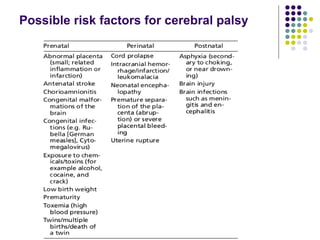
Possible risk factors for cerebral palsy
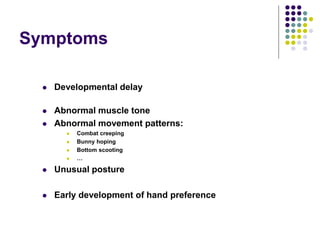
Symptoms
 Developmental delay
 Abnormal muscle tone
 Abnormal movement patterns:
 Combat creeping
 Bunny hoping
 Bottom scooting
 …
 Unusual posture
 Early development of hand preference
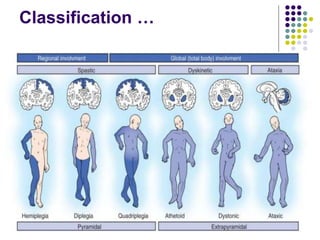
Classifications
• Topographical
• Physiological
• Functional
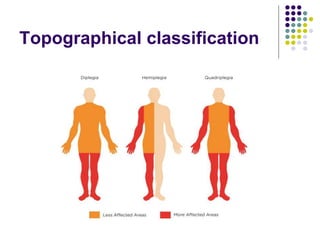
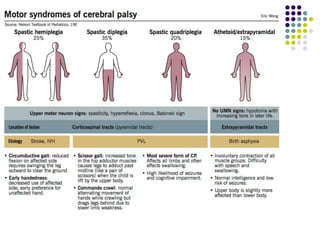
Topographical classification
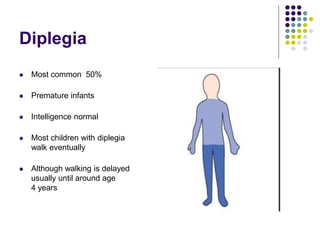
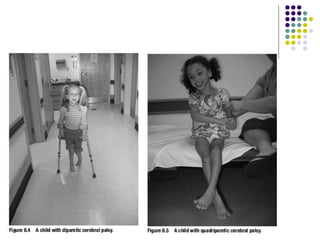
Diplegia
 Most common 50%
 Premature infants
 Intelligence normal
 Most children with diplegia
walk eventually
 Although walking is delayed
usually until around age
4 years
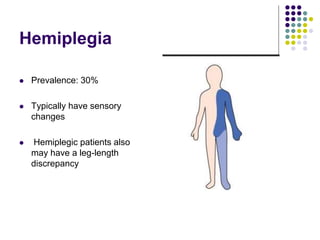
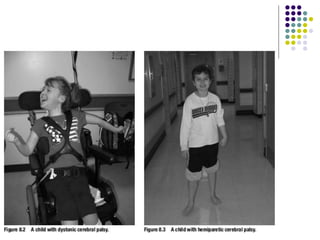
Hemiplegia
 Prevalence: 30%
 Typically have sensory
changes
 Hemiplegic patients also
may have a leg-length
discrepancy
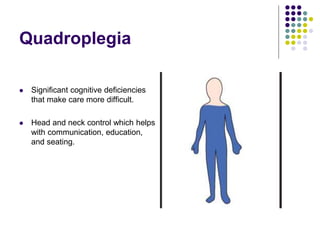
Quadroplegia
 Significant cognitive deficiencies
that make care more difficult.
 Head and neck control which helps
with communication, education,
and seating.
Physiological classification
 Spastic:
 The commonest neurologic abnormality in CP
 Characterized by increased muscle tone manifest as increased resistance to stretch
that is velocity dependent
 Flexor posture in upper limb and Extensor posture in lower limbs
 Dyskinetic: Stereotyped, involuntary movements that are accentuated with effort
 Has two types:
 Dystonia: abnormal postures due to sustained muscle contractions are the essential feature
 Choreo-athetosis:
 Choreiform movements: rapid and jerky
 Athetoid movements: have a writhing quality
 Ataxic:
 Ataxic gait(staggering, wide-based gait)
 Coordination (finger to nose)
 Intention tremor
 Hypotonic
Classification …
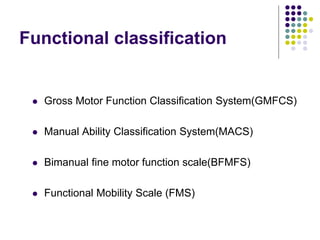
Functional classification
 Gross Motor Function Classification System(GMFCS)
 Manual Ability Classification System(MACS)
 Bimanual fine motor function scale(BFMFS)
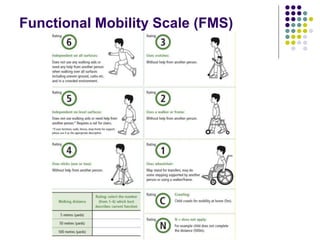
 Functional Mobility Scale (FMS)
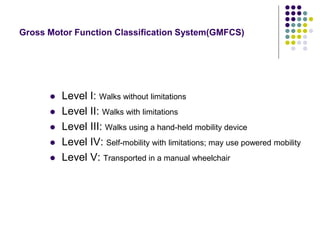
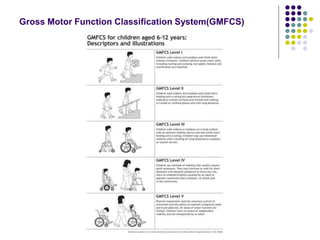
Gross Motor Function Classification System(GMFCS)
 Level I: Walks without limitations
 Level II: Walks with limitations
 Level III: Walks using a hand-held mobility device
 Level IV: Self-mobility with limitations; may use powered mobility
 Level V: Transported in a manual wheelchair
Gross Motor Function Classification System(GMFCS)
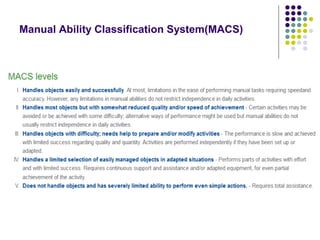
Manual Ability Classification System(MACS)
Functional Mobility Scale (FMS)
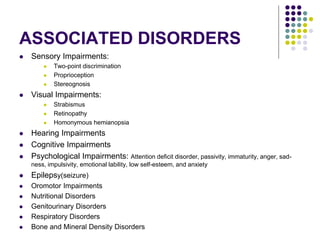
ASSOCIATED DISORDERS
 Sensory Impairments:
 Two-point discrimination
 Proprioception
 Stereognosis
 Visual Impairments:
 Strabismus
 Retinopathy
 Homonymous hemianopsia
 Hearing Impairments
 Cognitive Impairments
 Psychological Impairments: Attention deficit disorder, passivity, immaturity, anger, sad-
ness, impulsivity, emotional lability, low self-esteem, and anxiety
 Epilepsy(seizure)
 Oromotor Impairments
 Nutritional Disorders
 Genitourinary Disorders
 Respiratory Disorders
 Bone and Mineral Density Disorders
Musculoskeletal Disorders
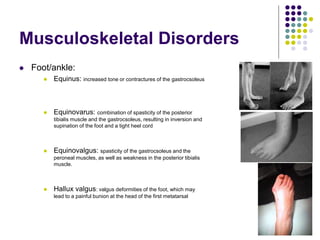
 Foot/ankle:
 Equinus: increased tone or contractures of the gastrocsoleus
 Equinovarus: combination of spasticity of the posterior
tibialis muscle and the gastrocsoleus, resulting in inversion and
supination of the foot and a tight heel cord
 Equinovalgus: spasticity of the gastrocsoleus and the
peroneal muscles, as well as weakness in the posterior tibialis
muscle.
 Hallux valgus: valgus deformities of the foot, which may
lead to a painful bunion at the head of the first metatarsal
Musculoskeletal…
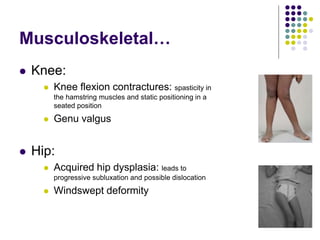
 Knee:
 Knee flexion contractures: spasticity in
the hamstring muscles and static positioning in a
seated position
 Genu valgus
 Hip:
 Acquired hip dysplasia: leads to
progressive subluxation and possible dislocation
 Windswept deformity
Musculoskeletal…
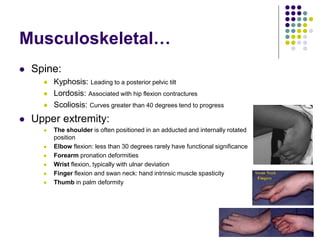
 Spine:
 Kyphosis: Leading to a posterior pelvic tilt
 Lordosis: Associated with hip flexion contractures
 Scoliosis: Curves greater than 40 degrees tend to progress
 Upper extremity:
 The shoulder is often positioned in an adducted and internally rotated
position
 Elbow flexion: less than 30 degrees rarely have functional significance
 Forearm pronation deformities
 Wrist flexion, typically with ulnar deviation
 Finger flexion and swan neck: hand intrinsic muscle spasticity
 Thumb in palm deformity
Musculoskeletal…
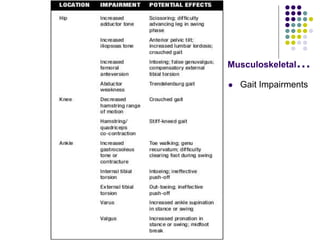
 Gait Impairments
Assessment
in Cerebral Palsy
Assessments
 Background data
 Systems assessments
 Gross motor
 Reach/support
 Fine motor
 Gait
 ADL and Play
Background data
 Reason for referral
 Medical history
 Parental concerns
 Information from other health professionals
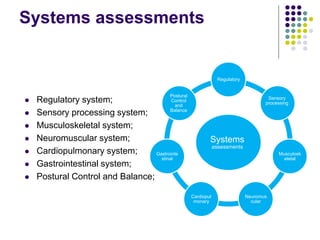
Systems assessments
 Regulatory system;
 Sensory processing system;
 Musculoskeletal system;
 Neuromuscular system;
 Cardiopulmonary system;
 Gastrointestinal system;
 Postural Control and Balance;
Systems
assessments
Regulatory
Sensory
processing
Musculosk
eletal
Neuromus
cular
Cardiopul
monary
Gastrointe
stinal
Postural
Control
and
Balance
Regulatory system
 Self-regulation: the internal capacity to tolerate sensory stimulation
from individuals and environment
 Capability to modulate the intensity of arousal experienced while
remaining engaged in the interaction/activity
 Sleep patterns and routines
 Calming/coping strategies used by parents
 Infant’s ability to self-calm
 Infant’s physiological responses to movement and handling
Sensory processing system
 Ability to receive, register, and organize sensory input for use in
generating the body’s adaptive responses to human and object
interactions and to the surrounding environment
 Awareness of and the ability to orient to sensory information, as well
as integrating combinations of multisensory input for functional
behavior
 1. Tactile/Somatosensory
 2. Proprioceptive
 3. Vestibular
 4. Visual
 5. Auditory
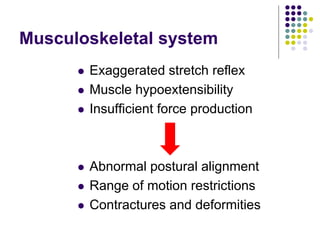
Musculoskeletal system
 Exaggerated stretch reflex
 Muscle hypoextensibility
 Insufficient force production
 Abnormal postural alignment
 Range of motion restrictions
 Contractures and deformities
Musculoskeletal…
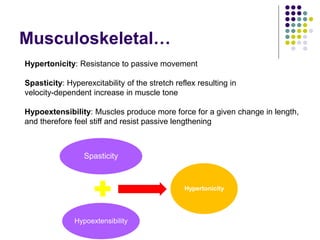
Spasticity
Hypoextensibility
Hypertonicity
Hypertonicity: Resistance to passive movement
Spasticity: Hyperexcitability of the stretch reflex resulting in
velocity-dependent increase in muscle tone
Hypoextensibility: Muscles produce more force for a given change in length,
and therefore feel stiff and resist passive lengthening
Musculoskeletal…
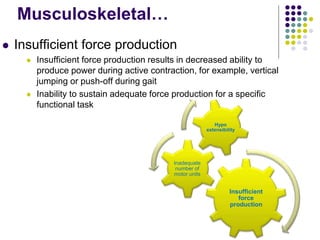
 Insufficient force production
 Insufficient force production results in decreased ability to
produce power during active contraction, for example, vertical
jumping or push-off during gait
 Inability to sustain adequate force production for a specific
functional task
Insufficient
force
production
Inadequate
number of
motor units
Hypo
extensibility
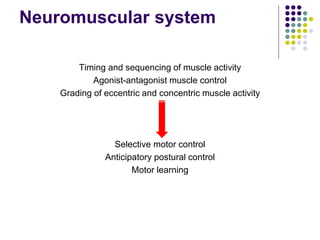
Neuromuscular system
Timing and sequencing of muscle activity
Agonist-antagonist muscle control
Grading of eccentric and concentric muscle activity
Selective motor control
Anticipatory postural control
Motor learning
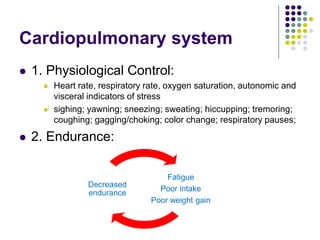
Cardiopulmonary system
 1. Physiological Control:
 Heart rate, respiratory rate, oxygen saturation, autonomic and
visceral indicators of stress
 sighing; yawning; sneezing; sweating; hiccupping; tremoring;
coughing; gagging/choking; color change; respiratory pauses;
 2. Endurance:
Fatigue
Poor intake
Poor weight gain
Decreased
endurance
Gastrointestinal system
 Abnormal extensor tone following feedings
 Frequently refuse feeding or take small amounts of food during feeding
 Excessive vomiting following meals
 Excessive GI discomfort (e.g., gas or burping) during or following feeding
 Disliking prone positioning
 …
Postural Control and Balance
 Postural control is the ability to adjust the body’s position in space
for the purposes of orientation, stability, anticipatory control, and
alignment
 Postural orientation: maintaining the appropriate relationship between body
segments in a specific environment for a specific task
 Postural stability or balance: ability to maintain the center of mass (COM) over
the base of support (BOS)
 Alignment (contributes to both orientation and stability): maintaining the most
optimal posture with respect to gravity and the base of support
 Anticipatory postural control: ability to modify the sensory and motor systems
in response to changing task and environmental demands
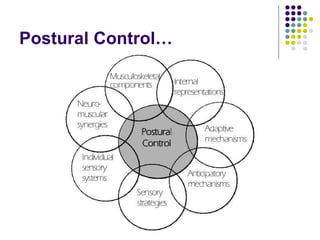
Postural Control…
Gross Motor Function
 Postural Control and Transitions
 Range of Motion and Skeletal Alignment
 Reflexes
 Postural Reactions
 Gait: Arm swing, stride length, heel strike, toe-off, and stance
Reach and Upper Extremity
Support
 In early development, the upper extremities are used to assist with
postural stability and control
 As the infant develops greater head and trunk control, arm function
increases
 Weight bearing, weight shifting, and reaching in the upper
extremities assist in the development of postural control and
development of scapula-humeral control necessary for reaching in
space
Hand Function
 Two responsibilities of the hand:
 Sensorimotor exploration of objects
 Perceptual gathering of information
 Functions:
 Grasp
 Release
 Manipulation
Play and ADL
 Play:
 Motivation or interest
 Adequate postural control
 Social interaction with a variety of people
 Gross and fine motor
 Regulatory and sensory systems
 Duration and frequency of play time
 Different positions for play
 ADL:
 Toleration or enjoyment in: feeding, dressing, bathing,
diapering, and being carried
 Positions and routines used for: feeding, dressing, bathing,
diapering, carrying, and sleeping.
Analysis of assessment data
 Look first at how the infant is moving and interacting
1. How atypical is the response?
2. How often is the atypical or abnormal response elicited and under what circumstances
or conditions?
3. What is going on in other areas of development that may be influencing this behavior?
4. How does the atypical or abnormal movement affect function?
5. Can the responses be managed with specific structuring, environment alterations, or
handling by parent, therapist, or caregiver?
 Analyzing why the impairments may be occurring and which
systems are involved
 Determine what impairments may be causing the abnormal movement patterns
and behaviors
 Assessment data for the eventual development of goals and treatment
strategies.
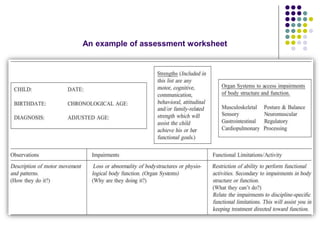
An example of assessment worksheet
Treatment Planning
and Intervention
Functional Goal Setting
 Functional goals are based on the identified functional
limitations
 The treatment goals should identify the expected
functional outcomes and provide the foundation for
treatment planning and selection of intervention
strategies
 Therapist may need to educate the family and to assist
them in accepting and writing more developmentally
appropriate goals
Functional Goal Setting
 A good functional goal should contain the following: subject , action
verb , observable functional performance , conditions of
performance , and criteria for performance:
 Subject is the client, who will be demonstrating success of the goal
 Action verb should be selected to show some posture or movement (e.g. walking,
standing, reaching, and cup drinking)
 Observable function performance is the movement skill that is directly related
to the action verb (e.g. child will move from long sit to side sit, Or will push up onto
extended arms)
 Conditions of the performance is the circumstances and environment under
which the goals will be evaluated. e.g.:
 Initial OT Goal : In supported sitting, Jenny will bang a toy on a surface using a gross radial grasp.
 Follow-Up OT Goal: Sitting in a high chair, Jenny will bang a toy on a surface using a gross radial grasp.
 Measurable or qualitative criteria to assess the achievement of the
performance (e.g. Accuracy, distance, and speed can all be used to measure how well the
performance is executed)
Treatment Planning
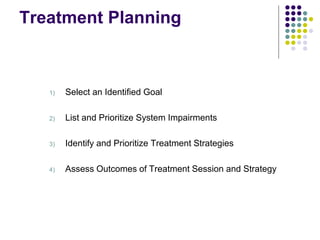
1) Select an Identified Goal
2) List and Prioritize System Impairments
3) Identify and Prioritize Treatment Strategies
4) Assess Outcomes of Treatment Session and Strategy
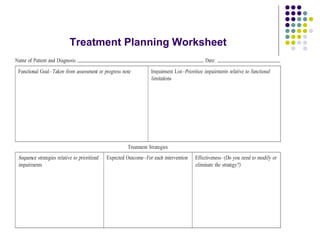
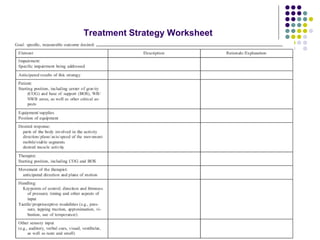
Treatment Planning Worksheet
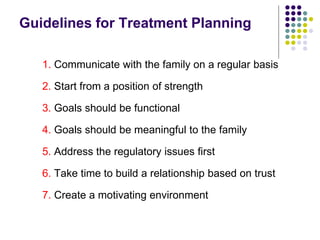
Guidelines for Treatment Planning
1. Communicate with the family on a regular basis
2. Start from a position of strength
3. Goals should be functional
4. Goals should be meaningful to the family
5. Address the regulatory issues first
6. Take time to build a relationship based on trust
7. Create a motivating environment
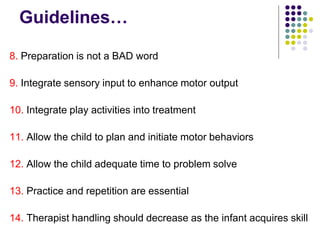
Guidelines…
8. Preparation is not a BAD word
9. Integrate sensory input to enhance motor output
10. Integrate play activities into treatment
11. Allow the child to plan and initiate motor behaviors
12. Allow the child adequate time to problem solve
13. Practice and repetition are essential
14. Therapist handling should decrease as the infant acquires skill
Treatment Strategy Worksheet
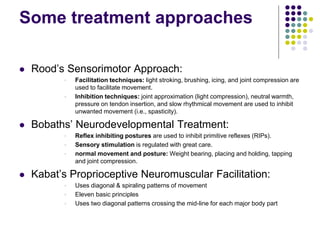
Some treatment approaches
 Rood’s Sensorimotor Approach:
 Facilitation techniques: light stroking, brushing, icing, and joint compression are
used to facilitate movement.
 Inhibition techniques: joint approximation (light compression), neutral warmth,
pressure on tendon insertion, and slow rhythmical movement are used to inhibit
unwanted movement (i.e., spasticity).
 Bobaths’ Neurodevelopmental Treatment:
 Reflex inhibiting postures are used to inhibit primitive reflexes (RIPs).
 Sensory stimulation is regulated with great care.
 normal movement and posture: Weight bearing, placing and holding, tapping
and joint compression.
 Kabat’s Proprioceptive Neuromuscular Facilitation:
 Uses diagonal & spiraling patterns of movement
 Eleven basic principles
 Uses two diagonal patterns crossing the mid-line for each major body part
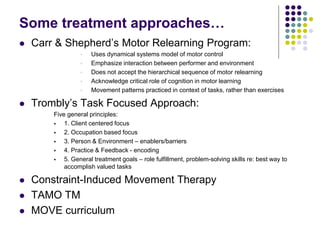
Some treatment approaches…
 Carr & Shepherd’s Motor Relearning Program:
 Uses dynamical systems model of motor control
 Emphasize interaction between performer and environment
 Does not accept the hierarchical sequence of motor relearning
 Acknowledge critical role of cognition in motor learning
 Movement patterns practiced in context of tasks, rather than exercises
 Trombly’s Task Focused Approach:
Five general principles:
 1. Client centered focus
 2. Occupation based focus
 3. Person & Environment – enablers/barriers
 4. Practice & Feedback - encoding
 5. General treatment goals – role fulfillment, problem-solving skills re: best way to
accomplish valued tasks
 Constraint-Induced Movement Therapy
 TAMO TM
 MOVE curriculum
Thank You!

Cerebral palsy

  • 1.
    Cerebral palsy M. SarhadyMSc OT 2013 Occupational Therapy Department Hamedan University of Medical Sciences Email: msarhady1980@gmail.com
  • 2.
    Cerebral Palsy Was firstdescribed by William Little in 1862. Then it was known as Little disease. The term Cerebral palsy originated with Freud. Definition Cerebral palsy (CP) describes a group of permanent disorders of the development of movement and posture, causing activity limitation, that are attributed to non-progressive disturbances that occurred in the developing fetal or infant brain. The motor disorders of cerebral palsy are often accompanied by disturbances of sensation, perception, cognition, communication, and behavior, by epilepsy, and by secondary musculoskeletal problems.
  • 3.
    KEY FEATUR ESOF THE DEF INITION  CP is best seen as a group of closely related conditions, heterogeneous both in manifestations and causes.  CP is understood to be a disorder of motor development.  CP must be of sufficient severity to cause activity limitation  .  CP is understood to be non-progressive disturbance of the brain
  • 4.
    PREVALENCE  The Incidenceis between 2.4-2.7 per 1000 live births.  In some references: 0.6 to 7cases per 1000 live births  In preterm or low birth weight infants: 40 to 150 per 1000 live births
  • 5.
    Possible risk factorsfor cerebral palsy
  • 6.
    Symptoms  Developmental delay Abnormal muscle tone  Abnormal movement patterns:  Combat creeping  Bunny hoping  Bottom scooting  …  Unusual posture  Early development of hand preference
  • 7.
  • 8.
  • 9.
    Diplegia  Most common50%  Premature infants  Intelligence normal  Most children with diplegia walk eventually  Although walking is delayed usually until around age 4 years
  • 10.
    Hemiplegia  Prevalence: 30% Typically have sensory changes  Hemiplegic patients also may have a leg-length discrepancy
  • 11.
    Quadroplegia  Significant cognitivedeficiencies that make care more difficult.  Head and neck control which helps with communication, education, and seating.
  • 12.
    Physiological classification  Spastic: The commonest neurologic abnormality in CP  Characterized by increased muscle tone manifest as increased resistance to stretch that is velocity dependent  Flexor posture in upper limb and Extensor posture in lower limbs  Dyskinetic: Stereotyped, involuntary movements that are accentuated with effort  Has two types:  Dystonia: abnormal postures due to sustained muscle contractions are the essential feature  Choreo-athetosis:  Choreiform movements: rapid and jerky  Athetoid movements: have a writhing quality  Ataxic:  Ataxic gait(staggering, wide-based gait)  Coordination (finger to nose)  Intention tremor  Hypotonic
  • 13.
  • 17.
    Functional classification  GrossMotor Function Classification System(GMFCS)  Manual Ability Classification System(MACS)  Bimanual fine motor function scale(BFMFS)  Functional Mobility Scale (FMS)
  • 18.
    Gross Motor FunctionClassification System(GMFCS)  Level I: Walks without limitations  Level II: Walks with limitations  Level III: Walks using a hand-held mobility device  Level IV: Self-mobility with limitations; may use powered mobility  Level V: Transported in a manual wheelchair
  • 19.
    Gross Motor FunctionClassification System(GMFCS)
  • 20.
  • 21.
  • 22.
    ASSOCIATED DISORDERS  SensoryImpairments:  Two-point discrimination  Proprioception  Stereognosis  Visual Impairments:  Strabismus  Retinopathy  Homonymous hemianopsia  Hearing Impairments  Cognitive Impairments  Psychological Impairments: Attention deficit disorder, passivity, immaturity, anger, sad- ness, impulsivity, emotional lability, low self-esteem, and anxiety  Epilepsy(seizure)  Oromotor Impairments  Nutritional Disorders  Genitourinary Disorders  Respiratory Disorders  Bone and Mineral Density Disorders
  • 23.
    Musculoskeletal Disorders  Foot/ankle: Equinus: increased tone or contractures of the gastrocsoleus  Equinovarus: combination of spasticity of the posterior tibialis muscle and the gastrocsoleus, resulting in inversion and supination of the foot and a tight heel cord  Equinovalgus: spasticity of the gastrocsoleus and the peroneal muscles, as well as weakness in the posterior tibialis muscle.  Hallux valgus: valgus deformities of the foot, which may lead to a painful bunion at the head of the first metatarsal
  • 24.
    Musculoskeletal…  Knee:  Kneeflexion contractures: spasticity in the hamstring muscles and static positioning in a seated position  Genu valgus  Hip:  Acquired hip dysplasia: leads to progressive subluxation and possible dislocation  Windswept deformity
  • 25.
    Musculoskeletal…  Spine:  Kyphosis:Leading to a posterior pelvic tilt  Lordosis: Associated with hip flexion contractures  Scoliosis: Curves greater than 40 degrees tend to progress  Upper extremity:  The shoulder is often positioned in an adducted and internally rotated position  Elbow flexion: less than 30 degrees rarely have functional significance  Forearm pronation deformities  Wrist flexion, typically with ulnar deviation  Finger flexion and swan neck: hand intrinsic muscle spasticity  Thumb in palm deformity
  • 26.
  • 27.
  • 28.
    Assessments  Background data Systems assessments  Gross motor  Reach/support  Fine motor  Gait  ADL and Play
  • 29.
    Background data  Reasonfor referral  Medical history  Parental concerns  Information from other health professionals
  • 30.
    Systems assessments  Regulatorysystem;  Sensory processing system;  Musculoskeletal system;  Neuromuscular system;  Cardiopulmonary system;  Gastrointestinal system;  Postural Control and Balance; Systems assessments Regulatory Sensory processing Musculosk eletal Neuromus cular Cardiopul monary Gastrointe stinal Postural Control and Balance
  • 31.
    Regulatory system  Self-regulation:the internal capacity to tolerate sensory stimulation from individuals and environment  Capability to modulate the intensity of arousal experienced while remaining engaged in the interaction/activity  Sleep patterns and routines  Calming/coping strategies used by parents  Infant’s ability to self-calm  Infant’s physiological responses to movement and handling
  • 32.
    Sensory processing system Ability to receive, register, and organize sensory input for use in generating the body’s adaptive responses to human and object interactions and to the surrounding environment  Awareness of and the ability to orient to sensory information, as well as integrating combinations of multisensory input for functional behavior  1. Tactile/Somatosensory  2. Proprioceptive  3. Vestibular  4. Visual  5. Auditory
  • 33.
    Musculoskeletal system  Exaggeratedstretch reflex  Muscle hypoextensibility  Insufficient force production  Abnormal postural alignment  Range of motion restrictions  Contractures and deformities
  • 34.
    Musculoskeletal… Spasticity Hypoextensibility Hypertonicity Hypertonicity: Resistance topassive movement Spasticity: Hyperexcitability of the stretch reflex resulting in velocity-dependent increase in muscle tone Hypoextensibility: Muscles produce more force for a given change in length, and therefore feel stiff and resist passive lengthening
  • 35.
    Musculoskeletal…  Insufficient forceproduction  Insufficient force production results in decreased ability to produce power during active contraction, for example, vertical jumping or push-off during gait  Inability to sustain adequate force production for a specific functional task Insufficient force production Inadequate number of motor units Hypo extensibility
  • 36.
    Neuromuscular system Timing andsequencing of muscle activity Agonist-antagonist muscle control Grading of eccentric and concentric muscle activity Selective motor control Anticipatory postural control Motor learning
  • 37.
    Cardiopulmonary system  1.Physiological Control:  Heart rate, respiratory rate, oxygen saturation, autonomic and visceral indicators of stress  sighing; yawning; sneezing; sweating; hiccupping; tremoring; coughing; gagging/choking; color change; respiratory pauses;  2. Endurance: Fatigue Poor intake Poor weight gain Decreased endurance
  • 38.
    Gastrointestinal system  Abnormalextensor tone following feedings  Frequently refuse feeding or take small amounts of food during feeding  Excessive vomiting following meals  Excessive GI discomfort (e.g., gas or burping) during or following feeding  Disliking prone positioning  …
  • 39.
    Postural Control andBalance  Postural control is the ability to adjust the body’s position in space for the purposes of orientation, stability, anticipatory control, and alignment  Postural orientation: maintaining the appropriate relationship between body segments in a specific environment for a specific task  Postural stability or balance: ability to maintain the center of mass (COM) over the base of support (BOS)  Alignment (contributes to both orientation and stability): maintaining the most optimal posture with respect to gravity and the base of support  Anticipatory postural control: ability to modify the sensory and motor systems in response to changing task and environmental demands
  • 40.
  • 41.
    Gross Motor Function Postural Control and Transitions  Range of Motion and Skeletal Alignment  Reflexes  Postural Reactions  Gait: Arm swing, stride length, heel strike, toe-off, and stance
  • 42.
    Reach and UpperExtremity Support  In early development, the upper extremities are used to assist with postural stability and control  As the infant develops greater head and trunk control, arm function increases  Weight bearing, weight shifting, and reaching in the upper extremities assist in the development of postural control and development of scapula-humeral control necessary for reaching in space
  • 43.
    Hand Function  Tworesponsibilities of the hand:  Sensorimotor exploration of objects  Perceptual gathering of information  Functions:  Grasp  Release  Manipulation
  • 44.
    Play and ADL Play:  Motivation or interest  Adequate postural control  Social interaction with a variety of people  Gross and fine motor  Regulatory and sensory systems  Duration and frequency of play time  Different positions for play  ADL:  Toleration or enjoyment in: feeding, dressing, bathing, diapering, and being carried  Positions and routines used for: feeding, dressing, bathing, diapering, carrying, and sleeping.
  • 45.
    Analysis of assessmentdata  Look first at how the infant is moving and interacting 1. How atypical is the response? 2. How often is the atypical or abnormal response elicited and under what circumstances or conditions? 3. What is going on in other areas of development that may be influencing this behavior? 4. How does the atypical or abnormal movement affect function? 5. Can the responses be managed with specific structuring, environment alterations, or handling by parent, therapist, or caregiver?  Analyzing why the impairments may be occurring and which systems are involved  Determine what impairments may be causing the abnormal movement patterns and behaviors  Assessment data for the eventual development of goals and treatment strategies.
  • 46.
    An example ofassessment worksheet
  • 47.
  • 48.
    Functional Goal Setting Functional goals are based on the identified functional limitations  The treatment goals should identify the expected functional outcomes and provide the foundation for treatment planning and selection of intervention strategies  Therapist may need to educate the family and to assist them in accepting and writing more developmentally appropriate goals
  • 49.
    Functional Goal Setting A good functional goal should contain the following: subject , action verb , observable functional performance , conditions of performance , and criteria for performance:  Subject is the client, who will be demonstrating success of the goal  Action verb should be selected to show some posture or movement (e.g. walking, standing, reaching, and cup drinking)  Observable function performance is the movement skill that is directly related to the action verb (e.g. child will move from long sit to side sit, Or will push up onto extended arms)  Conditions of the performance is the circumstances and environment under which the goals will be evaluated. e.g.:  Initial OT Goal : In supported sitting, Jenny will bang a toy on a surface using a gross radial grasp.  Follow-Up OT Goal: Sitting in a high chair, Jenny will bang a toy on a surface using a gross radial grasp.  Measurable or qualitative criteria to assess the achievement of the performance (e.g. Accuracy, distance, and speed can all be used to measure how well the performance is executed)
  • 50.
    Treatment Planning 1) Selectan Identified Goal 2) List and Prioritize System Impairments 3) Identify and Prioritize Treatment Strategies 4) Assess Outcomes of Treatment Session and Strategy
  • 51.
  • 52.
    Guidelines for TreatmentPlanning 1. Communicate with the family on a regular basis 2. Start from a position of strength 3. Goals should be functional 4. Goals should be meaningful to the family 5. Address the regulatory issues first 6. Take time to build a relationship based on trust 7. Create a motivating environment
  • 53.
    Guidelines… 8. Preparation isnot a BAD word 9. Integrate sensory input to enhance motor output 10. Integrate play activities into treatment 11. Allow the child to plan and initiate motor behaviors 12. Allow the child adequate time to problem solve 13. Practice and repetition are essential 14. Therapist handling should decrease as the infant acquires skill
  • 54.
  • 55.
    Some treatment approaches Rood’s Sensorimotor Approach:  Facilitation techniques: light stroking, brushing, icing, and joint compression are used to facilitate movement.  Inhibition techniques: joint approximation (light compression), neutral warmth, pressure on tendon insertion, and slow rhythmical movement are used to inhibit unwanted movement (i.e., spasticity).  Bobaths’ Neurodevelopmental Treatment:  Reflex inhibiting postures are used to inhibit primitive reflexes (RIPs).  Sensory stimulation is regulated with great care.  normal movement and posture: Weight bearing, placing and holding, tapping and joint compression.  Kabat’s Proprioceptive Neuromuscular Facilitation:  Uses diagonal & spiraling patterns of movement  Eleven basic principles  Uses two diagonal patterns crossing the mid-line for each major body part
  • 56.
    Some treatment approaches… Carr & Shepherd’s Motor Relearning Program:  Uses dynamical systems model of motor control  Emphasize interaction between performer and environment  Does not accept the hierarchical sequence of motor relearning  Acknowledge critical role of cognition in motor learning  Movement patterns practiced in context of tasks, rather than exercises  Trombly’s Task Focused Approach: Five general principles:  1. Client centered focus  2. Occupation based focus  3. Person & Environment – enablers/barriers  4. Practice & Feedback - encoding  5. General treatment goals – role fulfillment, problem-solving skills re: best way to accomplish valued tasks  Constraint-Induced Movement Therapy  TAMO TM  MOVE curriculum
  • 57.