z
Autism Spectrum
Disorders
Dr. Radwa Said
Lecturer of Physical Therapy, MTI University
z
Definition
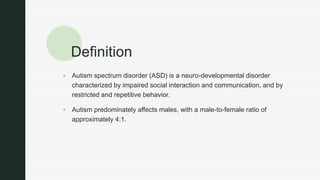
 Autism spectrum disorder (ASD) is a neuro-developmental disorder
characterized by impaired social interaction and communication, and by
restricted and repetitive behavior.
 Autism predominately affects males, with a male-to-female ratio of
approximately 4:1.
z
CLINICAL
CHARACTERISTICS
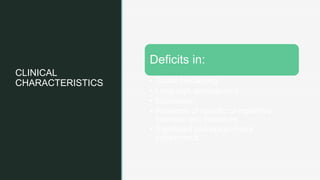
Deficits in:
‱ Social functioning
‱ Language development
‱ Expression
‱ Presence of specific or repetitive
interests and behaviors
‱ Significant perceptuo-motor
impairments
z
Neuropathology
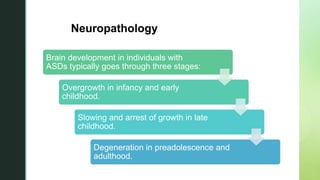
Brain development in individuals with
ASDs typically goes through three stages:
Overgrowth in infancy and early
childhood.
Slowing and arrest of growth in late
childhood.
Degeneration in preadolescence and
adulthood.
z
 Head circumference of 1–2-year-old children who
later developed autism was significantly greater
than typically developing children
 Head size is near normal at birth which indicates
that brain overgrowth may occur in the first 2
years of life.
z
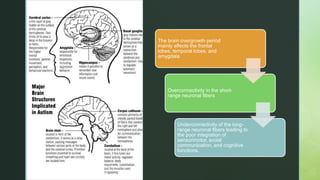
The brain overgrowth period
mainly affects the frontal
lobes, temporal lobes, and
amygdala
Overconnectivity in the short-
range neuronal fibers
Underconnectivity of the long-
range neuronal fibers leading to
the poor integration of
sensorimotor, social
communication, and cognitive
functions.
z
Classification
according to
symptom
severity:
Autism
Pervasive developmental
disorders– not otherwise
specified (PDD-NOS)
Asperger syndrome
z
Autism
 Marked abnormalities in social interaction and
communication as well as the presence of stereotypes and
unusual interests, with symptoms emerging prior to three
years of age within the domains of social communication
development and imaginative play.
z
Qualitative
social
impairments
mainly
include
impairments
in:
 Nonverbal behaviors such as eye
gaze.
 Facial expressions.
 Body postures.
 Gestures during social
interactions.
z
Additional
hallmarks of
autism
include:
 A failure to develop peer
relationships.
 Lack of spontaneous sharing of
interests and enjoyment.
 Lack of social or emotional
reciprocity.
z
Communication
impairments
include:
 A delay or lack of spoken language.
 Impaired ability to initiate or sustain a
conversation with others.
 Use of repetitive or idiosyncratic
language.
 Lack of spontaneous, pretend play.
z
Restricted
repetitive
and
stereotyped
behaviors
and interests
include:
 One or more stereotyped patterns of interest.
 Inflexible adherence to routines and rituals.
 Stereotyped and repetitive motor mannerisms.
 Persistent preoccupation with parts of objects.
z
PDD-NOS
 Child presents with fewer symptoms of the
aforementioned characteristics of autism.
z
Asperger syndrome
 Characterized by a significant impairment in social
interaction and the presence of repetitive behaviors and
restricted and unusual prevalence and key diagnostic
impairments for the various subcategories of individuals with
ASDs as well as early symptoms in infants at risk for ASDs.
z
z
Signs and
Symptoms
z
1. Social skills:
Not responding
to their own
name
Avoiding eye
contact
A strong
preference to
play by
themselves
Has flat facial
expressions
Avoids or resists
physical contact
Isn’t comforted
by their parents
during times of
distress
A lack of interest
in the world
around them
Failure to copy
words and
actions
Not clapping or
waving goodbye
Not wanting to
play peek-a-boo
or pat-a-cake
z
2. Communication:
Some can speak fine; others
can’t speak at all.
Some may have some words by
the time they’re 18-months-old
then lose them
Other signs include:
Echolalia: the continued repetition of words or
phrases
Not pointing at anything or responding when
you point to something
Having few, if any, gestures: Not waving
goodbye
Not engaging in pretend play like feeding
their doll
z
3. Unusual Interests and Behaviors:
their toys
Lining up
with their toys in the exact same way every time
Playing
to play with a specific part of a toy like its wheel
Preferring
by minor changes to their routine
Getting
upset
their hands, rocking their body, or spinning in circles
Flapping
z
4. Developmental Delays:
Each child develops differently
They may learn a harder skill before an easier one
The show postural, motor, and functional delays.
‱ Asymmetry
‱ Oral-motor problems
‱ Repetitive motor movements
‱ Dyspraxia
‱ Lack of motor coordination
‱ Movement preparation reaction
‱ Motor milestone delays
‱ Toe walking
Like:
z
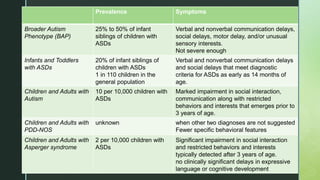
Prevalence Symptoms
Broader Autism
Phenotype (BAP)
25% to 50% of infant
siblings of children with
ASDs
Verbal and nonverbal communication delays,
social delays, motor delay, and/or unusual
sensory interests.
Not severe enough
Infants and Toddlers
with ASDs
20% of infant siblings of
children with ASDs
1 in 110 children in the
general population
Verbal and nonverbal communication delays
and social delays that meet diagnostic
criteria for ASDs as early as 14 months of
age.
Children and Adults with
Autism
10 per 10,000 children with
ASDs
Marked impairment in social interaction,
communication along with restricted
behaviors and interests that emerges prior to
3 years of age.
Children and Adults with
PDD-NOS
unknown when other two diagnoses are not suggested
Fewer specific behavioral features
Children and Adults with
Asperger syndrome
2 per 10,000 children with
ASDs
Significant impairment in social interaction
and restricted behaviors and interests
typically detected after 3 years of age.
no clinically significant delays in expressive
language or cognitive development
z
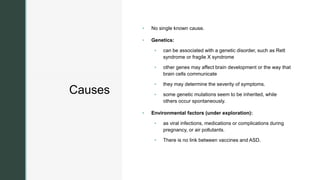
Causes
 No single known cause.
 Genetics:
 can be associated with a genetic disorder, such as Rett
syndrome or fragile X syndrome
 other genes may affect brain development or the way that
brain cells communicate
 they may determine the severity of symptoms.
 some genetic mutations seem to be inherited, while
others occur spontaneously.
 Environmental factors (under exploration):
 as viral infections, medications or complications during
pregnancy, or air pollutants.
 There is no link between vaccines and ASD.
z
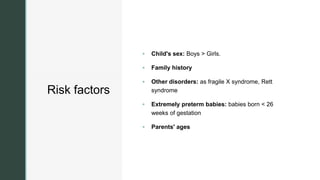
Risk factors
 Child's sex: Boys > Girls.
 Family history
 Other disorders: as fragile X syndrome, Rett
syndrome
 Extremely preterm babies: babies born < 26
weeks of gestation
 Parents' ages
z
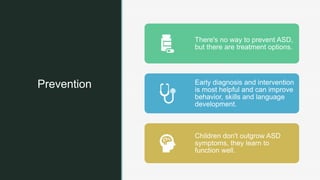
Prevention
There's no way to prevent ASD,
but there are treatment options.
Early diagnosis and intervention
is most helpful and can improve
behavior, skills and language
development.
Children don't outgrow ASD
symptoms, they learn to
function well.
z
z
Management
z
z
Assessment
z
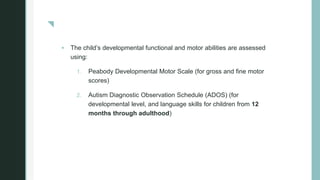
 The child’s developmental functional and motor abilities are assessed
using:
1. Peabody Developmental Motor Scale (for gross and fine motor
scores)
2. Autism Diagnostic Observation Schedule (ADOS) (for
developmental level, and language skills for children from 12
months through adulthood)
z
z
Treatment
z
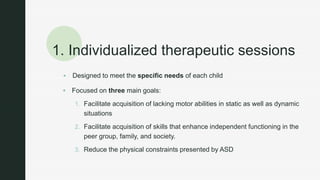
1. Individualized therapeutic sessions
 Designed to meet the specific needs of each child
 Focused on three main goals:
1. Facilitate acquisition of lacking motor abilities in static as well as dynamic
situations
2. Facilitate acquisition of skills that enhance independent functioning in the
peer group, family, and society.
3. Reduce the physical constraints presented by ASD
z
2. Group therapeutic sessions
 According to the needs of all children
 According with their performance level
 According to their behavioral challenges they present
z
 Implemented as playground activity or as indoor program.
 Enhancing the child’s motivation for movement through peer
observation and imitation.
 Assisting the child in meeting basic demands of interaction with
peers (taking turns, patience, acceptance of the needs and
pace of others, acknowledging the wants of others).
 Assisting the child in acquiring imitational skills which composite
a crucial part in learning.
z
3. Parent/staff guidance and supervision
 To incorporate physical challenges as enhancers of appropriate
educational and social behaviors.
 Constructing and supervising programs in:
 educational facility (playground activities, bicycle training, stair training).
 home or in the neighborhood surroundings by the parents.
 Motor intervention programs to be implemented with peers
z
4. Team meetings and collaboration
 On a regular basis.
 At these meetings, members of the interdisciplinary
staff jointly develop treatment goals, plan initiation of
joint interventions, and share knowledge.
z
z
Questions??

Autism pediatrics round for physiotherapy.pptx

  • 1.
    z Autism Spectrum Disorders Dr. RadwaSaid Lecturer of Physical Therapy, MTI University
  • 2.
    z Definition  Autism spectrumdisorder (ASD) is a neuro-developmental disorder characterized by impaired social interaction and communication, and by restricted and repetitive behavior.  Autism predominately affects males, with a male-to-female ratio of approximately 4:1.
  • 3.
    z CLINICAL CHARACTERISTICS Deficits in: ‱ Socialfunctioning ‱ Language development ‱ Expression ‱ Presence of specific or repetitive interests and behaviors ‱ Significant perceptuo-motor impairments
  • 4.
    z Neuropathology Brain development inindividuals with ASDs typically goes through three stages: Overgrowth in infancy and early childhood. Slowing and arrest of growth in late childhood. Degeneration in preadolescence and adulthood.
  • 5.
    z  Head circumferenceof 1–2-year-old children who later developed autism was significantly greater than typically developing children  Head size is near normal at birth which indicates that brain overgrowth may occur in the first 2 years of life.
  • 6.
    z The brain overgrowthperiod mainly affects the frontal lobes, temporal lobes, and amygdala Overconnectivity in the short- range neuronal fibers Underconnectivity of the long- range neuronal fibers leading to the poor integration of sensorimotor, social communication, and cognitive functions.
  • 7.
  • 8.
    z Autism  Marked abnormalitiesin social interaction and communication as well as the presence of stereotypes and unusual interests, with symptoms emerging prior to three years of age within the domains of social communication development and imaginative play.
  • 9.
    z Qualitative social impairments mainly include impairments in:  Nonverbal behaviorssuch as eye gaze.  Facial expressions.  Body postures.  Gestures during social interactions.
  • 10.
    z Additional hallmarks of autism include:  Afailure to develop peer relationships.  Lack of spontaneous sharing of interests and enjoyment.  Lack of social or emotional reciprocity.
  • 11.
    z Communication impairments include:  A delayor lack of spoken language.  Impaired ability to initiate or sustain a conversation with others.  Use of repetitive or idiosyncratic language.  Lack of spontaneous, pretend play.
  • 12.
    z Restricted repetitive and stereotyped behaviors and interests include:  Oneor more stereotyped patterns of interest.  Inflexible adherence to routines and rituals.  Stereotyped and repetitive motor mannerisms.  Persistent preoccupation with parts of objects.
  • 13.
    z PDD-NOS  Child presentswith fewer symptoms of the aforementioned characteristics of autism.
  • 14.
    z Asperger syndrome  Characterizedby a significant impairment in social interaction and the presence of repetitive behaviors and restricted and unusual prevalence and key diagnostic impairments for the various subcategories of individuals with ASDs as well as early symptoms in infants at risk for ASDs.
  • 15.
  • 16.
    z 1. Social skills: Notresponding to their own name Avoiding eye contact A strong preference to play by themselves Has flat facial expressions Avoids or resists physical contact Isn’t comforted by their parents during times of distress A lack of interest in the world around them Failure to copy words and actions Not clapping or waving goodbye Not wanting to play peek-a-boo or pat-a-cake
  • 17.
    z 2. Communication: Some canspeak fine; others can’t speak at all. Some may have some words by the time they’re 18-months-old then lose them Other signs include: Echolalia: the continued repetition of words or phrases Not pointing at anything or responding when you point to something Having few, if any, gestures: Not waving goodbye Not engaging in pretend play like feeding their doll
  • 18.
    z 3. Unusual Interestsand Behaviors: their toys Lining up with their toys in the exact same way every time Playing to play with a specific part of a toy like its wheel Preferring by minor changes to their routine Getting upset their hands, rocking their body, or spinning in circles Flapping
  • 19.
    z 4. Developmental Delays: Eachchild develops differently They may learn a harder skill before an easier one The show postural, motor, and functional delays. ‱ Asymmetry ‱ Oral-motor problems ‱ Repetitive motor movements ‱ Dyspraxia ‱ Lack of motor coordination ‱ Movement preparation reaction ‱ Motor milestone delays ‱ Toe walking Like:
  • 20.
    z Prevalence Symptoms Broader Autism Phenotype(BAP) 25% to 50% of infant siblings of children with ASDs Verbal and nonverbal communication delays, social delays, motor delay, and/or unusual sensory interests. Not severe enough Infants and Toddlers with ASDs 20% of infant siblings of children with ASDs 1 in 110 children in the general population Verbal and nonverbal communication delays and social delays that meet diagnostic criteria for ASDs as early as 14 months of age. Children and Adults with Autism 10 per 10,000 children with ASDs Marked impairment in social interaction, communication along with restricted behaviors and interests that emerges prior to 3 years of age. Children and Adults with PDD-NOS unknown when other two diagnoses are not suggested Fewer specific behavioral features Children and Adults with Asperger syndrome 2 per 10,000 children with ASDs Significant impairment in social interaction and restricted behaviors and interests typically detected after 3 years of age. no clinically significant delays in expressive language or cognitive development
  • 21.
    z Causes  No singleknown cause.  Genetics:  can be associated with a genetic disorder, such as Rett syndrome or fragile X syndrome  other genes may affect brain development or the way that brain cells communicate  they may determine the severity of symptoms.  some genetic mutations seem to be inherited, while others occur spontaneously.  Environmental factors (under exploration):  as viral infections, medications or complications during pregnancy, or air pollutants.  There is no link between vaccines and ASD.
  • 22.
    z Risk factors  Child'ssex: Boys > Girls.  Family history  Other disorders: as fragile X syndrome, Rett syndrome  Extremely preterm babies: babies born < 26 weeks of gestation  Parents' ages
  • 23.
    z Prevention There's no wayto prevent ASD, but there are treatment options. Early diagnosis and intervention is most helpful and can improve behavior, skills and language development. Children don't outgrow ASD symptoms, they learn to function well.
  • 24.
  • 25.
  • 26.
    z  The child’sdevelopmental functional and motor abilities are assessed using: 1. Peabody Developmental Motor Scale (for gross and fine motor scores) 2. Autism Diagnostic Observation Schedule (ADOS) (for developmental level, and language skills for children from 12 months through adulthood)
  • 27.
  • 28.
    z 1. Individualized therapeuticsessions  Designed to meet the specific needs of each child  Focused on three main goals: 1. Facilitate acquisition of lacking motor abilities in static as well as dynamic situations 2. Facilitate acquisition of skills that enhance independent functioning in the peer group, family, and society. 3. Reduce the physical constraints presented by ASD
  • 29.
    z 2. Group therapeuticsessions  According to the needs of all children  According with their performance level  According to their behavioral challenges they present
  • 30.
    z  Implemented asplayground activity or as indoor program.  Enhancing the child’s motivation for movement through peer observation and imitation.  Assisting the child in meeting basic demands of interaction with peers (taking turns, patience, acceptance of the needs and pace of others, acknowledging the wants of others).  Assisting the child in acquiring imitational skills which composite a crucial part in learning.
  • 31.
    z 3. Parent/staff guidanceand supervision  To incorporate physical challenges as enhancers of appropriate educational and social behaviors.  Constructing and supervising programs in:  educational facility (playground activities, bicycle training, stair training).  home or in the neighborhood surroundings by the parents.  Motor intervention programs to be implemented with peers
  • 32.
    z 4. Team meetingsand collaboration  On a regular basis.  At these meetings, members of the interdisciplinary staff jointly develop treatment goals, plan initiation of joint interventions, and share knowledge.
  • 33.