Overview of Transformation
Dheeraj S Sadawarte
https://dheerajsadawarte.blogspot.com
1 Dheeraj S Sadawarte
https://dheerajsadawarte.blogspot.com
Transformation
2
 Transformation changes the way object appears.
 Implementing changes in size of object, its position on
screen or its orientation called Transformation.
Dheeraj S Sadawarte
https://dheerajsadawarte.blogspot.com
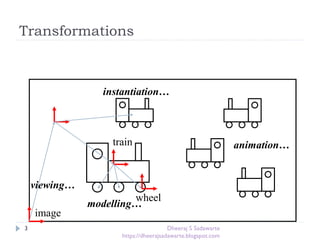
Transformations
3
image
train
wheel
modelling…
instantiation…
viewing…
animation…
Dheeraj S Sadawarte
https://dheerajsadawarte.blogspot.com
Basic 2D Transformation
4
 Translation
 Scaling
 Rotation
Dheeraj S Sadawarte
https://dheerajsadawarte.blogspot.com
Translation
5
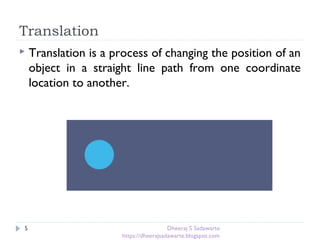
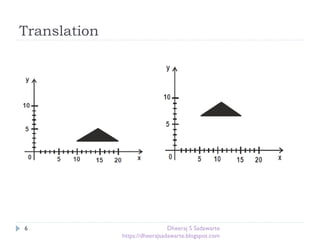
 Translation is a process of changing the position of an
object in a straight line path from one coordinate
location to another.
Dheeraj S Sadawarte
https://dheerajsadawarte.blogspot.com
Translation
6 Dheeraj S Sadawarte
https://dheerajsadawarte.blogspot.com
Translation
7
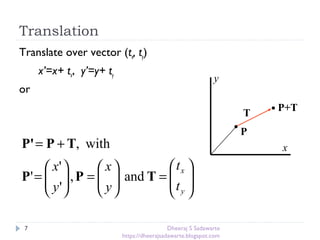
Translate over vector (tx, ty)
x’=x+ tx, y’=y+ ty
or
x
y
P
P+T
T








=





=





=
+=
y
x
t
t
y
x
y
x
TPP
TPP'
and,
'
'
'
with,
Dheeraj S Sadawarte
https://dheerajsadawarte.blogspot.com
Translation
8
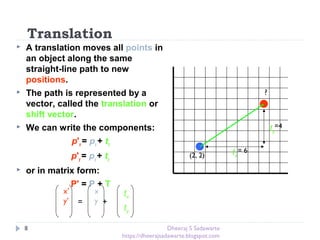
 A translation moves all points in
an object along the same
straight-line path to new
positions.
 The path is represented by a
vector, called the translation or
shift vector.
 We can write the components:
p'x = px + tx
p'y = py + ty
 or in matrix form:
P' = P + T
tx
ty
x’
y’
x
y
tx
ty
= +
(2, 2)
= 6
=4
?
Dheeraj S Sadawarte
https://dheerajsadawarte.blogspot.com
Translation polygon
9
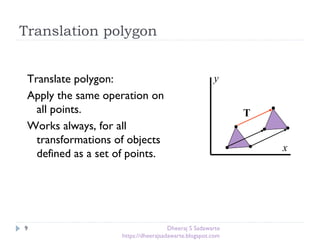
Translate polygon:
Apply the same operation on
all points.
Works always, for all
transformations of objects
defined as a set of points.
x
y
T
Dheeraj S Sadawarte
https://dheerajsadawarte.blogspot.com
Exercise
10
 Translate a polygon with coordinates A(2,5), B (7, 10),
and C (10, 2) by 3 units in x direction and 4 units in y
direction
Dheeraj S Sadawarte
https://dheerajsadawarte.blogspot.com
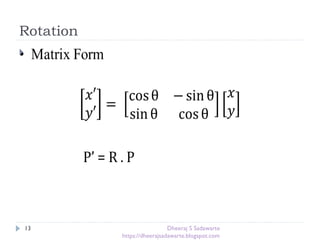
Rotation
11
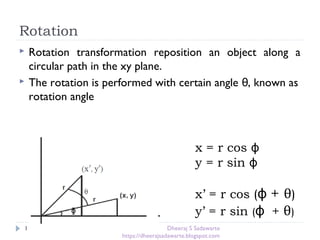
 Rotation transformation reposition an object along a
circular path in the xy plane.
 The rotation is performed with certain angle , known asθ
rotation angle
x = r cos ϕ
y = r sin ϕ
x’ = r cos (ϕ + θ)
y’ = r sin (ϕ + θ)ᶲᶲ
Dheeraj S Sadawarte
https://dheerajsadawarte.blogspot.com
Rotation
12
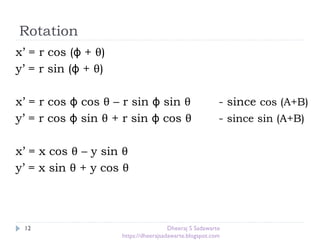
x’ = r cos (ϕ + θ)
y’ = r sin (ϕ + θ)
x’ = r cos ϕ cos θ – r sin ϕ sin θ - since cos (A+B)
y’ = r cos ϕ sin θ + r sin ϕ cos θ - since sin (A+B)
x’ = x cos θ – y sin θ
y’ = x sin θ + y cos θ
Dheeraj S Sadawarte
https://dheerajsadawarte.blogspot.com
Rotation
13 Dheeraj S Sadawarte
https://dheerajsadawarte.blogspot.com
Rotation
14
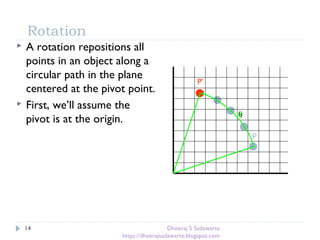
 A rotation repositions all
points in an object along a
circular path in the plane
centered at the pivot point.
 First, we’ll assume the
pivot is at the origin. θθ
P
P’
Dheeraj S Sadawarte
https://dheerajsadawarte.blogspot.com
Rotation
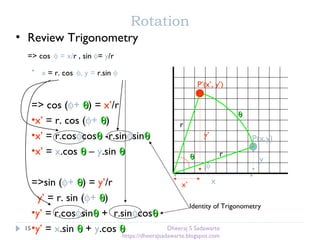
• Review Trigonometry
=> cos φ = x/r , sin φ= y/r
• x = r. cos φ, y = r.sin φ
θθ
φ
P(x,y)
x
y
r
x’
y’
θθ
P’(x’, y’)
r
=> cos (φ+ θθ) = x’/r
•x’ = r. cos (φ+ θθ)
•x’ = r.cosφcosθθ -r.sinφsinθθ
•x’ = x.cos θθ – y.sin θθ
=>sin (φ+ θθ) = y’/r
y’ = r. sin (φ+ θθ)
•y’ = r.cosφsinθθ + r.sinφcosθθ
•y’ = x.sin θθ + y.cos θθ
Identity of Trigonometry
15 Dheeraj S Sadawarte
https://dheerajsadawarte.blogspot.com
Rotation
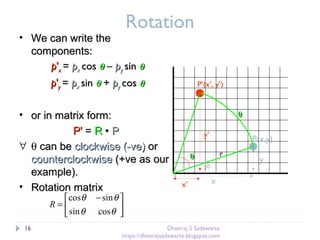
• We can write theWe can write the
components:components:
pp''xx == ppxx coscos θθ –– ppyy sinsin θθ
pp''yy == ppxx sinsin θθ ++ ppyy coscos θθ
• or in matrix form:or in matrix form:
PP'' == RR •• PP
∀ θ can becan be clockwise (-ve)clockwise (-ve) oror
counterclockwisecounterclockwise (+ve as our(+ve as our
example).example).
• Rotation matrixRotation matrix
θθ
P(x,y)
φ
x
y
r
x’
y’
θθ
P’(x’, y’)





 −
=
θθ
θθ
cossin
sincos
R
16 Dheeraj S Sadawarte
https://dheerajsadawarte.blogspot.com
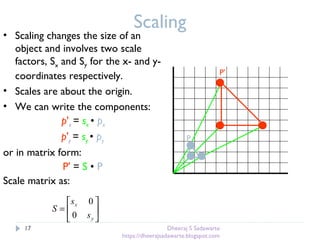
Scaling
• Scaling changes the size of an
object and involves two scale
factors, Sx and Sy for the x- and y-
coordinates respectively.
• Scales are about the origin.
• We can write the components:
p'x = sx • px
p'y = sy • py
or in matrix form:
P' = S • P
Scale matrix as:






=
y
x
s
s
S
0
0
P
P’
17 Dheeraj S Sadawarte
https://dheerajsadawarte.blogspot.com
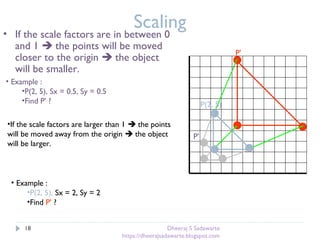
Scaling• If the scale factors are in between 0
and 1  the points will be moved
closer to the origin  the object
will be smaller.
P(2, 5)
P’
• Example :
•P(2, 5), Sx = 0.5, Sy = 0.5
•Find P’ ?
•If the scale factors are larger than 1  the points
will be moved away from the origin  the object
will be larger.
P’
• Example :
•P(2, 5), Sx = 2, Sy = 2
•Find P’ ?
18 Dheeraj S Sadawarte
https://dheerajsadawarte.blogspot.com
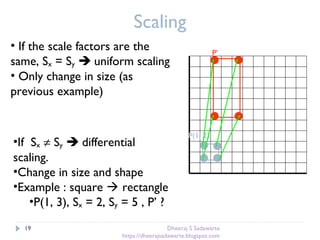
Scaling
• If the scale factors are the
same, Sx = Sy  uniform scaling
• Only change in size (as
previous example)
P(1, 2)
P’
•If Sx ≠ Sy  differential
scaling.
•Change in size and shape
•Example : square  rectangle
•P(1, 3), Sx = 2, Sy = 5 , P’ ?
19 Dheeraj S Sadawarte
https://dheerajsadawarte.blogspot.com
[6]-20




















=










′
′



















 −
=










′
′




















=










′
′
1100
00
00
1
1100
0cossin
0sincos
1
1100
10
01
1
y
x
s
s
y
x
y
x
y
x
y
x
t
t
y
x
y
x
y
x
θθ
θθ
Translation
P’=TP
Rotation [O]
P’=RP
Scaling
P’=SP
Basic Transformations
Homogeneous Coordinates
Dheeraj S Sadawarte
https://dheerajsadawarte.blogspot.com
Other Transformation
21
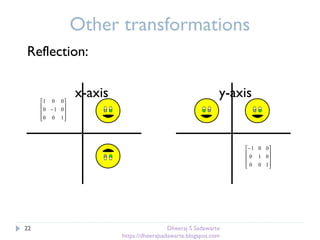
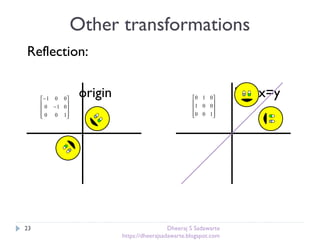
 Reflection
 Produces a mirror image of an object relative to an axis of
reflection.
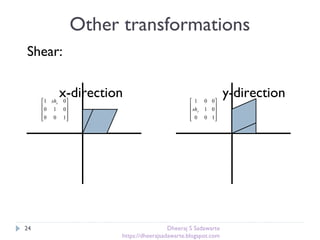
 Shear
 A transformation that slants the shape of an object is called
the shear transformation
 X Shear
preserves y coordinates but changes x values
 Y Shear
preserves x coordinates but changes y values
Dheeraj S Sadawarte
https://dheerajsadawarte.blogspot.com
Other transformations
Reflection:
x-axis y-axis










−
100
010
001









−
100
010
001
22 Dheeraj S Sadawarte
https://dheerajsadawarte.blogspot.com
Other transformations
Reflection:
origin line x=y










−
−
100
010
001










100
001
010
23 Dheeraj S Sadawarte
https://dheerajsadawarte.blogspot.com
Other transformations
Shear:
x-direction y-direction










100
010
01 xsh










100
01
001
ysh
24 Dheeraj S Sadawarte
https://dheerajsadawarte.blogspot.com
Rotating About An Arbitrary Point
25
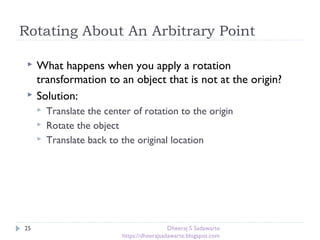
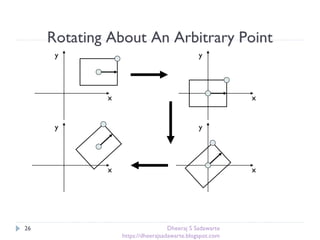
 What happens when you apply a rotation
transformation to an object that is not at the origin?
 Solution:
 Translate the center of rotation to the origin
 Rotate the object
 Translate back to the original location
Dheeraj S Sadawarte
https://dheerajsadawarte.blogspot.com
Rotating About An Arbitrary Point
x
y
x
y
x
y
x
y
26 Dheeraj S Sadawarte
https://dheerajsadawarte.blogspot.com
27
(xp , yp)
(x,y)(x’,y’)
Pivot Point
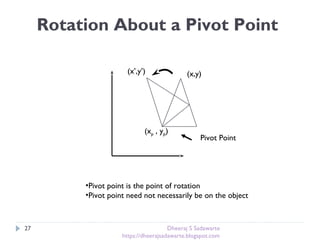
•Pivot point is the point of rotation
•Pivot point need not necessarily be on the object
Rotation About a Pivot Point
Dheeraj S Sadawarte
https://dheerajsadawarte.blogspot.com
(xp , yp)
p
p
yyy
xxx
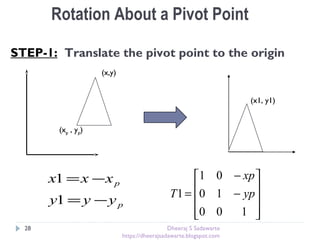
−=
−=
1
1
(x,y)
(x1, y1)
STEP-1: Translate the pivot point to the origin
Rotation About a Pivot Point










−
−
=
100
10
01
1 yp
xp
T
28 Dheeraj S Sadawarte
https://dheerajsadawarte.blogspot.com
θθ
θθ
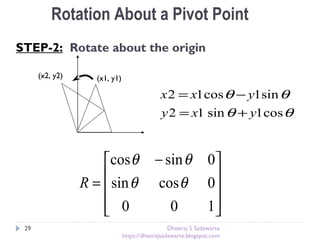
cos1sin12
sin1cos12
yxy
yxx
+=
−=
(x1, y1)
STEP-2: Rotate about the origin
(x2, y2)
Rotation About a Pivot Point









 −
=
100
0cossin
0sincos
θθ
θθ
R
29 Dheeraj S Sadawarte
https://dheerajsadawarte.blogspot.com
p
p
yyy
xxx
+=′
+=′
2
2
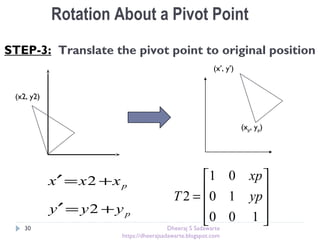
STEP-3: Translate the pivot point to original position
(x2, y2)
(xp, yp)
(x’, y’)
Rotation About a Pivot Point










=
100
10
01
2 yp
xp
T
30 Dheeraj S Sadawarte
https://dheerajsadawarte.blogspot.com
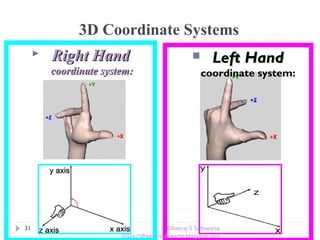
3D Coordinate Systems
 Right HandRight Hand
coordinate system:coordinate system:
31
 Left HandLeft Hand
coordinate system:
Dheeraj S Sadawarte
https://dheerajsadawarte.blogspot.com
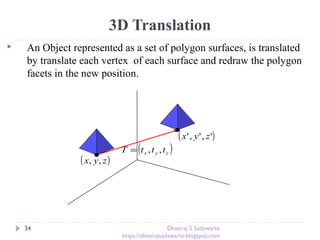
3 D Translation
32
 In translation, an object is displaced and direction from
its original position.
 The new object point p’=(x’,z’,z’) can be found by
applying the transform Ttx,ty,tz to p=(x,y,z)
 Here tx=distance moved by object along x-axis
ty=distance moved by object along y-axis
tz=distance moved by object along z-axis
Dheeraj S Sadawarte
https://dheerajsadawarte.blogspot.com
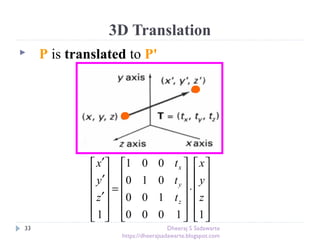
3D Translation
 P is translated to P' by:
33
PTP ⋅=′












⋅












=












′
′
′
11000
100
010
001
1
z
y
x
t
t
t
z
y
x
z
y
x
Dheeraj S Sadawarte
https://dheerajsadawarte.blogspot.com
3D Translation
 An Object represented as a set of polygon surfaces, is translated
by translate each vertex of each surface and redraw the polygon
facets in the new position.
34
( )zyx tttT ,,=
( )zyx ,,
( )',',' zyx
Dheeraj S Sadawarte
https://dheerajsadawarte.blogspot.com
3D Rotation
35
 In general, rotations are specified by a
rotation axis and an angle.
 In two-dimensions there is only one choice of
a rotation axis that leaves points in the plane.
Dheeraj S Sadawarte
https://dheerajsadawarte.blogspot.com
3D Rotation
36
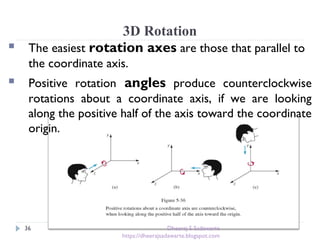
 The easiest rotation axes are those that parallel to
the coordinate axis.
 Positive rotation angles produce counterclockwise
rotations about a coordinate axis, if we are looking
along the positive half of the axis toward the coordinate
origin.
Dheeraj S Sadawarte
https://dheerajsadawarte.blogspot.com
37
Coordinate Axis
Rotations
Dheeraj S Sadawarte
https://dheerajsadawarte.blogspot.com
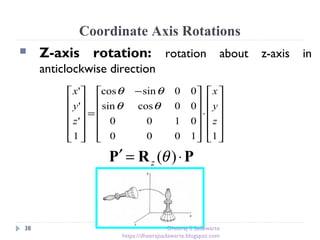
Coordinate Axis Rotations
38
 Z-axis rotation: rotation about z-axis in
anticlockwise direction












⋅











 −
=












11000
0100
00cossin
00sincos
1
'
'
'
z
y
x
z
y
x
θθ
θθ
PRP ⋅=′ )(θz
Dheeraj S Sadawarte
https://dheerajsadawarte.blogspot.com
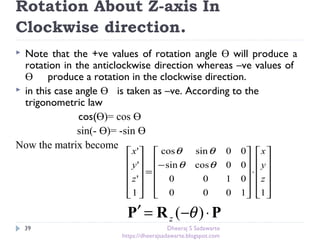
Rotation About Z-axis In
Clockwise direction.
39
 Note that the +ve values of rotation angle Ө will produce a
rotation in the anticlockwise direction whereas –ve values of
Ө produce a rotation in the clockwise direction.
 in this case angle Ө is taken as –ve. According to the
trigonometric law
cos(Ө)= cos Ө
sin(- Ө)= -sin Ө
Now the matrix become












⋅












−
=












11000
0100
00cossin
00sincos
1
'
'
'
z
y
x
z
y
x
θθ
θθ
PRP ⋅−=′ )( θz
Dheeraj S Sadawarte
https://dheerajsadawarte.blogspot.com
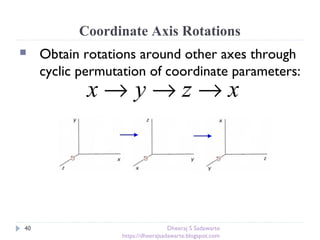
Coordinate Axis Rotations
40
 Obtain rotations around other axes through
cyclic permutation of coordinate parameters:
xzyx →→→
Dheeraj S Sadawarte
https://dheerajsadawarte.blogspot.com
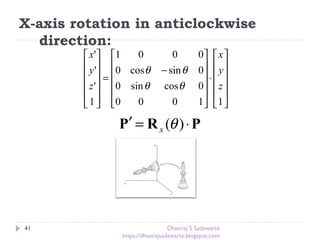
X-axis rotation in anticlockwise
direction:












⋅












−
=












11000
0cossin0
0sincos0
0001
1
'
'
'
z
y
x
z
y
x
θθ
θθ
PRP ⋅=′ )(θx
41 Dheeraj S Sadawarte
https://dheerajsadawarte.blogspot.com
X-axis rotation in anticlockwise direction:
42












⋅












−
=












11000
0cossin0
0sincos0
0001
1
'
'
'
z
y
x
z
y
x
θθ
θθ
PRP ⋅=′ )(θx
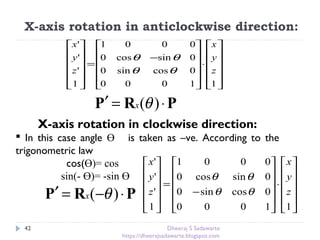
X-axis rotation in clockwise direction:
 In this case angle Ө is taken as –ve. According to the
trigonometric law
cos(Ө)= cos
sin(- Ө)= -sin Ө












⋅












−
=












11000
0cossin0
0sincos0
0001
1
'
'
'
z
y
x
z
y
x
θθ
θθ
PRP ⋅−=′ )( θx
Dheeraj S Sadawarte
https://dheerajsadawarte.blogspot.com
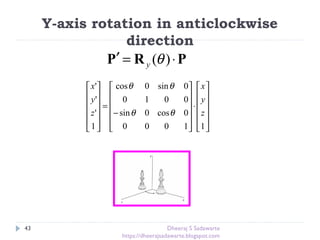
Y-axis rotation in anticlockwise
direction












⋅












−
=












11000
0cos0sin
0010
0sin0cos
1
'
'
'
z
y
x
z
y
x
θθ
θθ
PRP ⋅=′ )(θy
43 Dheeraj S Sadawarte
https://dheerajsadawarte.blogspot.com
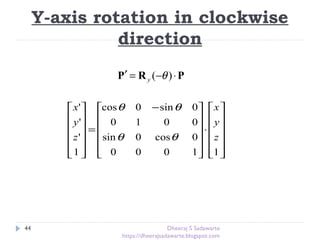
Y-axis rotation in clockwise
direction
44
PRP ⋅−=′ )( θy












⋅











 −
=












11000
0cos0sin
0010
0sin0cos
1
'
'
'
z
y
x
z
y
x
θθ
θθ
Dheeraj S Sadawarte
https://dheerajsadawarte.blogspot.com
Scaling Transformation
45
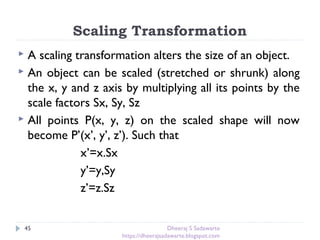
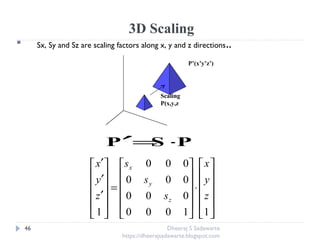
 A scaling transformation alters the size of an object.
 An object can be scaled (stretched or shrunk) along
the x, y and z axis by multiplying all its points by the
scale factors Sx, Sy, Sz
 All points P(x, y, z) on the scaled shape will now
become P’(x’, y’, z’). Such that
x’=x.Sx
y’=y,Sy
z’=z.Sz
Dheeraj S Sadawarte
https://dheerajsadawarte.blogspot.com
3D Scaling
46

Sx, Sy and Sz are scaling factors along x, y and z directions..












⋅












=












′
′
′
11000
000
000
000
1
z
y
x
s
s
s
z
y
x
z
y
x
PSP ⋅=′
Scaling
P(x,y,z
P’(x’y’z’)
Dheeraj S Sadawarte
https://dheerajsadawarte.blogspot.com
Scaling Transformation
47
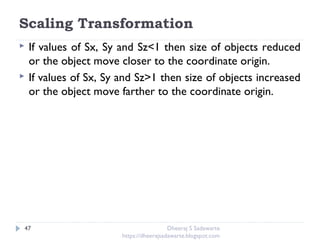
 If values of Sx, Sy and Sz<1 then size of objects reduced
or the object move closer to the coordinate origin.
 If values of Sx, Sy and Sz>1 then size of objects increased
or the object move farther to the coordinate origin.
Dheeraj S Sadawarte
https://dheerajsadawarte.blogspot.com
Projections
48
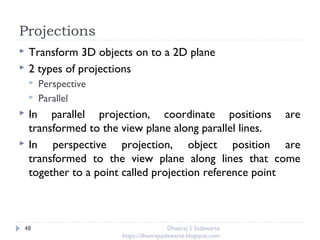
 Transform 3D objects on to a 2D plane
 2 types of projections
 Perspective
 Parallel
 In parallel projection, coordinate positions are
transformed to the view plane along parallel lines.
 In perspective projection, object position are
transformed to the view plane along lines that come
together to a point called projection reference point
Dheeraj S Sadawarte
https://dheerajsadawarte.blogspot.com
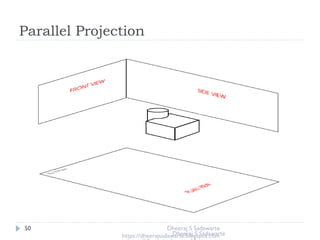
Parallel Projection
49
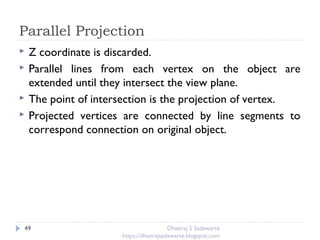
 Z coordinate is discarded.
 Parallel lines from each vertex on the object are
extended until they intersect the view plane.
 The point of intersection is the projection of vertex.
 Projected vertices are connected by line segments to
correspond connection on original object.
Dheeraj S Sadawarte
https://dheerajsadawarte.blogspot.com
Parallel Projection
50 Dheeraj S Sadawarte
https://dheerajsadawarte.blogspot.comDheeraj S Sadawarte
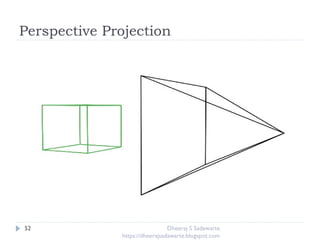
Perspective Projection
51
 Produces realistic views but does not preserves relative
proportions.
 Lines of projection are not parallel.
 Instead they all converge at single point called projection
reference point.
Dheeraj S Sadawarte
https://dheerajsadawarte.blogspot.comDheeraj S Sadawarte
Perspective Projection
52 Dheeraj S Sadawarte
https://dheerajsadawarte.blogspot.com

Overview of 2D and 3D Transformation

  • 1.
    Overview of Transformation DheerajS Sadawarte https://dheerajsadawarte.blogspot.com 1 Dheeraj S Sadawarte https://dheerajsadawarte.blogspot.com
  • 2.
    Transformation 2  Transformation changesthe way object appears.  Implementing changes in size of object, its position on screen or its orientation called Transformation. Dheeraj S Sadawarte https://dheerajsadawarte.blogspot.com
  • 3.
  • 4.
    Basic 2D Transformation 4 Translation  Scaling  Rotation Dheeraj S Sadawarte https://dheerajsadawarte.blogspot.com
  • 5.
    Translation 5  Translation isa process of changing the position of an object in a straight line path from one coordinate location to another. Dheeraj S Sadawarte https://dheerajsadawarte.blogspot.com
  • 6.
    Translation 6 Dheeraj SSadawarte https://dheerajsadawarte.blogspot.com
  • 7.
    Translation 7 Translate over vector(tx, ty) x’=x+ tx, y’=y+ ty or x y P P+T T         =      =      = += y x t t y x y x TPP TPP' and, ' ' ' with, Dheeraj S Sadawarte https://dheerajsadawarte.blogspot.com
  • 8.
    Translation 8  A translationmoves all points in an object along the same straight-line path to new positions.  The path is represented by a vector, called the translation or shift vector.  We can write the components: p'x = px + tx p'y = py + ty  or in matrix form: P' = P + T tx ty x’ y’ x y tx ty = + (2, 2) = 6 =4 ? Dheeraj S Sadawarte https://dheerajsadawarte.blogspot.com
  • 9.
    Translation polygon 9 Translate polygon: Applythe same operation on all points. Works always, for all transformations of objects defined as a set of points. x y T Dheeraj S Sadawarte https://dheerajsadawarte.blogspot.com
  • 10.
    Exercise 10  Translate apolygon with coordinates A(2,5), B (7, 10), and C (10, 2) by 3 units in x direction and 4 units in y direction Dheeraj S Sadawarte https://dheerajsadawarte.blogspot.com
  • 11.
    Rotation 11  Rotation transformationreposition an object along a circular path in the xy plane.  The rotation is performed with certain angle , known asθ rotation angle x = r cos ϕ y = r sin ϕ x’ = r cos (ϕ + θ) y’ = r sin (ϕ + θ)ᶲᶲ Dheeraj S Sadawarte https://dheerajsadawarte.blogspot.com
  • 12.
    Rotation 12 x’ = rcos (ϕ + θ) y’ = r sin (ϕ + θ) x’ = r cos ϕ cos θ – r sin ϕ sin θ - since cos (A+B) y’ = r cos ϕ sin θ + r sin ϕ cos θ - since sin (A+B) x’ = x cos θ – y sin θ y’ = x sin θ + y cos θ Dheeraj S Sadawarte https://dheerajsadawarte.blogspot.com
  • 13.
    Rotation 13 Dheeraj SSadawarte https://dheerajsadawarte.blogspot.com
  • 14.
    Rotation 14  A rotationrepositions all points in an object along a circular path in the plane centered at the pivot point.  First, we’ll assume the pivot is at the origin. θθ P P’ Dheeraj S Sadawarte https://dheerajsadawarte.blogspot.com
  • 15.
    Rotation • Review Trigonometry =>cos φ = x/r , sin φ= y/r • x = r. cos φ, y = r.sin φ θθ φ P(x,y) x y r x’ y’ θθ P’(x’, y’) r => cos (φ+ θθ) = x’/r •x’ = r. cos (φ+ θθ) •x’ = r.cosφcosθθ -r.sinφsinθθ •x’ = x.cos θθ – y.sin θθ =>sin (φ+ θθ) = y’/r y’ = r. sin (φ+ θθ) •y’ = r.cosφsinθθ + r.sinφcosθθ •y’ = x.sin θθ + y.cos θθ Identity of Trigonometry 15 Dheeraj S Sadawarte https://dheerajsadawarte.blogspot.com
  • 16.
    Rotation • We canwrite theWe can write the components:components: pp''xx == ppxx coscos θθ –– ppyy sinsin θθ pp''yy == ppxx sinsin θθ ++ ppyy coscos θθ • or in matrix form:or in matrix form: PP'' == RR •• PP ∀ θ can becan be clockwise (-ve)clockwise (-ve) oror counterclockwisecounterclockwise (+ve as our(+ve as our example).example). • Rotation matrixRotation matrix θθ P(x,y) φ x y r x’ y’ θθ P’(x’, y’)       − = θθ θθ cossin sincos R 16 Dheeraj S Sadawarte https://dheerajsadawarte.blogspot.com
  • 17.
    Scaling • Scaling changesthe size of an object and involves two scale factors, Sx and Sy for the x- and y- coordinates respectively. • Scales are about the origin. • We can write the components: p'x = sx • px p'y = sy • py or in matrix form: P' = S • P Scale matrix as:       = y x s s S 0 0 P P’ 17 Dheeraj S Sadawarte https://dheerajsadawarte.blogspot.com
  • 18.
    Scaling• If thescale factors are in between 0 and 1  the points will be moved closer to the origin  the object will be smaller. P(2, 5) P’ • Example : •P(2, 5), Sx = 0.5, Sy = 0.5 •Find P’ ? •If the scale factors are larger than 1  the points will be moved away from the origin  the object will be larger. P’ • Example : •P(2, 5), Sx = 2, Sy = 2 •Find P’ ? 18 Dheeraj S Sadawarte https://dheerajsadawarte.blogspot.com
  • 19.
    Scaling • If thescale factors are the same, Sx = Sy  uniform scaling • Only change in size (as previous example) P(1, 2) P’ •If Sx ≠ Sy  differential scaling. •Change in size and shape •Example : square  rectangle •P(1, 3), Sx = 2, Sy = 5 , P’ ? 19 Dheeraj S Sadawarte https://dheerajsadawarte.blogspot.com
  • 20.
  • 21.
    Other Transformation 21  Reflection Produces a mirror image of an object relative to an axis of reflection.  Shear  A transformation that slants the shape of an object is called the shear transformation  X Shear preserves y coordinates but changes x values  Y Shear preserves x coordinates but changes y values Dheeraj S Sadawarte https://dheerajsadawarte.blogspot.com
  • 22.
  • 23.
    Other transformations Reflection: origin linex=y           − − 100 010 001           100 001 010 23 Dheeraj S Sadawarte https://dheerajsadawarte.blogspot.com
  • 24.
    Other transformations Shear: x-direction y-direction           100 010 01xsh           100 01 001 ysh 24 Dheeraj S Sadawarte https://dheerajsadawarte.blogspot.com
  • 25.
    Rotating About AnArbitrary Point 25  What happens when you apply a rotation transformation to an object that is not at the origin?  Solution:  Translate the center of rotation to the origin  Rotate the object  Translate back to the original location Dheeraj S Sadawarte https://dheerajsadawarte.blogspot.com
  • 26.
    Rotating About AnArbitrary Point x y x y x y x y 26 Dheeraj S Sadawarte https://dheerajsadawarte.blogspot.com
  • 27.
    27 (xp , yp) (x,y)(x’,y’) PivotPoint •Pivot point is the point of rotation •Pivot point need not necessarily be on the object Rotation About a Pivot Point Dheeraj S Sadawarte https://dheerajsadawarte.blogspot.com
  • 28.
    (xp , yp) p p yyy xxx −= −= 1 1 (x,y) (x1,y1) STEP-1: Translate the pivot point to the origin Rotation About a Pivot Point           − − = 100 10 01 1 yp xp T 28 Dheeraj S Sadawarte https://dheerajsadawarte.blogspot.com
  • 29.
    θθ θθ cos1sin12 sin1cos12 yxy yxx += −= (x1, y1) STEP-2: Rotateabout the origin (x2, y2) Rotation About a Pivot Point           − = 100 0cossin 0sincos θθ θθ R 29 Dheeraj S Sadawarte https://dheerajsadawarte.blogspot.com
  • 30.
    p p yyy xxx +=′ +=′ 2 2 STEP-3: Translate thepivot point to original position (x2, y2) (xp, yp) (x’, y’) Rotation About a Pivot Point           = 100 10 01 2 yp xp T 30 Dheeraj S Sadawarte https://dheerajsadawarte.blogspot.com
  • 31.
    3D Coordinate Systems Right HandRight Hand coordinate system:coordinate system: 31  Left HandLeft Hand coordinate system: Dheeraj S Sadawarte https://dheerajsadawarte.blogspot.com
  • 32.
    3 D Translation 32 In translation, an object is displaced and direction from its original position.  The new object point p’=(x’,z’,z’) can be found by applying the transform Ttx,ty,tz to p=(x,y,z)  Here tx=distance moved by object along x-axis ty=distance moved by object along y-axis tz=distance moved by object along z-axis Dheeraj S Sadawarte https://dheerajsadawarte.blogspot.com
  • 33.
    3D Translation  Pis translated to P' by: 33 PTP ⋅=′             ⋅             =             ′ ′ ′ 11000 100 010 001 1 z y x t t t z y x z y x Dheeraj S Sadawarte https://dheerajsadawarte.blogspot.com
  • 34.
    3D Translation  AnObject represented as a set of polygon surfaces, is translated by translate each vertex of each surface and redraw the polygon facets in the new position. 34 ( )zyx tttT ,,= ( )zyx ,, ( )',',' zyx Dheeraj S Sadawarte https://dheerajsadawarte.blogspot.com
  • 35.
    3D Rotation 35  Ingeneral, rotations are specified by a rotation axis and an angle.  In two-dimensions there is only one choice of a rotation axis that leaves points in the plane. Dheeraj S Sadawarte https://dheerajsadawarte.blogspot.com
  • 36.
    3D Rotation 36  Theeasiest rotation axes are those that parallel to the coordinate axis.  Positive rotation angles produce counterclockwise rotations about a coordinate axis, if we are looking along the positive half of the axis toward the coordinate origin. Dheeraj S Sadawarte https://dheerajsadawarte.blogspot.com
  • 37.
    37 Coordinate Axis Rotations Dheeraj SSadawarte https://dheerajsadawarte.blogspot.com
  • 38.
    Coordinate Axis Rotations 38 Z-axis rotation: rotation about z-axis in anticlockwise direction             ⋅             − =             11000 0100 00cossin 00sincos 1 ' ' ' z y x z y x θθ θθ PRP ⋅=′ )(θz Dheeraj S Sadawarte https://dheerajsadawarte.blogspot.com
  • 39.
    Rotation About Z-axisIn Clockwise direction. 39  Note that the +ve values of rotation angle Ө will produce a rotation in the anticlockwise direction whereas –ve values of Ө produce a rotation in the clockwise direction.  in this case angle Ө is taken as –ve. According to the trigonometric law cos(Ө)= cos Ө sin(- Ө)= -sin Ө Now the matrix become             ⋅             − =             11000 0100 00cossin 00sincos 1 ' ' ' z y x z y x θθ θθ PRP ⋅−=′ )( θz Dheeraj S Sadawarte https://dheerajsadawarte.blogspot.com
  • 40.
    Coordinate Axis Rotations 40 Obtain rotations around other axes through cyclic permutation of coordinate parameters: xzyx →→→ Dheeraj S Sadawarte https://dheerajsadawarte.blogspot.com
  • 41.
    X-axis rotation inanticlockwise direction:             ⋅             − =             11000 0cossin0 0sincos0 0001 1 ' ' ' z y x z y x θθ θθ PRP ⋅=′ )(θx 41 Dheeraj S Sadawarte https://dheerajsadawarte.blogspot.com
  • 42.
    X-axis rotation inanticlockwise direction: 42             ⋅             − =             11000 0cossin0 0sincos0 0001 1 ' ' ' z y x z y x θθ θθ PRP ⋅=′ )(θx X-axis rotation in clockwise direction:  In this case angle Ө is taken as –ve. According to the trigonometric law cos(Ө)= cos sin(- Ө)= -sin Ө             ⋅             − =             11000 0cossin0 0sincos0 0001 1 ' ' ' z y x z y x θθ θθ PRP ⋅−=′ )( θx Dheeraj S Sadawarte https://dheerajsadawarte.blogspot.com
  • 43.
    Y-axis rotation inanticlockwise direction             ⋅             − =             11000 0cos0sin 0010 0sin0cos 1 ' ' ' z y x z y x θθ θθ PRP ⋅=′ )(θy 43 Dheeraj S Sadawarte https://dheerajsadawarte.blogspot.com
  • 44.
    Y-axis rotation inclockwise direction 44 PRP ⋅−=′ )( θy             ⋅             − =             11000 0cos0sin 0010 0sin0cos 1 ' ' ' z y x z y x θθ θθ Dheeraj S Sadawarte https://dheerajsadawarte.blogspot.com
  • 45.
    Scaling Transformation 45  Ascaling transformation alters the size of an object.  An object can be scaled (stretched or shrunk) along the x, y and z axis by multiplying all its points by the scale factors Sx, Sy, Sz  All points P(x, y, z) on the scaled shape will now become P’(x’, y’, z’). Such that x’=x.Sx y’=y,Sy z’=z.Sz Dheeraj S Sadawarte https://dheerajsadawarte.blogspot.com
  • 46.
    3D Scaling 46  Sx, Syand Sz are scaling factors along x, y and z directions..             ⋅             =             ′ ′ ′ 11000 000 000 000 1 z y x s s s z y x z y x PSP ⋅=′ Scaling P(x,y,z P’(x’y’z’) Dheeraj S Sadawarte https://dheerajsadawarte.blogspot.com
  • 47.
    Scaling Transformation 47  Ifvalues of Sx, Sy and Sz<1 then size of objects reduced or the object move closer to the coordinate origin.  If values of Sx, Sy and Sz>1 then size of objects increased or the object move farther to the coordinate origin. Dheeraj S Sadawarte https://dheerajsadawarte.blogspot.com
  • 48.
    Projections 48  Transform 3Dobjects on to a 2D plane  2 types of projections  Perspective  Parallel  In parallel projection, coordinate positions are transformed to the view plane along parallel lines.  In perspective projection, object position are transformed to the view plane along lines that come together to a point called projection reference point Dheeraj S Sadawarte https://dheerajsadawarte.blogspot.com
  • 49.
    Parallel Projection 49  Zcoordinate is discarded.  Parallel lines from each vertex on the object are extended until they intersect the view plane.  The point of intersection is the projection of vertex.  Projected vertices are connected by line segments to correspond connection on original object. Dheeraj S Sadawarte https://dheerajsadawarte.blogspot.com
  • 50.
    Parallel Projection 50 DheerajS Sadawarte https://dheerajsadawarte.blogspot.comDheeraj S Sadawarte
  • 51.
    Perspective Projection 51  Producesrealistic views but does not preserves relative proportions.  Lines of projection are not parallel.  Instead they all converge at single point called projection reference point. Dheeraj S Sadawarte https://dheerajsadawarte.blogspot.comDheeraj S Sadawarte
  • 52.
    Perspective Projection 52 DheerajS Sadawarte https://dheerajsadawarte.blogspot.com