Pronouns
Míriam Tomàs
Work it out
Have a look at the example sentences
and find out when and why the
pronouns are used.
Generic pronouns
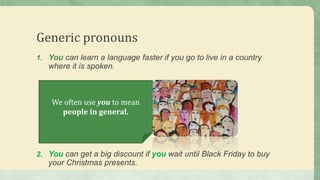
1. You can learn a language faster if you go to live in a country
where it is spoken.
2. You can get a big discount if you wait until Black Friday to buy
your Christmas presents.
We often use you to mean
people in general.
Generic pronouns
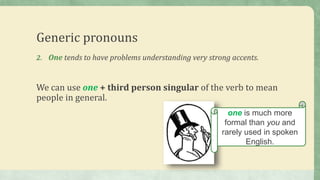
2. One tends to have problems understanding very strong accents.
We can use one + third person singular of the verb to mean
people in general.
one is much more
formal than you and
rarely used in spoken
English.
Generic pronouns
3. When we talk about an accent, we must not confuse this with
pronunciation.
• We must be aware of the potential dangers of not recycling.
we can also be used to make a
general statement of opinion which
includes the reader / listener.
Generic pronouns
4. They always say that it’s never too late to learn a new language.
They should make it compulsory for people to learn two foreign
languages at school.
We often use they to talk about other
people in general, or people in authority,
e.g. They always say… (They = people in
general);
They should make it compulsory… (They =
the government).
Informal
English
Male or
female?
Generic pronouns
5. If someone goes to live in a foreign country, they will have to get used
to a different way of life.
Could the person who left their bag in the library please come and see
me?
Male or
female?
As we don’t know,
we use they, them,
and their, instead
of using he or she,
his or her, etc.
Choose the
correct
pronoun or
say if both
are possible.
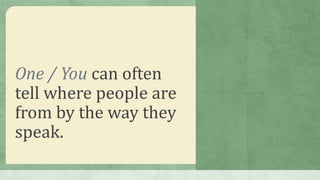
One / You can often
tell where people are
from by the way they
speak.
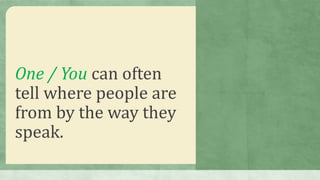
One / You can often
tell where people are
from by the way they
speak.
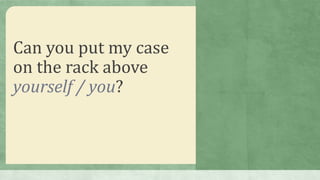
Can you put my case
on the rack above
yourself / you?
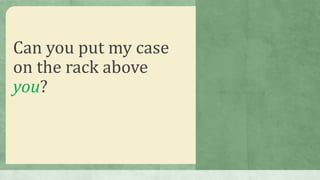
Can you put my case
on the rack above
you?
Sally and her sister
look incredibly like
each other / one
another. Are they
twins?
Sally and her sister
look incredibly like
each other / one
another. Are they
twins?
Steve’s a really
private person and he
rarely talks about him
/ himself.
Steve’s a really
private person and he
rarely talks about
himself.
Either Suzie or Mark
has left her /their bag
behind, because
there’s only one in the
back of the car.
Either Suzie or Mark
has left their bag
behind, because
there’s only one in the
back of the car.
When a person goes to
live abroad it may take
them / him a while to
pick up the language.
When a person goes to
live abroad it may take
them / him a while to
pick up the language.
They / One say that
eating tomatoes can
help protect the body
against certain diseases.
They say that eating
tomatoes can help
protect the body against
certain diseases.
Now let’s
find out
more about
pronouns
Reflexive and reciprocal pronouns
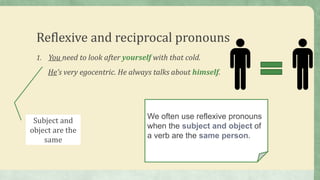
1. You need to look after yourself with that cold.
He’s very egocentric. He always talks about himself.
Subject and
object are the
same
We often use reflexive pronouns
when the subject and object of
a verb are the same person.
Reflexive and reciprocal pronouns: enjoy
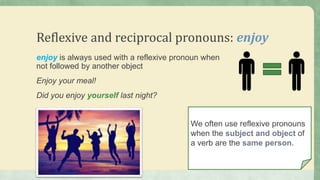
enjoy is always used with a reflexive pronoun when
not followed by another object
Enjoy your meal!
Did you enjoy yourself last night?
We often use reflexive pronouns
when the subject and object of
a verb are the same person.
Reflexive and reciprocal pronouns
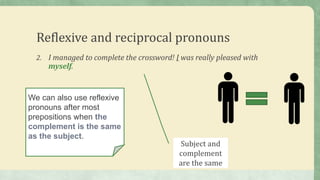
2. I managed to complete the crossword! I was really pleased with
myself.
We can also use reflexive
pronouns after most
prepositions when the
complement is the same
as the subject.
Subject and
complement
are the same
Reflexive and reciprocal pronouns
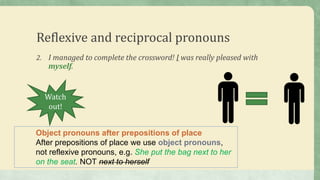
2. I managed to complete the crossword! I was really pleased with
myself.
Object pronouns after prepositions of place
After prepositions of place we use object pronouns,
not reflexive pronouns, e.g. She put the bag next to her
on the seat. NOT next to herself
Watch
out!
Reflexive and reciprocal pronouns
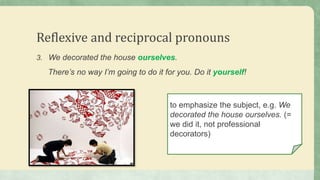
3. We decorated the house ourselves.
There’s no way I’m going to do it for you. Do it yourself!
to emphasize the subject, e.g. We
decorated the house ourselves. (=
we did it, not professional
decorators)
Reflexive and reciprocal pronouns
4. I don’t feel very comfortable going to the cinema by myself.
by + reflexive pronoun = alone, on your / her, etc. own.
Reflexive and reciprocal pronouns
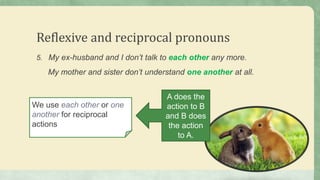
5. My ex-husband and I don’t talk to each other any more.
My mother and sister don’t understand one another at all.
We use each other or one
another for reciprocal
actions
A does the
action to B
and B does
the action
to A.
Complete with
a pronoun
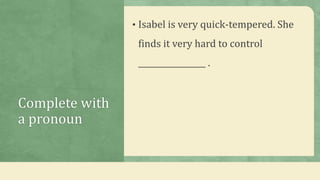
• Isabel is very quick-tempered. She
finds it very hard to control
_________________ .
Complete with
a pronoun
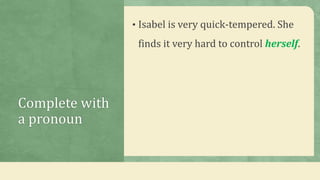
• Isabel is very quick-tempered. She
finds it very hard to control herself.
Complete with
a pronoun
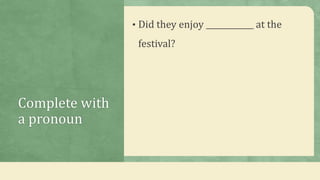
• Did they enjoy ____________ at the
festival?
Complete with
a pronoun
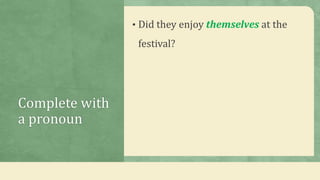
• Did they enjoy themselves at the
festival?
Complete with
a pronoun
• Are you going to have the flat
repainted or will you and Jo do it
_____________ ?
Complete with
a pronoun
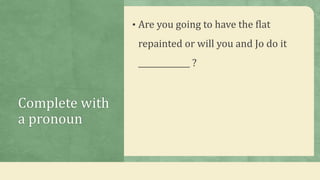
• Are you going to have the flat
repainted or will you and Jo do it
yourselves?
It and there
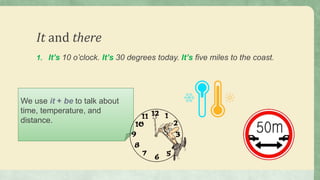
1. It’s 10 o’clock. It’s 30 degrees today. It’s five miles to the coast.
We use it + be to talk about
time, temperature, and
distance.
It and there
2. It was great to hear that you and Martina are getting married!
It used to be difficult to buy fresh pasta in the UK, but now you
can get it everywhere.
We also use it + be as a
‘preparatory’ subject before
adjectives
It will be fun to meet
again.
To meet again will be
fun.
It and there
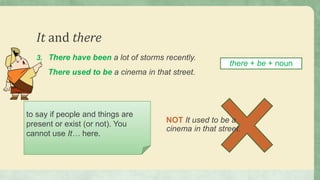
3. There have been a lot of storms recently.
There used to be a cinema in that street.
to say if people and things are
present or exist (or not). You
cannot use It… here.
there + be + noun
NOT It used to be a
cinema in that street.
Complete with
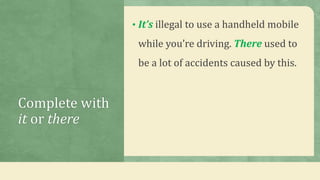
it or there
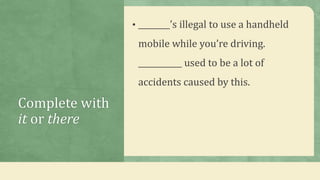
• ________’s illegal to use a handheld
mobile while you’re driving.
___________ used to be a lot of
accidents caused by this.
Complete with
it or there
• It’s illegal to use a handheld mobile
while you’re driving. There used to
be a lot of accidents caused by this.
Complete with
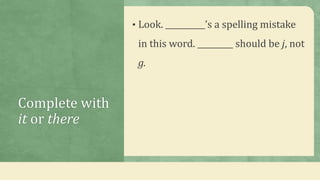
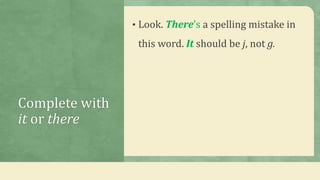
it or there
• Look. __________’s a spelling mistake
in this word. _________ should be j, not
g.
Complete with
it or there
• Look. There’s a spelling mistake in
this word. It should be j, not g.
Complete with
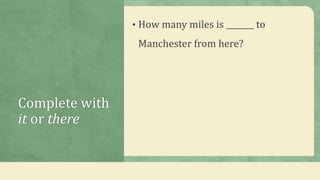
it or there
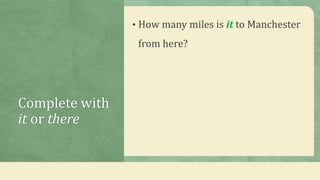
• How many miles is _______ to
Manchester from here?
Complete with
it or there
• How many miles is it to Manchester
from here?
Complete with
it or there
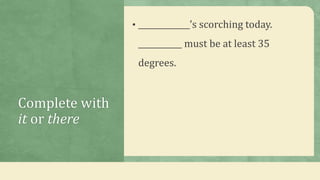
• _____________’s scorching today.
___________ must be at least 35
degrees.
Complete with
it or there
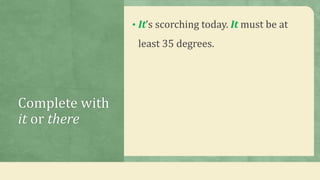
• It’s scorching today. It must be at
least 35 degrees.
Complete with
it or there
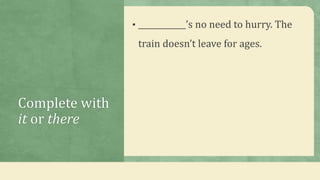
• ____________’s no need to hurry. The
train doesn’t leave for ages.
Complete with
it or there
• There’s no need to hurry. The train
doesn’t leave for ages.
Complete with
it or there
• It’s not worth buying the paper
today. There’s absolutely nothing
interesting in it.
Pronouns

Pronouns

  • 1.
  • 2.
    Work it out Havea look at the example sentences and find out when and why the pronouns are used.
  • 3.
    Generic pronouns 1. Youcan learn a language faster if you go to live in a country where it is spoken. 2. You can get a big discount if you wait until Black Friday to buy your Christmas presents. We often use you to mean people in general.
  • 4.
    Generic pronouns 2. Onetends to have problems understanding very strong accents. We can use one + third person singular of the verb to mean people in general. one is much more formal than you and rarely used in spoken English.
  • 5.
    Generic pronouns 3. Whenwe talk about an accent, we must not confuse this with pronunciation. • We must be aware of the potential dangers of not recycling. we can also be used to make a general statement of opinion which includes the reader / listener.
  • 6.
    Generic pronouns 4. Theyalways say that it’s never too late to learn a new language. They should make it compulsory for people to learn two foreign languages at school. We often use they to talk about other people in general, or people in authority, e.g. They always say… (They = people in general); They should make it compulsory… (They = the government). Informal English
  • 7.
    Male or female? Generic pronouns 5.If someone goes to live in a foreign country, they will have to get used to a different way of life. Could the person who left their bag in the library please come and see me? Male or female? As we don’t know, we use they, them, and their, instead of using he or she, his or her, etc.
  • 8.
    Choose the correct pronoun or sayif both are possible.
  • 9.
    One / Youcan often tell where people are from by the way they speak.
  • 10.
    One / Youcan often tell where people are from by the way they speak.
  • 11.
    Can you putmy case on the rack above yourself / you?
  • 12.
    Can you putmy case on the rack above you?
  • 13.
    Sally and hersister look incredibly like each other / one another. Are they twins?
  • 14.
    Sally and hersister look incredibly like each other / one another. Are they twins?
  • 15.
    Steve’s a really privateperson and he rarely talks about him / himself.
  • 16.
    Steve’s a really privateperson and he rarely talks about himself.
  • 17.
    Either Suzie orMark has left her /their bag behind, because there’s only one in the back of the car.
  • 18.
    Either Suzie orMark has left their bag behind, because there’s only one in the back of the car.
  • 19.
    When a persongoes to live abroad it may take them / him a while to pick up the language.
  • 20.
    When a persongoes to live abroad it may take them / him a while to pick up the language.
  • 21.
    They / Onesay that eating tomatoes can help protect the body against certain diseases.
  • 22.
    They say thateating tomatoes can help protect the body against certain diseases.
  • 23.
  • 24.
    Reflexive and reciprocalpronouns 1. You need to look after yourself with that cold. He’s very egocentric. He always talks about himself. Subject and object are the same We often use reflexive pronouns when the subject and object of a verb are the same person.
  • 25.
    Reflexive and reciprocalpronouns: enjoy enjoy is always used with a reflexive pronoun when not followed by another object Enjoy your meal! Did you enjoy yourself last night? We often use reflexive pronouns when the subject and object of a verb are the same person.
  • 26.
    Reflexive and reciprocalpronouns 2. I managed to complete the crossword! I was really pleased with myself. We can also use reflexive pronouns after most prepositions when the complement is the same as the subject. Subject and complement are the same
  • 27.
    Reflexive and reciprocalpronouns 2. I managed to complete the crossword! I was really pleased with myself. Object pronouns after prepositions of place After prepositions of place we use object pronouns, not reflexive pronouns, e.g. She put the bag next to her on the seat. NOT next to herself Watch out!
  • 28.
    Reflexive and reciprocalpronouns 3. We decorated the house ourselves. There’s no way I’m going to do it for you. Do it yourself! to emphasize the subject, e.g. We decorated the house ourselves. (= we did it, not professional decorators)
  • 29.
    Reflexive and reciprocalpronouns 4. I don’t feel very comfortable going to the cinema by myself. by + reflexive pronoun = alone, on your / her, etc. own.
  • 30.
    Reflexive and reciprocalpronouns 5. My ex-husband and I don’t talk to each other any more. My mother and sister don’t understand one another at all. We use each other or one another for reciprocal actions A does the action to B and B does the action to A.
  • 31.
    Complete with a pronoun •Isabel is very quick-tempered. She finds it very hard to control _________________ .
  • 32.
    Complete with a pronoun •Isabel is very quick-tempered. She finds it very hard to control herself.
  • 33.
    Complete with a pronoun •Did they enjoy ____________ at the festival?
  • 34.
    Complete with a pronoun •Did they enjoy themselves at the festival?
  • 35.
    Complete with a pronoun •Are you going to have the flat repainted or will you and Jo do it _____________ ?
  • 36.
    Complete with a pronoun •Are you going to have the flat repainted or will you and Jo do it yourselves?
  • 37.
    It and there 1.It’s 10 o’clock. It’s 30 degrees today. It’s five miles to the coast. We use it + be to talk about time, temperature, and distance.
  • 38.
    It and there 2.It was great to hear that you and Martina are getting married! It used to be difficult to buy fresh pasta in the UK, but now you can get it everywhere. We also use it + be as a ‘preparatory’ subject before adjectives It will be fun to meet again. To meet again will be fun.
  • 39.
    It and there 3.There have been a lot of storms recently. There used to be a cinema in that street. to say if people and things are present or exist (or not). You cannot use It… here. there + be + noun NOT It used to be a cinema in that street.
  • 40.
    Complete with it orthere • ________’s illegal to use a handheld mobile while you’re driving. ___________ used to be a lot of accidents caused by this.
  • 41.
    Complete with it orthere • It’s illegal to use a handheld mobile while you’re driving. There used to be a lot of accidents caused by this.
  • 42.
    Complete with it orthere • Look. __________’s a spelling mistake in this word. _________ should be j, not g.
  • 43.
    Complete with it orthere • Look. There’s a spelling mistake in this word. It should be j, not g.
  • 44.
    Complete with it orthere • How many miles is _______ to Manchester from here?
  • 45.
    Complete with it orthere • How many miles is it to Manchester from here?
  • 46.
    Complete with it orthere • _____________’s scorching today. ___________ must be at least 35 degrees.
  • 47.
    Complete with it orthere • It’s scorching today. It must be at least 35 degrees.
  • 48.
    Complete with it orthere • ____________’s no need to hurry. The train doesn’t leave for ages.
  • 49.
    Complete with it orthere • There’s no need to hurry. The train doesn’t leave for ages.
  • 50.
    Complete with it orthere • It’s not worth buying the paper today. There’s absolutely nothing interesting in it.