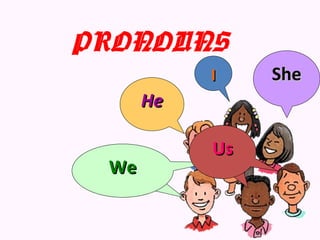
PRONOUNS
           I    She
      He

           Us
 We
Definition
"Pronoun" is the sentence element
used to replace a noun, or a noun
equivalent construction. The
replaced noun is named the
". "antecedent
CATEGORI
  ES OF
PRONOUNS
Syntactically, pronouns have the
    same functions as nouns do;
morphologically, pronouns are used
     to avoid repetition, and to
  set/clarify nouns' categories of
   . number, person, and gender
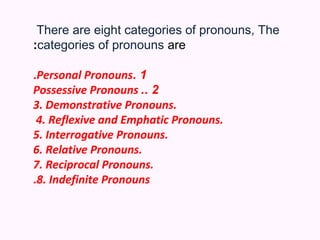
There are eight categories of pronouns, The
:categories of pronouns are

.Personal Pronouns. 1
Possessive Pronouns .. 2
3. Demonstrative Pronouns.
 4. Reflexive and Emphatic Pronouns.
5. Interrogative Pronouns.
6. Relative Pronouns.
7. Reciprocal Pronouns.
.8. Indefinite Pronouns
PERSONAL
PRONOUN
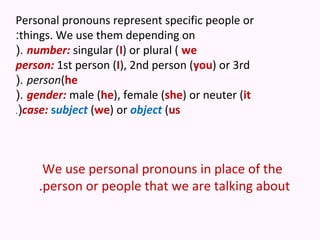
Personal pronouns represent specific people or
:things. We use them depending on
(. number: singular (I) or plural ( we
person: 1st person (I), 2nd person (you) or 3rd
(. person(he
(. gender: male (he), female (she) or neuter (it
.(case: subject (we) or object (us


     We use personal pronouns in place of the
    .person or people that we are talking about
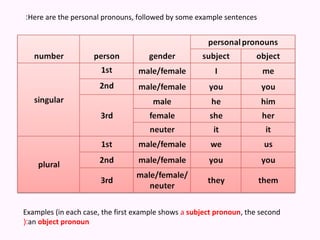
:Here are the personal pronouns, followed by some example sentences


Examples (in each case, the first example shows a subject pronoun, the second
(:an object pronoun
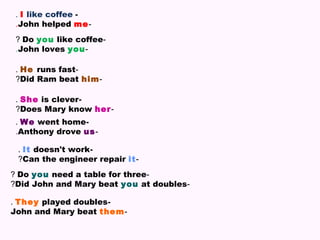
. I like coffee -
 .John helped me -
 ? Do you like coffee-
 .John loves you -

 . He runs fast-
 ?Did Ram beat him -

 . She is clever-
 ?Does Mary know her -
 . We went home-
 .Anthony drove us -

 . It doesn't work-
 ?Can the engineer repair it -
? Do you need a table for three-
?Did John and Mary beat you at doubles-

. They played doubles-
John and Mary beat them -
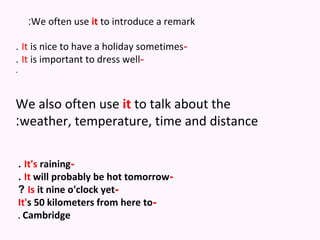
:We often use it to introduce a remark

. It is nice to have a holiday sometimes-
. It is important to dress well-
.


We also often use it to talk about the
:weather, temperature, time and distance

    . It's raining-
    . It will probably be hot tomorrow-
    ? Is it nine o'clock yet-
    It's 50 kilometers from here to-
    . Cambridge
Possessive
Pronouns
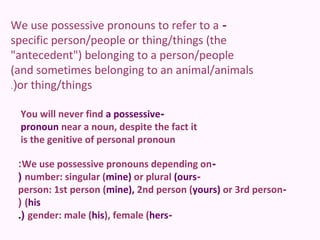
We use possessive pronouns to refer to a -
specific person/people or thing/things (the
"antecedent") belonging to a person/people
(and sometimes belonging to an animal/animals
.(or thing/things


 You will never find a possessive-
 pronoun near a noun, despite the fact it
 is the genitive of personal pronoun

 :We use possessive pronouns depending on-
 ( number: singular (mine) or plural (ours-
 person: 1st person (mine), 2nd person (yours) or 3rd person-
 ( (his
 .( gender: male (his), female (hers-
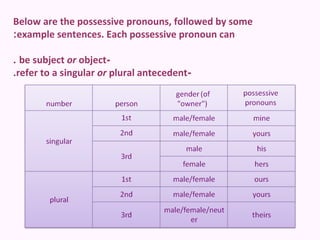
Below are the possessive pronouns, followed by some
:example sentences. Each possessive pronoun can

. be subject or object-
.refer to a singular or plural antecedent-
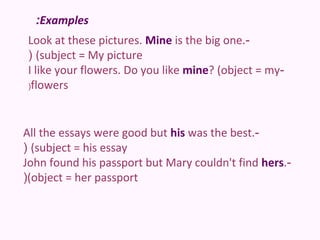
:Examples
Look at these pictures. Mine is the big one.-
( (subject = My picture
I like your flowers. Do you like mine? (object = my-
(flowers


All the essays were good but his was the best.-
( (subject = his essay
John found his passport but Mary couldn't find hers.-
((object = her passport
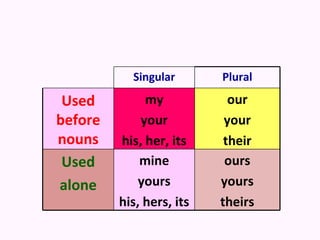
Singular       Plural

 Used         my            our
before       your          your
nouns    his, her, its     their
 Used        mine          ours
alone        yours        yours
         his, hers, its   theirs
REFLEXIV
  E AND
EMPHATIC
PRONOUN
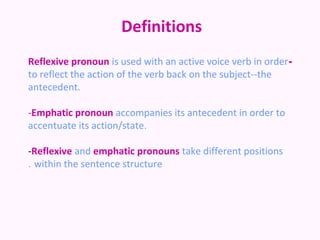
Definitions
Reflexive pronoun is used with an active voice verb in order-
to reflect the action of the verb back on the subject--the
antecedent.

-Emphatic pronoun accompanies its antecedent in order to
accentuate its action/state.

-Reflexive and emphatic pronouns take different positions
. within the sentence structure
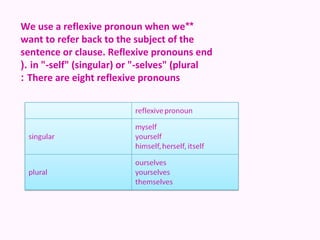
We use a reflexive pronoun when we**
want to refer back to the subject of the
sentence or clause. Reflexive pronouns end
(. in "-self" (singular) or "-selves" (plural
: There are eight reflexive pronouns
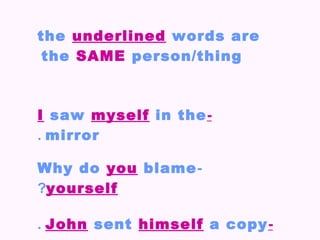
the underlined words are
 the SAME person/thing


I saw myself in the -
. mirror

Why do you blame -
?yourself

. John sent himself a copy -
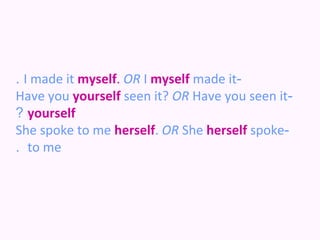
. I made it myself. OR I myself made it-
Have you yourself seen it? OR Have you seen it-
? yourself
She spoke to me herself. OR She herself spoke-
. to me
DEMONSTRATI
     VE
  PRONOUN
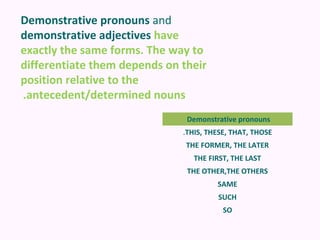
Demonstrative pronouns and
demonstrative adjectives have
exactly the same forms. The way to
differentiate them depends on their
position relative to the
.antecedent/determined nouns
                               Demonstrative pronouns
                              .THIS, THESE, THAT, THOSE
                               THE FORMER, THE LATER
                                 THE FIRST, THE LAST
                               THE OTHER,THE OTHERS
                                       SAME
                                       SUCH
                                         SO
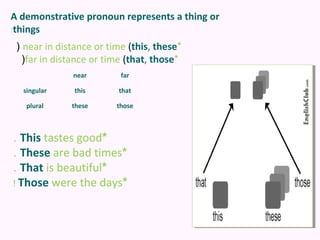
A demonstrative pronoun represents a thing or
:things

 ( near in distance or time (this, these*
   (far in distance or time (that, those*
              near        far

  singular     this      that

   plural     these      those


. This tastes good*
. These are bad times*
. That is beautiful*
! Those were the days*
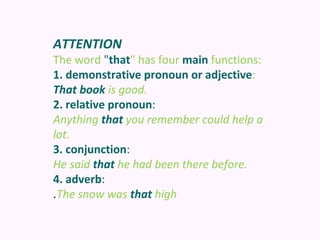
ATTENTION
The word "that" has four main functions:
1. demonstrative pronoun or adjective:
That book is good.
2. relative pronoun:
Anything that you remember could help a
lot.
3. conjunction:
He said that he had been there before.
4. adverb:
.The snow was that high
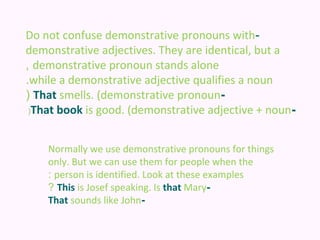
Do not confuse demonstrative pronouns with-
demonstrative adjectives. They are identical, but a
, demonstrative pronoun stands alone
.while a demonstrative adjective qualifies a noun
( That smells. (demonstrative pronoun-
 (That book is good. (demonstrative adjective + noun-


    Normally we use demonstrative pronouns for things
    only. But we can use them for people when the
    : person is identified. Look at these examples
    ? This is Josef speaking. Is that Mary-
    That sounds like John-
INTERROGATI
         VE
  PRONOUN
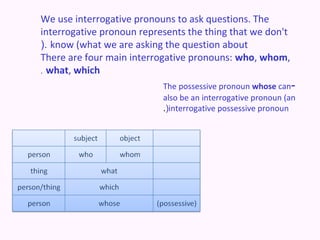
We use interrogative pronouns to ask questions. The
interrogative pronoun represents the thing that we don't
(. know (what we are asking the question about
There are four main interrogative pronouns: who, whom,
. what, which
                           The possessive pronoun whose can-
                           also be an interrogative pronoun (an
                           .(interrogative possessive pronoun
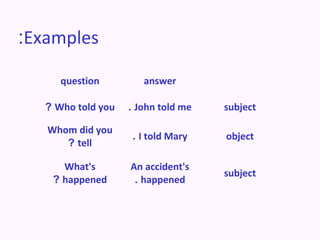
:Examples

      question         answer

   ? Who told you   . John told me   subject

   Whom did you
                    . I told Mary    object
      ? tell

      What's        An accident's
                                     subject
    ? happened       . happened
Relative
Pronouns
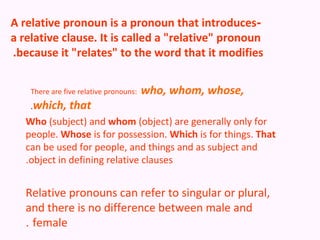
A relative pronoun is a pronoun that introduces-
a relative clause. It is called a "relative" pronoun
.because it "relates" to the word that it modifies


    There are five relative pronouns:   who, whom, whose,
    .which,     that
   Who (subject) and whom (object) are generally only for
   people. Whose is for possession. Which is for things. That
   can be used for people, and things and as subject and
   .object in defining relative clauses


   Relative pronouns can refer to singular or plural,
   and there is no difference between male and
   . female
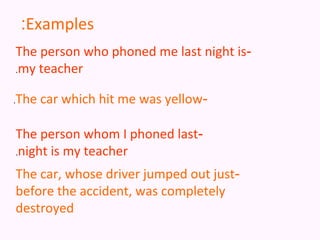
:Examples
    The person who phoned me last night is-
    .my teacher


.   The car which hit me was yellow-

    The person whom I phoned last-
    .night is my teacher

    The car, whose driver jumped out just-
    before the accident, was completely
    destroyed
Reciproc
   al
Pronouns
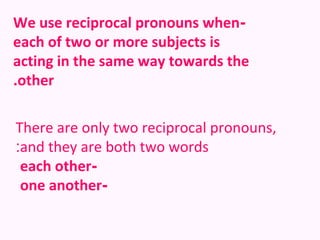
We use reciprocal pronouns when-
each of two or more subjects is
acting in the same way towards the
.other

There are only two reciprocal pronouns,
:and they are both two words
 each other-
 one another-
:When we use these reciprocal pronouns-

there must be two or more people, things or groups
involved (so we cannot use reciprocal pronouns with I,
 you [singular], he/she/it), and
they must be doing the same thing
 :Examples
. John and Mary love each other-
The ten prisoners were all blaming-
. one another
?Why don't you believe each other-
INDEFINITE
 PRONOUN
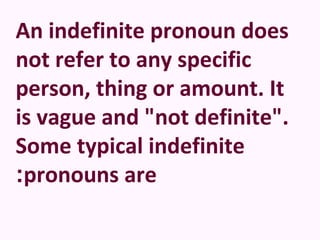
An indefinite pronoun does
not refer to any specific
person, thing or amount. It
is vague and "not definite".
Some typical indefinite
:pronouns are
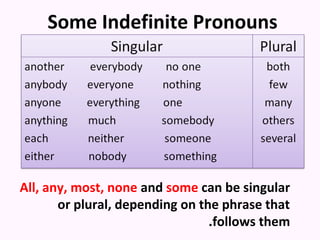
Some Indefinite Pronouns


All, any, most, none and some can be singular
       or plural, depending on the phrase that
                                 .follows them
Note that many indefinite pronouns also function
as other parts of speech. Look at "another" in the
:following sentences


He has one job in the day and another at night.-
( (pronoun
(I'd like another drink, please. (adjective-
Most indefinite pronouns are either singular or plural.
  However, some of them can be singular in one context and
  .plural in another

  Notice that : A singular pronoun takes a singular
  verb AND that any personal pronoun should also
   (.agree (in number and gender
All is forgiven.-
.- All have arrived

We can start the meeting because everybody-
.has arrived
.John likes coffee but not tea. I think both are good-
: References
. www.englishclub.com -1

-2
.www.corollarytheorems.com

Taghreed Ahmed Basabrain
3091116

Pronouns 100425004955-phpapp01

  • 1.
    PRONOUNS I She He Us We
  • 2.
    Definition "Pronoun" is thesentence element used to replace a noun, or a noun equivalent construction. The replaced noun is named the ". "antecedent
  • 3.
    CATEGORI ESOF PRONOUNS
  • 4.
    Syntactically, pronouns havethe same functions as nouns do; morphologically, pronouns are used to avoid repetition, and to set/clarify nouns' categories of . number, person, and gender
  • 5.
    There are eightcategories of pronouns, The :categories of pronouns are .Personal Pronouns. 1 Possessive Pronouns .. 2 3. Demonstrative Pronouns. 4. Reflexive and Emphatic Pronouns. 5. Interrogative Pronouns. 6. Relative Pronouns. 7. Reciprocal Pronouns. .8. Indefinite Pronouns
  • 6.
  • 7.
    Personal pronouns representspecific people or :things. We use them depending on (. number: singular (I) or plural ( we person: 1st person (I), 2nd person (you) or 3rd (. person(he (. gender: male (he), female (she) or neuter (it .(case: subject (we) or object (us We use personal pronouns in place of the .person or people that we are talking about
  • 8.
    :Here are thepersonal pronouns, followed by some example sentences Examples (in each case, the first example shows a subject pronoun, the second (:an object pronoun
  • 9.
    . I likecoffee - .John helped me - ? Do you like coffee- .John loves you - . He runs fast- ?Did Ram beat him - . She is clever- ?Does Mary know her - . We went home- .Anthony drove us - . It doesn't work- ?Can the engineer repair it - ? Do you need a table for three- ?Did John and Mary beat you at doubles- . They played doubles- John and Mary beat them -
  • 10.
    :We often useit to introduce a remark . It is nice to have a holiday sometimes- . It is important to dress well- . We also often use it to talk about the :weather, temperature, time and distance . It's raining- . It will probably be hot tomorrow- ? Is it nine o'clock yet- It's 50 kilometers from here to- . Cambridge
  • 11.
  • 12.
    We use possessivepronouns to refer to a - specific person/people or thing/things (the "antecedent") belonging to a person/people (and sometimes belonging to an animal/animals .(or thing/things You will never find a possessive- pronoun near a noun, despite the fact it is the genitive of personal pronoun :We use possessive pronouns depending on- ( number: singular (mine) or plural (ours- person: 1st person (mine), 2nd person (yours) or 3rd person- ( (his .( gender: male (his), female (hers-
  • 13.
    Below are thepossessive pronouns, followed by some :example sentences. Each possessive pronoun can . be subject or object- .refer to a singular or plural antecedent-
  • 14.
    :Examples Look at thesepictures. Mine is the big one.- ( (subject = My picture I like your flowers. Do you like mine? (object = my- (flowers All the essays were good but his was the best.- ( (subject = his essay John found his passport but Mary couldn't find hers.- ((object = her passport
  • 15.
    Singular Plural Used my our before your your nouns his, her, its their Used mine ours alone yours yours his, hers, its theirs
  • 16.
    REFLEXIV EAND EMPHATIC PRONOUN
  • 17.
    Definitions Reflexive pronoun isused with an active voice verb in order- to reflect the action of the verb back on the subject--the antecedent. -Emphatic pronoun accompanies its antecedent in order to accentuate its action/state. -Reflexive and emphatic pronouns take different positions . within the sentence structure
  • 18.
    We use areflexive pronoun when we** want to refer back to the subject of the sentence or clause. Reflexive pronouns end (. in "-self" (singular) or "-selves" (plural : There are eight reflexive pronouns
  • 19.
    the underlined wordsare the SAME person/thing I saw myself in the - . mirror Why do you blame - ?yourself . John sent himself a copy -
  • 20.
    . I madeit myself. OR I myself made it- Have you yourself seen it? OR Have you seen it- ? yourself She spoke to me herself. OR She herself spoke- . to me
  • 21.
    DEMONSTRATI VE PRONOUN
  • 22.
    Demonstrative pronouns and demonstrativeadjectives have exactly the same forms. The way to differentiate them depends on their position relative to the .antecedent/determined nouns Demonstrative pronouns .THIS, THESE, THAT, THOSE THE FORMER, THE LATER THE FIRST, THE LAST THE OTHER,THE OTHERS SAME SUCH SO
  • 23.
    A demonstrative pronounrepresents a thing or :things ( near in distance or time (this, these* (far in distance or time (that, those* near far singular this that plural these those . This tastes good* . These are bad times* . That is beautiful* ! Those were the days*
  • 24.
    ATTENTION The word "that"has four main functions: 1. demonstrative pronoun or adjective: That book is good. 2. relative pronoun: Anything that you remember could help a lot. 3. conjunction: He said that he had been there before. 4. adverb: .The snow was that high
  • 25.
    Do not confusedemonstrative pronouns with- demonstrative adjectives. They are identical, but a , demonstrative pronoun stands alone .while a demonstrative adjective qualifies a noun ( That smells. (demonstrative pronoun- (That book is good. (demonstrative adjective + noun- Normally we use demonstrative pronouns for things only. But we can use them for people when the : person is identified. Look at these examples ? This is Josef speaking. Is that Mary- That sounds like John-
  • 26.
    INTERROGATI VE PRONOUN
  • 27.
    We use interrogativepronouns to ask questions. The interrogative pronoun represents the thing that we don't (. know (what we are asking the question about There are four main interrogative pronouns: who, whom, . what, which The possessive pronoun whose can- also be an interrogative pronoun (an .(interrogative possessive pronoun
  • 28.
    :Examples question answer ? Who told you . John told me subject Whom did you . I told Mary object ? tell What's An accident's subject ? happened . happened
  • 29.
  • 30.
    A relative pronounis a pronoun that introduces- a relative clause. It is called a "relative" pronoun .because it "relates" to the word that it modifies There are five relative pronouns: who, whom, whose, .which, that Who (subject) and whom (object) are generally only for people. Whose is for possession. Which is for things. That can be used for people, and things and as subject and .object in defining relative clauses Relative pronouns can refer to singular or plural, and there is no difference between male and . female
  • 31.
    :Examples The person who phoned me last night is- .my teacher . The car which hit me was yellow- The person whom I phoned last- .night is my teacher The car, whose driver jumped out just- before the accident, was completely destroyed
  • 32.
    Reciproc al Pronouns
  • 33.
    We use reciprocalpronouns when- each of two or more subjects is acting in the same way towards the .other There are only two reciprocal pronouns, :and they are both two words each other- one another-
  • 34.
    :When we usethese reciprocal pronouns- there must be two or more people, things or groups involved (so we cannot use reciprocal pronouns with I, you [singular], he/she/it), and they must be doing the same thing :Examples . John and Mary love each other- The ten prisoners were all blaming- . one another ?Why don't you believe each other-
  • 35.
  • 36.
    An indefinite pronoundoes not refer to any specific person, thing or amount. It is vague and "not definite". Some typical indefinite :pronouns are
  • 37.
    Some Indefinite Pronouns All,any, most, none and some can be singular or plural, depending on the phrase that .follows them
  • 38.
    Note that manyindefinite pronouns also function as other parts of speech. Look at "another" in the :following sentences He has one job in the day and another at night.- ( (pronoun (I'd like another drink, please. (adjective-
  • 39.
    Most indefinite pronounsare either singular or plural. However, some of them can be singular in one context and .plural in another Notice that : A singular pronoun takes a singular verb AND that any personal pronoun should also (.agree (in number and gender All is forgiven.- .- All have arrived We can start the meeting because everybody- .has arrived .John likes coffee but not tea. I think both are good-
  • 41.
    : References . www.englishclub.com-1 -2 .www.corollarytheorems.com Taghreed Ahmed Basabrain 3091116