What is Salt Analysis?
Salt analysis (also known as systematic qualitative
analysis or qualitative inorganic analysis) involves the
identification of the cation(positive) and
anion(negative) of an inorganic salt. This is done by
conducting a series of tests in a systematic manner
and using the observations to confirm the absence or
presence of specific cations and anions.
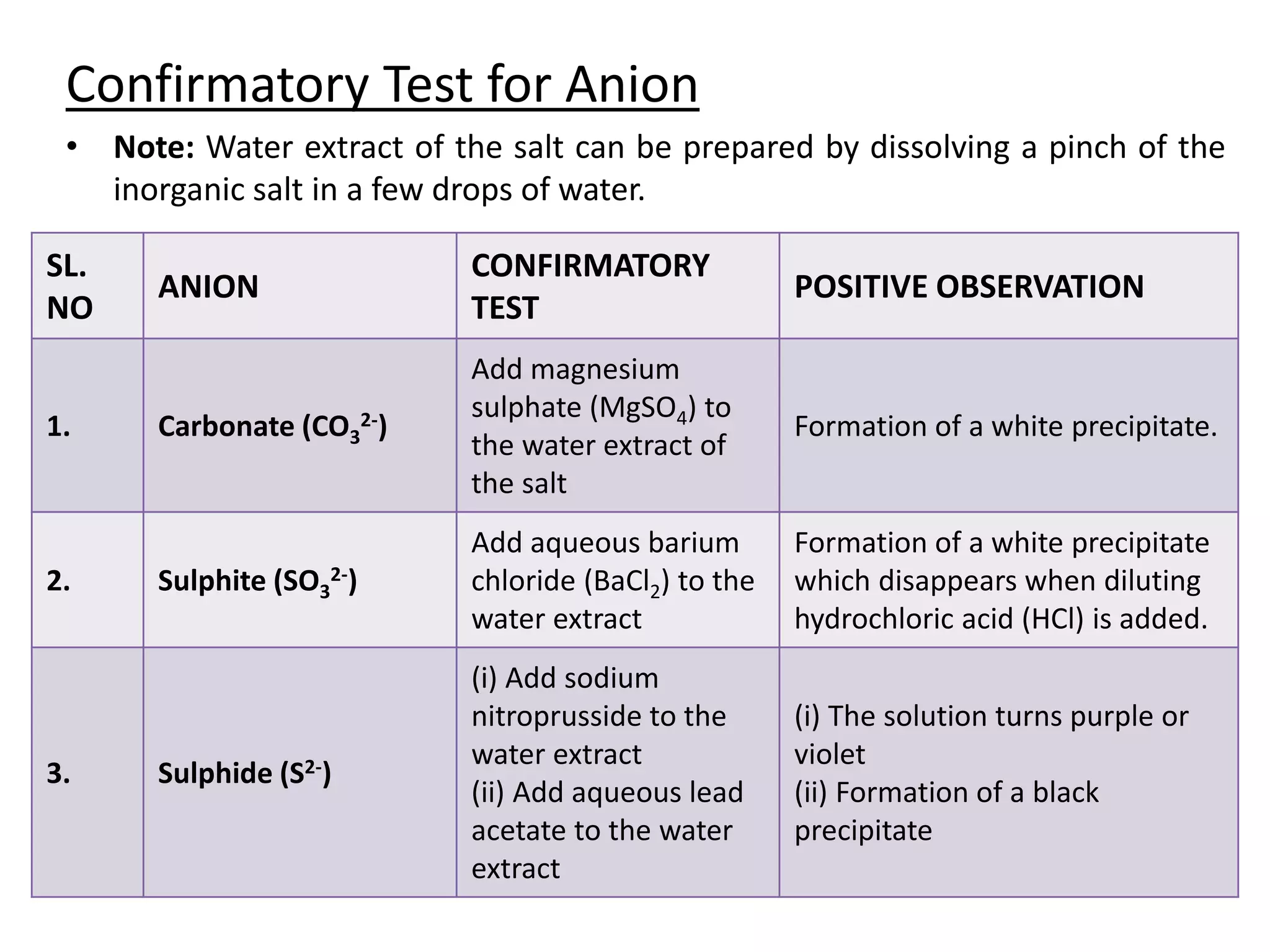
Confirmatory Test for Anion
• Note: Water extract of the salt can be prepared by dissolving a pinch of the
inorganic salt in a few drops of water.
SL.
NO
ANION
CONFIRMATORY
TEST
POSITIVE OBSERVATION
1. Carbonate (CO3
2-)
Add magnesium
sulphate (MgSO4) to
the water extract of
the salt
Formation of a white precipitate.
2. Sulphite (SO3
2-)
Add aqueous barium
chloride (BaCl2) to the
water extract
Formation of a white precipitate
which disappears when diluting
hydrochloric acid (HCl) is added.
3. Sulphide (S2-)
(i) Add sodium
nitroprusside to the
water extract
(ii) Add aqueous lead
acetate to the water
extract
(i) The solution turns purple or
violet
(ii) Formation of a black
precipitate
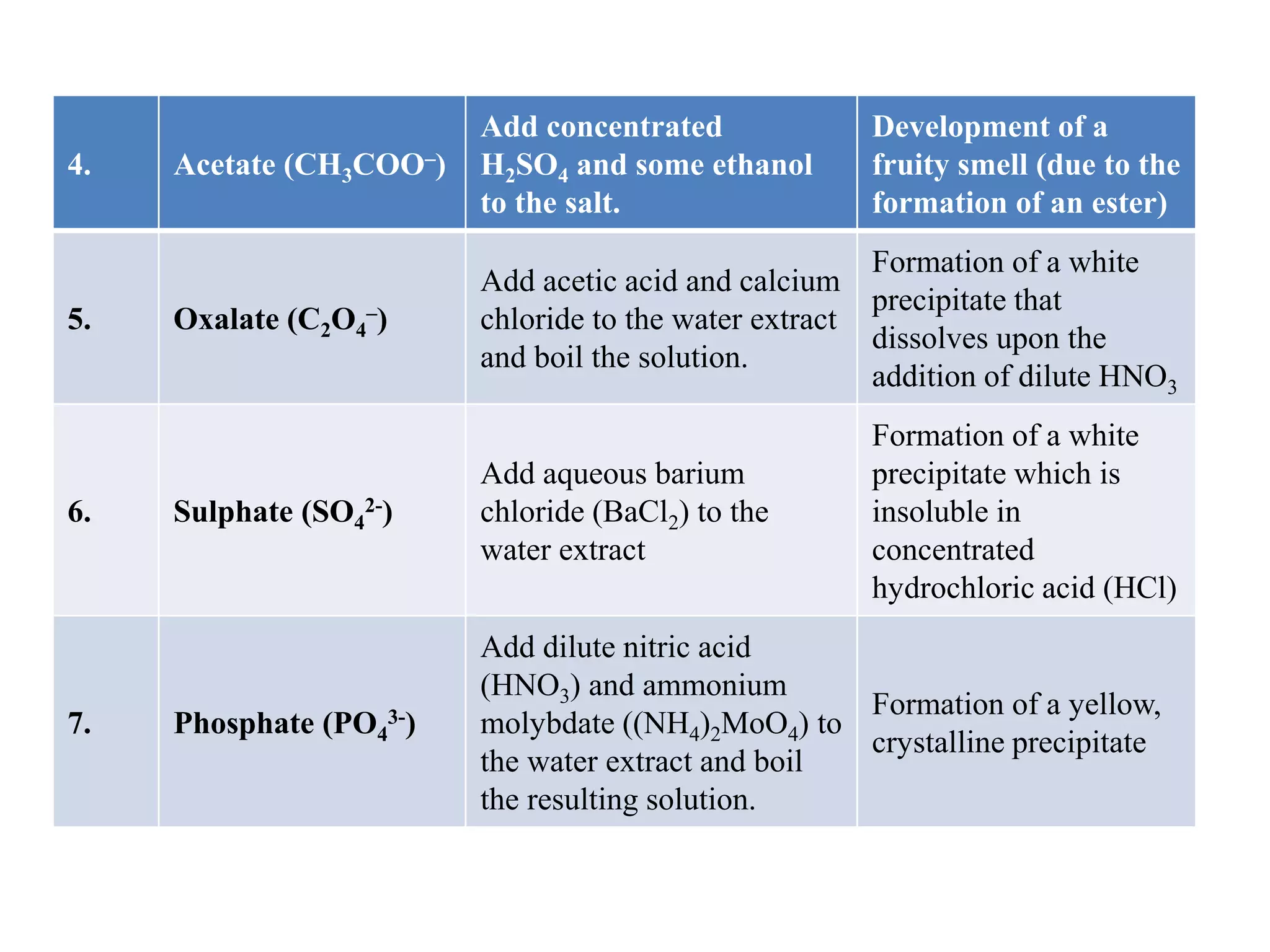
4. Acetate (CH3COO–)
Add concentrated
H2SO4 and some ethanol
to the salt.
Development of a
fruity smell (due to the
formation of an ester)
5. Oxalate (C2O4
–)
Add acetic acid and calcium
chloride to the water extract
and boil the solution.
Formation of a white
precipitate that
dissolves upon the
addition of dilute HNO3
6. Sulphate (SO4
2-)
Add aqueous barium
chloride (BaCl2) to the
water extract
Formation of a white
precipitate which is
insoluble in
concentrated
hydrochloric acid (HCl)
7. Phosphate (PO4
3-)
Add dilute nitric acid
(HNO3) and ammonium
molybdate ((NH4)2MoO4) to
the water extract and boil
the resulting solution.
Formation of a yellow,
crystalline precipitate
8. Nitrite (NO2
–)
Boil a mixture of the water extract
and dilute H2SO4. Now add solid
potassium iodide and starch
solution to it
The solution develops a deep
blue colour
9. Chloride (Cl–)
Add silver nitrate (AgNO3) to the
water extract
Formation of a white
precipitate which is soluble in
ammonium hydroxide
(NH4OH)
10. Bromide (Br–) Add silver nitrate to the water extract
Formation of a yellow
precipitate which is partially
soluble in ammonium
hydroxide
11. Iodide (I–) Add silver nitrate to the water extract
Formation of a yellow
precipitate which is insoluble in
NH4OH
12. Nitrate (NO3
–)
Mix the water extract with iron (II)
sulphate solution (FeSO4) and add
one drop of concentrated nitric acid
(HNO3) along the side of the test
tube.
Formation of a brown ring at
the junction of the acid and the
solution.
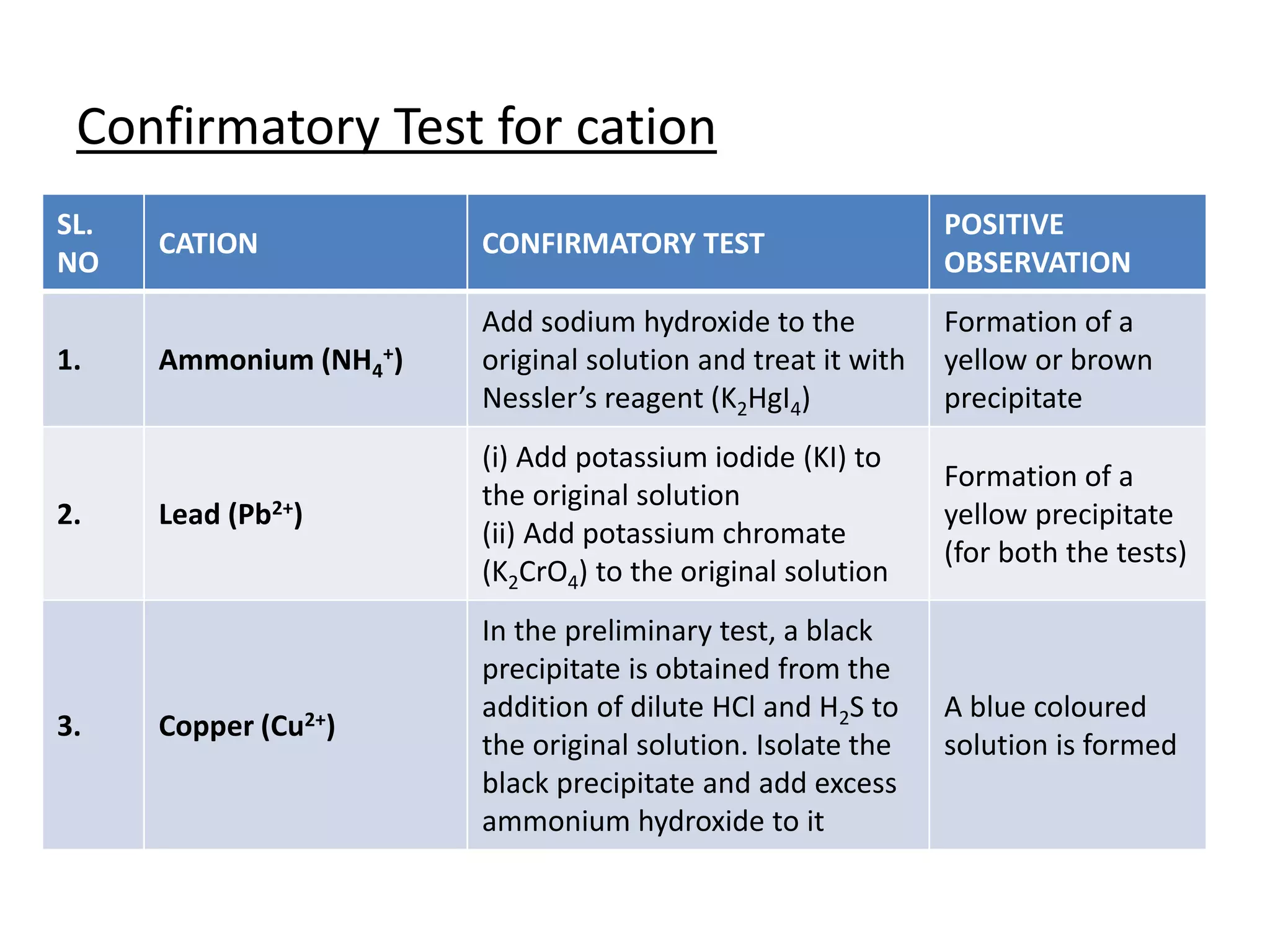
Confirmatory Test for cation
SL.
NO
CATION CONFIRMATORY TEST
POSITIVE
OBSERVATION
1. Ammonium (NH4
+)
Add sodium hydroxide to the
original solution and treat it with
Nessler’s reagent (K2HgI4)
Formation of a
yellow or brown
precipitate
2. Lead (Pb2+)
(i) Add potassium iodide (KI) to
the original solution
(ii) Add potassium chromate
(K2CrO4) to the original solution
Formation of a
yellow precipitate
(for both the tests)
3. Copper (Cu2+)
In the preliminary test, a black
precipitate is obtained from the
addition of dilute HCl and H2S to
the original solution. Isolate the
black precipitate and add excess
ammonium hydroxide to it
A blue coloured
solution is formed
4. Iron (Fe3+)
Add concentrated nitric acid to the
original solution and heat it. A brown
precipitate will form. Add HCl and
potassium ferrocyanide (K4[Fe(CN)6]) to
it
A blue
precipitate is
formed
5.
Aluminium
(Al3+)
A gelatinous white precipitate is
obtained when NH4Cl and excess NH4OH
are added to the original solution.
Isolate the precipitate and dissolve it in
HCl. now add blue litmus and NH4OH to
it drop-by-drop
A floating, blue
layer is formed
on the surface
of the clear
solution
6. Cobalt (Co2+)
Add solid NH4Cl and excess NH4OH to
the original solution and pass H2S gas
through it. Dissolve the resulting blue
residue in water and add dilute
CH3COOH and KNO2 to it. Now warm the
mixture.
A yellow
precipitate is
obtained.
7. Nickel (Ni2+)
Add solid NH4Cl and excess
NH4OH to the original solution
and pass H2S gas through it.
Dissolve the resulting yellow
residue in water (you will now
obtain a green-coloured
solution). Add NaOH and bromine
water to this mixture and boil it.
A black precipitate is
formed
8.
Manganese
(Mn2+)
To the skin-coloured precipitate
obtained in the preliminary test,
add dilute HCl and boil off the
H2S. Now add NaOH.
Formation of a
white precipitate
that turns brown or
black when bromine
water is added
9. Zinc (Zn2+)
Add NaOH (in excess) to the
greyish-white precipitate
obtained in the preliminary test.
The white
precipitate is
dissolved
10.
Barium (Ba2+),
Strontium (Sr2+),
and Calcium
(Ca2+)
Flame test: Make a paste of
the salt by mixing it with a
few drops of concentrated
hydrochloric acid. Now take
off some of the paste with a
glass rod and expose it to a
Bunsen Burner’s flame.
Ba2+: Green-
coloured flame
Sr2+: Crimson red
flame
Ca2+: Brick red
flame
11.
Magnesium
(Mg2+)
Add NH4Cl,
(NH4)3PO4 (ammonium
phosphate) and excess
NH4OH to the original
solution.
A white
precipitate is
obtained.
Identification of cations and anions

Identification of cations and anions

  • 2.
    What is SaltAnalysis? Salt analysis (also known as systematic qualitative analysis or qualitative inorganic analysis) involves the identification of the cation(positive) and anion(negative) of an inorganic salt. This is done by conducting a series of tests in a systematic manner and using the observations to confirm the absence or presence of specific cations and anions.
  • 3.
    Confirmatory Test forAnion • Note: Water extract of the salt can be prepared by dissolving a pinch of the inorganic salt in a few drops of water. SL. NO ANION CONFIRMATORY TEST POSITIVE OBSERVATION 1. Carbonate (CO3 2-) Add magnesium sulphate (MgSO4) to the water extract of the salt Formation of a white precipitate. 2. Sulphite (SO3 2-) Add aqueous barium chloride (BaCl2) to the water extract Formation of a white precipitate which disappears when diluting hydrochloric acid (HCl) is added. 3. Sulphide (S2-) (i) Add sodium nitroprusside to the water extract (ii) Add aqueous lead acetate to the water extract (i) The solution turns purple or violet (ii) Formation of a black precipitate
  • 4.
    4. Acetate (CH3COO–) Addconcentrated H2SO4 and some ethanol to the salt. Development of a fruity smell (due to the formation of an ester) 5. Oxalate (C2O4 –) Add acetic acid and calcium chloride to the water extract and boil the solution. Formation of a white precipitate that dissolves upon the addition of dilute HNO3 6. Sulphate (SO4 2-) Add aqueous barium chloride (BaCl2) to the water extract Formation of a white precipitate which is insoluble in concentrated hydrochloric acid (HCl) 7. Phosphate (PO4 3-) Add dilute nitric acid (HNO3) and ammonium molybdate ((NH4)2MoO4) to the water extract and boil the resulting solution. Formation of a yellow, crystalline precipitate
  • 5.
    8. Nitrite (NO2 –) Boila mixture of the water extract and dilute H2SO4. Now add solid potassium iodide and starch solution to it The solution develops a deep blue colour 9. Chloride (Cl–) Add silver nitrate (AgNO3) to the water extract Formation of a white precipitate which is soluble in ammonium hydroxide (NH4OH) 10. Bromide (Br–) Add silver nitrate to the water extract Formation of a yellow precipitate which is partially soluble in ammonium hydroxide 11. Iodide (I–) Add silver nitrate to the water extract Formation of a yellow precipitate which is insoluble in NH4OH 12. Nitrate (NO3 –) Mix the water extract with iron (II) sulphate solution (FeSO4) and add one drop of concentrated nitric acid (HNO3) along the side of the test tube. Formation of a brown ring at the junction of the acid and the solution.
  • 6.
    Confirmatory Test forcation SL. NO CATION CONFIRMATORY TEST POSITIVE OBSERVATION 1. Ammonium (NH4 +) Add sodium hydroxide to the original solution and treat it with Nessler’s reagent (K2HgI4) Formation of a yellow or brown precipitate 2. Lead (Pb2+) (i) Add potassium iodide (KI) to the original solution (ii) Add potassium chromate (K2CrO4) to the original solution Formation of a yellow precipitate (for both the tests) 3. Copper (Cu2+) In the preliminary test, a black precipitate is obtained from the addition of dilute HCl and H2S to the original solution. Isolate the black precipitate and add excess ammonium hydroxide to it A blue coloured solution is formed
  • 7.
    4. Iron (Fe3+) Addconcentrated nitric acid to the original solution and heat it. A brown precipitate will form. Add HCl and potassium ferrocyanide (K4[Fe(CN)6]) to it A blue precipitate is formed 5. Aluminium (Al3+) A gelatinous white precipitate is obtained when NH4Cl and excess NH4OH are added to the original solution. Isolate the precipitate and dissolve it in HCl. now add blue litmus and NH4OH to it drop-by-drop A floating, blue layer is formed on the surface of the clear solution 6. Cobalt (Co2+) Add solid NH4Cl and excess NH4OH to the original solution and pass H2S gas through it. Dissolve the resulting blue residue in water and add dilute CH3COOH and KNO2 to it. Now warm the mixture. A yellow precipitate is obtained.
  • 8.
    7. Nickel (Ni2+) Addsolid NH4Cl and excess NH4OH to the original solution and pass H2S gas through it. Dissolve the resulting yellow residue in water (you will now obtain a green-coloured solution). Add NaOH and bromine water to this mixture and boil it. A black precipitate is formed 8. Manganese (Mn2+) To the skin-coloured precipitate obtained in the preliminary test, add dilute HCl and boil off the H2S. Now add NaOH. Formation of a white precipitate that turns brown or black when bromine water is added 9. Zinc (Zn2+) Add NaOH (in excess) to the greyish-white precipitate obtained in the preliminary test. The white precipitate is dissolved
  • 9.
    10. Barium (Ba2+), Strontium (Sr2+), andCalcium (Ca2+) Flame test: Make a paste of the salt by mixing it with a few drops of concentrated hydrochloric acid. Now take off some of the paste with a glass rod and expose it to a Bunsen Burner’s flame. Ba2+: Green- coloured flame Sr2+: Crimson red flame Ca2+: Brick red flame 11. Magnesium (Mg2+) Add NH4Cl, (NH4)3PO4 (ammonium phosphate) and excess NH4OH to the original solution. A white precipitate is obtained.