VISUAL SYMBOLS are representations of direct
reality, which comes in the form of signs and
symbols.
“Visual symbols worth a thousand words”
VISUALS SYMBOLS include drawings, cartoons,
strips drawings, diagrams, formulas, charts,
graphs, maps, and globes. They are more clearly
understood than mere words.
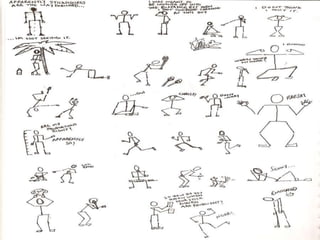
A.DRAWINGS
- the art or act of making figure,
plan, or sketch by means of lines.
- it may not be real thing but better to
have a concrete visual aid than nothing.
One essential skill that the TEACHER
should possess is drawing. It helps you a
lot if you are capable of doing simple
freehand sketching.
B. CARTOONS
- another kind of visual symbols. It
tells its story metaphorically. The perfect
cartoons need no caption. The symbolism
conveys its message.
- it could also be used as springboard
for a lesson or a concluding activity.
* They usually appear in newspaper and in
magazines.
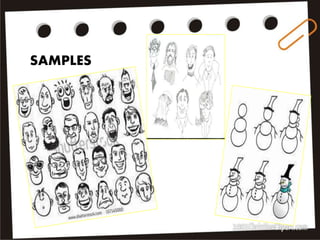
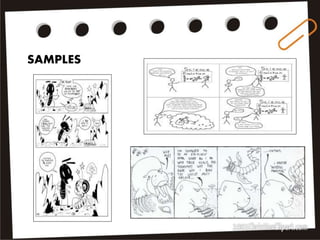
SAMPLES
C. STRIP DRAWINGS
- commonly called comics or comic
strip. it is educational and entertaining at
the same time.
- it can also serve as motivation and
starter of the lesson. It can also be given as
an activity for students to express insights
gained at the conclusion of the lesson.
SAMPLES
D. DIAGRAMS
- any line drawing that shows
arrangement and relations as of parts to the
whole, relative values, origins and
development, chronological, fluctuations, and
distributions.
* the word DIAGRAM is sometimes used as
a synonyms for GRAPH.
TYPES OF DIAGRAMS
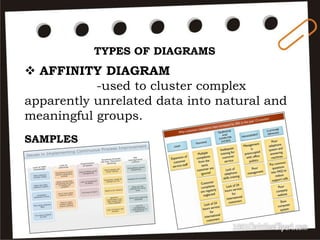
 AFFINITY DIAGRAM
-used to cluster complex
apparently unrelated data into natural and
meaningful groups.
SAMPLES
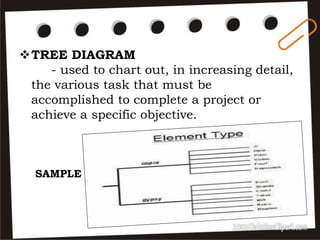
TREE DIAGRAM
- used to chart out, in increasing detail,
the various task that must be
accomplished to complete a project or
achieve a specific objective.
SAMPLE
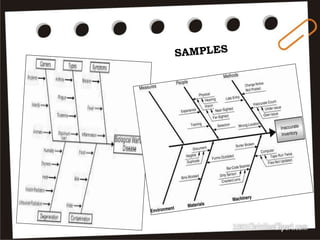
 FISHBONE DIAGRAM
- it is also called as cause-and-effect
diagram. It is structured form of
brainstorming that graphically shows the
relationship of possible causes and sub-
causes directly related to an identified
effect/ problem.
* Commonly used to analyze work-related
problems.
E. CHARTS
- is a diagrammatic representation of
relationships among individuals within an
organizations.
Examples of chart
a.Time chart
b.Tree or stream chart
c.Flow chart
d.Organizational chart
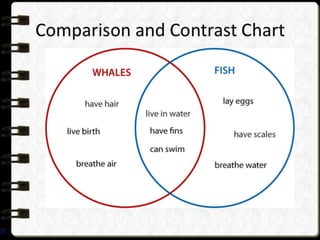
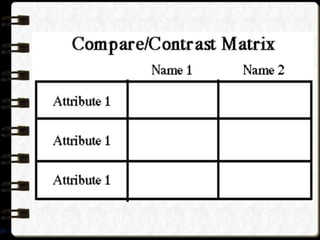
e.Comparison and contrast chart
f. Gannt chart
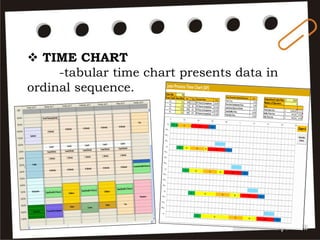
 TIME CHART
-tabular time chart presents data in
ordinal sequence.
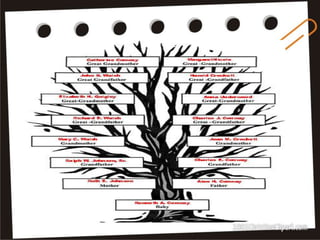
 TREE OR STREAM CHART
- Depicts development growth
and change by beginning with a
simple course with spread outs into
many branches.
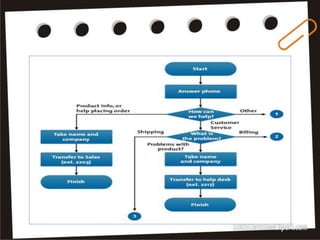
 FLOW CHART
-visual way of charting or
showing a process from beginning
to end. It means of analyzing a
process. By outlining every step in
a process, you can begin to
inefficiencies or problems.
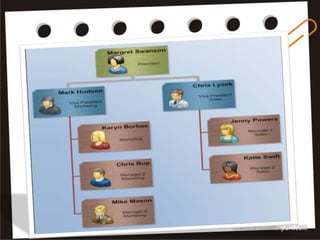
 ORGANIZATIONAL CHART
- shows how one part of the
organization relates to other parts of
the organization.
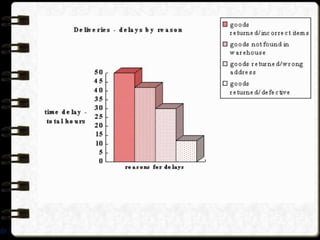
 PARETO CHART
- type of a bar chart, prioritized
in descending order or magnitude or
importance from left to right.
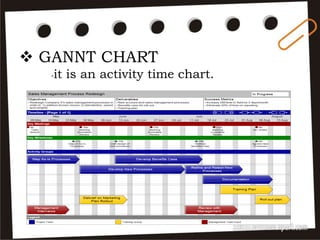
 GANNT CHART
-it is an activity time chart.
E. GRAPHS
-pictures that help us
understand amounts. These
amounts are so called data.
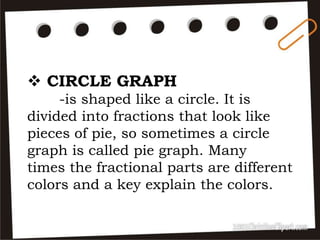
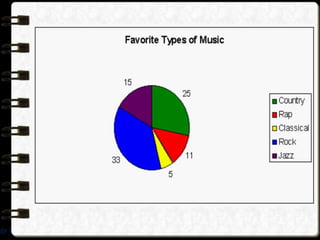
 CIRCLE GRAPH
-is shaped like a circle. It is
divided into fractions that look like
pieces of pie, so sometimes a circle
graph is called pie graph. Many
times the fractional parts are different
colors and a key explain the colors.
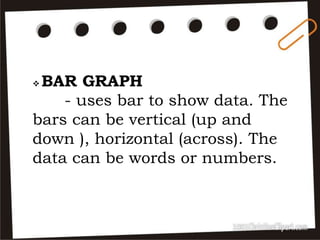
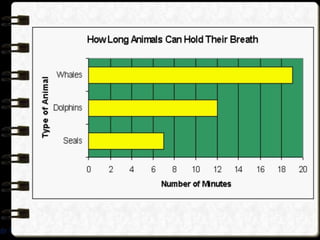
 BAR GRAPH
- uses bar to show data. The
bars can be vertical (up and
down ), horizontal (across). The
data can be words or numbers.
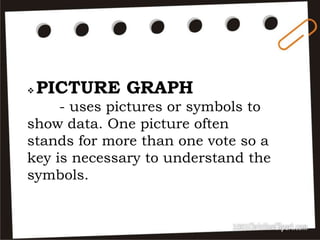
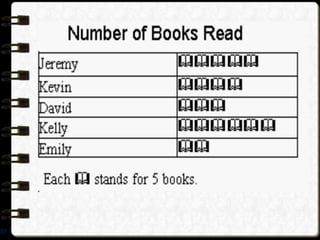
 PICTURE GRAPH
- uses pictures or symbols to
show data. One picture often
stands for more than one vote so a
key is necessary to understand the
symbols.
F. MAPS
-is visual representation of an
area
- a symbolic depiction
highlighting relationships between
elements of that space such as
objects, regions, and themes.
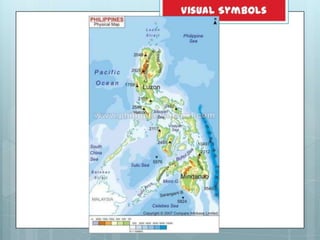
PHYSICAL MAP
-combines in a single
projection data like altitude,
temperature, rainfall,
precipitation, vegetation and
soil.
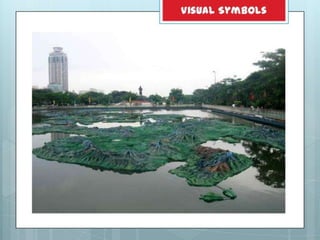
RELIEF MAP
-has three dimensional
representations and show
contours the physical data of the
earth or part of the earth.
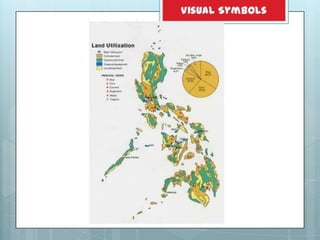
COMMERCIAL OR
ECONOMIC MAP
- also called product or
industrial map since they show
land areas in relation to the
economy
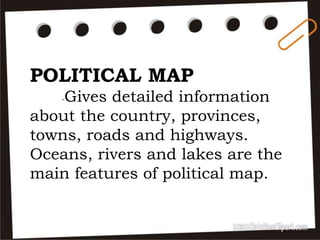
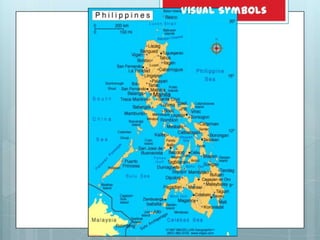
POLITICAL MAP
-Gives detailed information
about the country, provinces,
towns, roads and highways.
Oceans, rivers and lakes are the
main features of political map.
teaching visual symbols

teaching visual symbols

  • 2.
    VISUAL SYMBOLS arerepresentations of direct reality, which comes in the form of signs and symbols. “Visual symbols worth a thousand words” VISUALS SYMBOLS include drawings, cartoons, strips drawings, diagrams, formulas, charts, graphs, maps, and globes. They are more clearly understood than mere words.
  • 4.
    A.DRAWINGS - the artor act of making figure, plan, or sketch by means of lines. - it may not be real thing but better to have a concrete visual aid than nothing. One essential skill that the TEACHER should possess is drawing. It helps you a lot if you are capable of doing simple freehand sketching.
  • 6.
    B. CARTOONS - anotherkind of visual symbols. It tells its story metaphorically. The perfect cartoons need no caption. The symbolism conveys its message. - it could also be used as springboard for a lesson or a concluding activity. * They usually appear in newspaper and in magazines.
  • 7.
  • 8.
    C. STRIP DRAWINGS -commonly called comics or comic strip. it is educational and entertaining at the same time. - it can also serve as motivation and starter of the lesson. It can also be given as an activity for students to express insights gained at the conclusion of the lesson.
  • 9.
  • 10.
    D. DIAGRAMS - anyline drawing that shows arrangement and relations as of parts to the whole, relative values, origins and development, chronological, fluctuations, and distributions. * the word DIAGRAM is sometimes used as a synonyms for GRAPH.
  • 11.
    TYPES OF DIAGRAMS AFFINITY DIAGRAM -used to cluster complex apparently unrelated data into natural and meaningful groups. SAMPLES
  • 12.
    TREE DIAGRAM - usedto chart out, in increasing detail, the various task that must be accomplished to complete a project or achieve a specific objective. SAMPLE
  • 13.
     FISHBONE DIAGRAM -it is also called as cause-and-effect diagram. It is structured form of brainstorming that graphically shows the relationship of possible causes and sub- causes directly related to an identified effect/ problem. * Commonly used to analyze work-related problems.
  • 15.
    E. CHARTS - isa diagrammatic representation of relationships among individuals within an organizations. Examples of chart a.Time chart b.Tree or stream chart c.Flow chart d.Organizational chart e.Comparison and contrast chart f. Gannt chart
  • 16.
     TIME CHART -tabulartime chart presents data in ordinal sequence.
  • 17.
     TREE ORSTREAM CHART - Depicts development growth and change by beginning with a simple course with spread outs into many branches.
  • 19.
     FLOW CHART -visualway of charting or showing a process from beginning to end. It means of analyzing a process. By outlining every step in a process, you can begin to inefficiencies or problems.
  • 21.
     ORGANIZATIONAL CHART -shows how one part of the organization relates to other parts of the organization.
  • 25.
     PARETO CHART -type of a bar chart, prioritized in descending order or magnitude or importance from left to right.
  • 27.
     GANNT CHART -itis an activity time chart.
  • 28.
    E. GRAPHS -pictures thathelp us understand amounts. These amounts are so called data.
  • 29.
     CIRCLE GRAPH -isshaped like a circle. It is divided into fractions that look like pieces of pie, so sometimes a circle graph is called pie graph. Many times the fractional parts are different colors and a key explain the colors.
  • 31.
     BAR GRAPH -uses bar to show data. The bars can be vertical (up and down ), horizontal (across). The data can be words or numbers.
  • 33.
     PICTURE GRAPH -uses pictures or symbols to show data. One picture often stands for more than one vote so a key is necessary to understand the symbols.
  • 35.
    F. MAPS -is visualrepresentation of an area - a symbolic depiction highlighting relationships between elements of that space such as objects, regions, and themes.
  • 37.
    PHYSICAL MAP -combines ina single projection data like altitude, temperature, rainfall, precipitation, vegetation and soil.
  • 39.
    RELIEF MAP -has threedimensional representations and show contours the physical data of the earth or part of the earth.
  • 41.
    COMMERCIAL OR ECONOMIC MAP -also called product or industrial map since they show land areas in relation to the economy
  • 43.
    POLITICAL MAP -Gives detailedinformation about the country, provinces, towns, roads and highways. Oceans, rivers and lakes are the main features of political map.