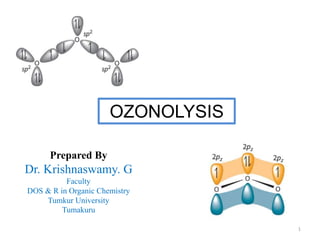
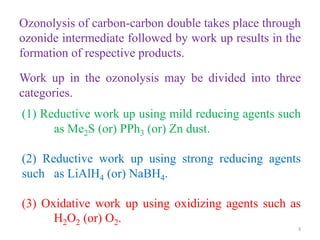
OZONOLYSIS
Prepared By
Dr. Krishnaswamy. G
Faculty
DOS & R in Organic Chemistry
Tumkur University
Tumakuru
1
Oxidative cleavage of carbon-carbon double bond
using ozone as an oxidizing agent is called Ozonolysis.
The reaction is performed in common organic solvents
such as Dichloromethane (or) Methanol (or) Acetone at
-78o C.
2
R1
R3
R2
R4
R1
R3
R2
R4
O O
O3
Work Up
Ozonolysis of carbon-carbon double takes place through
ozonide intermediate followed by work up results in the
formation of respective products.
Work up in the ozonolysis may be divided into three
categories.
3
(1) Reductive work up using mild reducing agents such
as Me2S (or) PPh3 (or) Zn dust.
(2) Reductive work up using strong reducing agents
such as LiAlH4 (or) NaBH4.
(3) Oxidative work up using oxidizing agents such as
H2O2 (or) O2.
4
(1) Reductive work up using mild reducing agents such
as Me2S (or) PPh3 (or) Zn dust produces
aldehyde and ketone.
R1
R3
R2
H
R1
R3
R2
H
O O
O3
Mild Reductive
Work Up
R1
R3
R2
H
O
O O
Me2S/PPh3/
Zn dust
[Ozonide]
5
(2) Reductive work up using strong reducing agents
such as LiAlH4 (or) NaBH4 produces alcohols.
R1
R3
R2
H
R1
R3
R2
OH HO
O3
Strong Reductive
Work Up
R1
R3
R2
H
O
O O
LiAlH4/
NaBH4
[Ozonide]
6
(3) Oxidative work up using oxidizing agents such as
H2O2 (or) O2 provides carboxylic acids.
R1
R3
R2
H
R1
R3
R2
OH
O O
O3
Oxidative
Work Up
R1
R3
R2
H
O
O O
H2O2/
O2
[Ozonide]
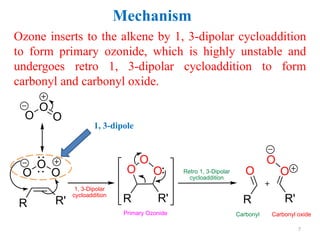
Ozone inserts to the alkene by 1, 3-dipolar cycloaddition
to form primary ozonide, which is highly unstable and
undergoes retro 1, 3-dipolar cycloaddition to form
carbonyl and carbonyl oxide.
7
R R'
O
R
O
O
Primary Ozonide
O
O
O
O
O
O
R'
O
R
O
O
R'
Carbonyl Carbonyl oxide
1, 3-Dipolar
cycloaddition
Retro 1, 3-Dipolar
cycloaddition
1, 3-dipole
Mechanism
8
Carbonyl oxide which has a dipole undergoes once again
1, 3 – dipolar cycloaddition reaction with carbonyl to for
the stable ozonide.
O
O
O
R'
Carbonyl Carbonyl oxide
R
O
O
O
R R'1, 3-Dipolar
cycloaddition
Ozonide
1, 3-dipole
9
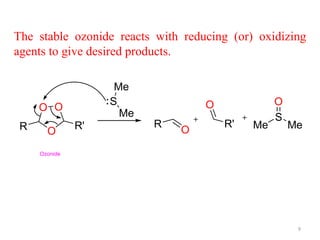
The stable ozonide reacts with reducing (or) oxidizing
agents to give desired products.
O
O
O
R R'
Ozonide
S
Me
Me
O
O
R R'
S
O
MeMe
Ozonolysis of simple allenes leads to the formation of
two carbonyl fragments and carbon monoxide.
10
C C C
R1
R3
R2
R4
C O
R1
R3
O C
R2
R4
CO
O3
Ozonolysis of alkynes leads to the formation of either
acid anhydrides or a diketone.
C C
O3
C C
O O
O
C C
O O
C C
O O
O
Diketone Anhydride
Work Up

Ozonolysis

  • 1.
    OZONOLYSIS Prepared By Dr. Krishnaswamy.G Faculty DOS & R in Organic Chemistry Tumkur University Tumakuru 1
  • 2.
    Oxidative cleavage ofcarbon-carbon double bond using ozone as an oxidizing agent is called Ozonolysis. The reaction is performed in common organic solvents such as Dichloromethane (or) Methanol (or) Acetone at -78o C. 2 R1 R3 R2 R4 R1 R3 R2 R4 O O O3 Work Up
  • 3.
    Ozonolysis of carbon-carbondouble takes place through ozonide intermediate followed by work up results in the formation of respective products. Work up in the ozonolysis may be divided into three categories. 3 (1) Reductive work up using mild reducing agents such as Me2S (or) PPh3 (or) Zn dust. (2) Reductive work up using strong reducing agents such as LiAlH4 (or) NaBH4. (3) Oxidative work up using oxidizing agents such as H2O2 (or) O2.
  • 4.
    4 (1) Reductive workup using mild reducing agents such as Me2S (or) PPh3 (or) Zn dust produces aldehyde and ketone. R1 R3 R2 H R1 R3 R2 H O O O3 Mild Reductive Work Up R1 R3 R2 H O O O Me2S/PPh3/ Zn dust [Ozonide]
  • 5.
    5 (2) Reductive workup using strong reducing agents such as LiAlH4 (or) NaBH4 produces alcohols. R1 R3 R2 H R1 R3 R2 OH HO O3 Strong Reductive Work Up R1 R3 R2 H O O O LiAlH4/ NaBH4 [Ozonide]
  • 6.
    6 (3) Oxidative workup using oxidizing agents such as H2O2 (or) O2 provides carboxylic acids. R1 R3 R2 H R1 R3 R2 OH O O O3 Oxidative Work Up R1 R3 R2 H O O O H2O2/ O2 [Ozonide]
  • 7.
    Ozone inserts tothe alkene by 1, 3-dipolar cycloaddition to form primary ozonide, which is highly unstable and undergoes retro 1, 3-dipolar cycloaddition to form carbonyl and carbonyl oxide. 7 R R' O R O O Primary Ozonide O O O O O O R' O R O O R' Carbonyl Carbonyl oxide 1, 3-Dipolar cycloaddition Retro 1, 3-Dipolar cycloaddition 1, 3-dipole Mechanism
  • 8.
    8 Carbonyl oxide whichhas a dipole undergoes once again 1, 3 – dipolar cycloaddition reaction with carbonyl to for the stable ozonide. O O O R' Carbonyl Carbonyl oxide R O O O R R'1, 3-Dipolar cycloaddition Ozonide 1, 3-dipole
  • 9.
    9 The stable ozonidereacts with reducing (or) oxidizing agents to give desired products. O O O R R' Ozonide S Me Me O O R R' S O MeMe
  • 10.
    Ozonolysis of simpleallenes leads to the formation of two carbonyl fragments and carbon monoxide. 10 C C C R1 R3 R2 R4 C O R1 R3 O C R2 R4 CO O3 Ozonolysis of alkynes leads to the formation of either acid anhydrides or a diketone. C C O3 C C O O O C C O O C C O O O Diketone Anhydride Work Up