1
* Created by using various internet Resources for Educational Purpose only
15-03-2018
2
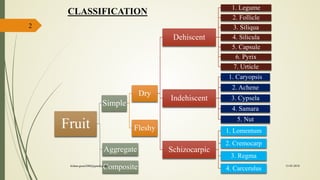
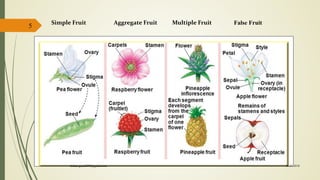
Fruit
Simple
Dry
Dehiscent
1. Legume
2. Follicle
3. Siliqua
4. Silicula
5. Capsule
6. Pyrix
7. Urticle
Indehiscent
1. Caryopsis
2. Achene
3. Cypsela
4. Samara
5. Nut
Schizocarpic
1. Lomentum
2. Cremocarp
3. Regma
4. Carcerulus
Fleshy
Aggregate
Composite
CLASSIFICATION
15-03-2018kishan.gusai2008@gmail.com
3
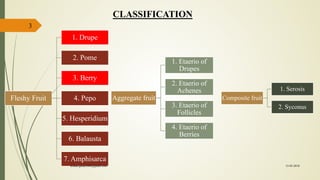
Fleshy Fruit
1. Drupe
2. Pome
3. Berry
4. Pepo
5. Hesperidium
6. Balausta
7. Amphisarca
Aggregate fruit
1. Etaerio of
Drupes
2. Etaerio of
Achenes
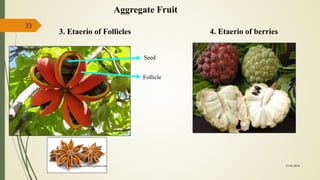
3. Etaerio of
Follicles
4. Etaerio of
Berries
Composite fruit
1. Serosis
2. Syconus
CLASSIFICATION
15-03-2018kishan.gusai2008@gmail.com
4
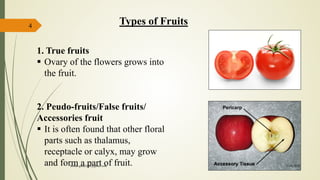
Types of Fruits
1. True fruits
 Ovary of the flowers grows into
the fruit.
2. Peudo-fruits/False fruits/
Accessories fruit
 It is often found that other floral
parts such as thalamus,
receptacle or calyx, may grow
and form a part of fruit. 15-03-2018kishan.gusai2008@gmail.com
5
Simple Fruit Aggregate Fruit Multiple Fruit False Fruit
15-03-2018kishan.gusai2008@gmail.com
6
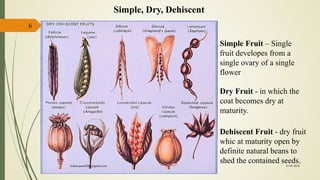
Simple, Dry, Dehiscent
Simple Fruit – Single
fruit developes from a
single ovary of a single
flower
Dry Fruit - in which the
coat becomes dry at
maturity.
Dehiscent Fruit - dry fruit
whic at maturity open by
definite natural beans to
shed the contained seeds.15-03-2018kishan.gusai2008@gmail.com
7
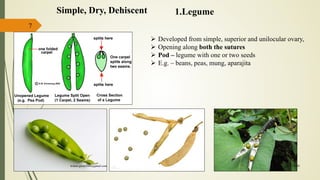
1.LegumeSimple, Dry, Dehiscent
 Developed from simple, superior and unilocular ovary,
 Opening along both the sutures
 Pod – legume with one or two seeds
 E.g. – beans, peas, mung, aparajita
15-03-2018kishan.gusai2008@gmail.com
8
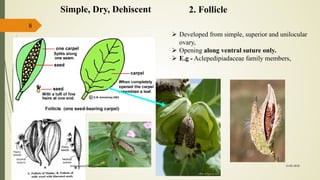
2. FollicleSimple, Dry, Dehiscent
 Developed from simple, superior and unilocular
ovary,
 Opening along ventral suture only.
 E.g - Aclepedipiadaceae family members,
15-03-2018kishan.gusai2008@gmail.com
9
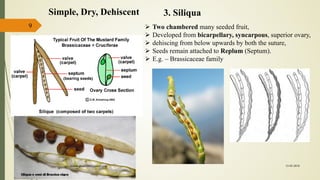
3. SiliquaSimple, Dry, Dehiscent
 Two chambered many seeded fruit,
 Developed from bicarpellary, syncarpous, superior ovary,
 dehiscing from below upwards by both the suture,
 Seeds remain attached to Replum (Septum).
 E.g. – Brassicaceae family
15-03-2018kishan.gusai2008@gmail.com
10
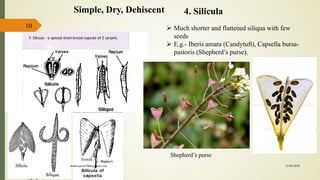
4. SiliculaSimple, Dry, Dehiscent
 Much shorter and flattened siliqua with few
seeds
 E.g.- Iberis amara (Candytuft), Capsella bursa-
pastoris (Shepherd’s purse).
Shepherd’s purse
15-03-2018kishan.gusai2008@gmail.com
11
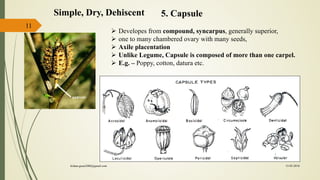
5. CapsuleSimple, Dry, Dehiscent
 Developes from compound, syncarpus, generally superior,
 one to many chambered ovary with many seeds,
 Axile placentation
 Unlike Legume, Capsule is composed of more than one carpel.
 E.g. – Poppy, cotton, datura etc.
15-03-2018kishan.gusai2008@gmail.com
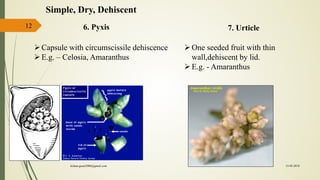
12 6. Pyxis
Simple, Dry, Dehiscent
Capsule with circumscissile dehiscence
E.g. – Celosia, Amaranthus
7. Urticle
One seeded fruit with thin
wall,dehiscent by lid.
E.g. - Amaranthus
15-03-2018kishan.gusai2008@gmail.com
13
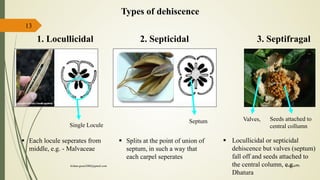
Single Locule
Septum
3. Septifragal
Valves, Seeds attached to
central collumn
Types of dehiscence
1. Locullicidal 2. Septicidal
 Each locule seperates from
middle, e.g. - Malvaceae
 Splits at the point of union of
septum, in such a way that
each carpel seperates
 Locullicidal or septicidal
dehiscence but valves (septum)
fall off and seeds attached to
the central column, e.g. -
Dhatura
15-03-2018kishan.gusai2008@gmail.com
14
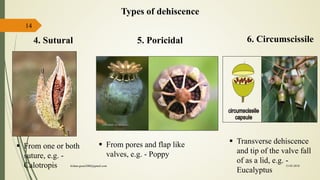
5. Poricidal4. Sutural
 From one or both
suture, e.g. -
Calotropis
 From pores and flap like
valves, e.g. - Poppy
6. Circumscissile
 Transverse dehiscence
and tip of the valve fall
of as a lid, e.g. -
Eucalyptus
Types of dehiscence
15-03-2018kishan.gusai2008@gmail.com
15
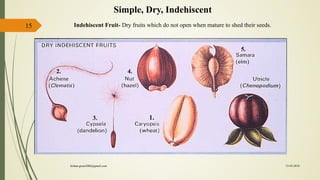
Simple, Dry, Indehiscent
1.
2.
3.
4.
5.
Indehiscent Fruit- Dry fruits which do not open when mature to shed their seeds.
15-03-2018kishan.gusai2008@gmail.com
16
Simple, Dry, Indehiscent
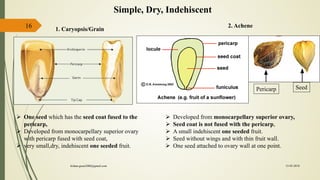
1. Caryopsis/Grain
 One seed which has the seed coat fused to the
pericarp,
 Developed from monocarpellary superior ovary
with pericarp fused with seed coat,
 very small,dry, indehiscent one seeded fruit.
2. Achene
 Developed from monocarpellary superior ovary,
 Seed coat is not fused with the pericarp,
 A small indehiscent one seeded fruit.
 Seed without wings and with thin fruit wall.
 One seed attached to ovary wall at one point.
Pericarp Seed
15-03-2018kishan.gusai2008@gmail.com
17
Simple, Dry, Indehiscent
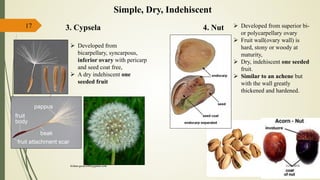
3. Cypsela
 Developed from
bicarpellary, syncarpous,
inferior ovary with pericarp
and seed coat free,
 A dry indehiscent one
seeded fruit
4. Nut  Developed from superior bi-
or polycarpellary ovary
 Fruit wall(ovary wall) is
hard, stony or woody at
maturity,
 Dry, indehiscent one seeded
fruit.
 Similar to an achene but
with the wall greatly
thickened and hardened.
15-03-2018kishan.gusai2008@gmail.com
18
Simple, Dry, Indehiscent
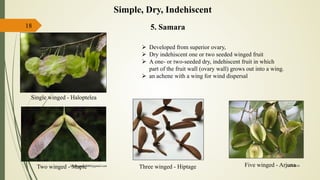
5. Samara
 Developed from superior ovary,
 Dry indehiscent one or two seeded winged fruit
 A one- or two-seeded dry, indehiscent fruit in which
part of the fruit wall (ovary wall) grows out into a wing.
 an achene with a wing for wind dispersal
Single winged - Haloptelea
Two winged - Maple Three winged - Hiptage Five winged - Arjuna15-03-2018kishan.gusai2008@gmail.com
19
Simple, Dry, Schizocarpic
15-03-2018kishan.gusai2008@gmail.com
20
Simple, Dry, Schizocarpic
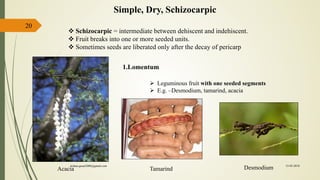
1.Lomentum
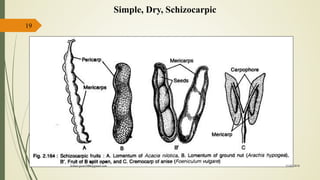
 Schizocarpic = intermediate between dehiscent and indehiscent.
 Fruit breaks into one or more seeded units.
 Sometimes seeds are liberated only after the decay of pericarp
 Leguminous fruit with one seeded segments
 E.g. –Desmodium, tamarind, acacia
DesmodiumTamarindAcacia
15-03-2018kishan.gusai2008@gmail.com
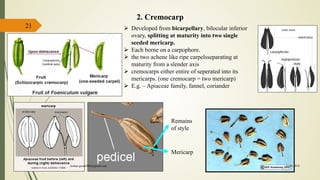
21  Developed from bicarpellary, bilocular inferior
ovary, splitting at maturity into two single
seeded mericarp.
 Each borne on a carpophore.
 the two achene like ripe carpelsseparating at
maturity from a slender axis
 cremocarps either entire of seperated into its
mericarps. (one cremocarp = two mericarp)
 E.g. – Apiaceae family, fannel, coriander
2. Cremocarp
Remains
of style
Mericarp
15-03-2018kishan.gusai2008@gmail.com
22
Simple, Dry, Schizocarpic
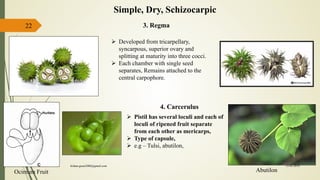
3. Regma
 Developed from tricarpellary,
syncarpous, superior ovary and
splitting at maturity into three cocci.
 Each chamber with single seed
separates, Remains attached to the
central carpophore.
4. Carcerulus
 Pistil has several loculi and each of
loculi of ripened fruit separate
from each other as mericarps,
 Type of capsule,
 e.g – Tulsi, abutilon,
Ocimum Fruit Abutilon
15-03-2018kishan.gusai2008@gmail.com
23
Simple, Fleshy fruits
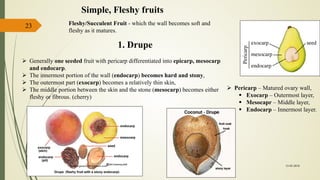
1. Drupe
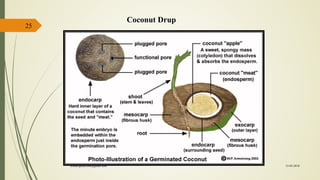
 Generally one seeded fruit with pericarp differentiated into epicarp, mesocarp
and endocarp.
 The innermost portion of the wall (endocarp) becomes hard and stony,
 The outermost part (exocarp) becomes a relatively thin skin,
 The middle portion between the skin and the stone (mesocarp) becomes either
fleshy or fibrous. (cherry)
 Pericarp – Matured ovary wall,
 Exocarp – Outermost layer,
 Mesocapr – Middle layer,
 Endocarp – Innermost layer.
Fleshy/Succulent Fruit - which the wall becomes soft and
fleshy as it matures.
15-03-2018kishan.gusai2008@gmail.com
24
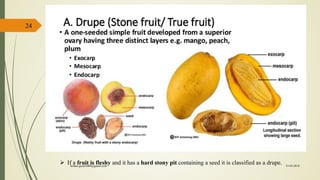
 If a fruit is fleshy and it has a hard stony pit containing a seed it is classified as a drupe. 15-03-2018kishan.gusai2008@gmail.com
25
Coconut Drup
15-03-2018kishan.gusai2008@gmail.com
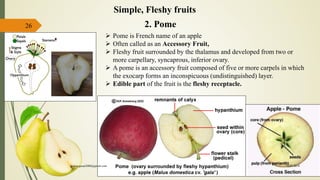
26 2. Pome
Simple, Fleshy fruits
 Pome is French name of an apple
 Often called as an Accessory Fruit,
 Fleshy fruit surrounded by the thalamus and developed from two or
more carpellary, syncaprous, inferior ovary.
 A pome is an accessory fruit composed of five or more carpels in which
the exocarp forms an inconspicuous (undistinguished) layer.
 Edible part of the fruit is the fleshy receptacle.
15-03-2018kishan.gusai2008@gmail.com
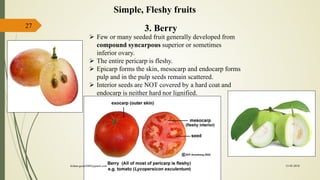
27 3. Berry
Simple, Fleshy fruits
 Few or many seeded fruit generally developed from
compound syncarpous superior or sometimes
inferior ovary.
 The entire pericarp is fleshy.
 Epicarp forms the skin, mesocarp and endocarp forms
pulp and in the pulp seeds remain scattered.
 Interior seeds are NOT covered by a hard coat and
endocarp is neither hard nor lignified.
15-03-2018kishan.gusai2008@gmail.com
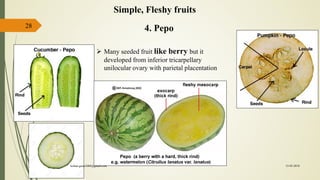
28 4. Pepo
Simple, Fleshy fruits
 Many seeded fruit like berry but it
developed from inferior tricarpellary
unilocular ovary with parietal placentation
15-03-2018kishan.gusai2008@gmail.com
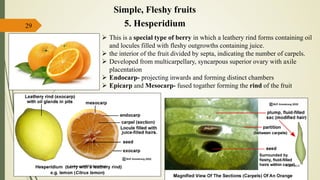
29 5. Hesperidium
Simple, Fleshy fruits
 This is a special type of berry in which a leathery rind forms containing oil
and locules filled with fleshy outgrowths containing juice.
 the interior of the fruit divided by septa, indicating the number of carpels.
 Developed from multicarpellary, syncarpous superior ovary with axile
placentation
 Endocarp- projecting inwards and forming distinct chambers
 Epicarp and Mesocarp- fused togather forming the rind of the fruit
15-03-2018kishan.gusai2008@gmail.com
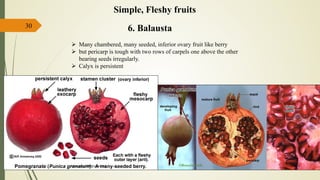
30 6. Balausta
Simple, Fleshy fruits
 Many chambered, many seeded, inferior ovary fruit like berry
 but pericarp is tough with two rows of carpels one above the other
bearing seeds irregularly.
 Calyx is persistent
15-03-2018kishan.gusai2008@gmail.com
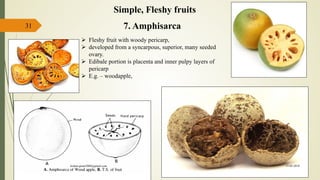
31 7. Amphisarca
Simple, Fleshy fruits
 Fleshy fruit with woody pericarp,
 developed from a syncarpous, superior, many seeded
ovary.
 Edibale portion is placenta and inner pulpy layers of
pericarp
 E.g. – woodapple,
15-03-2018kishan.gusai2008@gmail.com
32
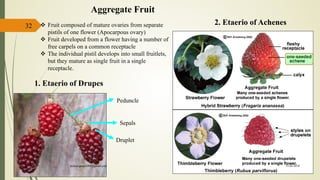
Aggregate Fruit
1. Etaerio of Drupes
 Fruit composed of mature ovaries from separate
pistils of one flower (Apocarpous ovary)
 Fruit developed from a flower having a number of
free carpels on a common receptacle
 The individual pistil develops into small fruitlets,
but they mature as single fruit in a single
receptacle.
2. Etaerio of Achenes
Peduncle
Druplet
Sepals
15-03-2018kishan.gusai2008@gmail.com
33
3. Etaerio of Follicles
Aggregate Fruit
4. Etaerio of berries
Seed
Follicle
15-03-2018kishan.gusai2008@gmail.com
34
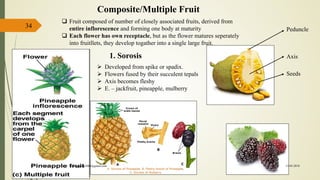
Composite/Multiple Fruit
1. Sorosis
 Fruit composed of number of closely associated fruits, derived from
entire inflorescence and forming one body at maturity
 Each flower has own receptacle, but as the flower matures seperately
into fruitllets, they develop togather into a single large fruit.
 Developed from spike or spadix.
 Flowers fused by their succulent tepals
 Axis becomes fleshy
 E. – jackfruit, pineapple, mulberry
Peduncle
Axis
Seeds
15-03-2018kishan.gusai2008@gmail.com
35
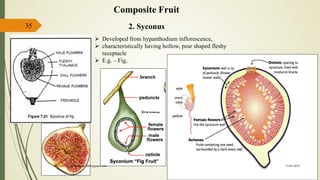
Composite Fruit
2. Syconus
 Developed from hypanthodium inflorescence,
 characteristically having hollow, pear shaped fleshy
receptacle
 E.g. – Fig,
15-03-2018kishan.gusai2008@gmail.com
36
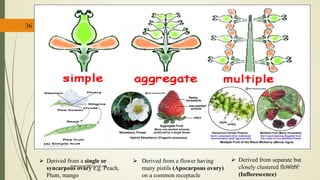
 Derived from separate but
closely clustered flowers
(Inflorescence)
 Derived from a flower having
many pistils (Apocarpous ovary)
on a common receptacle
 Derived from a single or
syncarpous ovary e.g. Peach,
Plum, mango
15-03-2018kishan.gusai2008@gmail.com
37
15-03-2018kishan.gusai2008@gmail.com

Fruit morphology and botanical classification

  • 1.
    1 * Created byusing various internet Resources for Educational Purpose only 15-03-2018
  • 2.
    2 Fruit Simple Dry Dehiscent 1. Legume 2. Follicle 3.Siliqua 4. Silicula 5. Capsule 6. Pyrix 7. Urticle Indehiscent 1. Caryopsis 2. Achene 3. Cypsela 4. Samara 5. Nut Schizocarpic 1. Lomentum 2. Cremocarp 3. Regma 4. Carcerulus Fleshy Aggregate Composite CLASSIFICATION 15-03-2018kishan.gusai2008@gmail.com
  • 3.
    3 Fleshy Fruit 1. Drupe 2.Pome 3. Berry 4. Pepo 5. Hesperidium 6. Balausta 7. Amphisarca Aggregate fruit 1. Etaerio of Drupes 2. Etaerio of Achenes 3. Etaerio of Follicles 4. Etaerio of Berries Composite fruit 1. Serosis 2. Syconus CLASSIFICATION 15-03-2018kishan.gusai2008@gmail.com
  • 4.
    4 Types of Fruits 1.True fruits  Ovary of the flowers grows into the fruit. 2. Peudo-fruits/False fruits/ Accessories fruit  It is often found that other floral parts such as thalamus, receptacle or calyx, may grow and form a part of fruit. 15-03-2018kishan.gusai2008@gmail.com
  • 5.
    5 Simple Fruit AggregateFruit Multiple Fruit False Fruit 15-03-2018kishan.gusai2008@gmail.com
  • 6.
    6 Simple, Dry, Dehiscent SimpleFruit – Single fruit developes from a single ovary of a single flower Dry Fruit - in which the coat becomes dry at maturity. Dehiscent Fruit - dry fruit whic at maturity open by definite natural beans to shed the contained seeds.15-03-2018kishan.gusai2008@gmail.com
  • 7.
    7 1.LegumeSimple, Dry, Dehiscent Developed from simple, superior and unilocular ovary,  Opening along both the sutures  Pod – legume with one or two seeds  E.g. – beans, peas, mung, aparajita 15-03-2018kishan.gusai2008@gmail.com
  • 8.
    8 2. FollicleSimple, Dry,Dehiscent  Developed from simple, superior and unilocular ovary,  Opening along ventral suture only.  E.g - Aclepedipiadaceae family members, 15-03-2018kishan.gusai2008@gmail.com
  • 9.
    9 3. SiliquaSimple, Dry,Dehiscent  Two chambered many seeded fruit,  Developed from bicarpellary, syncarpous, superior ovary,  dehiscing from below upwards by both the suture,  Seeds remain attached to Replum (Septum).  E.g. – Brassicaceae family 15-03-2018kishan.gusai2008@gmail.com
  • 10.
    10 4. SiliculaSimple, Dry,Dehiscent  Much shorter and flattened siliqua with few seeds  E.g.- Iberis amara (Candytuft), Capsella bursa- pastoris (Shepherd’s purse). Shepherd’s purse 15-03-2018kishan.gusai2008@gmail.com
  • 11.
    11 5. CapsuleSimple, Dry,Dehiscent  Developes from compound, syncarpus, generally superior,  one to many chambered ovary with many seeds,  Axile placentation  Unlike Legume, Capsule is composed of more than one carpel.  E.g. – Poppy, cotton, datura etc. 15-03-2018kishan.gusai2008@gmail.com
  • 12.
    12 6. Pyxis Simple,Dry, Dehiscent Capsule with circumscissile dehiscence E.g. – Celosia, Amaranthus 7. Urticle One seeded fruit with thin wall,dehiscent by lid. E.g. - Amaranthus 15-03-2018kishan.gusai2008@gmail.com
  • 13.
    13 Single Locule Septum 3. Septifragal Valves,Seeds attached to central collumn Types of dehiscence 1. Locullicidal 2. Septicidal  Each locule seperates from middle, e.g. - Malvaceae  Splits at the point of union of septum, in such a way that each carpel seperates  Locullicidal or septicidal dehiscence but valves (septum) fall off and seeds attached to the central column, e.g. - Dhatura 15-03-2018kishan.gusai2008@gmail.com
  • 14.
    14 5. Poricidal4. Sutural From one or both suture, e.g. - Calotropis  From pores and flap like valves, e.g. - Poppy 6. Circumscissile  Transverse dehiscence and tip of the valve fall of as a lid, e.g. - Eucalyptus Types of dehiscence 15-03-2018kishan.gusai2008@gmail.com
  • 15.
    15 Simple, Dry, Indehiscent 1. 2. 3. 4. 5. IndehiscentFruit- Dry fruits which do not open when mature to shed their seeds. 15-03-2018kishan.gusai2008@gmail.com
  • 16.
    16 Simple, Dry, Indehiscent 1.Caryopsis/Grain  One seed which has the seed coat fused to the pericarp,  Developed from monocarpellary superior ovary with pericarp fused with seed coat,  very small,dry, indehiscent one seeded fruit. 2. Achene  Developed from monocarpellary superior ovary,  Seed coat is not fused with the pericarp,  A small indehiscent one seeded fruit.  Seed without wings and with thin fruit wall.  One seed attached to ovary wall at one point. Pericarp Seed 15-03-2018kishan.gusai2008@gmail.com
  • 17.
    17 Simple, Dry, Indehiscent 3.Cypsela  Developed from bicarpellary, syncarpous, inferior ovary with pericarp and seed coat free,  A dry indehiscent one seeded fruit 4. Nut  Developed from superior bi- or polycarpellary ovary  Fruit wall(ovary wall) is hard, stony or woody at maturity,  Dry, indehiscent one seeded fruit.  Similar to an achene but with the wall greatly thickened and hardened. 15-03-2018kishan.gusai2008@gmail.com
  • 18.
    18 Simple, Dry, Indehiscent 5.Samara  Developed from superior ovary,  Dry indehiscent one or two seeded winged fruit  A one- or two-seeded dry, indehiscent fruit in which part of the fruit wall (ovary wall) grows out into a wing.  an achene with a wing for wind dispersal Single winged - Haloptelea Two winged - Maple Three winged - Hiptage Five winged - Arjuna15-03-2018kishan.gusai2008@gmail.com
  • 19.
  • 20.
    20 Simple, Dry, Schizocarpic 1.Lomentum Schizocarpic = intermediate between dehiscent and indehiscent.  Fruit breaks into one or more seeded units.  Sometimes seeds are liberated only after the decay of pericarp  Leguminous fruit with one seeded segments  E.g. –Desmodium, tamarind, acacia DesmodiumTamarindAcacia 15-03-2018kishan.gusai2008@gmail.com
  • 21.
    21  Developedfrom bicarpellary, bilocular inferior ovary, splitting at maturity into two single seeded mericarp.  Each borne on a carpophore.  the two achene like ripe carpelsseparating at maturity from a slender axis  cremocarps either entire of seperated into its mericarps. (one cremocarp = two mericarp)  E.g. – Apiaceae family, fannel, coriander 2. Cremocarp Remains of style Mericarp 15-03-2018kishan.gusai2008@gmail.com

  • 22.
    22 Simple, Dry, Schizocarpic 3.Regma  Developed from tricarpellary, syncarpous, superior ovary and splitting at maturity into three cocci.  Each chamber with single seed separates, Remains attached to the central carpophore. 4. Carcerulus  Pistil has several loculi and each of loculi of ripened fruit separate from each other as mericarps,  Type of capsule,  e.g – Tulsi, abutilon, Ocimum Fruit Abutilon 15-03-2018kishan.gusai2008@gmail.com
  • 23.
    23 Simple, Fleshy fruits 1.Drupe  Generally one seeded fruit with pericarp differentiated into epicarp, mesocarp and endocarp.  The innermost portion of the wall (endocarp) becomes hard and stony,  The outermost part (exocarp) becomes a relatively thin skin,  The middle portion between the skin and the stone (mesocarp) becomes either fleshy or fibrous. (cherry)  Pericarp – Matured ovary wall,  Exocarp – Outermost layer,  Mesocapr – Middle layer,  Endocarp – Innermost layer. Fleshy/Succulent Fruit - which the wall becomes soft and fleshy as it matures. 15-03-2018kishan.gusai2008@gmail.com
  • 24.
    24  If afruit is fleshy and it has a hard stony pit containing a seed it is classified as a drupe. 15-03-2018kishan.gusai2008@gmail.com
  • 25.
  • 26.
    26 2. Pome Simple,Fleshy fruits  Pome is French name of an apple  Often called as an Accessory Fruit,  Fleshy fruit surrounded by the thalamus and developed from two or more carpellary, syncaprous, inferior ovary.  A pome is an accessory fruit composed of five or more carpels in which the exocarp forms an inconspicuous (undistinguished) layer.  Edible part of the fruit is the fleshy receptacle. 15-03-2018kishan.gusai2008@gmail.com
  • 27.
    27 3. Berry Simple,Fleshy fruits  Few or many seeded fruit generally developed from compound syncarpous superior or sometimes inferior ovary.  The entire pericarp is fleshy.  Epicarp forms the skin, mesocarp and endocarp forms pulp and in the pulp seeds remain scattered.  Interior seeds are NOT covered by a hard coat and endocarp is neither hard nor lignified. 15-03-2018kishan.gusai2008@gmail.com
  • 28.
    28 4. Pepo Simple,Fleshy fruits  Many seeded fruit like berry but it developed from inferior tricarpellary unilocular ovary with parietal placentation 15-03-2018kishan.gusai2008@gmail.com
  • 29.
    29 5. Hesperidium Simple,Fleshy fruits  This is a special type of berry in which a leathery rind forms containing oil and locules filled with fleshy outgrowths containing juice.  the interior of the fruit divided by septa, indicating the number of carpels.  Developed from multicarpellary, syncarpous superior ovary with axile placentation  Endocarp- projecting inwards and forming distinct chambers  Epicarp and Mesocarp- fused togather forming the rind of the fruit 15-03-2018kishan.gusai2008@gmail.com
  • 30.
    30 6. Balausta Simple,Fleshy fruits  Many chambered, many seeded, inferior ovary fruit like berry  but pericarp is tough with two rows of carpels one above the other bearing seeds irregularly.  Calyx is persistent 15-03-2018kishan.gusai2008@gmail.com
  • 31.
    31 7. Amphisarca Simple,Fleshy fruits  Fleshy fruit with woody pericarp,  developed from a syncarpous, superior, many seeded ovary.  Edibale portion is placenta and inner pulpy layers of pericarp  E.g. – woodapple, 15-03-2018kishan.gusai2008@gmail.com
  • 32.
    32 Aggregate Fruit 1. Etaerioof Drupes  Fruit composed of mature ovaries from separate pistils of one flower (Apocarpous ovary)  Fruit developed from a flower having a number of free carpels on a common receptacle  The individual pistil develops into small fruitlets, but they mature as single fruit in a single receptacle. 2. Etaerio of Achenes Peduncle Druplet Sepals 15-03-2018kishan.gusai2008@gmail.com
  • 33.
    33 3. Etaerio ofFollicles Aggregate Fruit 4. Etaerio of berries Seed Follicle 15-03-2018kishan.gusai2008@gmail.com
  • 34.
    34 Composite/Multiple Fruit 1. Sorosis Fruit composed of number of closely associated fruits, derived from entire inflorescence and forming one body at maturity  Each flower has own receptacle, but as the flower matures seperately into fruitllets, they develop togather into a single large fruit.  Developed from spike or spadix.  Flowers fused by their succulent tepals  Axis becomes fleshy  E. – jackfruit, pineapple, mulberry Peduncle Axis Seeds 15-03-2018kishan.gusai2008@gmail.com
  • 35.
    35 Composite Fruit 2. Syconus Developed from hypanthodium inflorescence,  characteristically having hollow, pear shaped fleshy receptacle  E.g. – Fig, 15-03-2018kishan.gusai2008@gmail.com
  • 36.
    36  Derived fromseparate but closely clustered flowers (Inflorescence)  Derived from a flower having many pistils (Apocarpous ovary) on a common receptacle  Derived from a single or syncarpous ovary e.g. Peach, Plum, mango 15-03-2018kishan.gusai2008@gmail.com
  • 37.