TYPES OF FRUITS- SIMPLE FRUITS, AGGREGATE FRUITS, COMPOSITE FRUITS
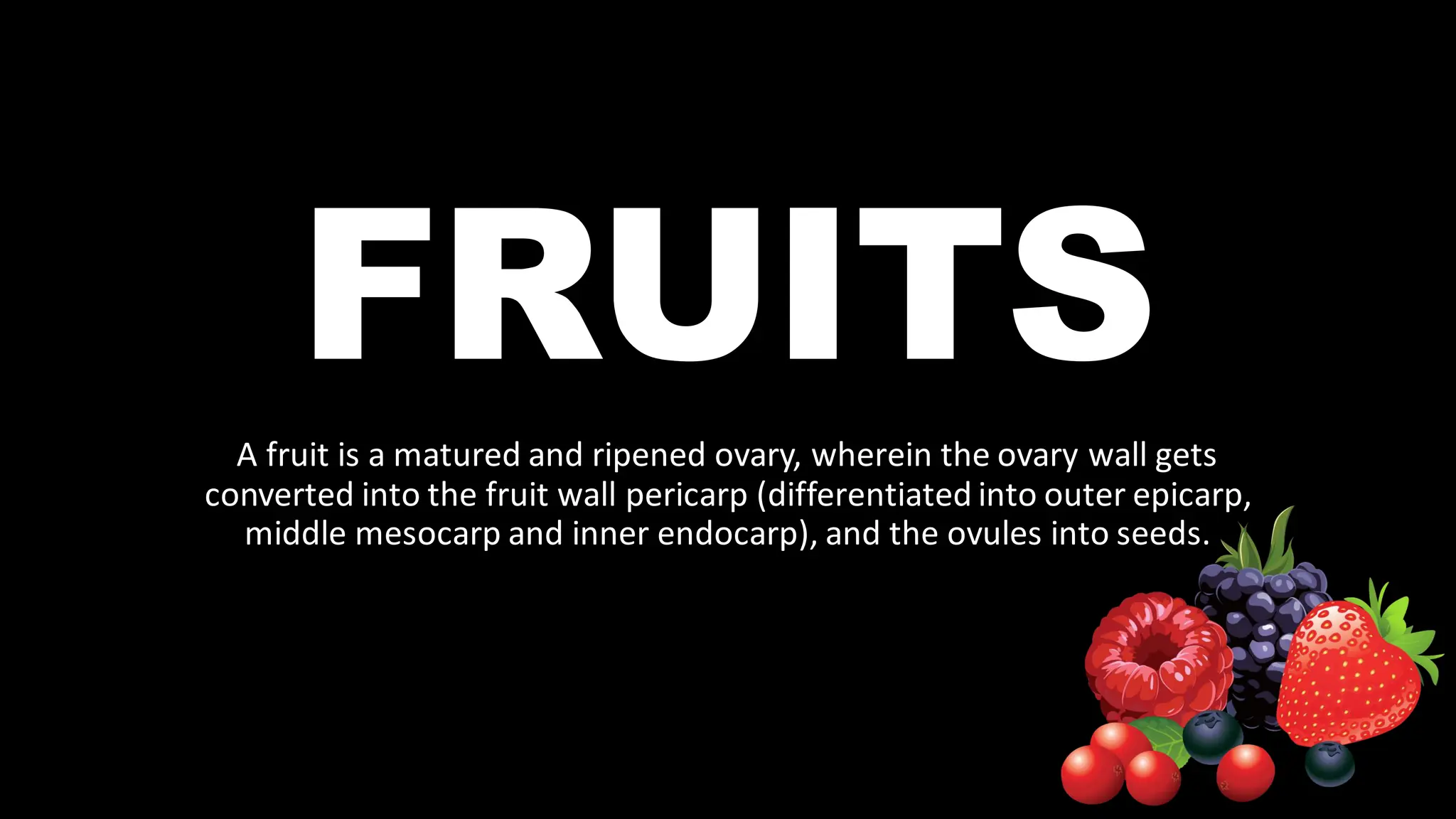
A fruit is a matured and ripened ovary, wherein the ovary wall gets converted into the fruit wall pericarp (differentiated into outer epicarp, middle mesocarp and inner endocarp), and the ovules into seeds.
TYPES OF FRUITS- SIMPLE FRUITS, AGGREGATE FRUITS, COMPOSITE FRUITS
1.
FRUITS
A fruit isa matured and ripened ovary, wherein the ovary wall gets
converted into the fruit wall pericarp (differentiated into outer epicarp,
middle mesocarp and inner endocarp), and the ovules into seeds.
2.
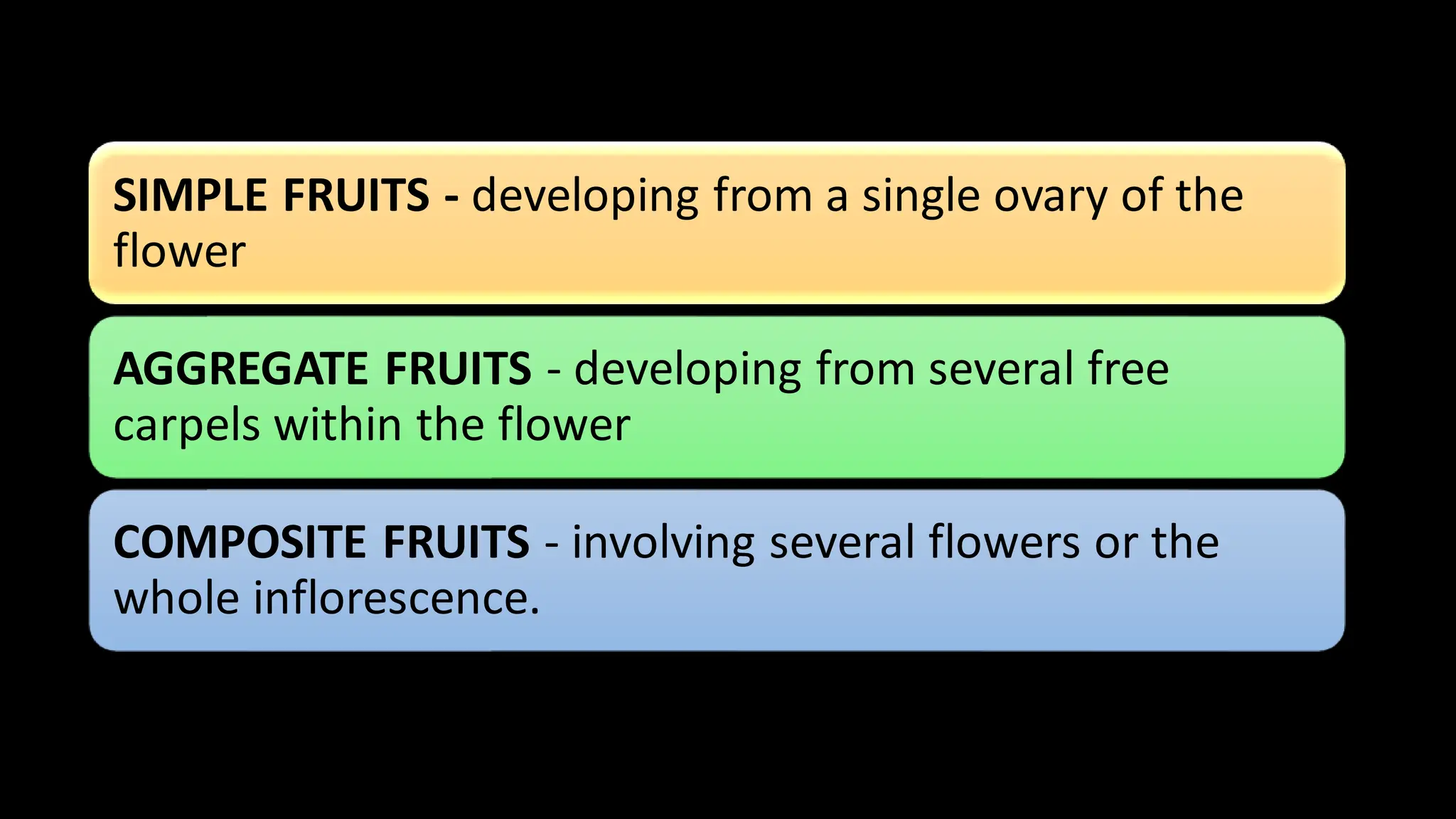
SIMPLE FRUITS -developing from a single ovary of the
flower
AGGREGATE FRUITS - developing from several free
carpels within the flower
COMPOSITE FRUITS - involving several flowers or the
whole inflorescence.
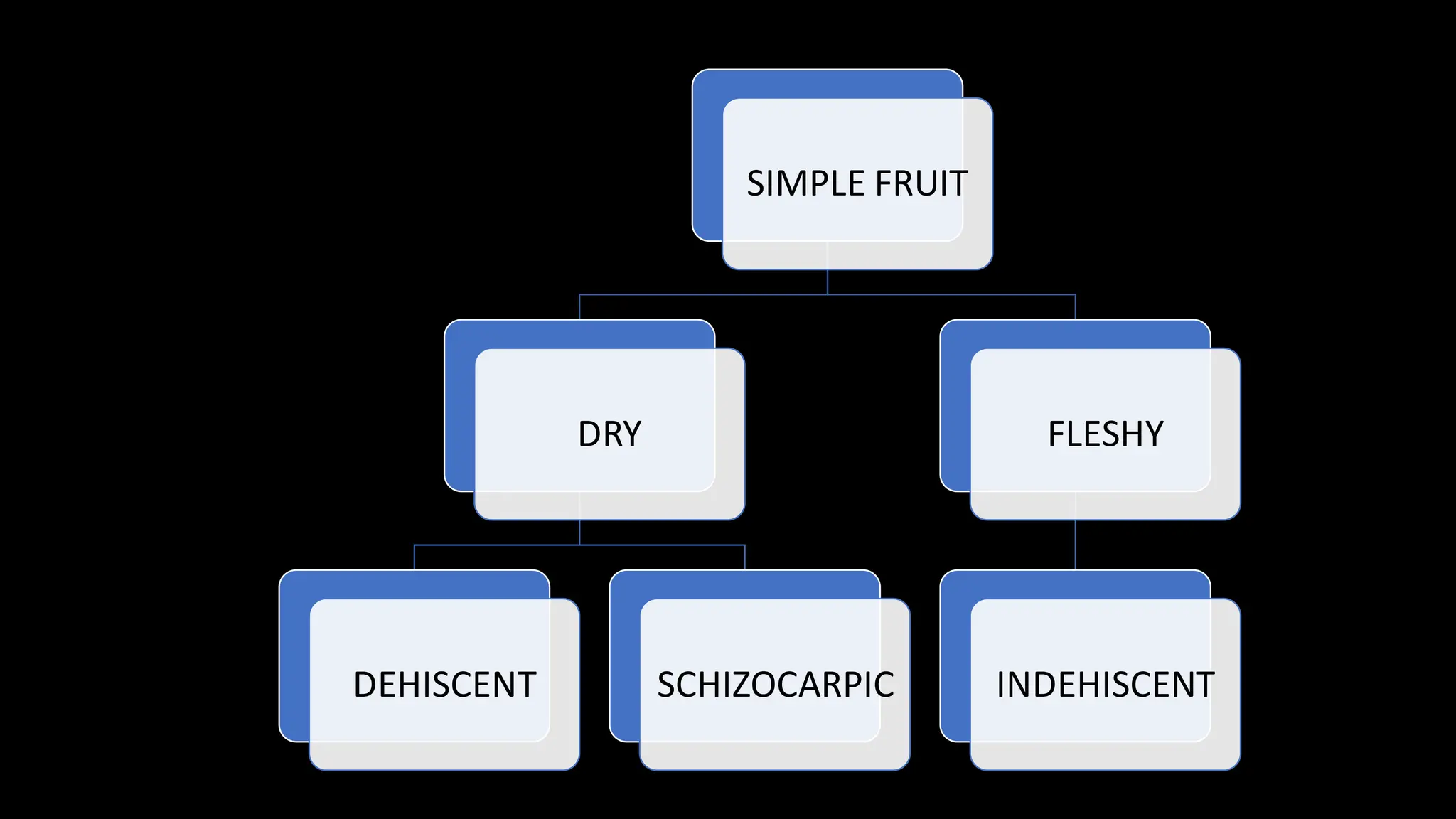
SIMPLE FRUITS
• Asingle fruit develops from a flower having a single carpel or
several united carpels so that the flower has a single ovary.
I. DRY FRUITS: Pericarp is hard and dry.
1. Dehiscent fruits
• Such fruits are generally dry and burst along the suture to release
their seeds. Common types are enumerated below:
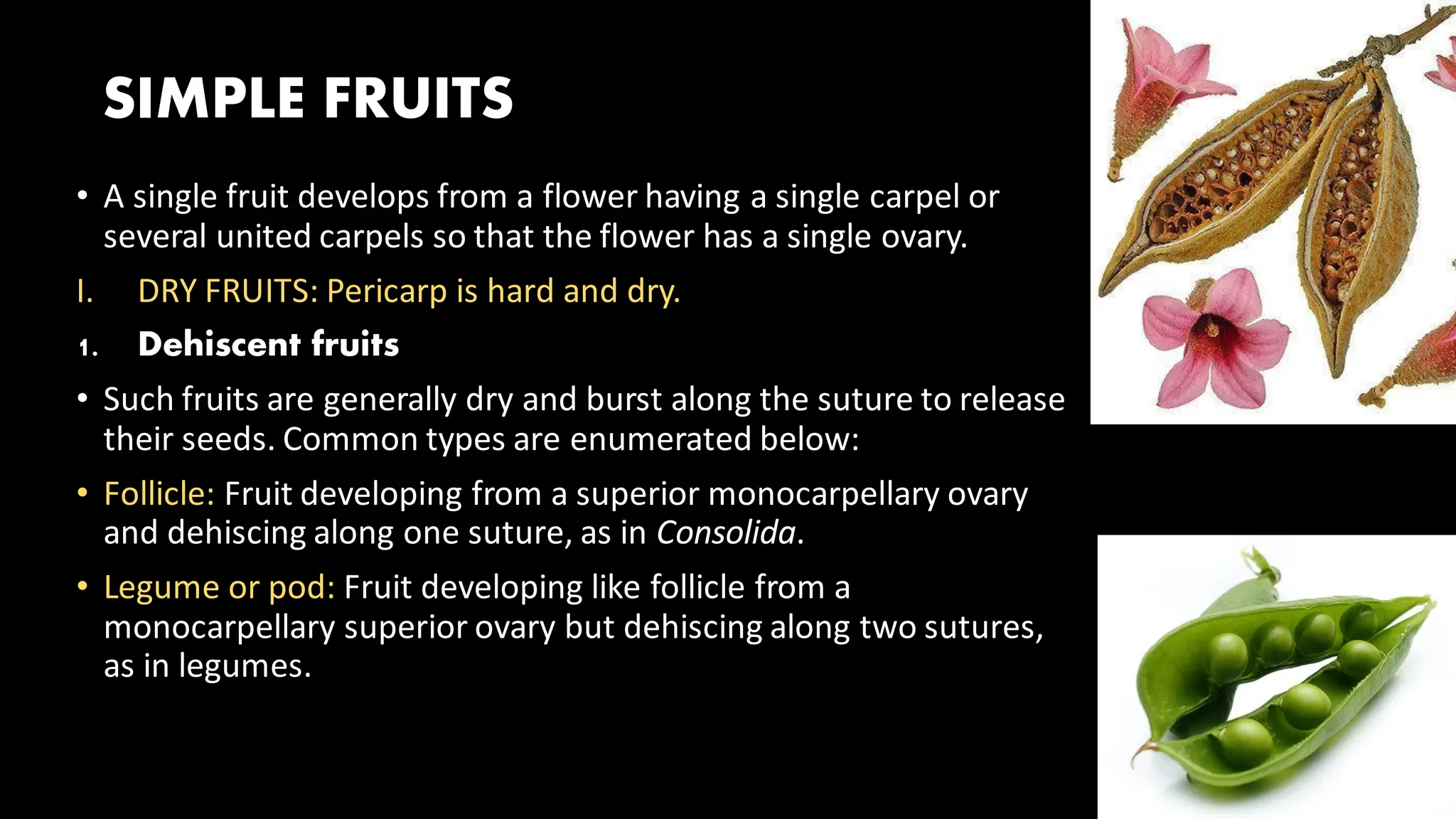
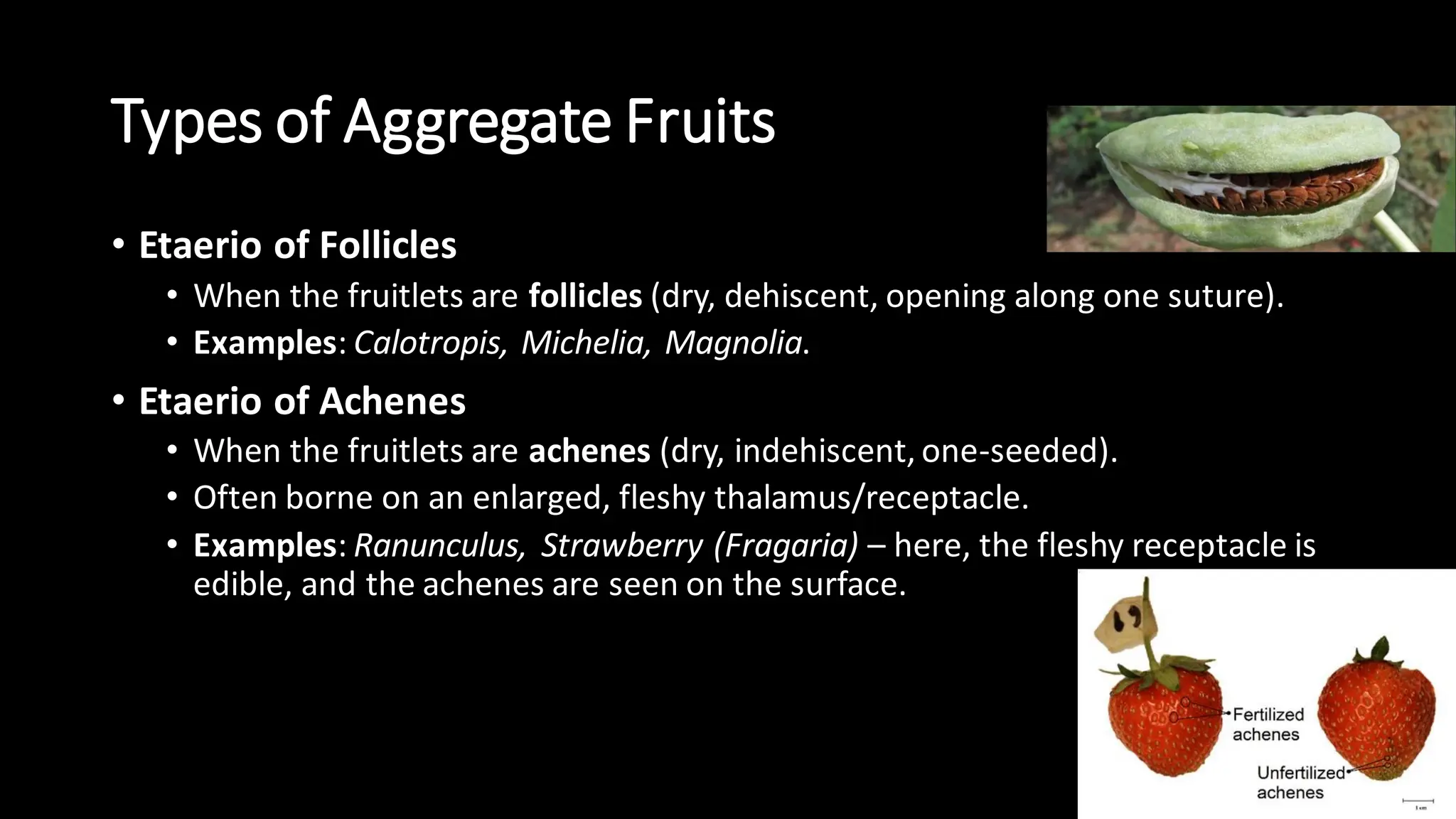
• Follicle: Fruit developing from a superior monocarpellary ovary
and dehiscing along one suture, as in Consolida.
• Legume or pod: Fruit developing like follicle from a
monocarpellary superior ovary but dehiscing along two sutures,
as in legumes.
5.
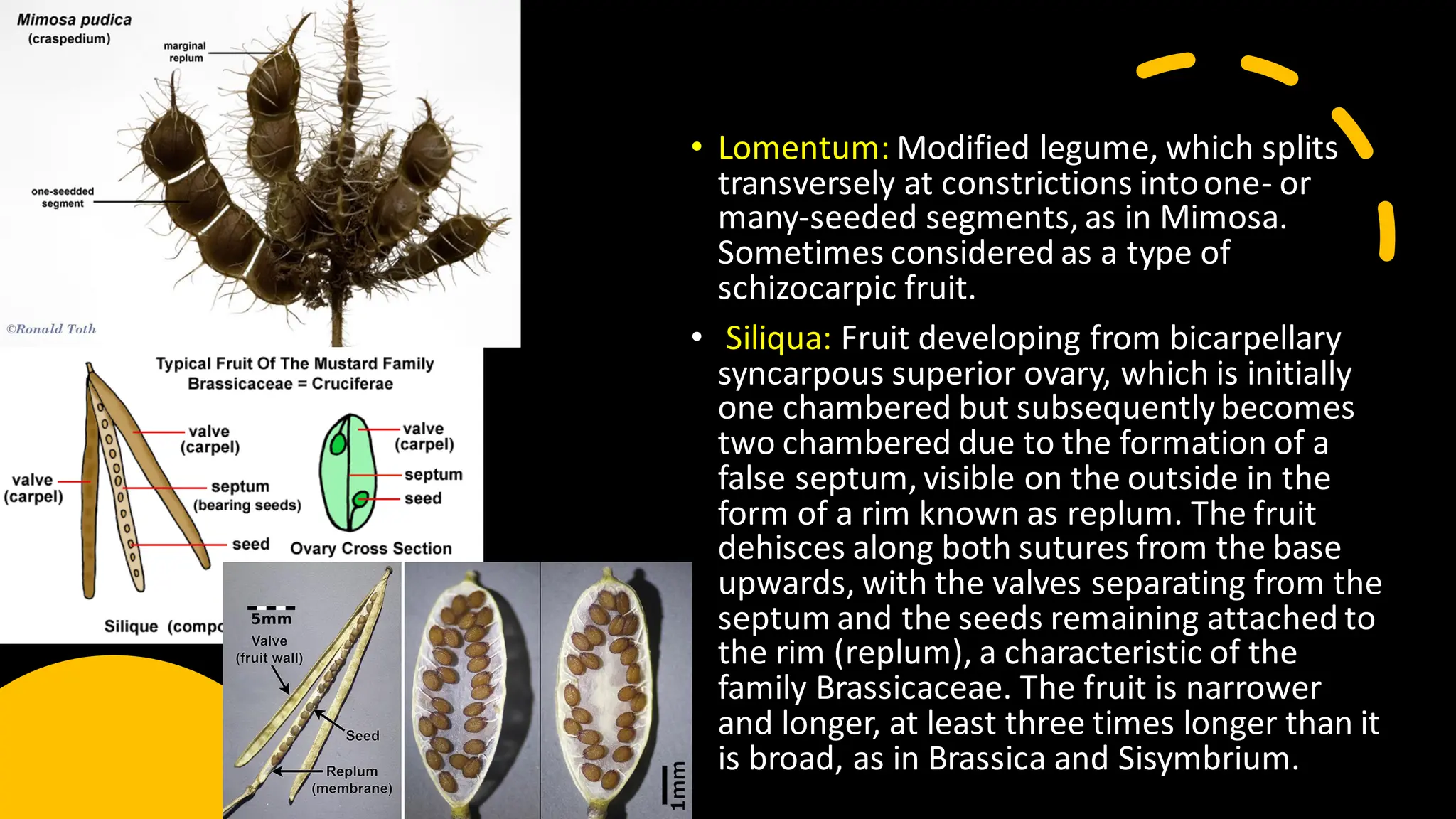
• Lomentum: Modifiedlegume, which splits
transversely at constrictions intoone- or
many-seeded segments, as in Mimosa.
Sometimes considered as a type of
schizocarpic fruit.
• Siliqua: Fruit developing from bicarpellary
syncarpous superior ovary, which is initially
one chambered but subsequentlybecomes
two chambered due to the formation of a
false septum, visible on the outside in the
form of a rim known as replum. The fruit
dehisces along both sutures from the base
upwards, with the valves separating from the
septum and the seeds remaining attached to
the rim (replum), a characteristic of the
family Brassicaceae. The fruit is narrower
and longer, at least three times longer than it
is broad, as in Brassica and Sisymbrium.
6.
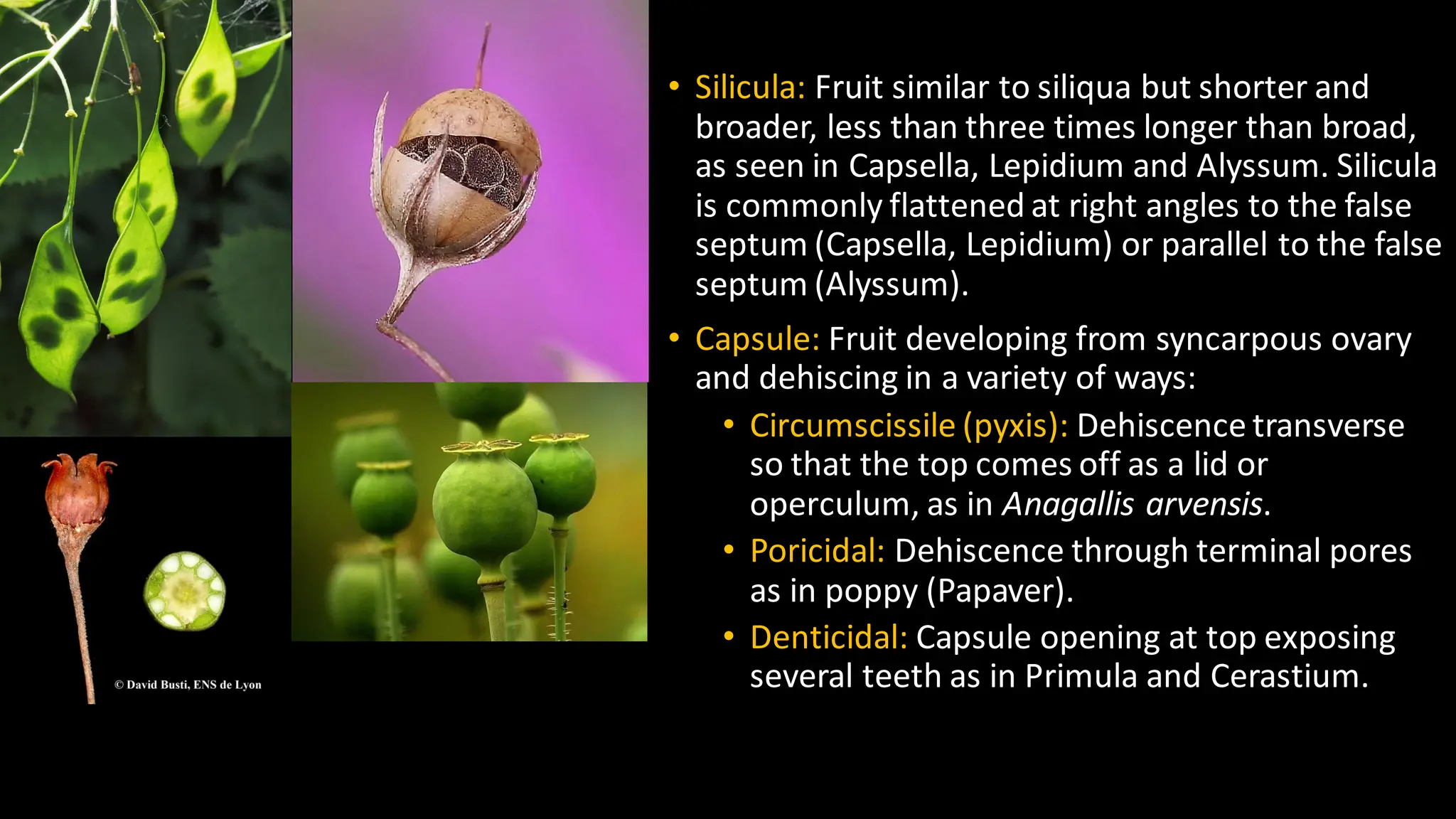
• Silicula: Fruitsimilar to siliqua but shorter and
broader, less than three times longer than broad,
as seen in Capsella, Lepidium and Alyssum. Silicula
is commonly flattened at right angles to the false
septum (Capsella, Lepidium) or parallel to the false
septum (Alyssum).
• Capsule: Fruit developing from syncarpous ovary
and dehiscing in a variety of ways:
• Circumscissile (pyxis): Dehiscence transverse
so that the top comes off as a lid or
operculum, as in Anagallis arvensis.
• Poricidal: Dehiscence through terminal pores
as in poppy (Papaver).
• Denticidal: Capsule opening at top exposing
several teeth as in Primula and Cerastium.
7.
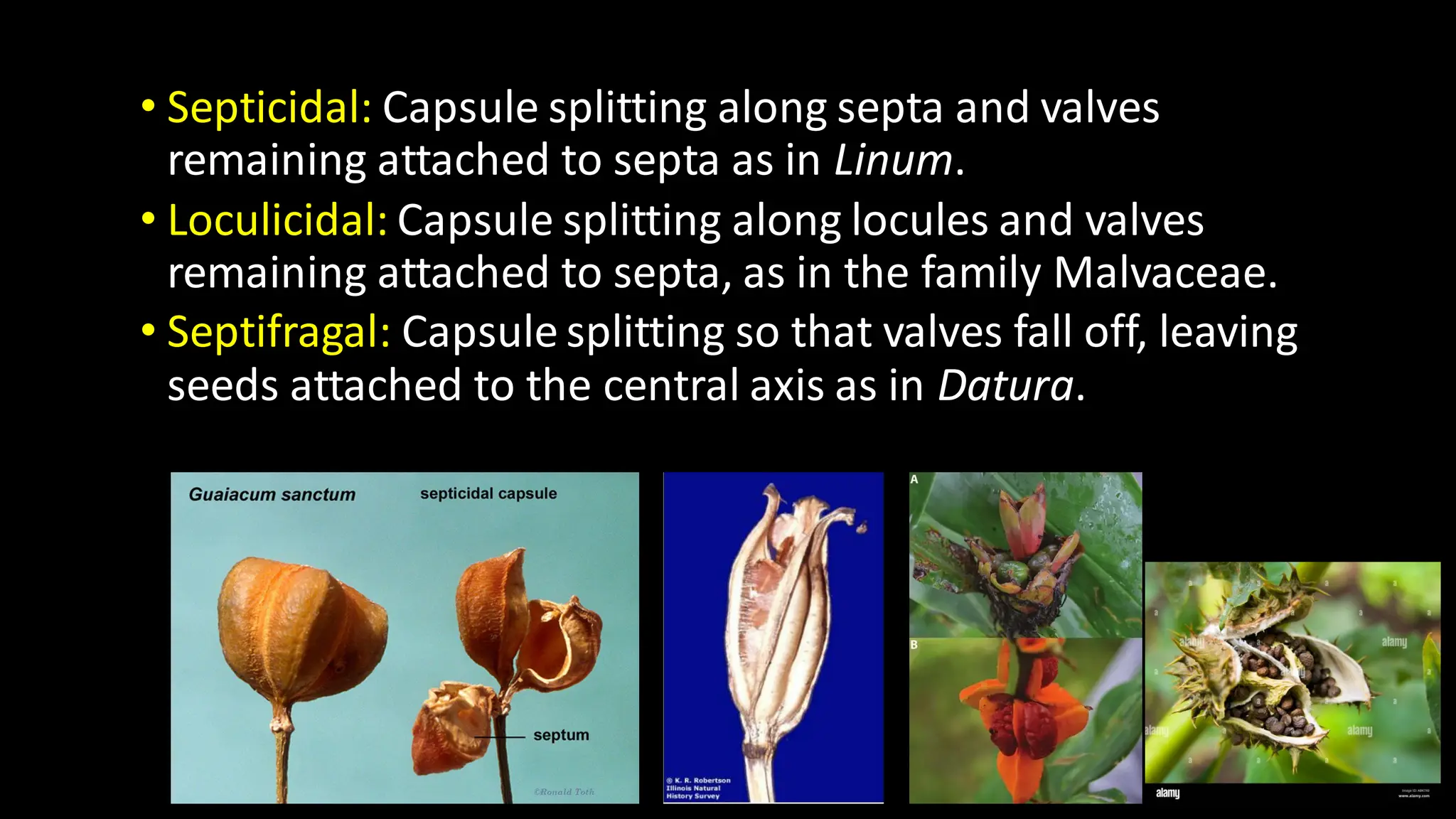
• Septicidal: Capsulesplitting along septa and valves
remaining attached to septa as in Linum.
• Loculicidal: Capsule splitting along locules and valves
remaining attached to septa, as in the family Malvaceae.
• Septifragal: Capsule splitting so that valves fall off, leaving
seeds attached to the central axis as in Datura.
8.
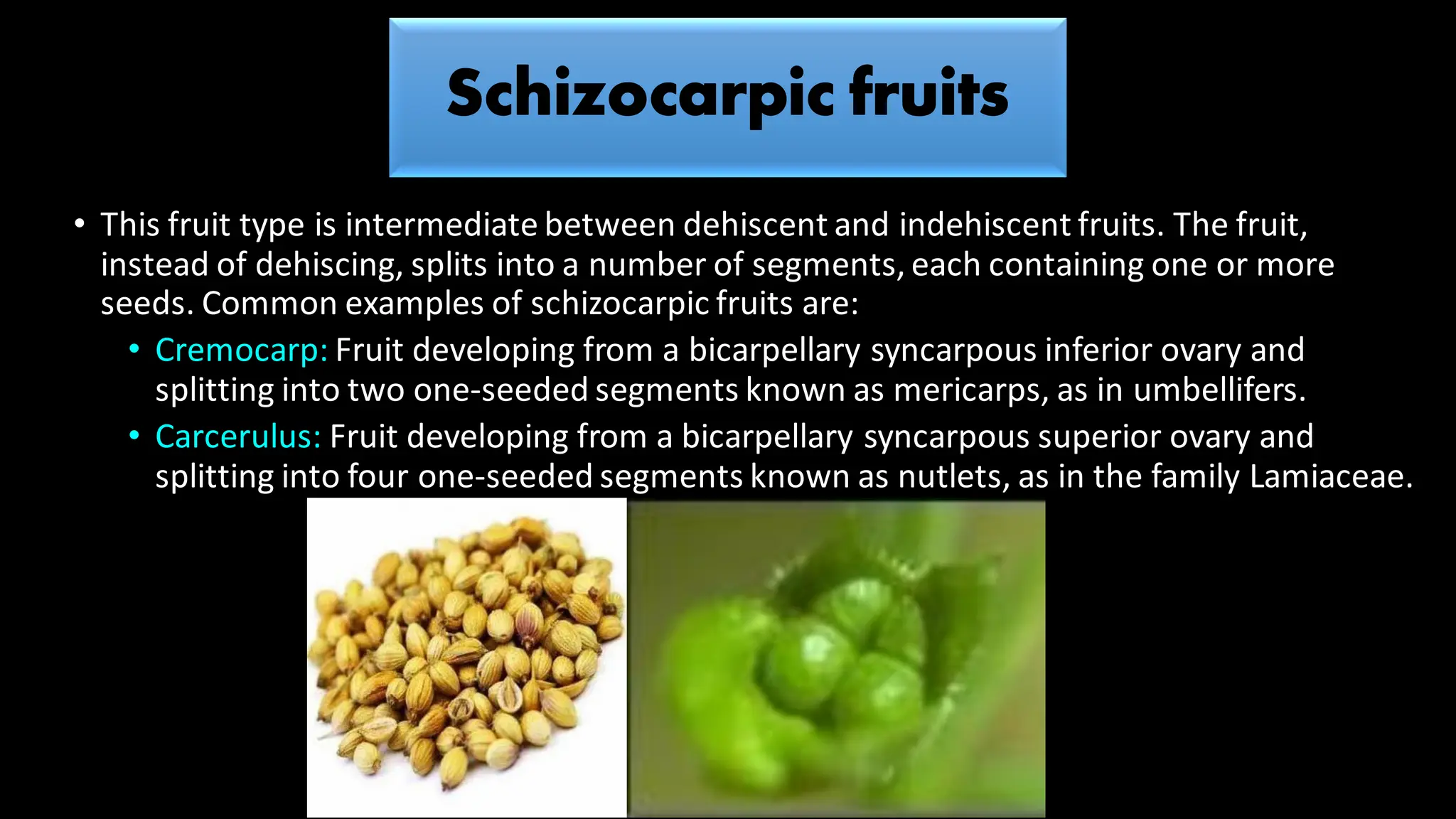
• This fruittype is intermediate between dehiscent and indehiscent fruits. The fruit,
instead of dehiscing, splits into a number of segments, each containing one or more
seeds. Common examples of schizocarpic fruits are:
• Cremocarp: Fruit developing from a bicarpellary syncarpous inferior ovary and
splitting into two one-seeded segments known as mericarps, as in umbellifers.
• Carcerulus: Fruit developing from a bicarpellary syncarpous superior ovary and
splitting into four one-seeded segments known as nutlets, as in the family Lamiaceae.
9.
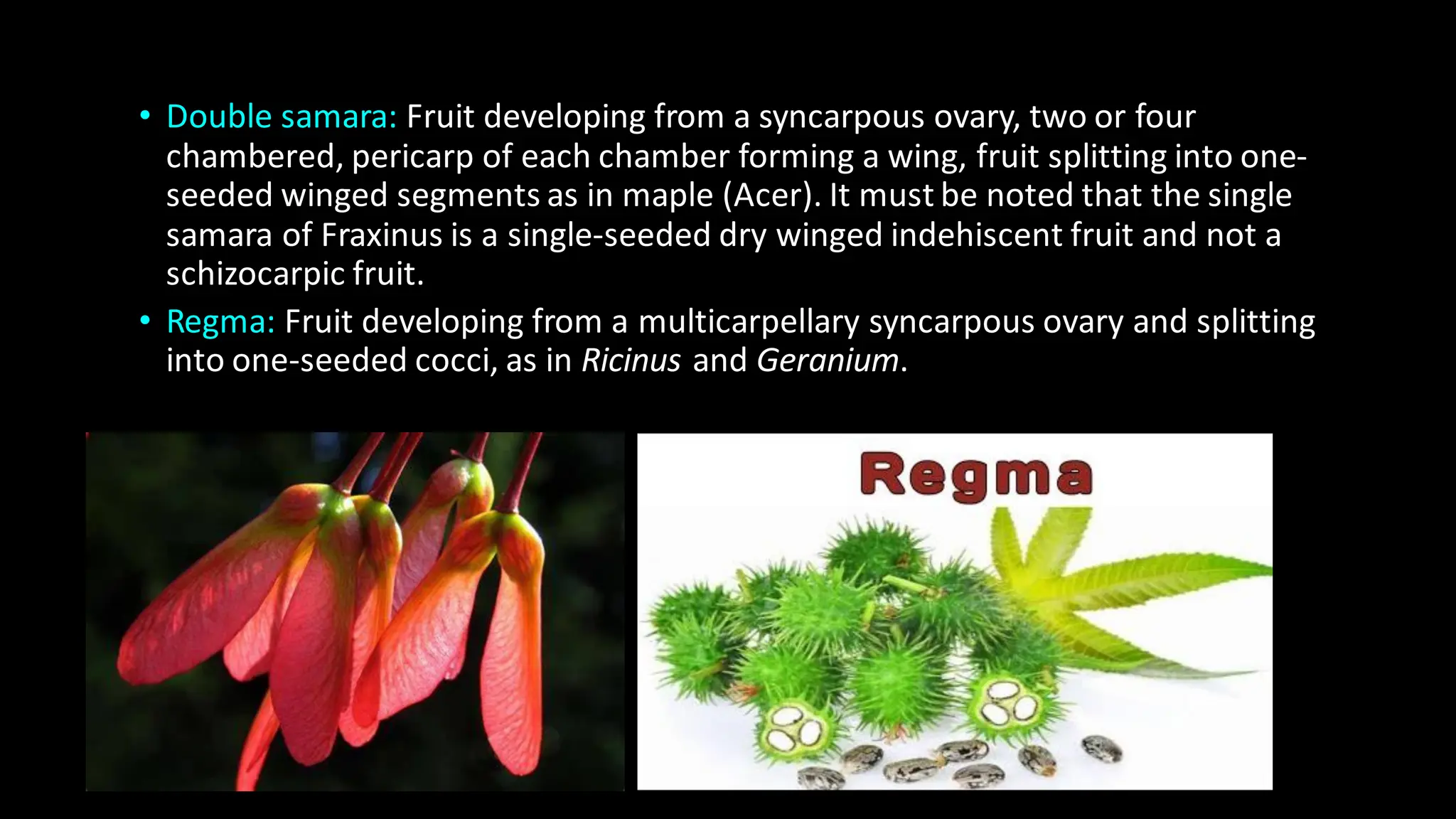
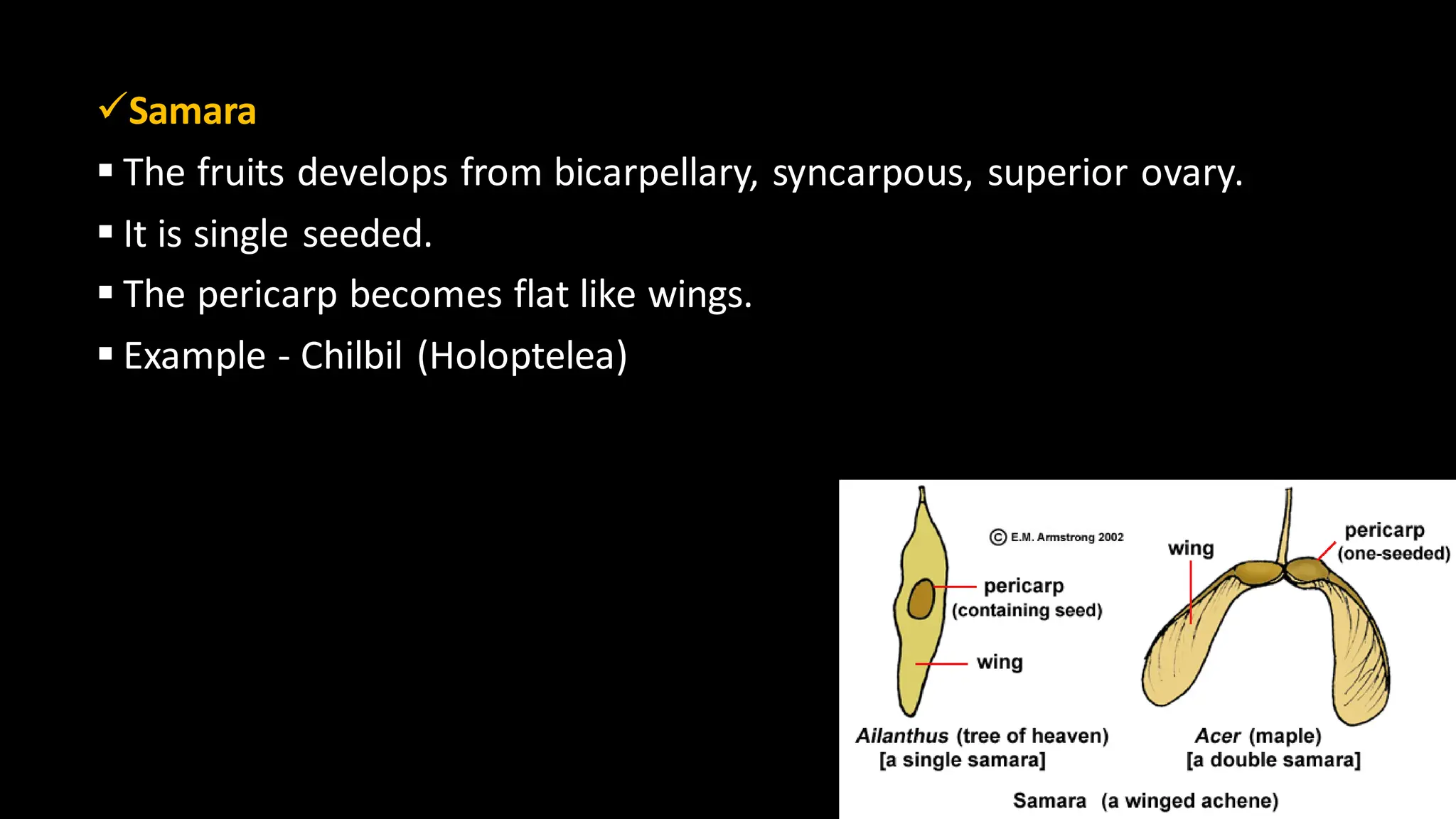
• Double samara:Fruit developing from a syncarpous ovary, two or four
chambered, pericarp of each chamber forming a wing, fruit splitting into one-
seeded winged segments as in maple (Acer). It must be noted that the single
samara of Fraxinus is a single-seeded dry winged indehiscent fruit and not a
schizocarpic fruit.
• Regma: Fruit developing from a multicarpellary syncarpous ovary and splitting
into one-seeded cocci, as in Ricinus and Geranium.
10.
Indehiscent fruits
• Suchfruits do not split open at maturity.Such fruits have a dry pericarp at
maturity,and are represented by:
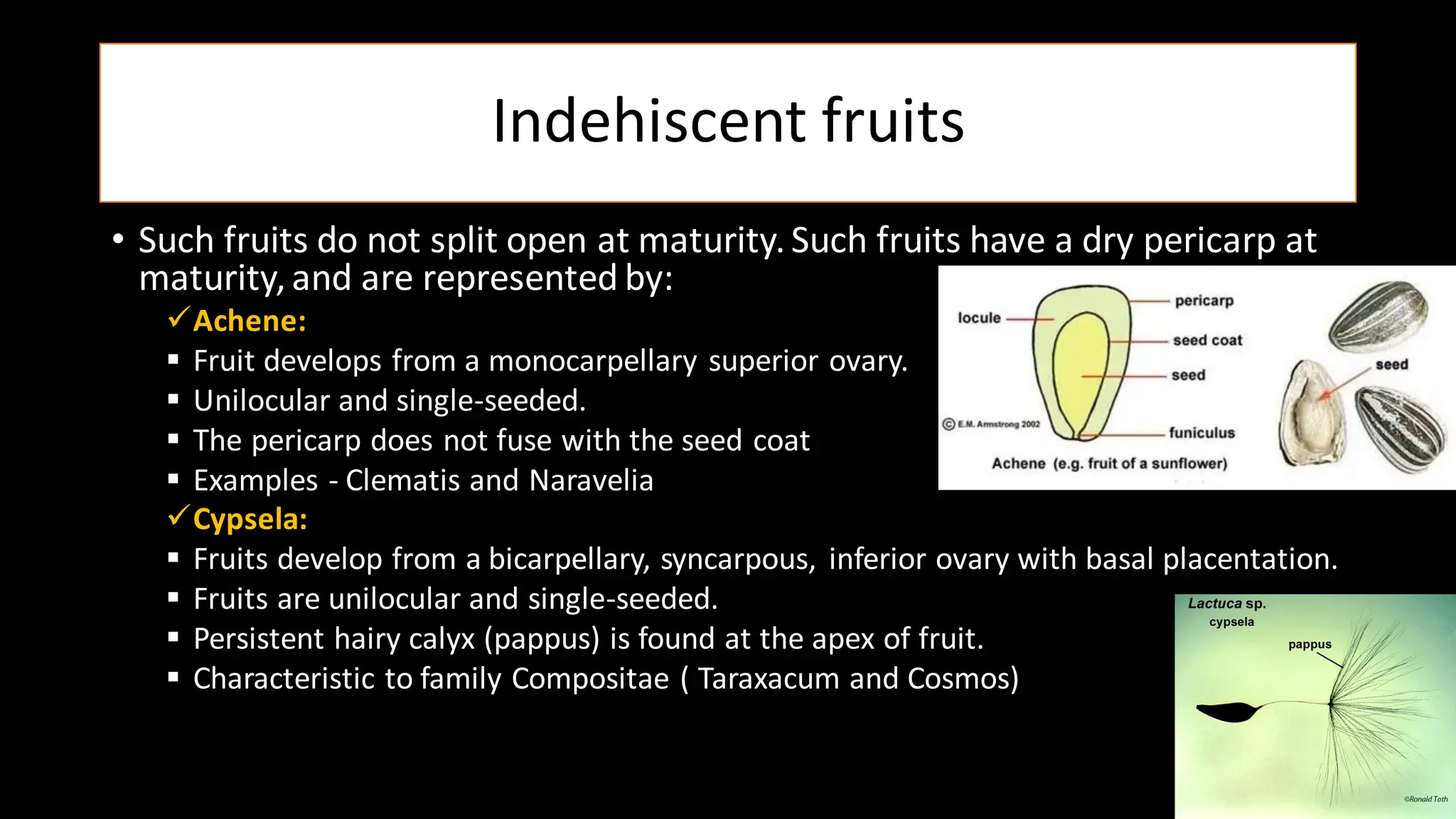
✓Achene:
▪ Fruit develops from a monocarpellary superior ovary.
▪ Unilocular and single-seeded.
▪ The pericarp does not fuse with the seed coat
▪ Examples - Clematis and Naravelia
✓Cypsela:
▪ Fruits develop from a bicarpellary, syncarpous, inferior ovary with basal placentation.
▪ Fruits are unilocular and single-seeded.
▪ Persistent hairy calyx (pappus) is found at the apex of fruit.
▪ Characteristic to family Compositae ( Taraxacum and Cosmos)
11.
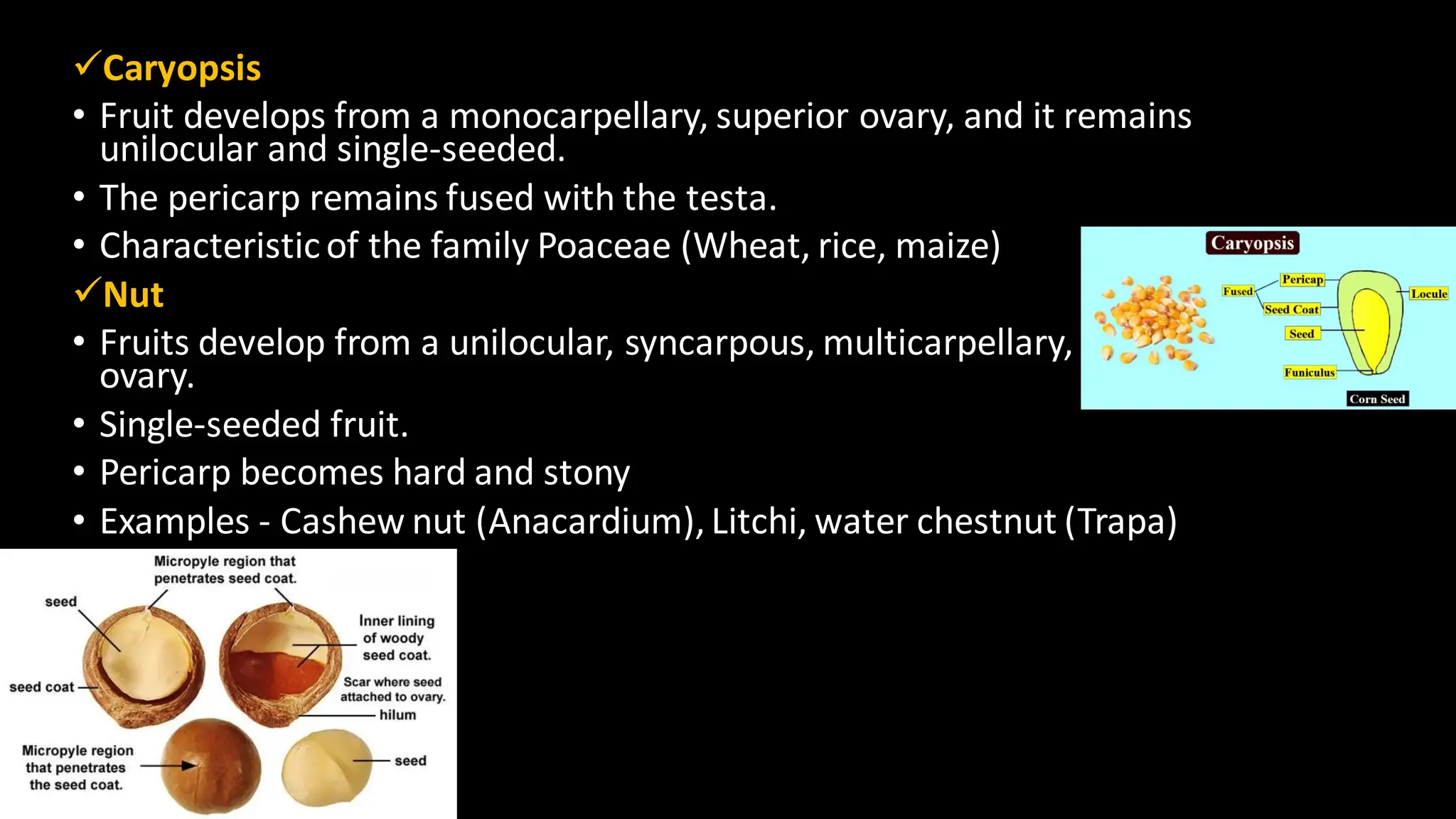
✓Caryopsis
• Fruit developsfrom a monocarpellary, superior ovary, and it remains
unilocular and single-seeded.
• The pericarp remains fused with the testa.
• Characteristicof the family Poaceae (Wheat, rice, maize)
✓Nut
• Fruits develop from a unilocular, syncarpous, multicarpellary, superior
ovary.
• Single-seeded fruit.
• Pericarp becomes hard and stony
• Examples - Cashew nut (Anacardium),Litchi, water chestnut (Trapa)
12.
✓Samara
▪ The fruitsdevelops from bicarpellary, syncarpous, superior ovary.
▪ It is single seeded.
▪ The pericarp becomes flat like wings.
▪ Example - Chilbil (Holoptelea)
13.
FLESHY
FRUITS
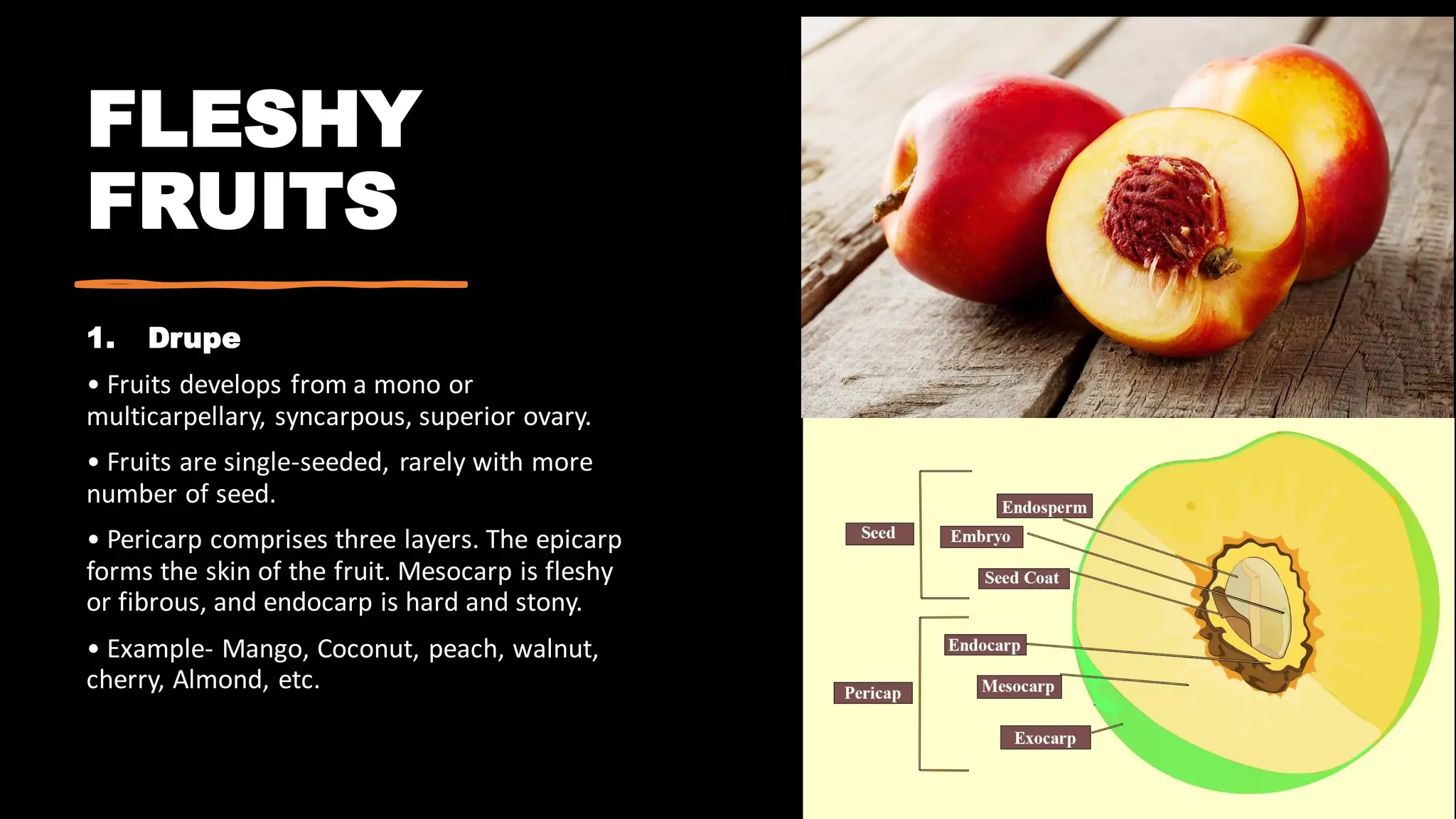
1. Drupe
• Fruitsdevelops from a mono or
multicarpellary, syncarpous, superior ovary.
• Fruits are single-seeded, rarely with more
number of seed.
• Pericarp comprises three layers. The epicarp
forms the skin of the fruit. Mesocarp is fleshy
or fibrous, and endocarp is hard and stony.
• Example- Mango, Coconut, peach, walnut,
cherry, Almond, etc.
14.
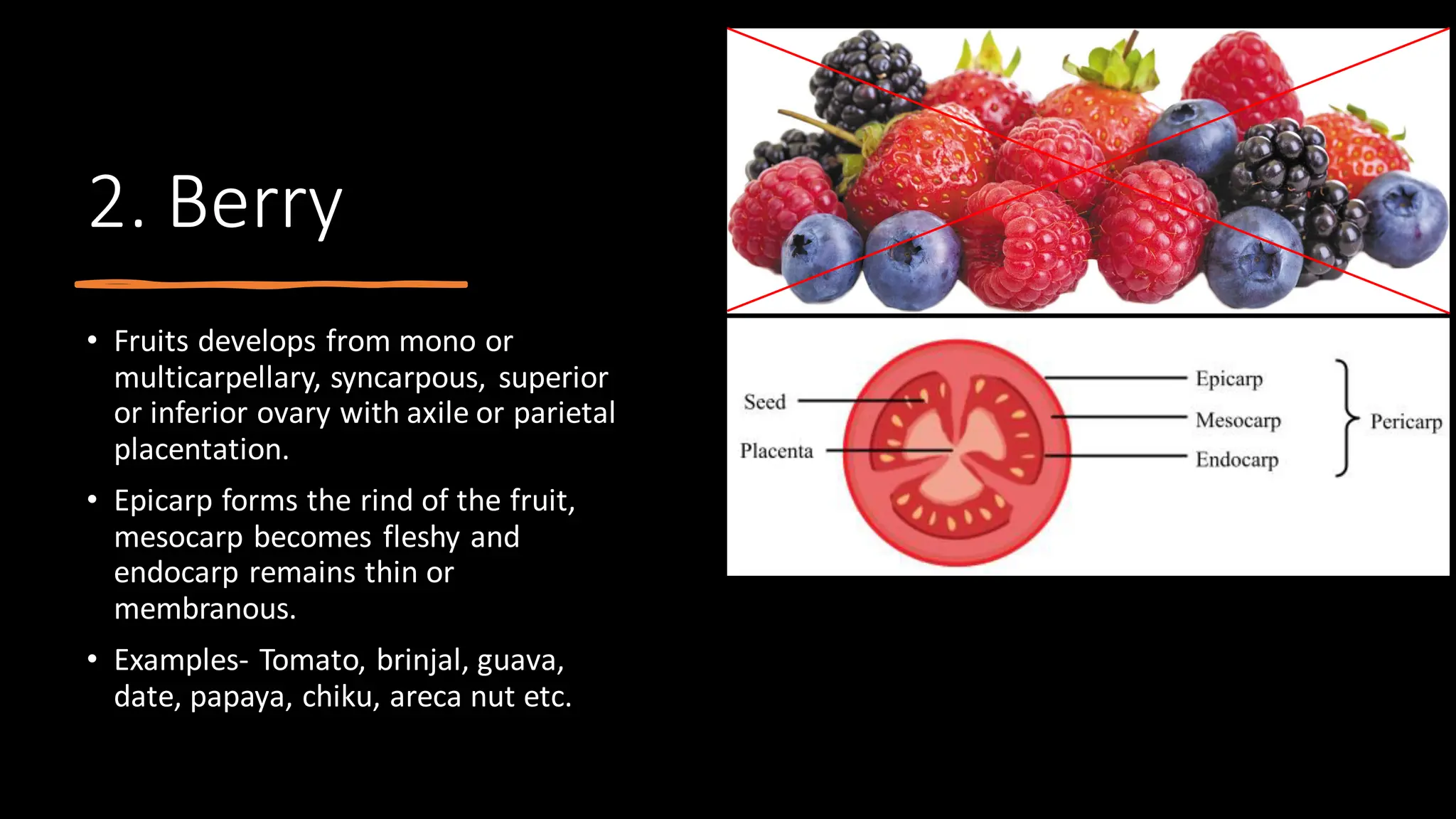
2. Berry
• Fruitsdevelops from mono or
multicarpellary, syncarpous, superior
or inferior ovary with axile or parietal
placentation.
• Epicarp forms the rind of the fruit,
mesocarp becomes fleshy and
endocarp remains thin or
membranous.
• Examples- Tomato, brinjal, guava,
date, papaya, chiku, areca nut etc.
15.
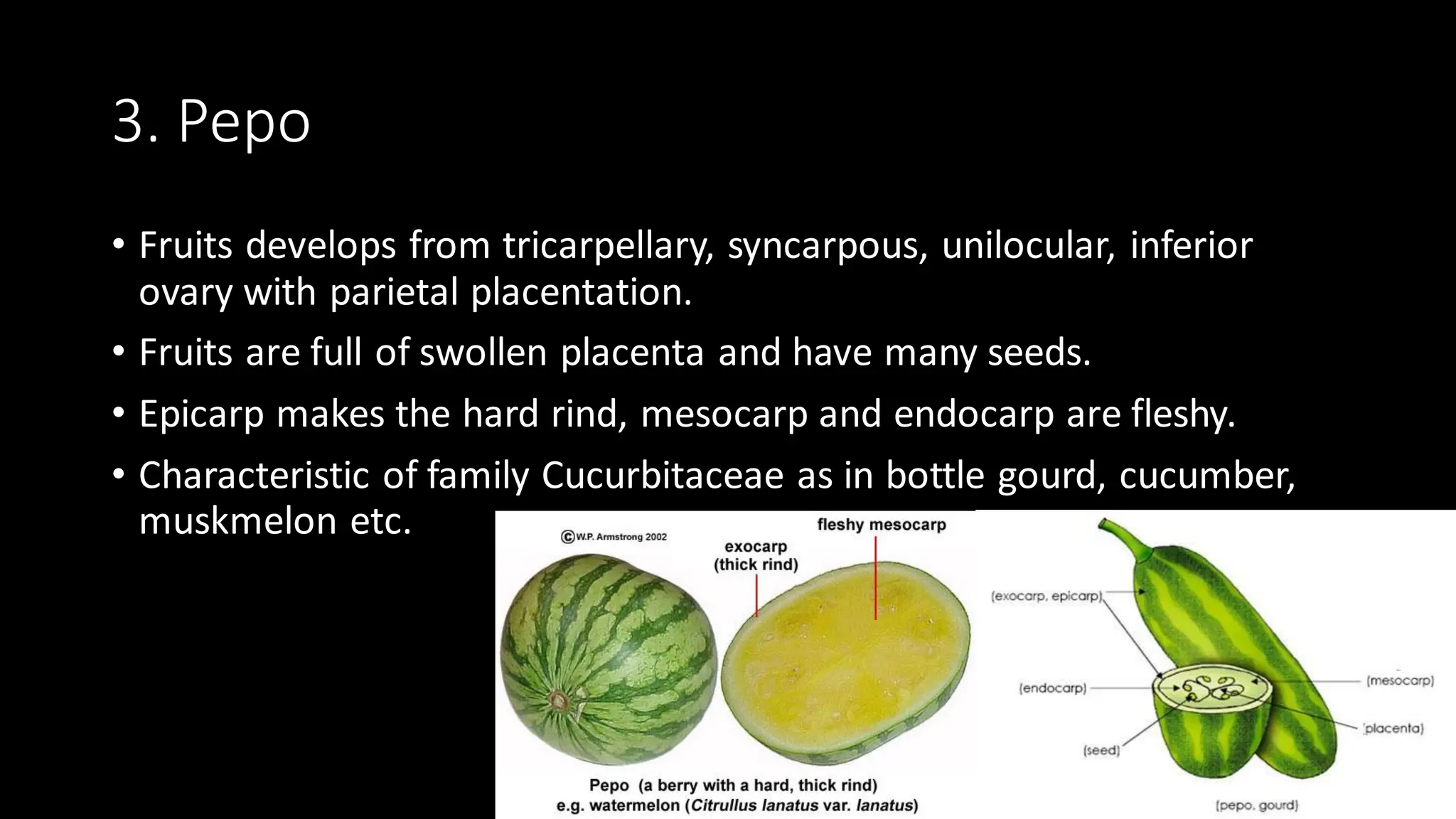
3. Pepo
• Fruitsdevelops from tricarpellary, syncarpous, unilocular, inferior
ovary with parietal placentation.
• Fruits are full of swollen placenta and have many seeds.
• Epicarp makes the hard rind, mesocarp and endocarp are fleshy.
• Characteristic of family Cucurbitaceae as in bottle gourd, cucumber,
muskmelon etc.
16.
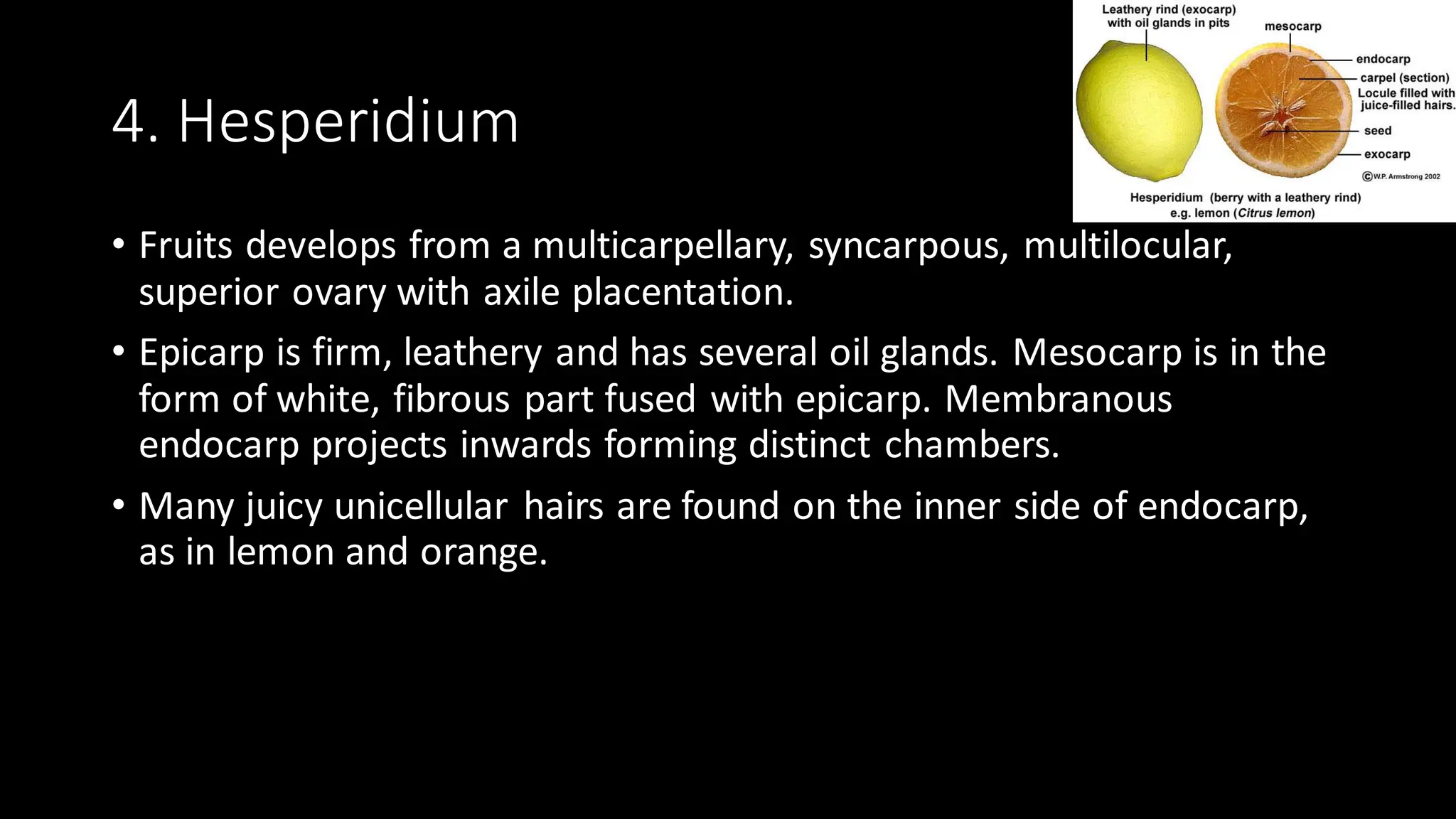
4. Hesperidium
• Fruitsdevelops from a multicarpellary, syncarpous, multilocular,
superior ovary with axile placentation.
• Epicarp is firm, leathery and has several oil glands. Mesocarp is in the
form of white, fibrous part fused with epicarp. Membranous
endocarp projects inwards forming distinct chambers.
• Many juicy unicellular hairs are found on the inner side of endocarp,
as in lemon and orange.
17.
AGGREGATE FRUITS
• Aggregatefruits develop from a multi-carpellary apocarpous ovary.
Each ovary forms a fruitlet, and the collection of fruitlets is known as
an etaerio.
• Aggregate fruits are apocarpous fruits formed from a single flower
that possesses multiple free carpels (apocarpous gynoecium). Each
free carpel develops into a small fruitlet, and together these fruitlets
constitute the aggregate fruit. Thus, aggregate fruits are a cluster of
fruitlets derived from the same flower, usually arranged on a common
receptacle.
18.
Types of AggregateFruits
• Etaerio of Follicles
• When the fruitlets are follicles (dry, dehiscent, opening along one suture).
• Examples: Calotropis, Michelia, Magnolia.
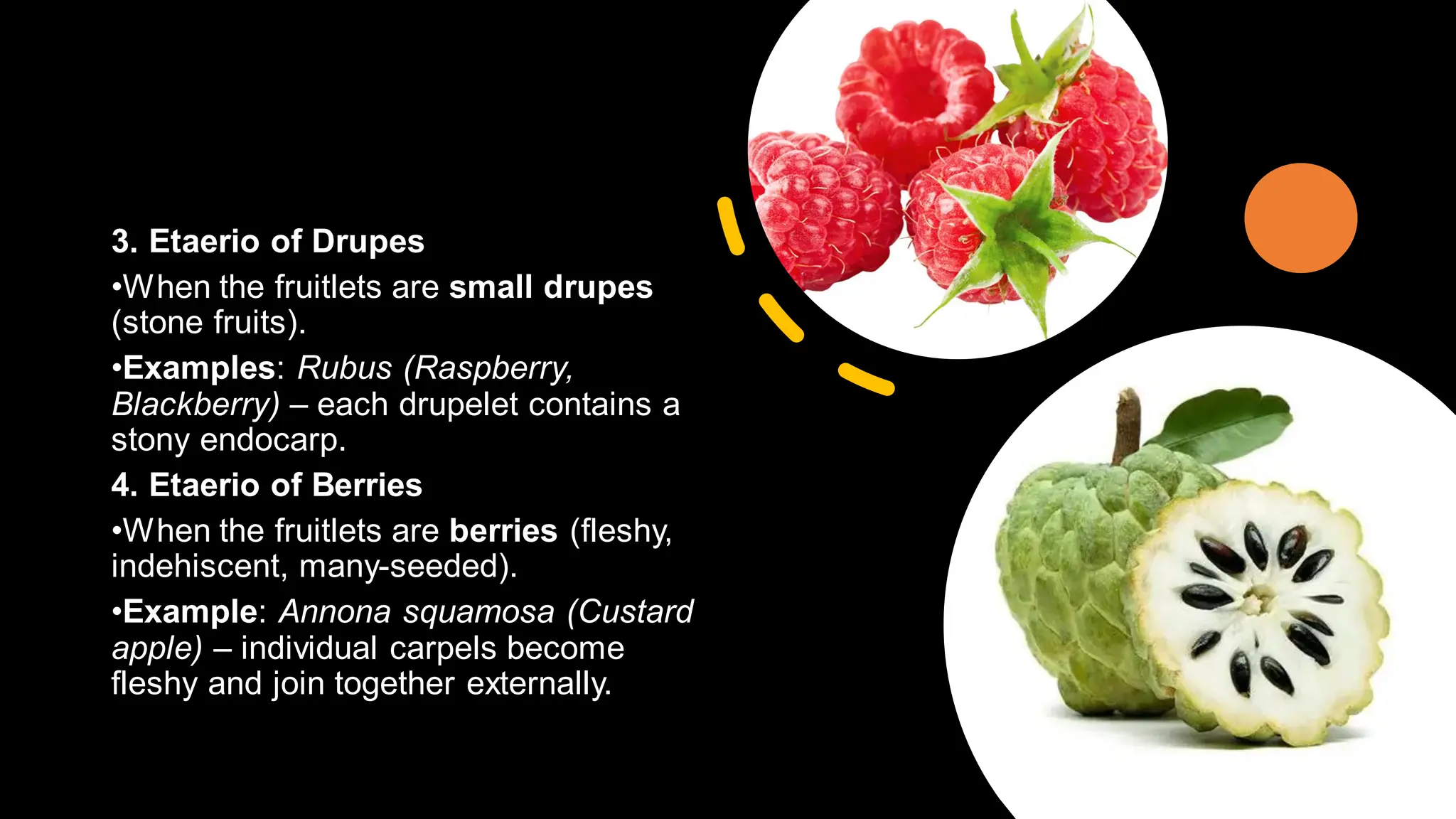
• Etaerio of Achenes
• When the fruitlets are achenes (dry, indehiscent, one-seeded).
• Often borne on an enlarged, fleshy thalamus/receptacle.
• Examples: Ranunculus, Strawberry (Fragaria) – here, the fleshy receptacle is
edible, and the achenes are seen on the surface.
19.
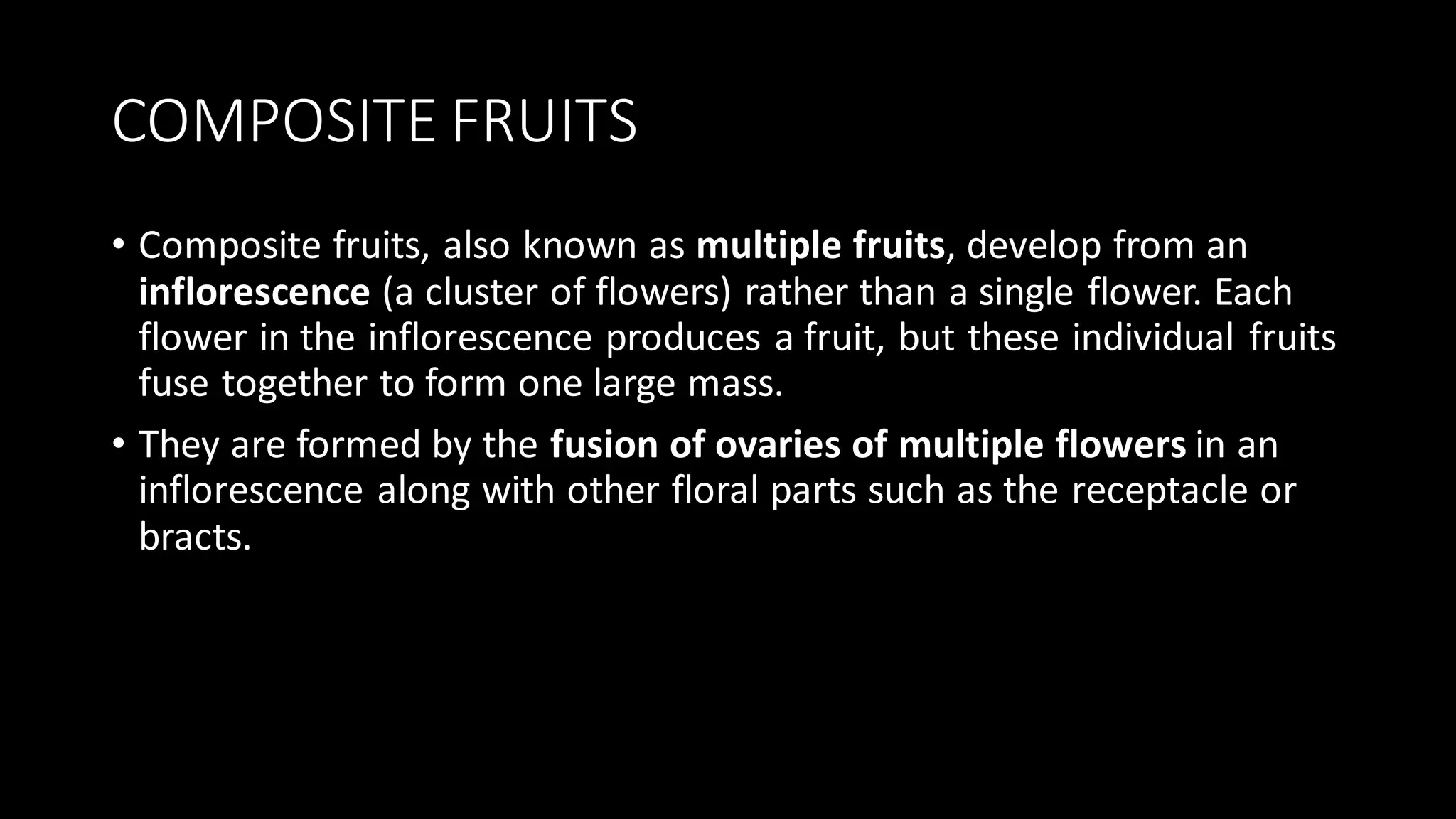
3. Etaerio ofDrupes
•When the fruitlets are small drupes
(stone fruits).
•Examples: Rubus (Raspberry,
Blackberry) – each drupelet contains a
stony endocarp.
4. Etaerio of Berries
•When the fruitlets are berries (fleshy,
indehiscent, many-seeded).
•Example: Annona squamosa (Custard
apple) – individual carpels become
fleshy and join together externally.
20.
COMPOSITE FRUITS
• Compositefruits, also known as multiple fruits, develop from an
inflorescence (a cluster of flowers) rather than a single flower. Each
flower in the inflorescence produces a fruit, but these individual fruits
fuse together to form one large mass.
• They are formed by the fusion of ovaries of multiple flowers in an
inflorescence along with other floral parts such as the receptacle or
bracts.
21.
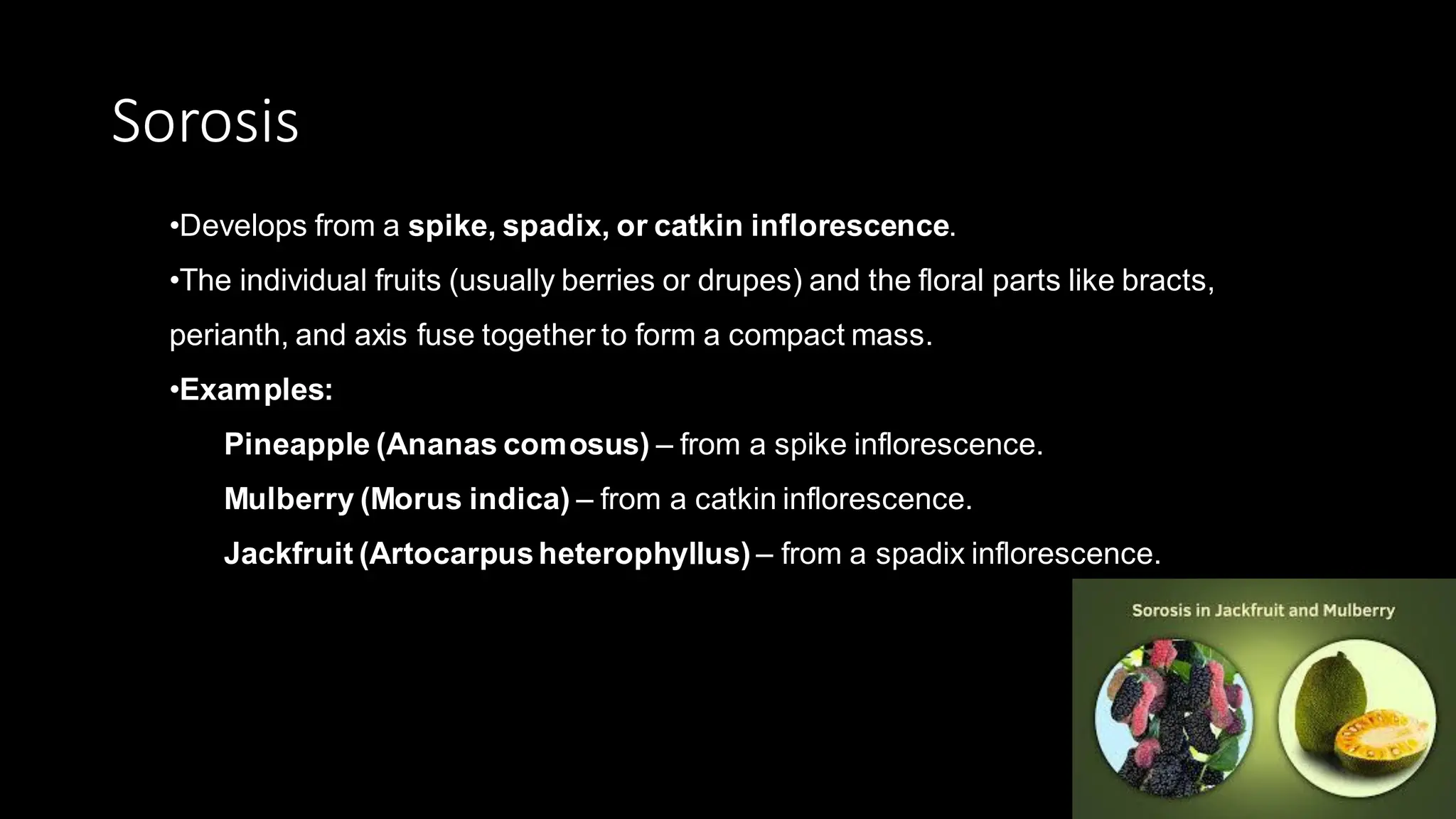
Sorosis
•Develops from aspike, spadix, or catkin inflorescence.
•The individual fruits (usually berries or drupes) and the floral parts like bracts,
perianth, and axis fuse together to form a compact mass.
•Examples:
Pineapple (Ananas comosus) – from a spike inflorescence.
Mulberry (Morus indica) – from a catkin inflorescence.
Jackfruit (Artocarpusheterophyllus) – from a spadix inflorescence.
22.
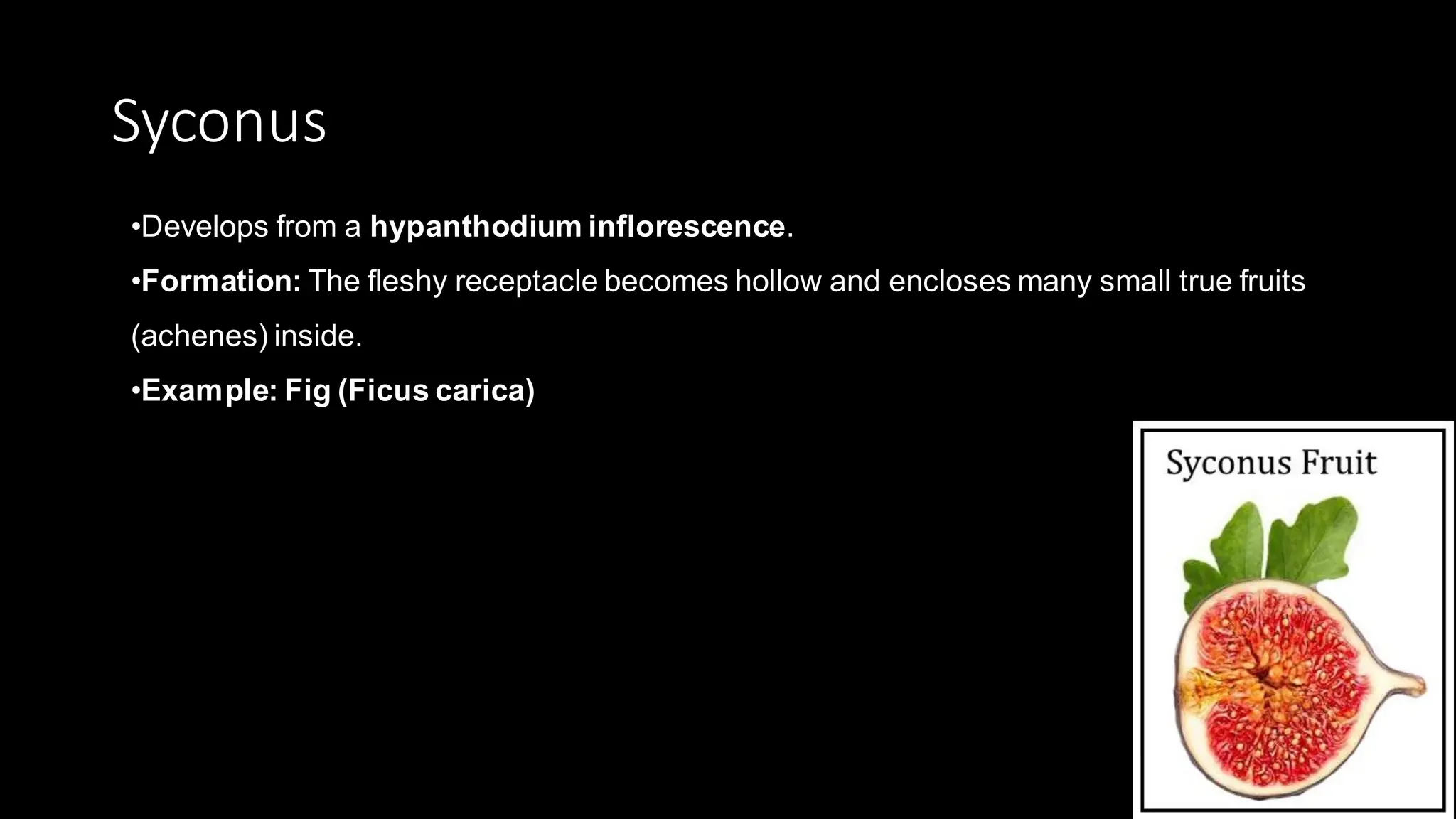
Syconus
•Develops from ahypanthodium inflorescence.
•Formation: The fleshy receptacle becomes hollow and encloses many small true fruits
(achenes) inside.
•Example: Fig (Ficus carica)