Fruit
Purnima Pandey
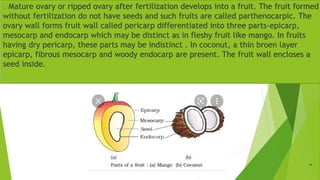
Mature ovary or ripped ovary after fertilization develops into a fruit. The fruit formed
without fertilization do not have seeds and such fruits are called parthenocarpic. The
ovary wall forms fruit wall called pericarp differentiated into three parts-epicarp,
mesocarp and endocarp which may be distinct as in fleshy fruit like mango. In fruits
having dry pericarp, these parts may be indistinct . In coconut, a thin broen layer
epicarp, fibrous mesocarp and woody endocarp are present. The fruit wall encloses a
seed inside.
True And False Fruits
True fruits are formed by the ovary(lower region of the pistil)
after fertilisatio. Sometimes, the bulk of the fruit is not
derived from the ovary but from other part(s) of the flower.
Such fruits are called false fruit or accessory fruit or
pseudocarp. These ojther parts or accessory parts in false
fruits can be perianth in mulberry, thalmbus or receptacle in
apple and strawberry, peduncle in cashewnut, etc.
Types Of Fruits
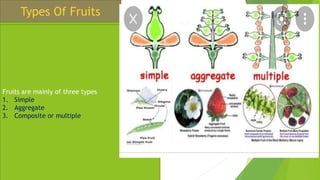
Fruits are mainly of three types
1. Simple
2. Aggregate
3. Composite or multiple
Simple Fruits
Simple fruits develop from a single flower having
monocarpellary or polycarpellaryand syncarpous
gynoecium. Aggregate fruits develop from
polycarpellary and apocarpous gynoecium and such
fruits are also called etaeri. Composite fruits
develop from theentire infloerescence.

 In simple fruits the pericarp can be dry or
fleshy. Dry simple fruits can be further divided imto
:
 Achenical (single seeded and indehiscent)
 Capsular (multiseeded and dehiscent
 Schizocarpic (multiseeded but spilt imto single
seeded chambers dehiscent or indehiscent
Simple dry Fruit
1. Achenical : Further divided into sub-types
a) Achene : It is a typical achenical fruit developing from monocarpellary superior
ovary e.g.,Rose,Mirabilis
b) Caryosis : Pericarp(fruit wall) is closely associated with seed coat and these two
are inseparable,e.g.,members of family gramine(wheat,rice,maize,etc.)
c) Samara : These singled seeded fruits develops from bicarpellary inferior ovary.
The example include sunflower,marigold,etc.,of family composite
d) Samara : These are winged fruits in which pericarp is modified into wing-like
structure,e.g.,Holoptelea,Disocorea,etc.
Nut : Pericarp in these fruits become thick and hard e.g.,Litchi,oak,cashew
nut,walnut,etc.
2. Capsular : The sub-types are as follows
a) Legume or Pod : Legume fruit is found in family papilionaceae e.g., pea,bean
b) Follicle : These fruits have only one suture,e.g.,Calotropis,Michelia,Delphinium
c) Siliqua : These fruits are characteristics of family
criciferae,e.g.,mustard,reddish etc.
d) Silicula : It is similar tp siliqua but smaller in siz.Its breadthand length are
equal,e.g.,Capsella,Iberis
e) Capsular : The important examples include okra,cotton,opium poppy
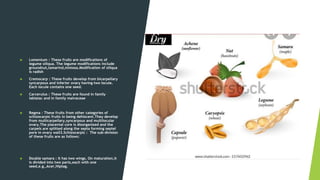
 Lomentum : These fruits are modifications of
legume siliqua. The legume modifications include
groundnut,tamarind,mimosa.Modification of siliqua
is radish
 Cremocarp : These fruits develop from bicarpellary
syncarpous and inferior ovary having two locule.
Each locule contains one seed.
 Carcerulus : These fruits are found in family
labiatac and in family malvaceae
 Regma : These fruits from other categories of
schizocarpic fruits in being dehiscent.They develop
from multicarpellary,syncarpous and multilocular
ovary.The placental core is disorganized and the
carpels are splitted along the septa forming septel
pore in ovary wall3.Schizocarpic : The sub-division
of these fruits are as follows:
 Double samara : It has two wings. On maturation,it
is divided into two parts,each with one
seed,e.g.,Acer,Hiptag.
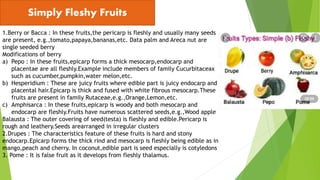
Simply Fleshy Fruits
1.Berry or Bacca : In these fruits,the pericarp is fleshly and usually many seeds
are present, e.g.,tomato,papaya,bananas,etc. Data palm and Areca nut are
single seeded berry
Modifications of berry
a) Pepo : In these fruits,epicarp forms a thick mesocarp,endocarp and
placentae are all fleshly.Example include members of family Cucurbitaceax
such as cucumber,pumpkin,water melon,etc.
b) Hesperidium : These are juicy fruits where edible part is juicy endocarp and
placental hair.Epicarp is thick and fused with white fibrous mesocarp.These
fruits are present in family Rutaceae,e.g.,Orange,Lemon,etc.
c) Amphisarca : In these fruits,epicarp is woody and both mesocarp and
endocarp are fleshly.Fruits have numerous scattered seeds,e.g.,Wood apple
Balausta : The outer covering of seed(testa) is fleshly and edible.Pericarp is
rough and leathery.Seeds arearranged in irregular clusters
2.Drupes : The characteristics feature of these fruits is hard and stony
endocarp.Epicarp forms the thick rind and mesocarp is fleshly being edible as in
mango,peach and cherry. In coconut,edible part is seed especially is cotyledons
3. Pome : It is false fruit as it develops from fleshly thalamus.
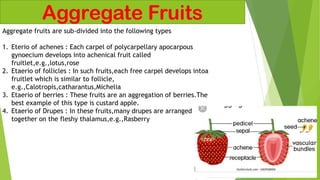
Aggregate Fruits
Aggregate fruits are sub-divided into the following types
1. Eterio of achenes : Each carpel of polycarpellary apocarpous
gynoecium develops into achenical fruit called
fruitlet,e.g.,lotus,rose
2. Etaerio of follicles : In such fruits,each free carpel develops intoa
fruitlet which is similar to follicle,
e.g.,Calotropis,catharantus,Michelia
3. Etaerio of berries : These fruits are an aggregation of berries.The
best example of this type is custard apple.
4. Etaerio of Drupes : In these fruits,many drupes are arranged
together on the fleshy thalamus,e.g.,Rasberry
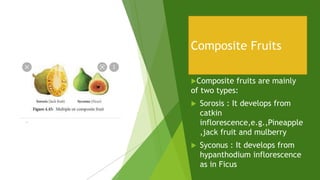
Composite Fruits
Composite fruits are mainly
of two types:
 Sorosis : It develops from
catkin
inflorescence,e.g.,Pineapple
,jack fruit and mulberry
 Syconus : It develops from
hypanthodium inflorescence
as in Ficus

PPT BIO TECHNOLOGY

  • 1.
  • 2.
    Mature ovary orripped ovary after fertilization develops into a fruit. The fruit formed without fertilization do not have seeds and such fruits are called parthenocarpic. The ovary wall forms fruit wall called pericarp differentiated into three parts-epicarp, mesocarp and endocarp which may be distinct as in fleshy fruit like mango. In fruits having dry pericarp, these parts may be indistinct . In coconut, a thin broen layer epicarp, fibrous mesocarp and woody endocarp are present. The fruit wall encloses a seed inside.
  • 3.
    True And FalseFruits True fruits are formed by the ovary(lower region of the pistil) after fertilisatio. Sometimes, the bulk of the fruit is not derived from the ovary but from other part(s) of the flower. Such fruits are called false fruit or accessory fruit or pseudocarp. These ojther parts or accessory parts in false fruits can be perianth in mulberry, thalmbus or receptacle in apple and strawberry, peduncle in cashewnut, etc.
  • 4.
    Types Of Fruits Fruitsare mainly of three types 1. Simple 2. Aggregate 3. Composite or multiple
  • 5.
    Simple Fruits Simple fruitsdevelop from a single flower having monocarpellary or polycarpellaryand syncarpous gynoecium. Aggregate fruits develop from polycarpellary and apocarpous gynoecium and such fruits are also called etaeri. Composite fruits develop from theentire infloerescence.   In simple fruits the pericarp can be dry or fleshy. Dry simple fruits can be further divided imto :  Achenical (single seeded and indehiscent)  Capsular (multiseeded and dehiscent  Schizocarpic (multiseeded but spilt imto single seeded chambers dehiscent or indehiscent
  • 6.
    Simple dry Fruit 1.Achenical : Further divided into sub-types a) Achene : It is a typical achenical fruit developing from monocarpellary superior ovary e.g.,Rose,Mirabilis b) Caryosis : Pericarp(fruit wall) is closely associated with seed coat and these two are inseparable,e.g.,members of family gramine(wheat,rice,maize,etc.) c) Samara : These singled seeded fruits develops from bicarpellary inferior ovary. The example include sunflower,marigold,etc.,of family composite d) Samara : These are winged fruits in which pericarp is modified into wing-like structure,e.g.,Holoptelea,Disocorea,etc. Nut : Pericarp in these fruits become thick and hard e.g.,Litchi,oak,cashew nut,walnut,etc. 2. Capsular : The sub-types are as follows a) Legume or Pod : Legume fruit is found in family papilionaceae e.g., pea,bean b) Follicle : These fruits have only one suture,e.g.,Calotropis,Michelia,Delphinium c) Siliqua : These fruits are characteristics of family criciferae,e.g.,mustard,reddish etc. d) Silicula : It is similar tp siliqua but smaller in siz.Its breadthand length are equal,e.g.,Capsella,Iberis e) Capsular : The important examples include okra,cotton,opium poppy
  • 7.
     Lomentum :These fruits are modifications of legume siliqua. The legume modifications include groundnut,tamarind,mimosa.Modification of siliqua is radish  Cremocarp : These fruits develop from bicarpellary syncarpous and inferior ovary having two locule. Each locule contains one seed.  Carcerulus : These fruits are found in family labiatac and in family malvaceae  Regma : These fruits from other categories of schizocarpic fruits in being dehiscent.They develop from multicarpellary,syncarpous and multilocular ovary.The placental core is disorganized and the carpels are splitted along the septa forming septel pore in ovary wall3.Schizocarpic : The sub-division of these fruits are as follows:  Double samara : It has two wings. On maturation,it is divided into two parts,each with one seed,e.g.,Acer,Hiptag.
  • 8.
    Simply Fleshy Fruits 1.Berryor Bacca : In these fruits,the pericarp is fleshly and usually many seeds are present, e.g.,tomato,papaya,bananas,etc. Data palm and Areca nut are single seeded berry Modifications of berry a) Pepo : In these fruits,epicarp forms a thick mesocarp,endocarp and placentae are all fleshly.Example include members of family Cucurbitaceax such as cucumber,pumpkin,water melon,etc. b) Hesperidium : These are juicy fruits where edible part is juicy endocarp and placental hair.Epicarp is thick and fused with white fibrous mesocarp.These fruits are present in family Rutaceae,e.g.,Orange,Lemon,etc. c) Amphisarca : In these fruits,epicarp is woody and both mesocarp and endocarp are fleshly.Fruits have numerous scattered seeds,e.g.,Wood apple Balausta : The outer covering of seed(testa) is fleshly and edible.Pericarp is rough and leathery.Seeds arearranged in irregular clusters 2.Drupes : The characteristics feature of these fruits is hard and stony endocarp.Epicarp forms the thick rind and mesocarp is fleshly being edible as in mango,peach and cherry. In coconut,edible part is seed especially is cotyledons 3. Pome : It is false fruit as it develops from fleshly thalamus.
  • 9.
    Aggregate Fruits Aggregate fruitsare sub-divided into the following types 1. Eterio of achenes : Each carpel of polycarpellary apocarpous gynoecium develops into achenical fruit called fruitlet,e.g.,lotus,rose 2. Etaerio of follicles : In such fruits,each free carpel develops intoa fruitlet which is similar to follicle, e.g.,Calotropis,catharantus,Michelia 3. Etaerio of berries : These fruits are an aggregation of berries.The best example of this type is custard apple. 4. Etaerio of Drupes : In these fruits,many drupes are arranged together on the fleshy thalamus,e.g.,Rasberry
  • 10.
    Composite Fruits Composite fruitsare mainly of two types:  Sorosis : It develops from catkin inflorescence,e.g.,Pineapple ,jack fruit and mulberry  Syconus : It develops from hypanthodium inflorescence as in Ficus