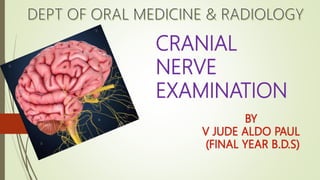
CRANIAL
NERVE
EXAMINATION
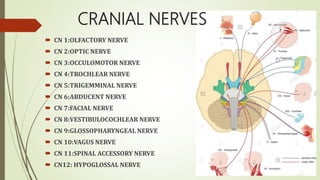
CRANIAL NERVES
 CN 1:OLFACTORY NERVE
 CN 2:OPTIC NERVE
 CN 3:OCCULOMOTOR NERVE
 CN 4:TROCHLEAR NERVE
 CN 5:TRIGEMMINAL NERVE
 CN 6:ABDUCENT NERVE
 CN 7:FACIAL NERVE
 CN 8:VESTIBULOCOCHLEAR NERVE
 CN 9:GLOSSOPHARYNGEAL NERVE
 CN 10:VAGUS NERVE
 CN 11:SPINAL ACCESSORY NERVE
 CN12: HYPOGLOSSAL NERVE
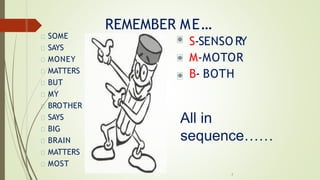
SOME
SAYS
MONEY
MATTERS
BUT
MY
BROTHER
SAYS
BIG
BRAIN
MATTERS
MOST
REMEMBER ME…
S-SENSO RY
M-MOTOR
B- BOTH
All in
sequence……
4
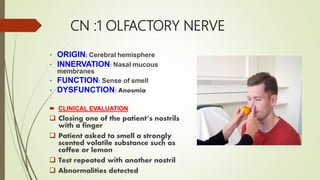
CN :1 OLFACTORY NERVE
• ORIGIN: Cerebral hemisphere
• INNERVATION: Nasal mucous
membranes
• FUNCTION: Sense of smell
• DYSFUNCTION: Anosmia
 CLINICAL EVALUATION
 Closing one of the patient’s nostrils
with a finger
 Patient asked to smell a strongly
scented volatile substance such as
coffee or lemon
 Test repeated with another nostril
 Abnormalities detected
CN :2 OPTIC NERVE
FUNCTIONS: The optics nerve consists of sensory fibers
conducting impulses from the retina.
CLINICAL EXAMINATION:
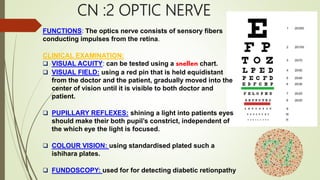
 VISUAL ACUITY: can be tested using a snellen chart.
 VISUAL FIELD: using a red pin that is held equidistant
from the doctor and the patient, gradually moved into the
center of vision until it is visible to both doctor and
patient.
 PUPILLARY REFLEXES: shining a light into patients eyes
should make their both pupil’s constrict, independent of
the which eye the light is focused.
 COLOUR VISION: using standardised plated such a
ishihara plates.
 FUNDOSCOPY: used for for detecting diabetic retionpathy
CN3:OCCULOMOTOR NERVE
CN4:(TROCHLEAR NERVE)
CN6:(ABDUCENT NERVE)
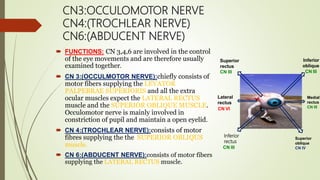
 FUNCTIONS: CN 3,4,6 are involved in the control
of the eye movements and are therefore usually
examined together.
 CN 3:(OCCULMOTOR NERVE):chiefly consists of
motor fibers supplying the LEVATOR
PALPEBRAE SUPERIORIS and all the extra
ocular muscles expect the LATERAL RECTUS
muscle and the SUPERIOR OBLIQUE MUSCLE.
Occulomotor nerve is mainly involved in
constriction of pupil and maintain a open eyelid.
 CN 4:(TROCHLEAR NERVE):consists of motor
fibres supplying the the SUPERIOR OBLIQUS
muscle.
 CN 6:(ABDUCENT NERVE):consists of motor fibers
supplying the LATERAL RECTUS muscle.
Medial
rectus
CN III
Superior
oblique
CN IV
Inferior
rectus
Superior
rectus
CN III
Inferior
oblique
CN III
CN III
Lateral
rectus
CN VI
Clinical evaluation
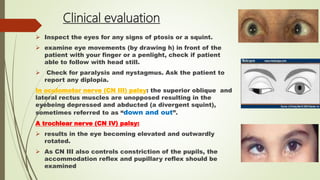
 Inspect the eyes for any signs of ptosis or a squint.
 examine eye movements (by drawing h) in front of the
patient with your finger or a penlight, check if patient
able to follow with head still.
 Check for paralysis and nystagmus. Ask the patient to
report any diplopia.
In oculomotor nerve (CN III) palsy: the superior oblique and
lateral rectus muscles are unopposed resulting in the
eyebeing depressed and abducted (a divergent squint),
sometimes referred to as “down and out”.
A trochlear nerve (CN IV) palsy:
 results in the eye becoming elevated and outwardly
rotated.
 As CN III also controls constriction of the pupils, the
accommodation reflex and pupillary reflex should be
examined
CN:5 TRIGEMINAL NERVE
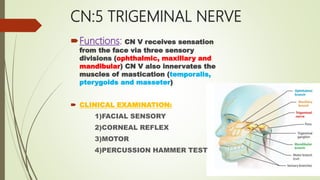
Functions: CN V receives sensation
from the face via three sensory
divisions (ophthalmic, maxillary and
mandibular) CN V also innervates the
muscles of mastication (temporalis,
pterygoids and masseter)
 CLINICAL EXAMINATION:
1)FACIAL SENSORY
2)CORNEAL REFLEX
3)MOTOR
4)PERCUSSION HAMMER TEST
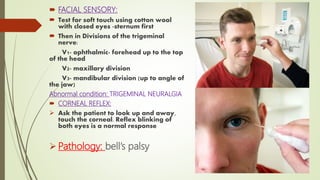
 FACIAL SENSORY:
 Test for soft touch using cotton wool
with closed eyes -sternum first
 Then in Divisions of the trigeminal
nerve:
V1- ophthalmic- forehead up to the top
of the head
V2- maxillary division
V3- mandibular division (up to angle of
the jaw)
Abnormal condition: TRIGEMINAL NEURALGIA
 CORNEAL REFLEX:
 Ask the patient to look up and away,
touch the corneal. Reflex blinking of
both eyes is a normal response
 Pathology: bell’s palsy
 MOTOR FUNCTIONS:
 Inspect for wasting of the temporal
and masseter muscles
 Ask patient to clench their teeth and
palpate for contraction of the temporal
and masseter muscles
 Ask patient to open their mouth and
hold it open while the examiner
attempts to force it shut [pterygoid
muscles].
JAW JERK TEST
Ask the patient to open her
mouth fully, and close
halfway place index finger
on her chin and tap with a
patella hammer, if jaw jerk
is highly exaggerated.
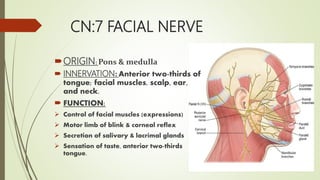
CN:7 FACIAL NERVE
ORIGIN: Pons & medulla
 INNERVATION: Anterior two-thirds of
tongue; facial muscles, scalp, ear,
and neck.
 FUNCTION:
 Control of facial muscles (expressions)
 Motor limb of blink & corneal reflex
 Secretion of salivary & lacrimal glands
 Sensation of taste, anterior two-thirds
tongue.
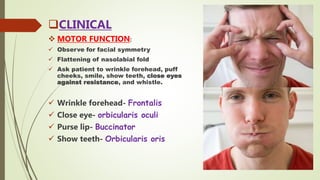
CLINICAL
 MOTOR FUNCTION:
 Observe for facial symmetry
 Flattening of nasolabial fold
 Ask patient to wrinkle forehead, puff
cheeks, smile, show teeth, close eyes
against resistance, and whistle.
 Wrinkle forehead- Frontalis
 Close eye- orbicularis oculi
 Purse lip- Buccinator
 Show teeth- Orbicularis oris
 SENSORY FUNCTION:
 Test each side of tongue separately.
 Test for sweet (tip of tongue); sour
(sides of tongue); salty (over most of
tongue, but concentrated on sides).
 Give sip of water between tastes.
 Prevent flowing it to the posterior
aspect of tongue .
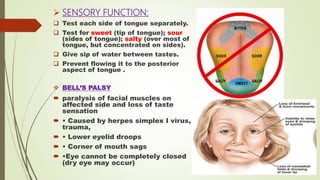
 BELL’S PALSY
 paralysis of facial muscles on
affected side and loss of taste
sensation
 • Caused by herpes simplex I virus,
trauma,
 • Lower eyelid droops
 • Corner of mouth sags
 •Eye cannot be completely closed
(dry eye may occur)
CN:8
VESTIBULOCOC
HLEAR NERVE
FUNCTIONS: Consists of two
sensory components:
 1) COCHLEAR BRANCH : impulses for
hearing
2) VESTIBULAR BRANCH : impulses
for balance
CLINICAL
EXAMINATION:
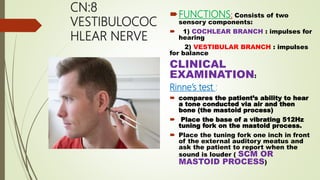
Rinne’s test :
 compares the patient’s ability to hear
a tone conducted via air and then
bone (the mastoid process)
 Place the base of a vibrating 512Hz
tuning fork on the mastoid process.
 Place the tuning fork one inch in front
of the external auditory meatus and
ask the patient to report when the
sound is louder ( SCM OR
MASTOID PROCESS)
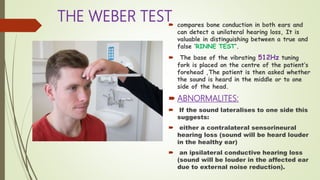
THE WEBER TEST compares bone conduction in both ears and
can detect a unilateral hearing loss, It is
valuable in distinguishing between a true and
false ‘RINNE TEST’.
 The base of the vibrating 512Hz tuning
fork is placed on the centre of the patient’s
forehead ,The patient is then asked whether
the sound is heard in the middle or to one
side of the head.
 ABNORMALITES:
 If the sound lateralises to one side this
suggests:
 either a contralateral sensorineural
hearing loss (sound will be heard louder
in the healthy ear)
 an ipsilateral conductive hearing loss
(sound will be louder in the affected ear
due to external noise reduction).
CN IX (Glossopharyngeal nerve)
CN X (Vagus nerve)
Function:
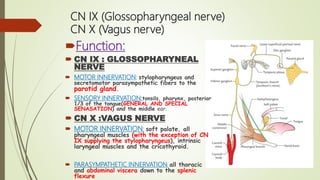
 CN IX : GLOSSOPHARYNEAL
NERVE
 MOTOR INNERVATION: stylopharyngeus and
secretomotor parasympathetic fibers to the
parotid gland.
 SENSORY INNERVATION:tonsils, pharynx, posterior
1/3 of the tongue(GENERAL AND SPECIAL
SENASATION) and the middle ear.
 CN X :VAGUS NERVE
 MOTOR INNERVATION: soft palate, all
pharyngeal muscles (with the exception of CN
IX supplying the stylopharyngeus), intrinsic
laryngeal muscles and the cricothyroid.
 PARASYMPATHETIC INNERVATION: all thoracic
and abdominal viscera down to the splenic
flexure
CLINICAL EXAMINATION:
 Patient should be specifically questioned
regarding:
 any speech or swallowing difficulties
(dysphagia), gross assessment of the
patient’s speech for dysphonia (usually
hoarseness) or a ‘nasal character’.
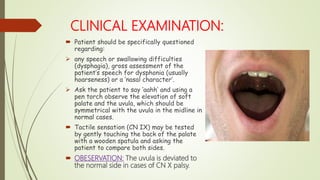
 Ask the patient to say ‘aahh’ and using a
pen torch observe the elevation of soft
palate and the uvula, which should be
symmetrical with the uvula in the midline in
normal cases.
 Tactile sensation (CN IX) may be tested
by gently touching the back of the palate
with a wooden spatula and asking the
patient to compare both sides.
 OBESERVATION: The uvula is deviated to
the normal side in cases of CN X palsy.
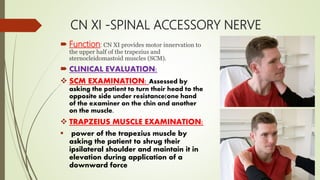
CN XI -SPINAL ACCESSORY NERVE
 Function: CN XI provides motor innervation to
the upper half of the trapezius and
sternocleidomastoid muscles (SCM).
 CLINICAL EVALUATION:
 SCM EXAMINATION: Assessed by
asking the patient to turn their head to the
opposite side under resistance(one hand
of the examiner on the chin and another
on the muscle.
 TRAPZEIUS MUSCLE EXAMINATION:
 power of the trapezius muscle by
asking the patient to shrug their
ipsilateral shoulder and maintain it in
elevation during application of a
downward force
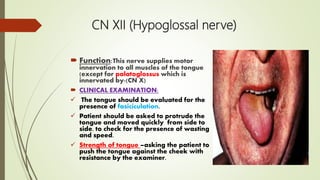
CN XII (Hypoglossal nerve)
 Function:This nerve supplies motor
innervation to all muscles of the tongue
(except for palatoglossus which is
innervated by-(CN X)
 CLINICAL EXAMINATION:
 The tongue should be evaluated for the
presence of fasiciculation.
 Patient should be asked to protrude the
tongue and moved quickly from side to
side, to check for the presence of wasting
and speed.
 Strength of tongue –asking the patient to
push the tongue against the cheek with
resistance by the examiner.
CRANIAL NERVE EXAMINATION

CRANIAL NERVE EXAMINATION

  • 1.
  • 2.
    CRANIAL NERVES  CN1:OLFACTORY NERVE  CN 2:OPTIC NERVE  CN 3:OCCULOMOTOR NERVE  CN 4:TROCHLEAR NERVE  CN 5:TRIGEMMINAL NERVE  CN 6:ABDUCENT NERVE  CN 7:FACIAL NERVE  CN 8:VESTIBULOCOCHLEAR NERVE  CN 9:GLOSSOPHARYNGEAL NERVE  CN 10:VAGUS NERVE  CN 11:SPINAL ACCESSORY NERVE  CN12: HYPOGLOSSAL NERVE
  • 3.
  • 4.
    CN :1 OLFACTORYNERVE • ORIGIN: Cerebral hemisphere • INNERVATION: Nasal mucous membranes • FUNCTION: Sense of smell • DYSFUNCTION: Anosmia  CLINICAL EVALUATION  Closing one of the patient’s nostrils with a finger  Patient asked to smell a strongly scented volatile substance such as coffee or lemon  Test repeated with another nostril  Abnormalities detected
  • 5.
    CN :2 OPTICNERVE FUNCTIONS: The optics nerve consists of sensory fibers conducting impulses from the retina. CLINICAL EXAMINATION:  VISUAL ACUITY: can be tested using a snellen chart.  VISUAL FIELD: using a red pin that is held equidistant from the doctor and the patient, gradually moved into the center of vision until it is visible to both doctor and patient.  PUPILLARY REFLEXES: shining a light into patients eyes should make their both pupil’s constrict, independent of the which eye the light is focused.  COLOUR VISION: using standardised plated such a ishihara plates.  FUNDOSCOPY: used for for detecting diabetic retionpathy
  • 6.
    CN3:OCCULOMOTOR NERVE CN4:(TROCHLEAR NERVE) CN6:(ABDUCENTNERVE)  FUNCTIONS: CN 3,4,6 are involved in the control of the eye movements and are therefore usually examined together.  CN 3:(OCCULMOTOR NERVE):chiefly consists of motor fibers supplying the LEVATOR PALPEBRAE SUPERIORIS and all the extra ocular muscles expect the LATERAL RECTUS muscle and the SUPERIOR OBLIQUE MUSCLE. Occulomotor nerve is mainly involved in constriction of pupil and maintain a open eyelid.  CN 4:(TROCHLEAR NERVE):consists of motor fibres supplying the the SUPERIOR OBLIQUS muscle.  CN 6:(ABDUCENT NERVE):consists of motor fibers supplying the LATERAL RECTUS muscle. Medial rectus CN III Superior oblique CN IV Inferior rectus Superior rectus CN III Inferior oblique CN III CN III Lateral rectus CN VI
  • 7.
    Clinical evaluation  Inspectthe eyes for any signs of ptosis or a squint.  examine eye movements (by drawing h) in front of the patient with your finger or a penlight, check if patient able to follow with head still.  Check for paralysis and nystagmus. Ask the patient to report any diplopia. In oculomotor nerve (CN III) palsy: the superior oblique and lateral rectus muscles are unopposed resulting in the eyebeing depressed and abducted (a divergent squint), sometimes referred to as “down and out”. A trochlear nerve (CN IV) palsy:  results in the eye becoming elevated and outwardly rotated.  As CN III also controls constriction of the pupils, the accommodation reflex and pupillary reflex should be examined
  • 8.
    CN:5 TRIGEMINAL NERVE Functions:CN V receives sensation from the face via three sensory divisions (ophthalmic, maxillary and mandibular) CN V also innervates the muscles of mastication (temporalis, pterygoids and masseter)  CLINICAL EXAMINATION: 1)FACIAL SENSORY 2)CORNEAL REFLEX 3)MOTOR 4)PERCUSSION HAMMER TEST
  • 9.
     FACIAL SENSORY: Test for soft touch using cotton wool with closed eyes -sternum first  Then in Divisions of the trigeminal nerve: V1- ophthalmic- forehead up to the top of the head V2- maxillary division V3- mandibular division (up to angle of the jaw) Abnormal condition: TRIGEMINAL NEURALGIA  CORNEAL REFLEX:  Ask the patient to look up and away, touch the corneal. Reflex blinking of both eyes is a normal response  Pathology: bell’s palsy
  • 10.
     MOTOR FUNCTIONS: Inspect for wasting of the temporal and masseter muscles  Ask patient to clench their teeth and palpate for contraction of the temporal and masseter muscles  Ask patient to open their mouth and hold it open while the examiner attempts to force it shut [pterygoid muscles]. JAW JERK TEST Ask the patient to open her mouth fully, and close halfway place index finger on her chin and tap with a patella hammer, if jaw jerk is highly exaggerated.
  • 11.
    CN:7 FACIAL NERVE ORIGIN:Pons & medulla  INNERVATION: Anterior two-thirds of tongue; facial muscles, scalp, ear, and neck.  FUNCTION:  Control of facial muscles (expressions)  Motor limb of blink & corneal reflex  Secretion of salivary & lacrimal glands  Sensation of taste, anterior two-thirds tongue.
  • 12.
    CLINICAL  MOTOR FUNCTION: Observe for facial symmetry  Flattening of nasolabial fold  Ask patient to wrinkle forehead, puff cheeks, smile, show teeth, close eyes against resistance, and whistle.  Wrinkle forehead- Frontalis  Close eye- orbicularis oculi  Purse lip- Buccinator  Show teeth- Orbicularis oris
  • 13.
     SENSORY FUNCTION: Test each side of tongue separately.  Test for sweet (tip of tongue); sour (sides of tongue); salty (over most of tongue, but concentrated on sides).  Give sip of water between tastes.  Prevent flowing it to the posterior aspect of tongue .  BELL’S PALSY  paralysis of facial muscles on affected side and loss of taste sensation  • Caused by herpes simplex I virus, trauma,  • Lower eyelid droops  • Corner of mouth sags  •Eye cannot be completely closed (dry eye may occur)
  • 14.
    CN:8 VESTIBULOCOC HLEAR NERVE FUNCTIONS: Consistsof two sensory components:  1) COCHLEAR BRANCH : impulses for hearing 2) VESTIBULAR BRANCH : impulses for balance CLINICAL EXAMINATION: Rinne’s test :  compares the patient’s ability to hear a tone conducted via air and then bone (the mastoid process)  Place the base of a vibrating 512Hz tuning fork on the mastoid process.  Place the tuning fork one inch in front of the external auditory meatus and ask the patient to report when the sound is louder ( SCM OR MASTOID PROCESS)
  • 15.
    THE WEBER TESTcompares bone conduction in both ears and can detect a unilateral hearing loss, It is valuable in distinguishing between a true and false ‘RINNE TEST’.  The base of the vibrating 512Hz tuning fork is placed on the centre of the patient’s forehead ,The patient is then asked whether the sound is heard in the middle or to one side of the head.  ABNORMALITES:  If the sound lateralises to one side this suggests:  either a contralateral sensorineural hearing loss (sound will be heard louder in the healthy ear)  an ipsilateral conductive hearing loss (sound will be louder in the affected ear due to external noise reduction).
  • 16.
    CN IX (Glossopharyngealnerve) CN X (Vagus nerve) Function:  CN IX : GLOSSOPHARYNEAL NERVE  MOTOR INNERVATION: stylopharyngeus and secretomotor parasympathetic fibers to the parotid gland.  SENSORY INNERVATION:tonsils, pharynx, posterior 1/3 of the tongue(GENERAL AND SPECIAL SENASATION) and the middle ear.  CN X :VAGUS NERVE  MOTOR INNERVATION: soft palate, all pharyngeal muscles (with the exception of CN IX supplying the stylopharyngeus), intrinsic laryngeal muscles and the cricothyroid.  PARASYMPATHETIC INNERVATION: all thoracic and abdominal viscera down to the splenic flexure
  • 17.
    CLINICAL EXAMINATION:  Patientshould be specifically questioned regarding:  any speech or swallowing difficulties (dysphagia), gross assessment of the patient’s speech for dysphonia (usually hoarseness) or a ‘nasal character’.  Ask the patient to say ‘aahh’ and using a pen torch observe the elevation of soft palate and the uvula, which should be symmetrical with the uvula in the midline in normal cases.  Tactile sensation (CN IX) may be tested by gently touching the back of the palate with a wooden spatula and asking the patient to compare both sides.  OBESERVATION: The uvula is deviated to the normal side in cases of CN X palsy.
  • 18.
    CN XI -SPINALACCESSORY NERVE  Function: CN XI provides motor innervation to the upper half of the trapezius and sternocleidomastoid muscles (SCM).  CLINICAL EVALUATION:  SCM EXAMINATION: Assessed by asking the patient to turn their head to the opposite side under resistance(one hand of the examiner on the chin and another on the muscle.  TRAPZEIUS MUSCLE EXAMINATION:  power of the trapezius muscle by asking the patient to shrug their ipsilateral shoulder and maintain it in elevation during application of a downward force
  • 19.
    CN XII (Hypoglossalnerve)  Function:This nerve supplies motor innervation to all muscles of the tongue (except for palatoglossus which is innervated by-(CN X)  CLINICAL EXAMINATION:  The tongue should be evaluated for the presence of fasiciculation.  Patient should be asked to protrude the tongue and moved quickly from side to side, to check for the presence of wasting and speed.  Strength of tongue –asking the patient to push the tongue against the cheek with resistance by the examiner.