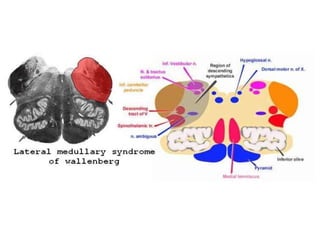
CRANIAL NERVES
PRELIMINARY
• Adequate Lighting/Exposure[Screen if
required]
• Comfort Patient
• Hand Wash/Rub; All equipment ready
• Explain testing procedure before
• Consent
• Be Gentle
ONE SUGGESTED APPROACH
• SUPRANUCLEAR Vs NUCLEAR/INFRANUC.
• FOR NUC/INFRANUC. VISUALISE LOCATION OF
NUCLEUS; FASCICLES; INTRACRANIAL COURSE;
FINAL DESTINATION.
• COMBINATIONS WITH OTHER NEUROLOGIC
TRACTS HELP IN HOMING ON SITE OF
DISORDER.
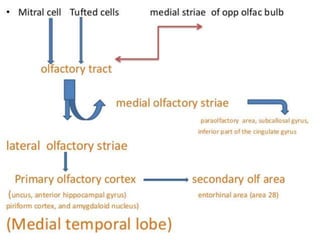
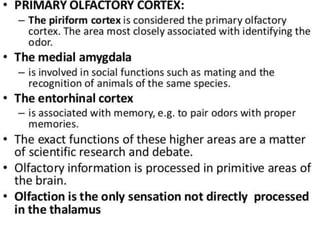
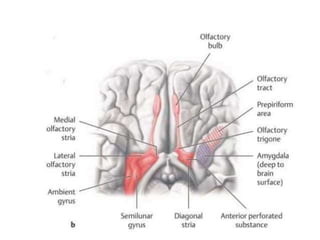
CRANIAL NERVE1
OLFACTORY
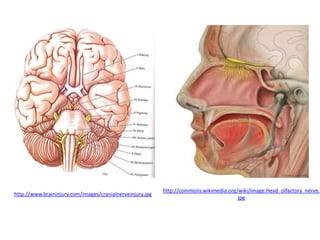
http://commons.wikimedia.org/wiki/Image:Head_olfactory_nerve.
jpg
http://www.braininjury.com/images/cranialnerveinjury.jpg
Cranial Nerve1
Olfaction
• Not tested much unless a frontal lobe
tumor is suspected
• Test by asking if patients can smell:
Hing;coffee;vanilla; cloves;peppermint or
cinnamon in each nostril. Avoid noxious
odors ( ie NH3 )
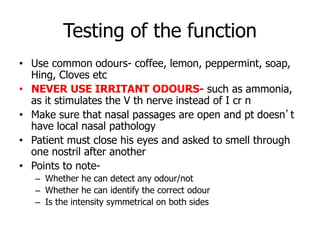
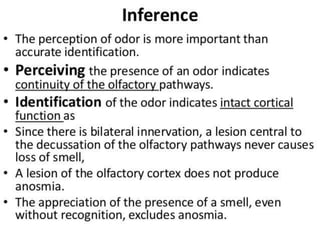
Testing of the function
• Use common odours- coffee, lemon, peppermint, soap,
Hing, Cloves etc
• NEVER USE IRRITANT ODOURS- such as ammonia,
as it stimulates the V th nerve instead of I cr n
• Make sure that nasal passages are open and pt doesn’t
have local nasal pathology
• Patient must close his eyes and asked to smell through
one nostril after another
• Points to note-
– Whether he can detect any odour/not
– Whether he can identify the correct odour
– Is the intensity symmetrical on both sides
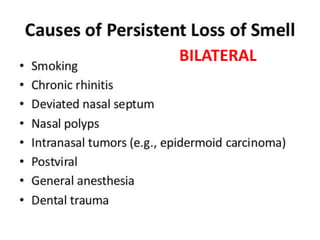
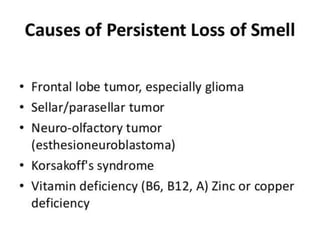
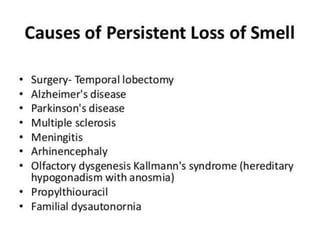
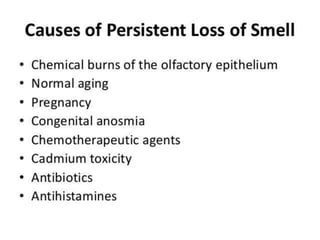
BILATERAL VS UNILATERAL ANOSMIA
Bilateral anosmia is more
common than unilateral, and has
more diverse causes - a variety of
conditions can lead to complete
loss of the sense of smell.
UNILATERAL ANOSMIA
one-sided loss of the sense of smell, is less
common than the bilateral lesion and is less
commonly detected by the routine enquiry in a
neurological examination. However, once
diagnosed there are relatively few causes which
ought to be investigated.
Possible unilateral causes of anosmia include:
1.Head trauma
2.Frontal lobe lesion - e.g. meningioma of the
olfactory groove - an early manifestation.
BILATERAL
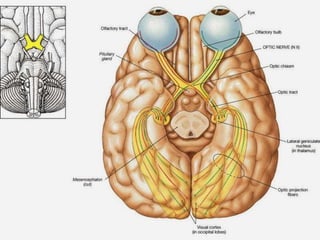
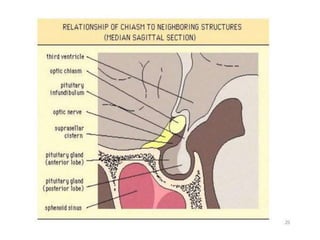
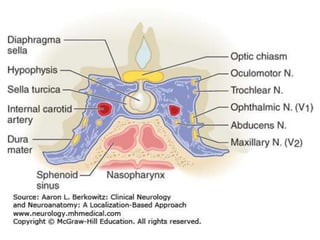
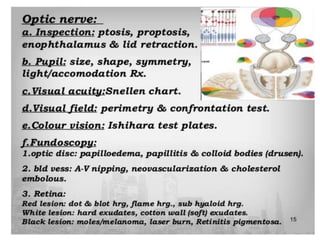
CRANIAL NERVE 2
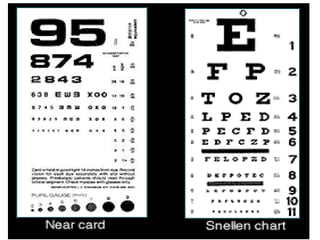
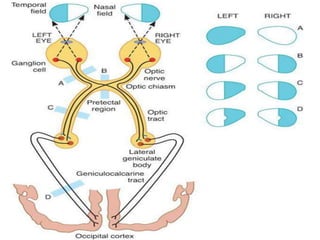
OPTIC NERVE
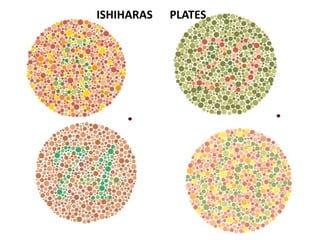
ISHIHARAS PLATES
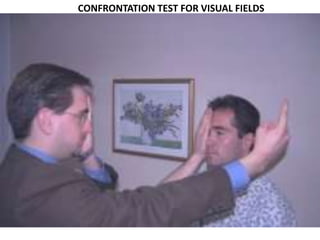
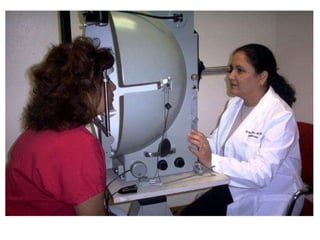
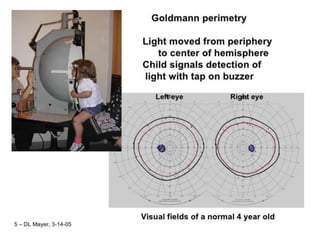
CONFRONTATION TEST FOR VISUAL FIELDS
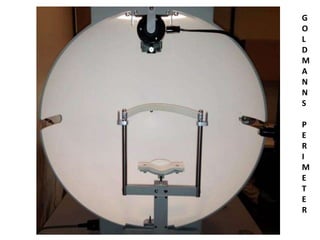
G
O
L
D
M
A
N
N
S
P
E
R
I
M
E
T
E
R
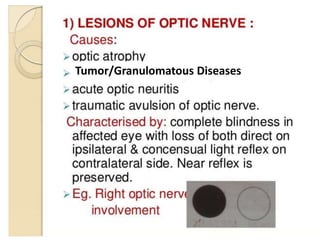
Tumor/Granulomatous Diseases
Meningitis
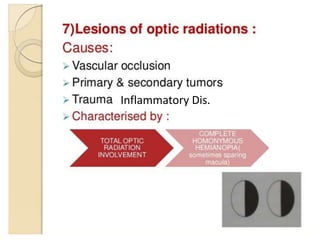
Inflammatory Dis.
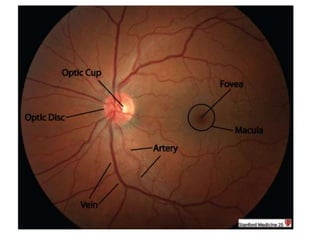
FUNDOSCOPY
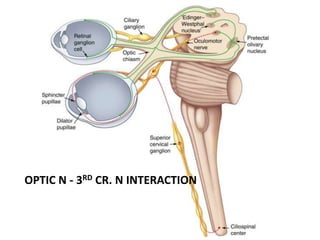
OPTIC N - 3RD CR. N INTERACTION
Cranial Nerve 2 and 3
Pupillary responses
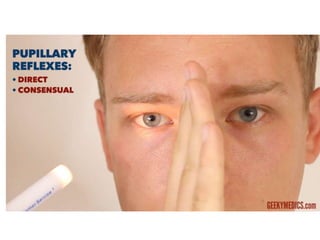
•The size and shape of the pupil should be recorded at rest.
Under normal conditions, the pupil constricts in response to
light. Note the direct response, meaning constriction of the
illuminated pupil, as well as the consensual response,
meaning constriction of the opposite pupil.
•Test the pupillary response to accommodation. Normally,
the pupils constrict while fixating on an object being moved
from far away to near the eyes.
•Direct response (pupil illuminated). The direct response is
impaired in lesions of the ipsilateral optic nerve, the
pretectal area, the ipsilateral parasympathetics traveling in
CN III, or the pupillary constrictor muscle of the iris.
http://www.neuroexam.com/
Cranial Nerve 2 and 3
Pupillary responses
•Consensual response (contralateral pupil illuminated). The
consensual response is impaired in lesions of the
contralateral optic nerve, the pretectal area, the ipsilateral
parasympathetics traveling in CN III, or the pupillary
constrictor muscle.
•Accommodation (response to looking at something moving
toward the eye). Accommodation is impaired in lesions of
the ipsilateral optic nerve, the ipsilateral parasympathetics
traveling in CN III, or the pupillary constrictor muscle, or in
bilateral lesions of the pathways from the optic tracts to the
visual cortex. Accommodation is relatively spared wrt Light
Rf. – ARP; DM; Multiple Sclerosis.
http://www.neuroexam.com/
CRANIAL NERVES
3,4,6
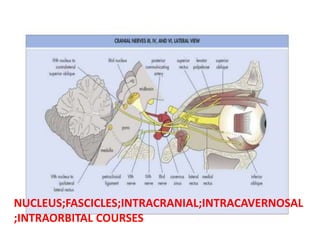
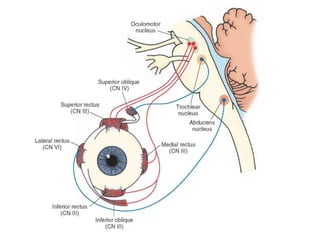
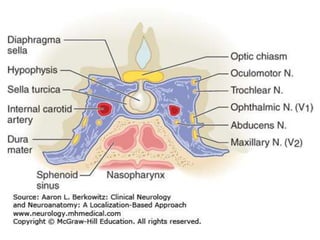
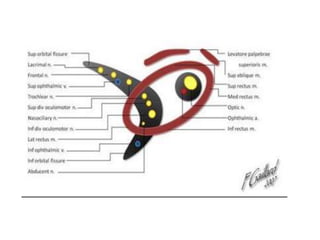
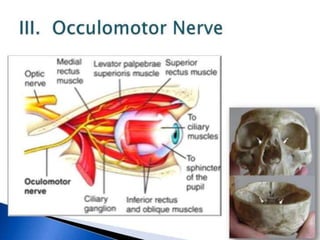
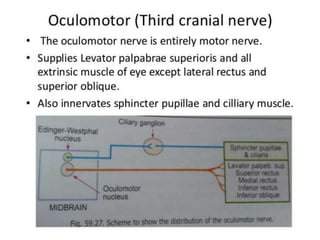
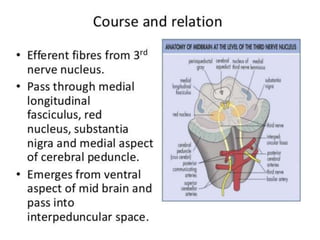
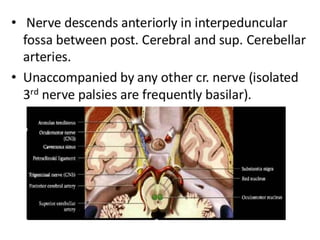
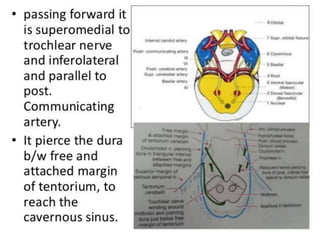
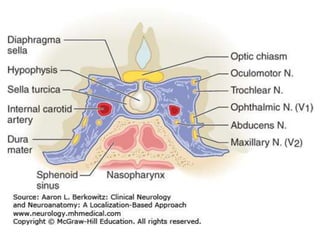
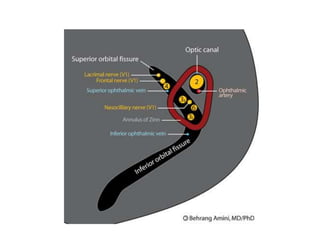
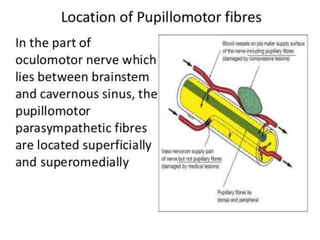
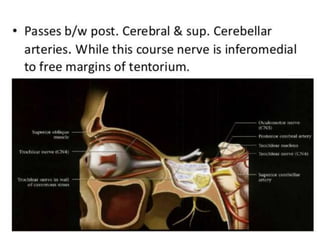
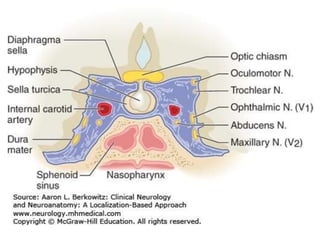
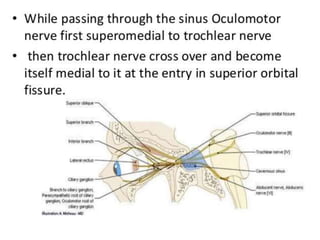
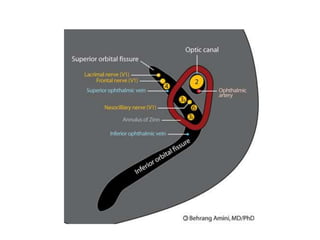
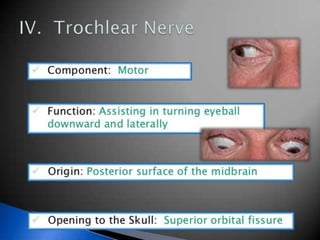
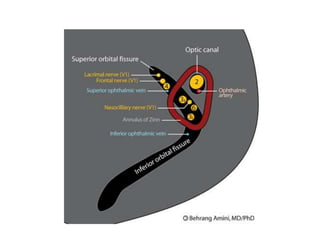
NUCLEUS;FASCICLES;INTRACRANIAL;INTRACAVERNOSAL
;INTRAORBITAL COURSES
Cranial Nerve 3,4,6
Extraocular Movements
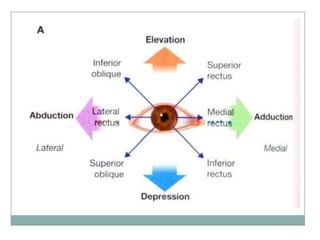
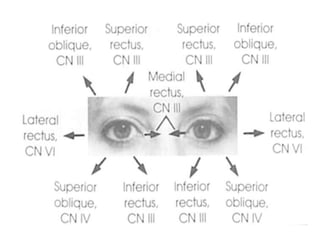
•Observe the eyes at rest to see if there are any abnormalities
such as spontaneous nystagmus (see below)or dysconjugate
gaze (eyes not both fixated on the same point) resulting in
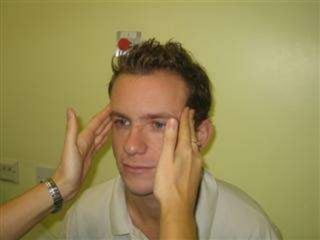
diplopia (double vision)
•Test smooth pursuit by having the patient follow an object
moved across their full range of horizontal and vertical eye
movements. Test convergence movements by having the
patient fixate on an object as it is moved slowly towards a point
right between the patient's eyes
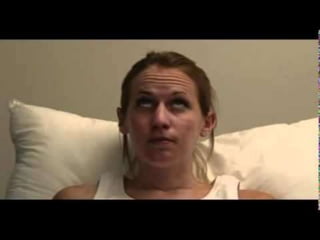
•In comatose or severely lethargic patients, the vestibulo-ocular
reflex can be used to test whether brainstem eye movement
pathways are intact. The oculocephalic reflex, a form of the
vestibulo-ocular reflex, is tested by holding the eyes open and
rotating the head from side to side or up and down
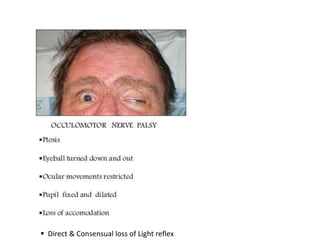
 Direct & Consensual loss of Light reflex
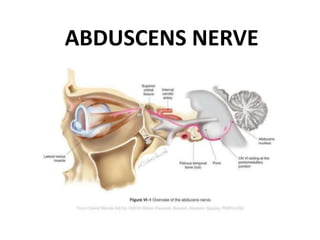
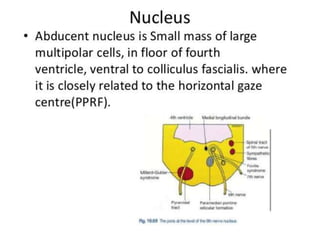
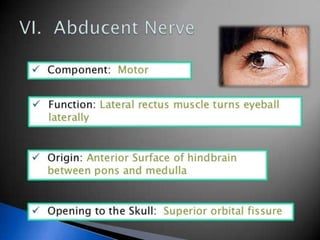
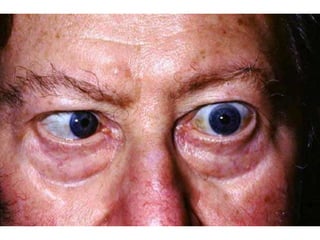
ABDUSCENS NERVE
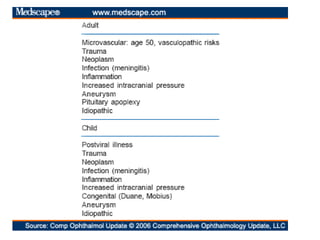
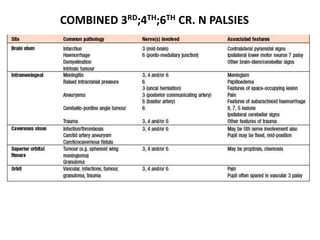
COMBINED 3RD;4TH;6TH CR. N PALSIES
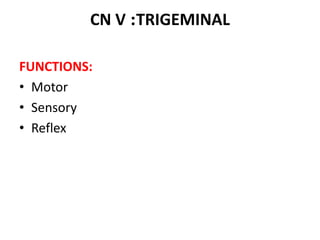
FUNCTIONS:
• Motor
• Sensory
• Reflex
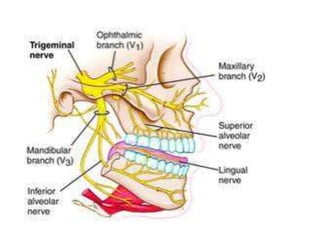
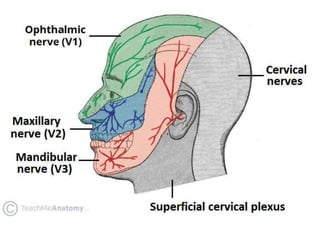
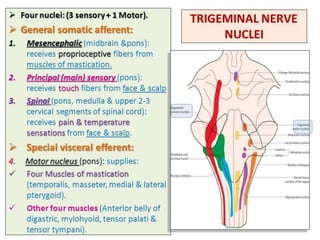
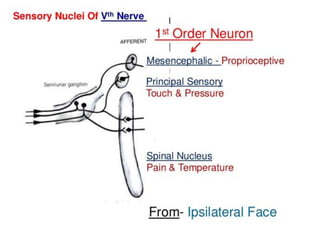
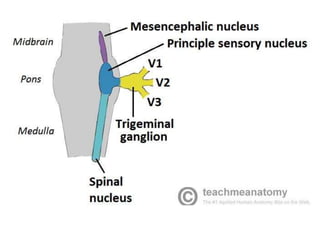
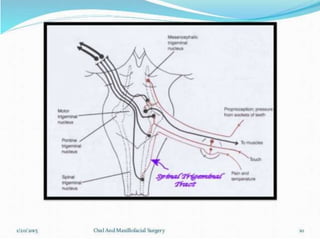
CN V :TRIGEMINAL
Cranial Nerve 5
Facial Sensation and Muscles of Mastication
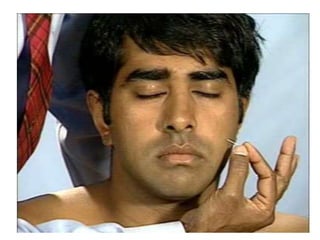
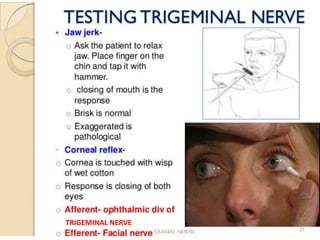
•Test facial sensation using a cotton wisp and a
sharp object. Also test for tactile extinction
using double simultaneous stimulation.
•The corneal reflex, which involves both CN 5
and CN 7, is tested by touching each cornea
gently with a cotton wisp and observing any
asymmetries in the blink response.
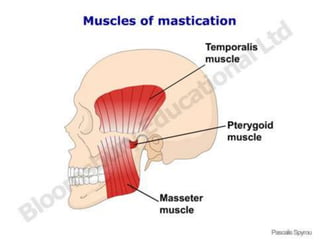
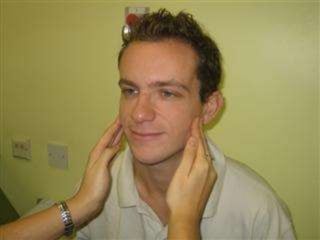
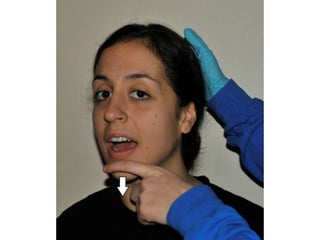
•Feel the masseter muscles during jaw clench.
Test for a jaw jerk reflex by gently tapping on
the jaw with the mouth slightly open.
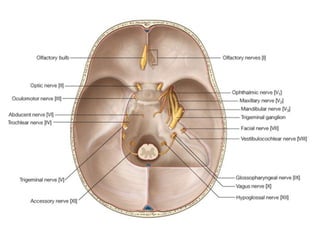
TRIGEMINAL NERVE
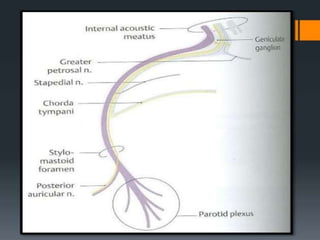
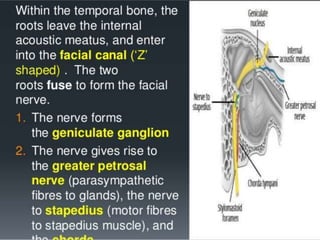
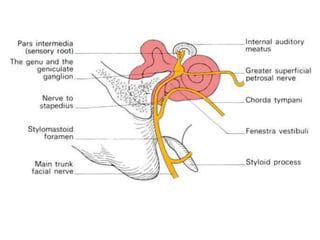
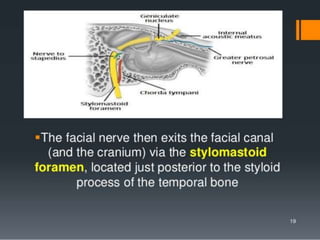
VIITH CRANIAL NERVE
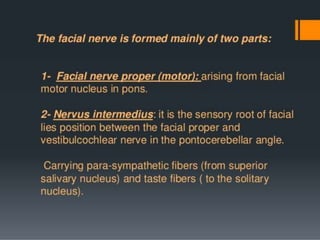
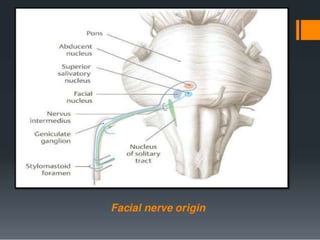
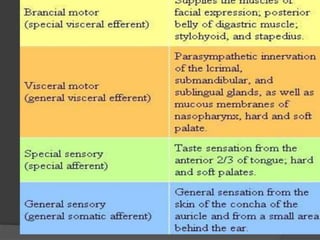
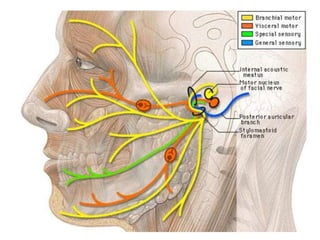
Cranial Nerve 7
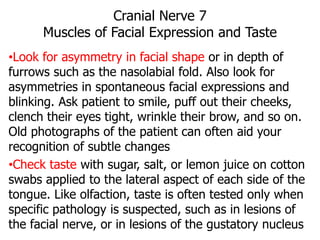
Muscles of Facial Expression and Taste
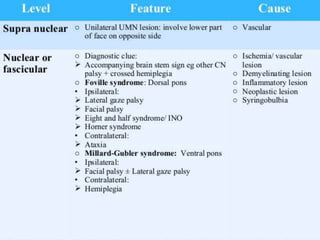
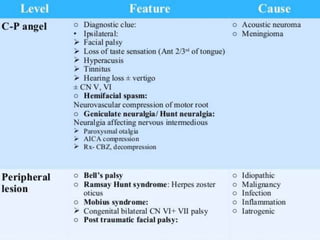
•Look for asymmetry in facial shape or in depth of
furrows such as the nasolabial fold. Also look for
asymmetries in spontaneous facial expressions and
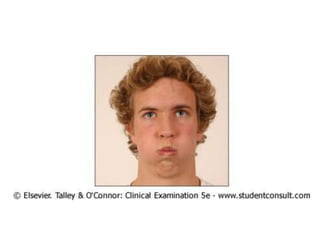
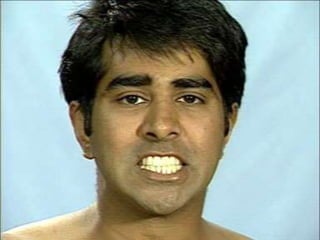
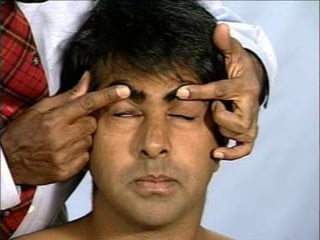
blinking. Ask patient to smile, puff out their cheeks,
clench their eyes tight, wrinkle their brow, and so on.
Old photographs of the patient can often aid your
recognition of subtle changes
•Check taste with sugar, salt, or lemon juice on cotton
swabs applied to the lateral aspect of each side of the
tongue. Like olfaction, taste is often tested only when
specific pathology is suspected, such as in lesions of
the facial nerve, or in lesions of the gustatory nucleus
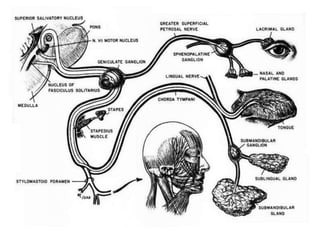
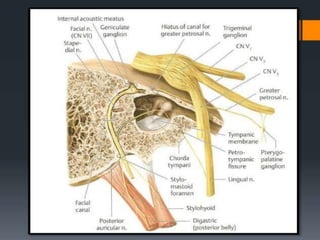
Cranial Nerve 7
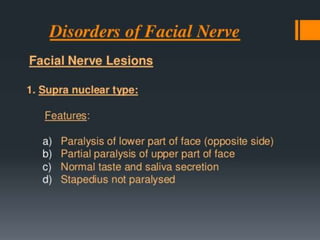
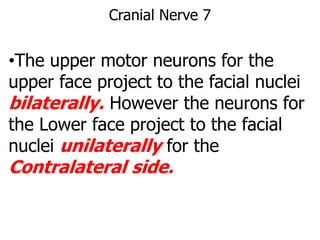
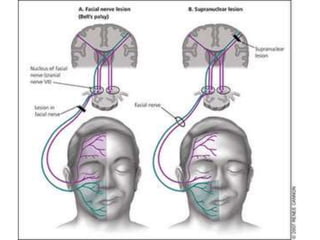
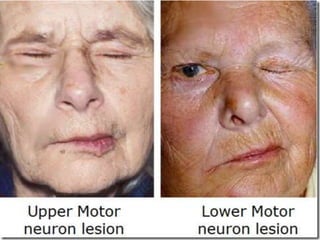
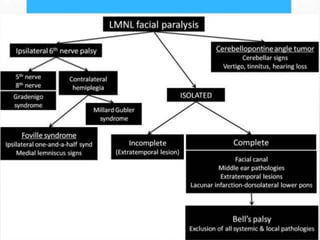
•The upper motor neurons for the
upper face project to the facial nuclei
bilaterally. However the neurons for
the Lower face project to the facial
nuclei unilaterally for the
Contralateral side.
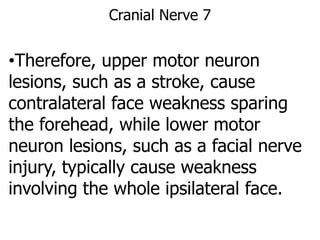
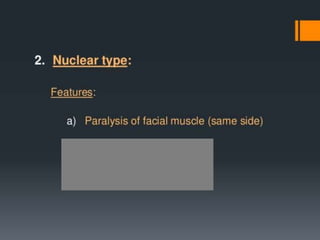
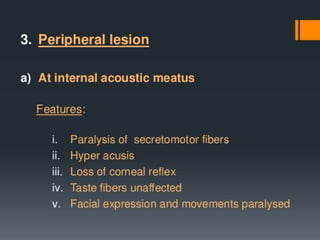
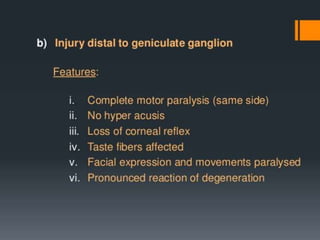
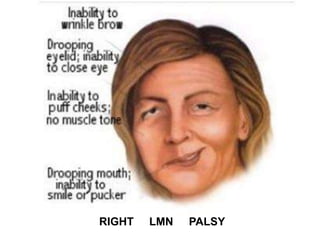
Cranial Nerve 7
•Therefore, upper motor neuron
lesions, such as a stroke, cause
contralateral face weakness sparing
the forehead, while lower motor
neuron lesions, such as a facial nerve
injury, typically cause weakness
involving the whole ipsilateral face.
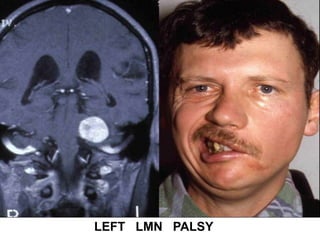
RIGHT LMN PALSY
LEFT LMN PALSY
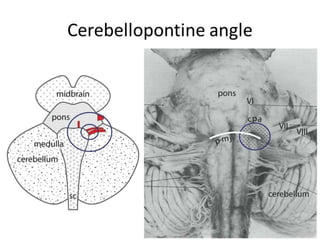
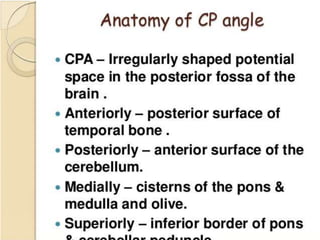
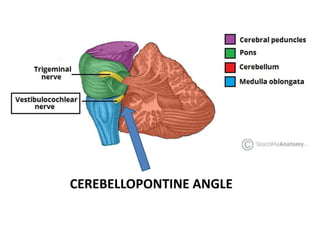
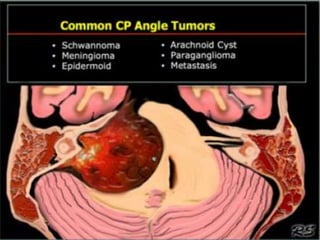
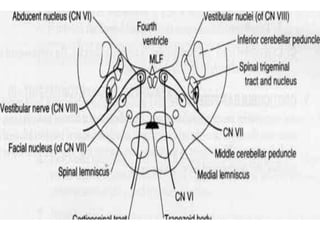
CEREBELLOPONTINE ANGLE
VIIITH CRANIAL NERVE
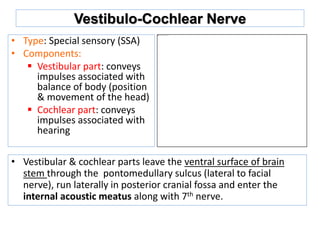
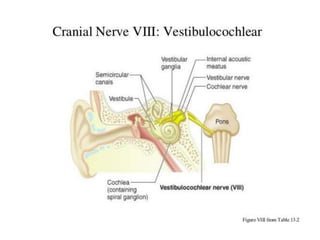
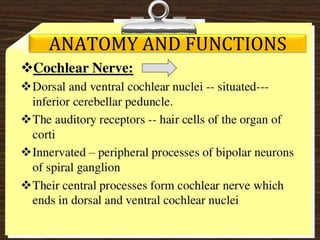
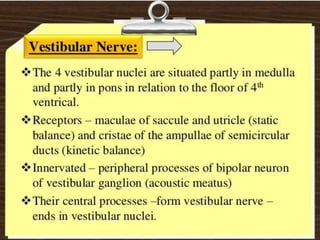
Vestibulo-Cochlear Nerve
• Type: Special sensory (SSA)
• Components:
 Vestibular part: conveys
impulses associated with
balance of body (position
& movement of the head)
 Cochlear part: conveys
impulses associated with
hearing
• Vestibular & cochlear parts leave the ventral surface of brain
stem through the pontomedullary sulcus (lateral to facial
nerve), run laterally in posterior cranial fossa and enter the
internal acoustic meatus along with 7th nerve.
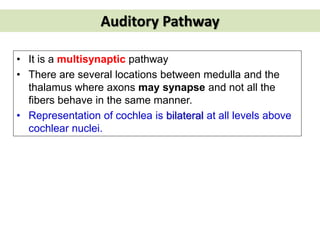
Auditory Pathway
• It is a multisynaptic pathway
• There are several locations between medulla and the
thalamus where axons may synapse and not all the
fibers behave in the same manner.
• Representation of cochlea is bilateral at all levels above
cochlear nuclei.
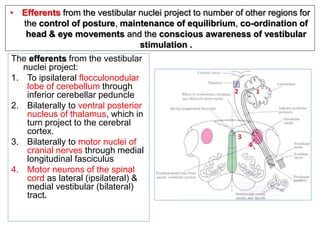
The efferents from the vestibular
nuclei project:
1. To ipsilateral flocculonodular
lobe of cerebellum through
inferior cerebellar peduncle
2. Bilaterally to ventral posterior
nucleus of thalamus, which in
turn project to the cerebral
cortex.
3. Bilaterally to motor nuclei of
cranial nerves through medial
longitudinal fasciculus
4. Motor neurons of the spinal
cord as lateral (ipsilateral) &
medial vestibular (bilateral)
tract.
2
4
3
1
• Efferents from the vestibular nuclei project to number of other regions for
the control of posture, maintenance of equilibrium, co-ordination of
head & eye movements and the conscious awareness of vestibular
stimulation .
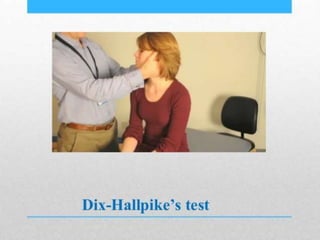
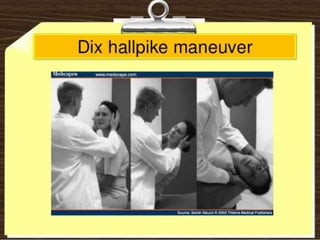
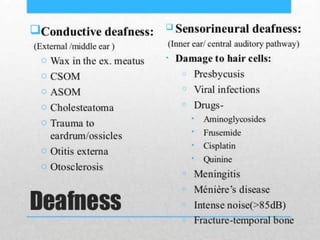
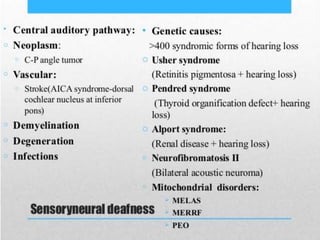
Cranial Nerve 8
Hearing and Balance
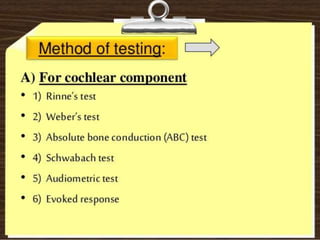
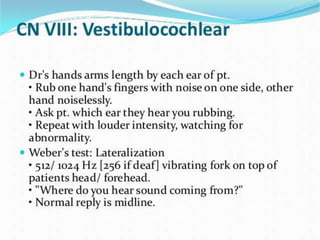
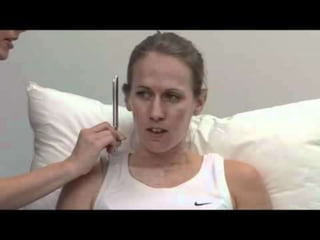
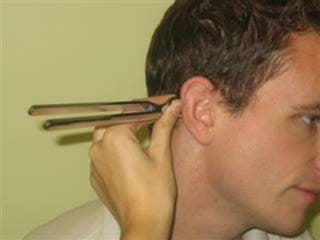
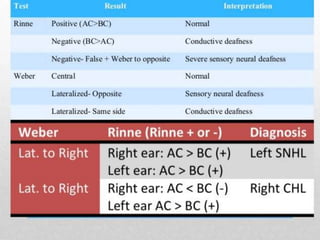
•Test to see can the patient hear fingers rubbed together or
words whispered just outside of the auditory canal and identify
which ear hears the sound? A tuning fork can be used to
perform the Weber and Rinne test to evaluate sensorineural
and conductive hearing loss respectively
•Hearing loss can be caused by lesions in the acoustic and
mechanical elements of the ear, the neural elements of the
cochlea, or the acoustic nerve (CN VIII). After the hearing
pathways enter the brainstem, they cross over at multiple
levels and ascend bilaterally to the thalamus and auditory
cortex. Therefore, clinically significant unilateral hearing loss is
invariably caused by peripheral neural or mechanical lesions.
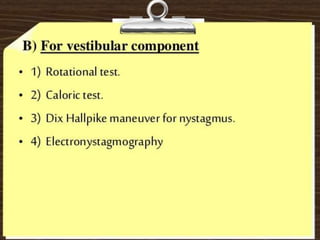
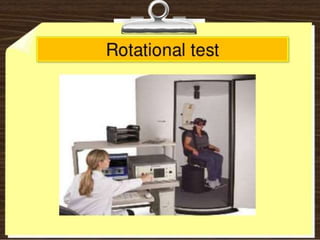
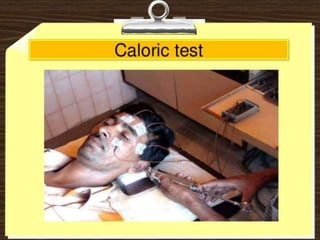
•Vestibular testing is not done routinely.
http://www.neuroexam.com/
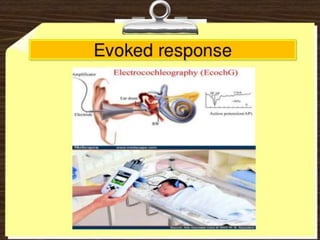
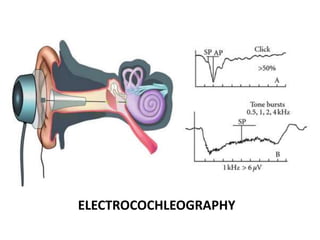
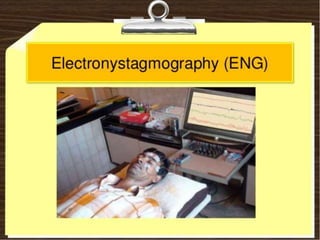
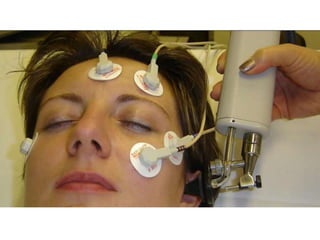
ELECTROCOCHLEOGRAPHY
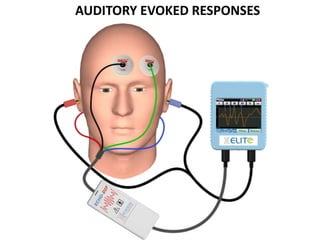
AUDITORY EVOKED RESPONSES
IX AND X CRANIAL NERVES
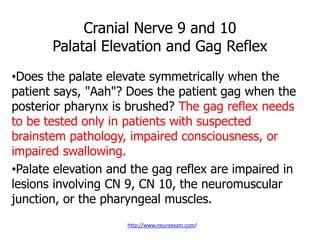
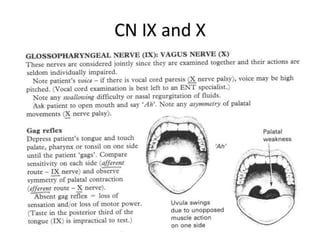
Cranial Nerve 9 and 10
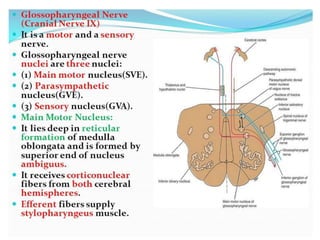
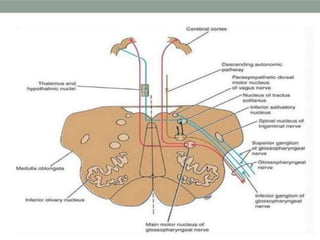
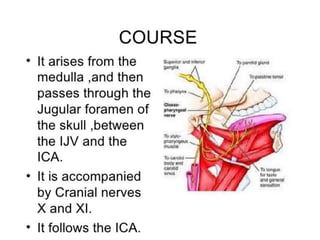
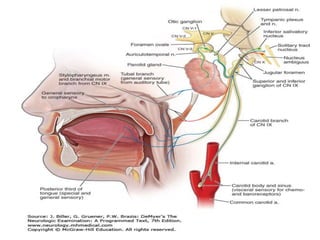
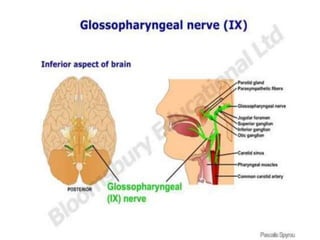
Palatal Elevation and Gag Reflex
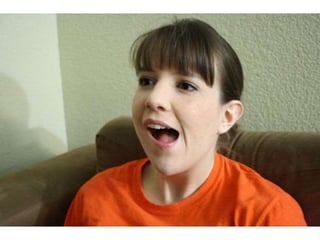
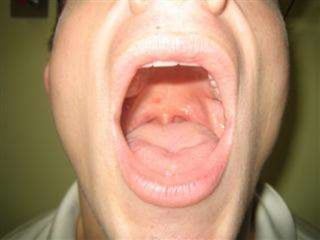
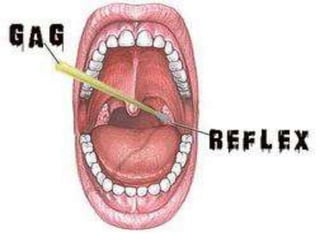
•Does the palate elevate symmetrically when the
patient says, "Aah"? Does the patient gag when the
posterior pharynx is brushed? The gag reflex needs
to be tested only in patients with suspected
brainstem pathology, impaired consciousness, or
impaired swallowing.
•Palate elevation and the gag reflex are impaired in
lesions involving CN 9, CN 10, the neuromuscular
junction, or the pharyngeal muscles.
http://www.neuroexam.com/
IX AND X NERVES
IONS
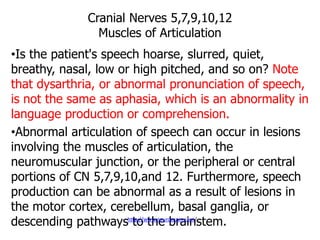
Cranial Nerves 5,7,9,10,12
Muscles of Articulation
•Is the patient's speech hoarse, slurred, quiet,
breathy, nasal, low or high pitched, and so on? Note
that dysarthria, or abnormal pronunciation of speech,
is not the same as aphasia, which is an abnormality in
language production or comprehension.
•Abnormal articulation of speech can occur in lesions
involving the muscles of articulation, the
neuromuscular junction, or the peripheral or central
portions of CN 5,7,9,10,and 12. Furthermore, speech
production can be abnormal as a result of lesions in
the motor cortex, cerebellum, basal ganglia, or
descending pathways to the brainstem.http://www.neuroexam.com/
CRANIAL NERVE XI
Cranial Nerve11
Sternocleidomastoid and Trapezius
Muscles
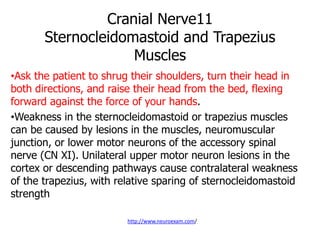
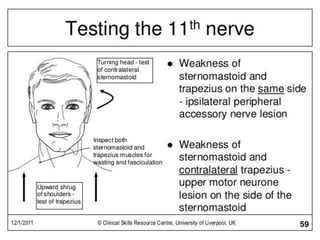
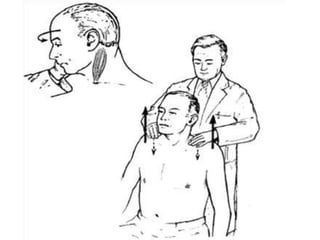
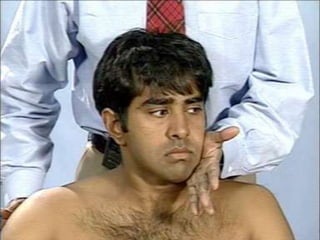
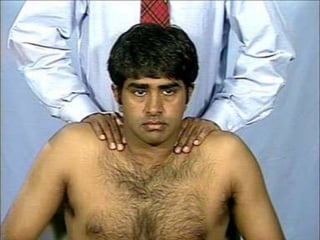
•Ask the patient to shrug their shoulders, turn their head in
both directions, and raise their head from the bed, flexing
forward against the force of your hands.
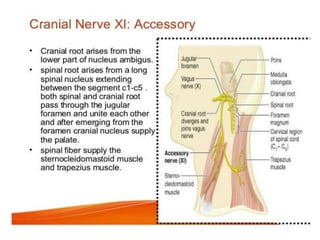
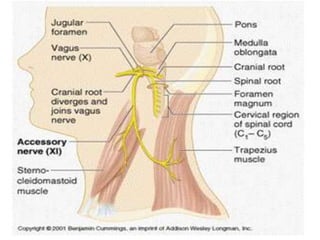
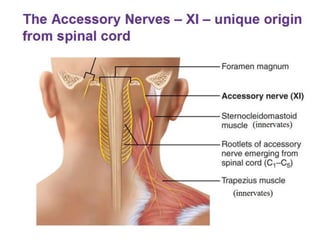
•Weakness in the sternocleidomastoid or trapezius muscles
can be caused by lesions in the muscles, neuromuscular
junction, or lower motor neurons of the accessory spinal
nerve (CN XI). Unilateral upper motor neuron lesions in the
cortex or descending pathways cause contralateral weakness
of the trapezius, with relative sparing of sternocleidomastoid
strength
http://www.neuroexam.com/
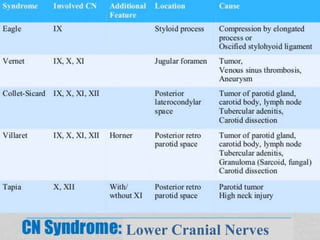
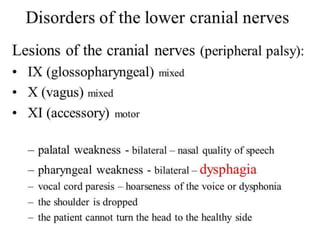
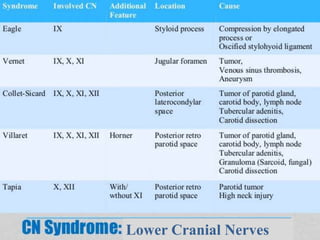
Lower Cranial Nerves
CRANIAL NERVE XII
[LAST:”THANK GOD”]
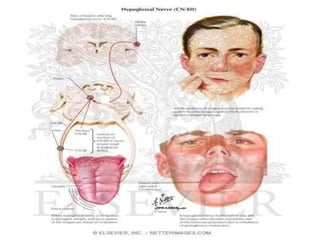
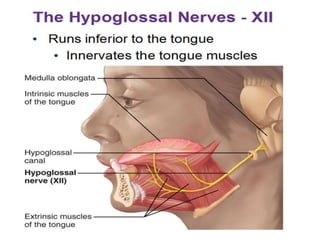
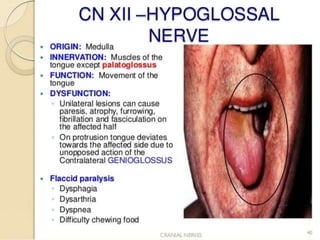
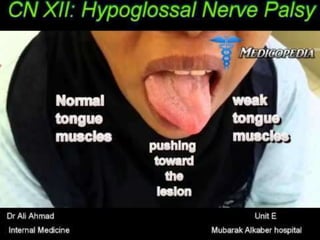
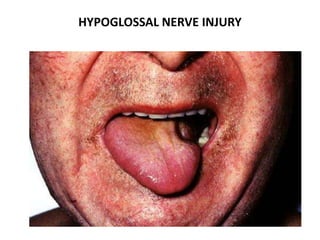
Cranial Nerve12
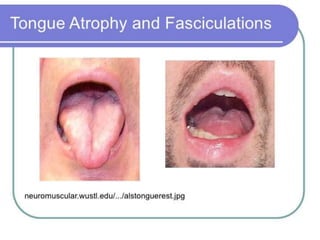
•Note any atrophy or fasciculations (spontaneous quivering
movements caused by firing of muscle motor units) of the
tongue while it is resting on the floor of the mouth. Ask the
patient to stick their tongue straight out and note whether it
curves to one side or the other. Ask the patient to move their
tongue from side to side and push it forcefully against the
inside of each cheek
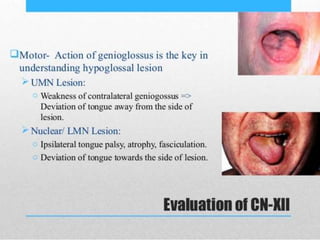
•Fasciculations and atrophy are signs of lower motor neuron
lesions. Unilateral tongue weakness causes the tongue to
deviate toward the weak side. Tongue weakness can result
from lesions of the tongue muscles, the neuromuscular
junction, the lower motor neurons of the hypoglossal nerve
(CN XII), or the upper motor neurons originating in the motor
cortex. Lesions of the motor cortex cause contralateral tongue
weakness.
http://www.neuroexam.com/
HYPOGLOSSAL NERVE INJURY
Lower Cranial Nerves
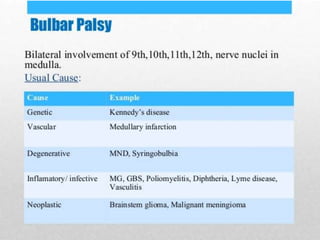
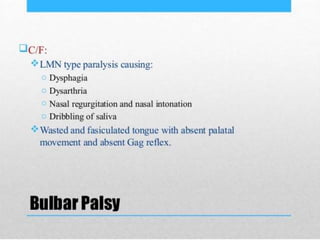
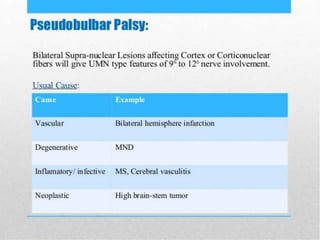
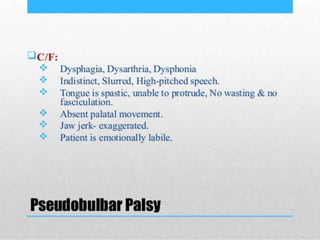
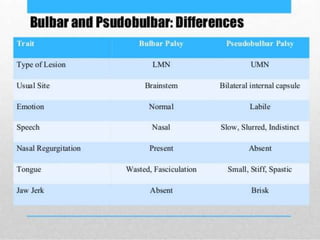
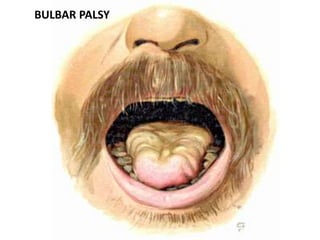
BULBAR PALSY
FINISH,
FINIS,FINITO,TERMINAR,FINITURA,
FERTIG

Cranial nerves

  • 1.
  • 2.
    PRELIMINARY • Adequate Lighting/Exposure[Screenif required] • Comfort Patient • Hand Wash/Rub; All equipment ready • Explain testing procedure before • Consent • Be Gentle
  • 3.
    ONE SUGGESTED APPROACH •SUPRANUCLEAR Vs NUCLEAR/INFRANUC. • FOR NUC/INFRANUC. VISUALISE LOCATION OF NUCLEUS; FASCICLES; INTRACRANIAL COURSE; FINAL DESTINATION. • COMBINATIONS WITH OTHER NEUROLOGIC TRACTS HELP IN HOMING ON SITE OF DISORDER.
  • 4.
  • 5.
  • 9.
    Cranial Nerve1 Olfaction • Nottested much unless a frontal lobe tumor is suspected • Test by asking if patients can smell: Hing;coffee;vanilla; cloves;peppermint or cinnamon in each nostril. Avoid noxious odors ( ie NH3 )
  • 10.
    Testing of thefunction • Use common odours- coffee, lemon, peppermint, soap, Hing, Cloves etc • NEVER USE IRRITANT ODOURS- such as ammonia, as it stimulates the V th nerve instead of I cr n • Make sure that nasal passages are open and pt doesn’t have local nasal pathology • Patient must close his eyes and asked to smell through one nostril after another • Points to note- – Whether he can detect any odour/not – Whether he can identify the correct odour – Is the intensity symmetrical on both sides
  • 12.
    BILATERAL VS UNILATERALANOSMIA Bilateral anosmia is more common than unilateral, and has more diverse causes - a variety of conditions can lead to complete loss of the sense of smell.
  • 13.
    UNILATERAL ANOSMIA one-sided lossof the sense of smell, is less common than the bilateral lesion and is less commonly detected by the routine enquiry in a neurological examination. However, once diagnosed there are relatively few causes which ought to be investigated. Possible unilateral causes of anosmia include: 1.Head trauma 2.Frontal lobe lesion - e.g. meningioma of the olfactory groove - an early manifestation.
  • 14.
  • 19.
  • 27.
  • 28.
  • 29.
  • 33.
  • 37.
  • 38.
  • 41.
  • 43.
    OPTIC N -3RD CR. N INTERACTION
  • 44.
    Cranial Nerve 2and 3 Pupillary responses •The size and shape of the pupil should be recorded at rest. Under normal conditions, the pupil constricts in response to light. Note the direct response, meaning constriction of the illuminated pupil, as well as the consensual response, meaning constriction of the opposite pupil. •Test the pupillary response to accommodation. Normally, the pupils constrict while fixating on an object being moved from far away to near the eyes. •Direct response (pupil illuminated). The direct response is impaired in lesions of the ipsilateral optic nerve, the pretectal area, the ipsilateral parasympathetics traveling in CN III, or the pupillary constrictor muscle of the iris. http://www.neuroexam.com/
  • 45.
    Cranial Nerve 2and 3 Pupillary responses •Consensual response (contralateral pupil illuminated). The consensual response is impaired in lesions of the contralateral optic nerve, the pretectal area, the ipsilateral parasympathetics traveling in CN III, or the pupillary constrictor muscle. •Accommodation (response to looking at something moving toward the eye). Accommodation is impaired in lesions of the ipsilateral optic nerve, the ipsilateral parasympathetics traveling in CN III, or the pupillary constrictor muscle, or in bilateral lesions of the pathways from the optic tracts to the visual cortex. Accommodation is relatively spared wrt Light Rf. – ARP; DM; Multiple Sclerosis. http://www.neuroexam.com/
  • 47.
  • 48.
  • 54.
    Cranial Nerve 3,4,6 ExtraocularMovements •Observe the eyes at rest to see if there are any abnormalities such as spontaneous nystagmus (see below)or dysconjugate gaze (eyes not both fixated on the same point) resulting in diplopia (double vision) •Test smooth pursuit by having the patient follow an object moved across their full range of horizontal and vertical eye movements. Test convergence movements by having the patient fixate on an object as it is moved slowly towards a point right between the patient's eyes •In comatose or severely lethargic patients, the vestibulo-ocular reflex can be used to test whether brainstem eye movement pathways are intact. The oculocephalic reflex, a form of the vestibulo-ocular reflex, is tested by holding the eyes open and rotating the head from side to side or up and down
  • 65.
     Direct &Consensual loss of Light reflex
  • 78.
  • 89.
  • 90.
    FUNCTIONS: • Motor • Sensory •Reflex CN V :TRIGEMINAL
  • 99.
    Cranial Nerve 5 FacialSensation and Muscles of Mastication •Test facial sensation using a cotton wisp and a sharp object. Also test for tactile extinction using double simultaneous stimulation. •The corneal reflex, which involves both CN 5 and CN 7, is tested by touching each cornea gently with a cotton wisp and observing any asymmetries in the blink response. •Feel the masseter muscles during jaw clench. Test for a jaw jerk reflex by gently tapping on the jaw with the mouth slightly open.
  • 106.
  • 109.
  • 125.
    Cranial Nerve 7 Musclesof Facial Expression and Taste •Look for asymmetry in facial shape or in depth of furrows such as the nasolabial fold. Also look for asymmetries in spontaneous facial expressions and blinking. Ask patient to smile, puff out their cheeks, clench their eyes tight, wrinkle their brow, and so on. Old photographs of the patient can often aid your recognition of subtle changes •Check taste with sugar, salt, or lemon juice on cotton swabs applied to the lateral aspect of each side of the tongue. Like olfaction, taste is often tested only when specific pathology is suspected, such as in lesions of the facial nerve, or in lesions of the gustatory nucleus
  • 131.
    Cranial Nerve 7 •Theupper motor neurons for the upper face project to the facial nuclei bilaterally. However the neurons for the Lower face project to the facial nuclei unilaterally for the Contralateral side.
  • 132.
    Cranial Nerve 7 •Therefore,upper motor neuron lesions, such as a stroke, cause contralateral face weakness sparing the forehead, while lower motor neuron lesions, such as a facial nerve injury, typically cause weakness involving the whole ipsilateral face.
  • 137.
  • 138.
  • 143.
  • 149.
  • 150.
    Vestibulo-Cochlear Nerve • Type:Special sensory (SSA) • Components:  Vestibular part: conveys impulses associated with balance of body (position & movement of the head)  Cochlear part: conveys impulses associated with hearing • Vestibular & cochlear parts leave the ventral surface of brain stem through the pontomedullary sulcus (lateral to facial nerve), run laterally in posterior cranial fossa and enter the internal acoustic meatus along with 7th nerve.
  • 153.
    Auditory Pathway • Itis a multisynaptic pathway • There are several locations between medulla and the thalamus where axons may synapse and not all the fibers behave in the same manner. • Representation of cochlea is bilateral at all levels above cochlear nuclei.
  • 156.
    The efferents fromthe vestibular nuclei project: 1. To ipsilateral flocculonodular lobe of cerebellum through inferior cerebellar peduncle 2. Bilaterally to ventral posterior nucleus of thalamus, which in turn project to the cerebral cortex. 3. Bilaterally to motor nuclei of cranial nerves through medial longitudinal fasciculus 4. Motor neurons of the spinal cord as lateral (ipsilateral) & medial vestibular (bilateral) tract. 2 4 3 1 • Efferents from the vestibular nuclei project to number of other regions for the control of posture, maintenance of equilibrium, co-ordination of head & eye movements and the conscious awareness of vestibular stimulation .
  • 160.
    Cranial Nerve 8 Hearingand Balance •Test to see can the patient hear fingers rubbed together or words whispered just outside of the auditory canal and identify which ear hears the sound? A tuning fork can be used to perform the Weber and Rinne test to evaluate sensorineural and conductive hearing loss respectively •Hearing loss can be caused by lesions in the acoustic and mechanical elements of the ear, the neural elements of the cochlea, or the acoustic nerve (CN VIII). After the hearing pathways enter the brainstem, they cross over at multiple levels and ascend bilaterally to the thalamus and auditory cortex. Therefore, clinically significant unilateral hearing loss is invariably caused by peripheral neural or mechanical lesions. •Vestibular testing is not done routinely. http://www.neuroexam.com/
  • 168.
  • 169.
  • 179.
    IX AND XCRANIAL NERVES
  • 191.
    Cranial Nerve 9and 10 Palatal Elevation and Gag Reflex •Does the palate elevate symmetrically when the patient says, "Aah"? Does the patient gag when the posterior pharynx is brushed? The gag reflex needs to be tested only in patients with suspected brainstem pathology, impaired consciousness, or impaired swallowing. •Palate elevation and the gag reflex are impaired in lesions involving CN 9, CN 10, the neuromuscular junction, or the pharyngeal muscles. http://www.neuroexam.com/
  • 195.
    IX AND XNERVES IONS
  • 198.
    Cranial Nerves 5,7,9,10,12 Musclesof Articulation •Is the patient's speech hoarse, slurred, quiet, breathy, nasal, low or high pitched, and so on? Note that dysarthria, or abnormal pronunciation of speech, is not the same as aphasia, which is an abnormality in language production or comprehension. •Abnormal articulation of speech can occur in lesions involving the muscles of articulation, the neuromuscular junction, or the peripheral or central portions of CN 5,7,9,10,and 12. Furthermore, speech production can be abnormal as a result of lesions in the motor cortex, cerebellum, basal ganglia, or descending pathways to the brainstem.http://www.neuroexam.com/
  • 199.
  • 203.
    Cranial Nerve11 Sternocleidomastoid andTrapezius Muscles •Ask the patient to shrug their shoulders, turn their head in both directions, and raise their head from the bed, flexing forward against the force of your hands. •Weakness in the sternocleidomastoid or trapezius muscles can be caused by lesions in the muscles, neuromuscular junction, or lower motor neurons of the accessory spinal nerve (CN XI). Unilateral upper motor neuron lesions in the cortex or descending pathways cause contralateral weakness of the trapezius, with relative sparing of sternocleidomastoid strength http://www.neuroexam.com/
  • 208.
  • 210.
  • 214.
    Cranial Nerve12 •Note anyatrophy or fasciculations (spontaneous quivering movements caused by firing of muscle motor units) of the tongue while it is resting on the floor of the mouth. Ask the patient to stick their tongue straight out and note whether it curves to one side or the other. Ask the patient to move their tongue from side to side and push it forcefully against the inside of each cheek •Fasciculations and atrophy are signs of lower motor neuron lesions. Unilateral tongue weakness causes the tongue to deviate toward the weak side. Tongue weakness can result from lesions of the tongue muscles, the neuromuscular junction, the lower motor neurons of the hypoglossal nerve (CN XII), or the upper motor neurons originating in the motor cortex. Lesions of the motor cortex cause contralateral tongue weakness. http://www.neuroexam.com/
  • 217.
  • 221.
  • 227.
  • 229.