Do something amazing... Give blood http://www.blood.co.uk/
Learning outcomes Describe the conditions that blood for transfusion is stored in. Explain how pH and temperature changes effect enzyme activity in  blood for transfusion Make links between calcium ion removal and blood storage
Key terms Buffer solution - maintains constant pH  Isotonic - same  water potential  (as cytoplasm)
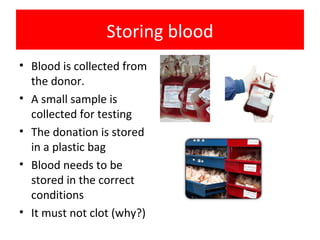
Storing blood Blood is collected from the donor. A small sample is collected for testing The donation is stored in a plastic bag Blood needs to be stored in the correct conditions It must not clot (why?)
Why is blood stored at 4 o C ? Blood must be stored at temperatures low enough to prevent enzyme activity. Blood proteins (e.g. Haemoglobin) must not be allowed to denature If we freeze blood ice crystals would form inside the red blood cells, these would damage the cell membranes so the cells would be destroyed when the blood thawed out.
Why do we use a buffer solution? pH affects enzyme activity. pH measures how acid or alkaline a solution is. Proteins are held in their globular, tertiary structure by weak bonds.  These also rely on weak positive and negative charges. The more acid, the more H +  ions present.  These can effect the charges on the molecule.  This causes the weak bonds to break.  The enzymes tertiary structure is altered.  The active site is no longer the right shape for the substrate to fit into. = DENATURED
How do we stop blood from clotting? Co factors are substances that are needed for an enzyme controlled reaction to occur. Calcium ions are needed for blood clotting enzymes to work. Calcium ions are normally in blood plasma and are released from damaged platelets. To stop blood from clotting calcium ions need to be removed. An anticoagulant is used to remove the calcium ions, e.g. Sodium citrate

Blood storage

  • 1.
    Do something amazing...Give blood http://www.blood.co.uk/
  • 2.
    Learning outcomes Describethe conditions that blood for transfusion is stored in. Explain how pH and temperature changes effect enzyme activity in blood for transfusion Make links between calcium ion removal and blood storage
  • 3.
    Key terms Buffersolution - maintains constant pH Isotonic - same water potential (as cytoplasm)
  • 4.
    Storing blood Bloodis collected from the donor. A small sample is collected for testing The donation is stored in a plastic bag Blood needs to be stored in the correct conditions It must not clot (why?)
  • 5.
    Why is bloodstored at 4 o C ? Blood must be stored at temperatures low enough to prevent enzyme activity. Blood proteins (e.g. Haemoglobin) must not be allowed to denature If we freeze blood ice crystals would form inside the red blood cells, these would damage the cell membranes so the cells would be destroyed when the blood thawed out.
  • 6.
    Why do weuse a buffer solution? pH affects enzyme activity. pH measures how acid or alkaline a solution is. Proteins are held in their globular, tertiary structure by weak bonds. These also rely on weak positive and negative charges. The more acid, the more H + ions present. These can effect the charges on the molecule. This causes the weak bonds to break. The enzymes tertiary structure is altered. The active site is no longer the right shape for the substrate to fit into. = DENATURED
  • 7.
    How do westop blood from clotting? Co factors are substances that are needed for an enzyme controlled reaction to occur. Calcium ions are needed for blood clotting enzymes to work. Calcium ions are normally in blood plasma and are released from damaged platelets. To stop blood from clotting calcium ions need to be removed. An anticoagulant is used to remove the calcium ions, e.g. Sodium citrate