Revision Part 4 – final section
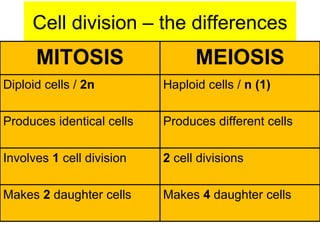
Cell division – the differences MITOSIS MEIOSIS Diploid cells /  2n Haploid cells /  n (1) Produces identical cells Produces different cells Involves  1  cell division 2  cell divisions Makes  2  daughter cells Makes  4  daughter cells
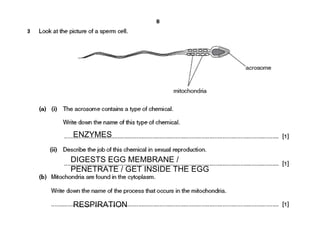
Sperm adaptations Acrosome  - contains enzymes to digest the egg cell membrane Tail – many mitochondria in cells to release energy. WHY
ENZYMES DIGESTS EGG MEMBRANE / PENETRATE / GET INSIDE THE EGG RESPIRATION
MITOSIS – DIPLOID CELLS (46 CHROMOSOMES) MEIOSIS – HAPLOID CELLS (23 CHROMOSOMES) MITOSIS – IDENTICAL CELLS MEIOSIS – DIFFERENT CELLS MITOSIS – 1 CELL DIVISIONS MEIOSIS – 2 CELL DIVISIONS MITOSIS 2 DAUGHTER CELLS MEIOSIS 4 DAUGHTER CELLS
DNA fingerprinting Isolate blood of cell sample Extract DNA Use restriction enzymes to fragment the DNA Place DNA fragments on gel Apply and separate fragments using an electric current (electrophoresis) Banding of DNA fingerprint can be matched.  
DNA is cut into fragments DNA FRAGMENTS SEPARATED / ELECTRIC CURRENT APPLIED / ELECTROPHORESIS
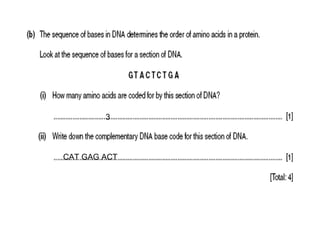
3 CAT GAG ACT
Plant cells and growth
Chloroplasts Cell Wall Vacuole Cell Membrane Nucleus Cytoplasm
Growth Plant Most growth is due to cells elongating (growing longer) not dividing Cell division only normally occurs at the tips of shoots and roots Many cells never lose the ability to differentiate Animal Growth is due to cells dividing Cell division occurs all over the body Most animal cells lose the ability to differentiate very early on
Plant hormones
 
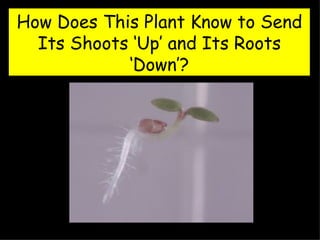
How Does This Plant Know to Send Its Shoots ‘Up’ and Its Roots ‘Down’?
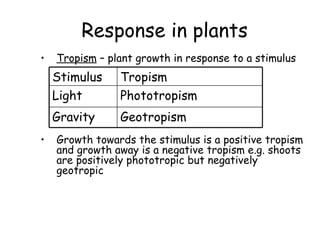
Response in plants  Tropism  – plant growth in response to a stimulus Growth towards the stimulus is a positive tropism and growth away is a negative tropism e.g. shoots are positively phototropic but negatively geotropic Stimulus Tropism Light Phototropism Gravity Geotropism
Artificial Use of Hormones
Artificial Use of Hormones Farmers use Artificial Hormones to increase their yield and to organise ripening times to suit their convenience There are 3 main types: Rooting Compound Ripening Hormone Selective Weed killers
 
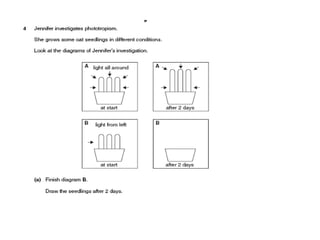
Auxin is made in the tip or top of plant The tip is covered so it doesn’t receive light Auxin levels are equal on both sides Both sides grow at the same rate
(1 mark) (1 mark)
(1 mark) (1 mark)
 
The Big Picture
Human growth – typical questions ? Graph analysis? Put the stages of human growth in the correct order, starting with the earliest: Adulthood (maturity) Childhood Infancy Old age Adolescence (puberty) What stage of growth are you in?
Mutations
What is a mutation? A mutation is a permanent change in the DNA sequence of a gene . Sometimes mutations in DNA can cause changes in the way a cell behaves. This is because genes contain the instructions necessary for a cell to work. If some of the instructions to the cell are wrong, then the cell may not know what it is supposed to do!
How does it happen? There are two ways in which DNA can become mutated: Mutations can be inherited.  This means that if a  parent has a mutation in his or her DNA, then the mutation is passed on to his or her children. e.g. Down’s syndrome  Mutations can be acquired. This happens when environmental agents damage DNA, (X rays, radiation, chemicals, chance), or when mistakes occur when a cell copies its DNA prior to cell division .
Selective Breeding Produces:- New Varieties Of Organisms Animals & Plants With  Increased Yields How? – animals / plants with the desired characteristic are selected to be bred
Selective Breeding   Advantages  Disadvantages Produces an organism with the right characteristics for that function A more efficient and economically viable process in farming & horticulture Loss of variation which reduces the species’ ability to respond to environmental change Reduces the number of alleles available for further selection
What is a stem cell? An undifferentiated cell, it has not yet specialised and can turn into different cells or tissues.
Adult Cloning
Cloning Clones are genetically identical.  They have the same DNA as the original animal or plant.  Identical twins are natural clones – they have the same DNA.
Cloning cows – embryo transplants
Embryo transplantation Sperm is collected from the prize bull;  A prize cow is artificially inseminated with the sperm.  When the fertilised egg divides into an eight-cell embryo it is collected and split into four two-celled embryos.  Each embryo is implanted into a surrogate cow where it grows into a calf.  All the calves will be genetically identical to each other but not to their parents.  
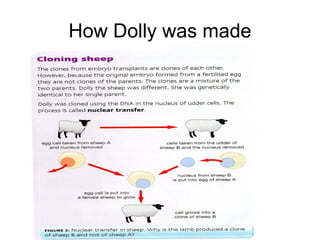
How Dolly was made
Nuclear transfer Egg cell taken from sheep A and the nucleus is removed. An udder cell is taken from sheep B and the nucleus is removed. The nucleus from sheep B is put into the egg cell of sheep A. The egg cell is put into a sheep to grow. The cell grows into a clone of sheep B (where the nucleus containing the genetic information came from
The importance of cloning Organ supply for humans Cloning of human embryos to provide stem cells Risks Low success rate Moral / ethical issues Complications / early death of clones Benefits Cloned pigs could make up a shortage in transplant organs Diseases could be cured using embryonic stem cells
(1 mark)
 
Cloning plants Produces exact genetic copies of themselves without involving another plant. Gardeners can take cuttings. Why is it easier to clone a plant instead of an animal? Plant cells keep their ability to differentiate
Plants that can do it by themselves?
Commercial cloning Choose the plant based on the characteristics you want Remove a small amount of tissue from the parent plant.  You need a tiny amount, this can be removed from several points to give several clones,  if possible take the tissue from fast-growing root and shoot tips The  tissue is grown in a medium containing  nutrients and growth hormones.  All of this is done in  aseptic conditions  to prevent growth of microbes. As the tissues produce shoots and roots they can be moved to potting compost to carry on growing.
Pros   and  cons You know pretty much the characteristics of the plant since it’s genetically identical to the parent Mass-produce plants that are hard to grow from scratch A change in the environment  or a disease could affect all of the plants Lack of genetic variation


OCR Biology B3 part 4

  • 1.
    Revision Part 4– final section
  • 2.
    Cell division –the differences MITOSIS MEIOSIS Diploid cells / 2n Haploid cells / n (1) Produces identical cells Produces different cells Involves 1 cell division 2 cell divisions Makes 2 daughter cells Makes 4 daughter cells
  • 3.
    Sperm adaptations Acrosome - contains enzymes to digest the egg cell membrane Tail – many mitochondria in cells to release energy. WHY
  • 4.
    ENZYMES DIGESTS EGGMEMBRANE / PENETRATE / GET INSIDE THE EGG RESPIRATION
  • 5.
    MITOSIS – DIPLOIDCELLS (46 CHROMOSOMES) MEIOSIS – HAPLOID CELLS (23 CHROMOSOMES) MITOSIS – IDENTICAL CELLS MEIOSIS – DIFFERENT CELLS MITOSIS – 1 CELL DIVISIONS MEIOSIS – 2 CELL DIVISIONS MITOSIS 2 DAUGHTER CELLS MEIOSIS 4 DAUGHTER CELLS
  • 6.
    DNA fingerprinting Isolateblood of cell sample Extract DNA Use restriction enzymes to fragment the DNA Place DNA fragments on gel Apply and separate fragments using an electric current (electrophoresis) Banding of DNA fingerprint can be matched.  
  • 7.
    DNA is cutinto fragments DNA FRAGMENTS SEPARATED / ELECTRIC CURRENT APPLIED / ELECTROPHORESIS
  • 8.
  • 9.
  • 10.
    Chloroplasts Cell WallVacuole Cell Membrane Nucleus Cytoplasm
  • 11.
    Growth Plant Mostgrowth is due to cells elongating (growing longer) not dividing Cell division only normally occurs at the tips of shoots and roots Many cells never lose the ability to differentiate Animal Growth is due to cells dividing Cell division occurs all over the body Most animal cells lose the ability to differentiate very early on
  • 12.
  • 13.
  • 14.
    How Does ThisPlant Know to Send Its Shoots ‘Up’ and Its Roots ‘Down’?
  • 15.
    Response in plants Tropism – plant growth in response to a stimulus Growth towards the stimulus is a positive tropism and growth away is a negative tropism e.g. shoots are positively phototropic but negatively geotropic Stimulus Tropism Light Phototropism Gravity Geotropism
  • 16.
  • 17.
    Artificial Use ofHormones Farmers use Artificial Hormones to increase their yield and to organise ripening times to suit their convenience There are 3 main types: Rooting Compound Ripening Hormone Selective Weed killers
  • 18.
  • 19.
    Auxin is madein the tip or top of plant The tip is covered so it doesn’t receive light Auxin levels are equal on both sides Both sides grow at the same rate
  • 20.
  • 21.
  • 22.
  • 23.
  • 24.
    Human growth –typical questions ? Graph analysis? Put the stages of human growth in the correct order, starting with the earliest: Adulthood (maturity) Childhood Infancy Old age Adolescence (puberty) What stage of growth are you in?
  • 25.
  • 26.
    What is amutation? A mutation is a permanent change in the DNA sequence of a gene . Sometimes mutations in DNA can cause changes in the way a cell behaves. This is because genes contain the instructions necessary for a cell to work. If some of the instructions to the cell are wrong, then the cell may not know what it is supposed to do!
  • 27.
    How does ithappen? There are two ways in which DNA can become mutated: Mutations can be inherited. This means that if a parent has a mutation in his or her DNA, then the mutation is passed on to his or her children. e.g. Down’s syndrome Mutations can be acquired. This happens when environmental agents damage DNA, (X rays, radiation, chemicals, chance), or when mistakes occur when a cell copies its DNA prior to cell division .
  • 28.
    Selective Breeding Produces:-New Varieties Of Organisms Animals & Plants With Increased Yields How? – animals / plants with the desired characteristic are selected to be bred
  • 29.
    Selective Breeding Advantages Disadvantages Produces an organism with the right characteristics for that function A more efficient and economically viable process in farming & horticulture Loss of variation which reduces the species’ ability to respond to environmental change Reduces the number of alleles available for further selection
  • 30.
    What is astem cell? An undifferentiated cell, it has not yet specialised and can turn into different cells or tissues.
  • 31.
  • 32.
    Cloning Clones aregenetically identical. They have the same DNA as the original animal or plant. Identical twins are natural clones – they have the same DNA.
  • 33.
    Cloning cows –embryo transplants
  • 34.
    Embryo transplantation Spermis collected from the prize bull; A prize cow is artificially inseminated with the sperm. When the fertilised egg divides into an eight-cell embryo it is collected and split into four two-celled embryos. Each embryo is implanted into a surrogate cow where it grows into a calf. All the calves will be genetically identical to each other but not to their parents.  
  • 35.
  • 36.
    Nuclear transfer Eggcell taken from sheep A and the nucleus is removed. An udder cell is taken from sheep B and the nucleus is removed. The nucleus from sheep B is put into the egg cell of sheep A. The egg cell is put into a sheep to grow. The cell grows into a clone of sheep B (where the nucleus containing the genetic information came from
  • 37.
    The importance ofcloning Organ supply for humans Cloning of human embryos to provide stem cells Risks Low success rate Moral / ethical issues Complications / early death of clones Benefits Cloned pigs could make up a shortage in transplant organs Diseases could be cured using embryonic stem cells
  • 38.
  • 39.
  • 40.
    Cloning plants Producesexact genetic copies of themselves without involving another plant. Gardeners can take cuttings. Why is it easier to clone a plant instead of an animal? Plant cells keep their ability to differentiate
  • 41.
    Plants that cando it by themselves?
  • 42.
    Commercial cloning Choosethe plant based on the characteristics you want Remove a small amount of tissue from the parent plant. You need a tiny amount, this can be removed from several points to give several clones, if possible take the tissue from fast-growing root and shoot tips The tissue is grown in a medium containing nutrients and growth hormones. All of this is done in aseptic conditions to prevent growth of microbes. As the tissues produce shoots and roots they can be moved to potting compost to carry on growing.
  • 43.
    Pros and cons You know pretty much the characteristics of the plant since it’s genetically identical to the parent Mass-produce plants that are hard to grow from scratch A change in the environment or a disease could affect all of the plants Lack of genetic variation
  • 44.
  • 45.
  • 46.