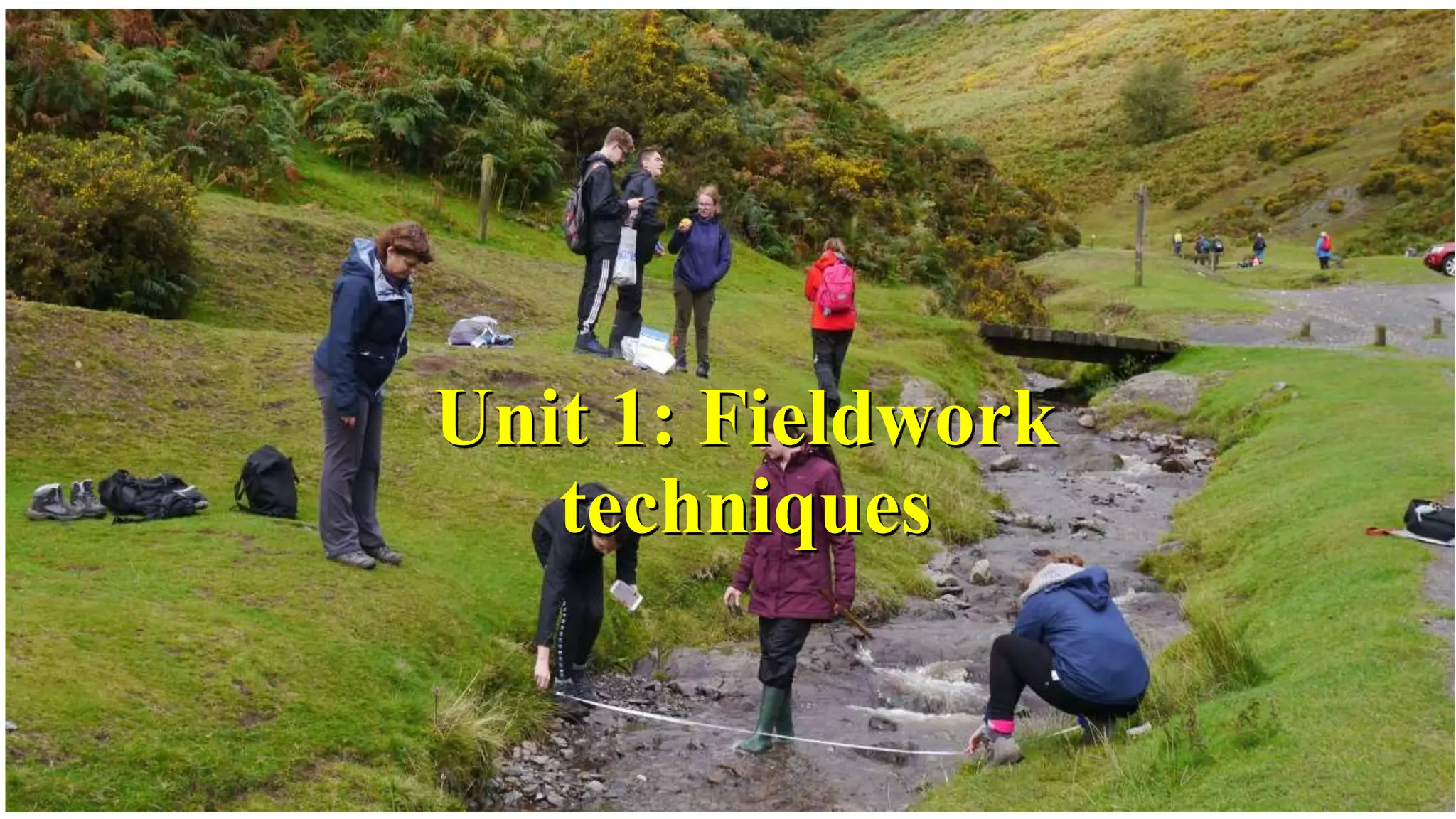


Unit 1: Fieldwork
techniques
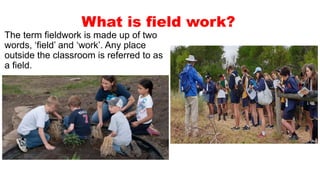
What is field work?
The term fieldwork is made up of two
words, ‘field’ and ‘work’. Any place
outside the classroom is referred to as
a field.
Fieldwork therefore refers to all learning undertakings or
activities that are done outside the classroom.
Fieldwork is the practical work that is done outside the
classroom to gather new information.
Fieldwork methods
Researchers use these methods when searching for
facts and ideas in relation to a given field of study.
Fieldwork data collection methods are classified into
the following.
•Primary data collection methods.
•Secondary data collection methods.
Primary data collection methods include
the following:
•Observation
•Use of questionnaires
•Interviews
•Recording
•Sampling
•Measurement
•Physical testing e.g. testing samples of soils and
soil texture.
•Photographs
Secondary data collection methods
This involve reading from available documents in the
library and public offices. This is also known as
literature review.
The available documents include:
•Government publications
•Earlier Research
•Census
•Personal records
•Client histories
•Service records
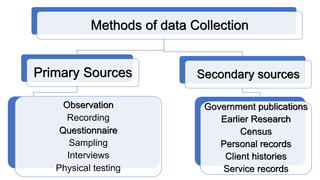
Methods of data Collection
Primary Sources
Observation
Recording
Questionnaire
Sampling
Interviews
Physical testing
Secondary sources
Government publications
Earlier Research
Census
Personal records
Client histories
Service records
1. Observation method
This method involves seeing and interpreting
geographical phenomena in relation to the topic of
study.
Through observation, the researcher identifies and
notes down the relationship existing between various
geographical aspects.
This method is best for collecting information on topics
such as vegetation, climate, external landforms and
relief features, rocks, wildlife and man-made features.
Advantages of observation method
•Direct information: This method provides first-hand
information that is not altered in any way
•Less expensive since the data is only collected
through sight-seeing.
•Updated information: It is possible to collect up-to-
date information since it is real-time observation
•It is not affected by language barrier
•Sound judgement: This method allows for application
of logical judgement of geographical facts
• Freedom: There is little or no direct interaction with other
people as it is the case with interviewing.
• Easy memory: Observation facilitates permanent memory in
an individual
• Acquisition of skills: Observation provides the unintended
skill acquisition like recording and interpretation data
• Information is obtained immediately: The researcher or
learners are able to get the needed information on the spot
• Used with other methods: Observation can be used
together with other methods of data collection. This saves
time and ensures the right and reliable data is collected.
• Limited misinformation: There is no room for
misinformation, hidden or exaggerated information
Disadvantages of observation method
•Unfit for visually impaired or blind learners
•It is tiresome
•It is expensive: Some of the equipment required for use
might also be expensive to purchase. For example,
binoculars and cameras.
•The data is based on the researcher’s preferences and
is therefore subjective
•Failure to get personal information
•Data is dependent on the researcher’s analytical
abilities
•It depends on observation skills
•It is affected by varying weather conditions
•It is difficult to use in remote areas
2. Questionnaire method
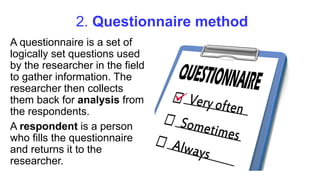
A questionnaire is a set of
logically set questions used
by the researcher in the field
to gather information. The
researcher then collects
them back for analysis from
the respondents.
A respondent is a person
who fills the questionnaire
and returns it to the
researcher.
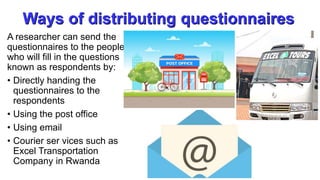
Ways of distributing questionnaires
A researcher can send the
questionnaires to the people
who will fill in the questions
known as respondents by:
• Directly handing the
questionnaires to the
respondents
• Using the post office
• Using email
• Courier ser vices such as
Excel Transportation
Company in Rwanda
Questionnaires are mostly used under the
following circumstances
•When the intended respondents are far.
•When the respondent is too busy for a face to face
interaction
•When information is to be obtained from high profile
respondents who are not easily available for face to
face interviews
•When the researcher is dealing with a large population
Types of questionnaires
1. Open-ended questionnaires: These questionnaires
have questions which do not limit the respondents’
answers. The respondent is free to give as much
information as possible. E.g. What are the
challenges faced as a result of land use in this
area?
2. Closed-ended questionnaires: These are
questionnaires that give possible answers that a
respondent can choose from. Options such as ‘Yes’,
‘No’ and ‘I don’t know’.
Characteristics of a good questionnaire
• The questions should be short and precise.
• Non-Provocative: They should respect the values of a
respondent
• The questions used in a questionnaire should not be
subjective or show any bias.
• All the questions used in the questionnaire should be strictly
related to the topic of study.
• The questions should be designed using the appropriate
language for easy understanding and interpretation.
• The questionnaires should be prepared in the language
understood by the respondent
Advantages of questionnaires
• This method holds a comparative advantage.
• This method is convenient to the researcher.
• It enables the researcher to gather a lot of information
• This method saves time
• This method allows the application of general analysis of
data.
• It enables the respondents to have sufficient time to
think critically before answering
• The method provides the researcher with a chance of
storing the primary data contained in the questionnaires
Disadvantages of questionnaires
• Some of the respondents have poor hand writings
• The method is associated with rigidity and lacks
flexibility.
• The researcher may not be able to obtain the needed
information in time.
• The questionnaire method can only be applied to
literate people
• The method involves high costs of purchasing the
materials used.
• This method is exposed to failure due to the reluctance
by some respondents.
• The respondents are likely to make mistakes,
omissions or sometimes exaggerate the information
provided
•Answering each question is sometimes tiresome
3. Interviews
Interviewing is the art of getting information through
holding a dialogue with a respondent.
It refers to a face-to-face discussion between a
researcher and a respondent. Interview is made up
of:
•Interviewer: A researcher who asks questions
•Interviewee: A respondent who answers
questions
Conditions that must be adhered to as one
prepares for an interview
• Behave in a respectable manner
•Avoid leading a respondent on by asking leading
questions.
• Pay attention to the language used
•Create a friendly atmosphere so that the interviewee
feels free and relaxed
• Ensure that all the data given is held with great secrecy
•Avoid making unnecessary interruptions during the
interview session
• Give a word of appreciation before asking another
question.
Advantages of using
interviews
•This method obtains much more information than
questionnaire method
•It facilitates easy flow of information
•This method offers first-hand information
•This method allows the data collected to be assessed
in time
•It method is less costly since most of the respondents
willingly provide information for free.
•The method can be used on both literate, semi-illiterate
and illiterate people.
•The method is fast and time saving.
•Interviews enable the researcher to identify with
individual feelings and attitudes of the interviewees
•The method is not limiting to both the interviewer and
respondent.
•The method favours people who may have visual
impairments.
Disadvantages of using
interviews
•This method of data collection is time consuming and
expensive.
•The interviewees may hide some important information
due to lack of confidence in the interviewer.
•The success of the interview method depends on the
strength of the respondent’s ability to remember.
•This method can only be effective when a common
language known to the interviewee and the interviewer
is used
•Some respondents become hostile and react
aggressively towards the researcher.
4. Extracting data from records
In this method, data is collected from information
recorded in materials such as books, statistical abstracts,
census reports, journals and magazines.
Advantages
• In most cases, content analysis provides the researcher with
correct information.
• The type of information required by the researcher is easily
collected. This is because records are readily available unlike
in other methods.
• It saves time and reduces expenses since data is within
reach.
• It is the only method used to collect information on vents that
took place a long time ago.
Disadvantages
•The researcher is only limited to
documented information.
•The author of the documented information
might have been biased.
•Sometimes, the information might not be up-
to-date.
5. Sampling method
This method involves choosing the representing
population for the whole population and the findings are
generalized. This is a data collection method used when
the area of study is wide and involves large population.
•Sampling is a technique where a small part of an
aspect of geographical importance is chosen to
represent the whole population.
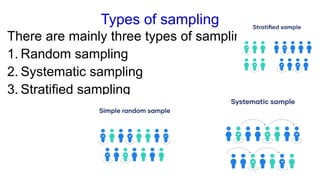
Types of sampling
There are mainly three types of sampling:
1. Random sampling
2. Systematic sampling
3. Stratified sampling
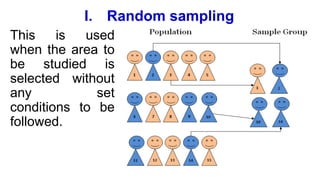
I. Random sampling
This is used
when the area to
be studied is
selected without
any set
conditions to be
followed.
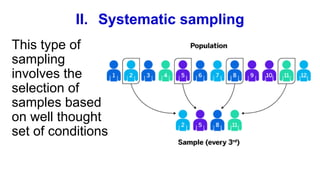
II. Systematic sampling
This type of
sampling
involves the
selection of
samples based
on well thought
set of conditions
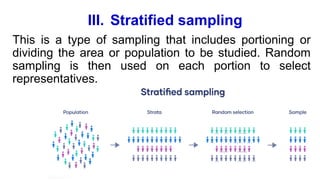
III. Stratified sampling
This is a type of sampling that includes portioning or
dividing the area or population to be studied. Random
sampling is then used on each portion to select
representatives.
Advantages of sampling method
•This method saves time since the research does not
use the entire population or area.
•Conclusions are easy to come up with since they are
generalisation of the entire areas or populations.
•The method is cheap to carry out since a small
population or area is dealt with.
•The method provides the researcher with a chance to
have detailed and well thought out research findings.
This is due to the size of the population.
Disadvantages of sampling
•The method is based on generalising facts,
which may not give a true picture of what was not
studied.
•The method is bound to provide wrong
information especially when the sample selected
is not well-informed.
•The researcher may be biased while choosing
the samples thus yielding poor results.
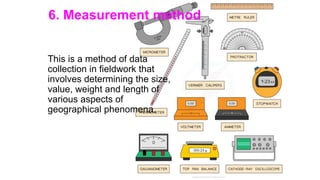
6. Measurement method
This is a method of data
collection in fieldwork that
involves determining the size,
value, weight and length of
various aspects of
geographical phenomena.
Measurement method involves use of the
following instruments
•Tape measures
•Metre rulers
•Weighing scales
•Jerrycans
•Tins
•Sacks
•Jars
•Thermometers, etc
The method of measurement is applied when the
study involves the following
• Measurement of elements of weather such as rainfall,
temperature, humidity
• Quantity in relation to value
• Size or area of given aspects of geographical phenomena
such as land.
• Weight while determining the relationship between quantity
and value.
• Length such as of roads, rivers. Heights such as determining
altitude and varying patterns of land use.
Advantages of measurement method
• The method is suitable while determining the
relationship existing between varying objects.
• The measurement method provides accurate
information to the researcher.
• The researcher is able to acquire various skills
which are later used in daily experiences such
as weighing skills
• It is more reliable hence the researcher is able
to get sufficient information.
Disadvantages of measurement method
• Since it involves use of instruments such as rulers, tape
measures and compasses, it is expensive.
• The method requires a lot of time, since it has to be applied
accurately.
• In case the instrument used is faulty, wrong readings are more
likely to be recorded.
• The method is subjected to physical barriers such as dense
vegetation, and floods. This renders the exercise non-
rewarding.
• The method requires physical involvement of the researcher
and this makes it to be tiresome and laborious
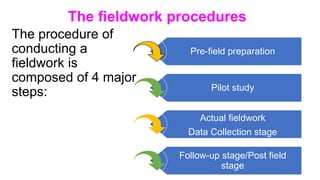
The fieldwork procedures
The procedure of
conducting a
fieldwork is
composed of 4 major
steps:
Pre-field preparation
Pilot study
Actual fieldwork
Data Collection stage
Follow-up stage/Post field
stage
I. Pre-field preparation stage
This stage is concerned with all the activities done before the
learners are set for the actual data collection. It includes:
• Choosing the area of study.
• Designing or selecting the topic of the study.
• Formulation of the objectives of study.
• Selecting the appropriate research methods of data collection to
be used in the field.
• Carrying out a reconnaissance or pre-survey.
• Seeking for permission from relevant authorities.
• Forming the work groups.
• Designing a time management plan.
• Assembling of fieldwork equipment and research instruments.
• Briefing the learners and departure.
II. Pilot study stage
Pilot study is a small-scale preliminary study.
It is conducted in order to evaluate feasibility, time, cost,
adverse events and effect size.
It is done to predict an appropriate sample size and
improve upon the study design.
It is usually done prior to the performance of a full-scale
research project
III. Data collection stage
Once adequate preparations have been done and the pilot study
carried out, the researcher is ready for data collection through
various collection methods
Data can be recorded in the following ways:
• Sketching maps.
• Tallying.
• Taking photographs.
• Note taking.
• Tape recording, videotaping, film making.
• Labelling of samples.
• Tabulation.
• Filling in questionnaires.
Some of the activities that a researcher is
involved in are as follows.
•Drawing and sketching maps and diagrams.
•Taking photographs.
•Making short notes.
•Observing and holding discussions.
•Interviewing and filling in questionnaires.
•Measuring distances, heights and angles.
•Collecting and labelling samples.
•Calculating areas.
•Sampling.
III. The follow-up stage
Is the last stage in fieldwork study. It involves putting together
the data collected, re-arranging them and analysing the
findings to reach logical conclusions. The following are the
steps involved in the follow-up stage.
• Organising the data collected during the field study
• Comparative analysis of the data collected
• Discussing and interpreting the data collected
• Using diagrams and sketch map to present the data
collected
• Making logical conclusions and suggesting
recommendations based on the data collected
The following follow up activities
should be carried out after a field study
• Discussing the findings with other students.
• Developing photographs, video tapes films and slides. Photos
should be pasted on the exercise books.
• Redrawing sketches and diagrams.
• Drawing statistical diagrams such as graphs, maps and charts
Relabelling of samples using clean labels. The place where a
sample was collected and the date should be included.
• Evaluating, interpreting and analysing the information collected
in the field.
• Displaying photographs, sketches and diagrams
• Writing out the findings or report
The methods of data presentation
When the fieldwork findings have been polished, analysed, interpreted
and concluded, the next step is to present the data. There are many
ways of presenting fieldwork findings. They include the following.
• They can be written in an essay form.
• They can be put in tables or graphs that are followed by descriptions
of the content in prose.
• They can be presented in form of maps especially when the findings
involve distribution of various geographical aspects.
• In case photographing was majorly used, an album containing various
photos accompanied by notes can be used.
• Samples collected as part of the findings can be presented by
displaying. This may include soils, crops, vegetation and fish species
among others.
• Pie charts and flowcharts can be used to describe the data.
• The information can then be presented to the rest of the class or to an
audience in a verbal presentation
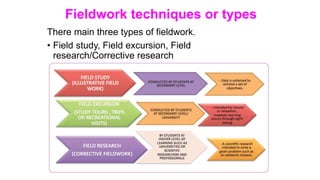
Fieldwork techniques or types
There main three types of fieldwork.
• Field study, Field excursion, Field
research/Corrective research
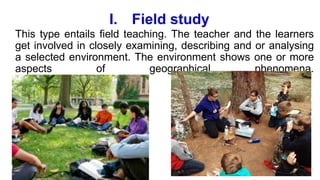
I. Field study
This type entails field teaching. The teacher and the learners
get involved in closely examining, describing and or analysing
a selected environment. The environment shows one or more
aspects of geographical phenomena.
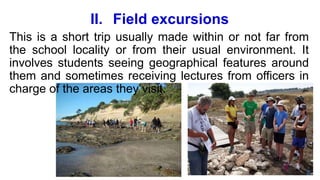
II. Field excursions
This is a short trip usually made within or not far from
the school locality or from their usual environment. It
involves students seeing geographical features around
them and sometimes receiving lectures from officers in
charge of the areas they visit.
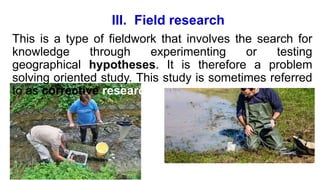
III. Field research
This is a type of fieldwork that involves the search for
knowledge through experimenting or testing
geographical hypotheses. It is therefore a problem
solving oriented study. This study is sometimes referred
to as corrective research.
Problems affecting planning and
implementation of fieldwork
• Illiterate respondents
• Uncooperative respondents
• Inadequate data
• Wild animals
• Inaccessibility of some areas
• Harsh weather conditions
• Dishonest respondents
• Accidents
• Hostile and violent
respondents
• Contradicting information
• Unpredictable situations
• Poor responses from the
authorities
• High costs of operation
• Linguistic diversity
• Poor choice of methods of
data collection
• Time consuming
• Inadequate expertise
• Boring
End of Unit Assessment/20mrks
1. As a geography learner, you are requested by your teacher to conduct a field study on
urbanisation in reference to a nearby town or trading centre of your choice.
(a)State the study topic. 1mark
(b)Name the objectives of the study. 4marks
(c)Explain two methods you would use to gather or collect the data (information) from the
field. 2marks
2. a. Define a questionnaire. 1mark
b. Explain circumstances that may influence the learners to use questionnaires while
conducting a fieldwork study. 2marks
c. Examine the advantages and disadvantages of using questionnaires as a method of data
collection. 8marks
d. Identify and describe the main types of questionnaires that researchers may use.
2marks

Unit 1 Fieldwork techniques.pptx

  • 1.
  • 2.
    What is fieldwork? The term fieldwork is made up of two words, ‘field’ and ‘work’. Any place outside the classroom is referred to as a field.
  • 3.
    Fieldwork therefore refersto all learning undertakings or activities that are done outside the classroom. Fieldwork is the practical work that is done outside the classroom to gather new information.
  • 4.
    Fieldwork methods Researchers usethese methods when searching for facts and ideas in relation to a given field of study. Fieldwork data collection methods are classified into the following. •Primary data collection methods. •Secondary data collection methods.
  • 5.
    Primary data collectionmethods include the following: •Observation •Use of questionnaires •Interviews •Recording •Sampling •Measurement •Physical testing e.g. testing samples of soils and soil texture. •Photographs
  • 6.
    Secondary data collectionmethods This involve reading from available documents in the library and public offices. This is also known as literature review. The available documents include: •Government publications •Earlier Research •Census •Personal records •Client histories •Service records
  • 7.
    Methods of dataCollection Primary Sources Observation Recording Questionnaire Sampling Interviews Physical testing Secondary sources Government publications Earlier Research Census Personal records Client histories Service records
  • 8.
    1. Observation method Thismethod involves seeing and interpreting geographical phenomena in relation to the topic of study. Through observation, the researcher identifies and notes down the relationship existing between various geographical aspects. This method is best for collecting information on topics such as vegetation, climate, external landforms and relief features, rocks, wildlife and man-made features.
  • 10.
    Advantages of observationmethod •Direct information: This method provides first-hand information that is not altered in any way •Less expensive since the data is only collected through sight-seeing. •Updated information: It is possible to collect up-to- date information since it is real-time observation •It is not affected by language barrier •Sound judgement: This method allows for application of logical judgement of geographical facts
  • 11.
    • Freedom: Thereis little or no direct interaction with other people as it is the case with interviewing. • Easy memory: Observation facilitates permanent memory in an individual • Acquisition of skills: Observation provides the unintended skill acquisition like recording and interpretation data • Information is obtained immediately: The researcher or learners are able to get the needed information on the spot • Used with other methods: Observation can be used together with other methods of data collection. This saves time and ensures the right and reliable data is collected. • Limited misinformation: There is no room for misinformation, hidden or exaggerated information
  • 12.
    Disadvantages of observationmethod •Unfit for visually impaired or blind learners •It is tiresome •It is expensive: Some of the equipment required for use might also be expensive to purchase. For example, binoculars and cameras. •The data is based on the researcher’s preferences and is therefore subjective •Failure to get personal information •Data is dependent on the researcher’s analytical abilities •It depends on observation skills •It is affected by varying weather conditions •It is difficult to use in remote areas
  • 13.
    2. Questionnaire method Aquestionnaire is a set of logically set questions used by the researcher in the field to gather information. The researcher then collects them back for analysis from the respondents. A respondent is a person who fills the questionnaire and returns it to the researcher.
  • 14.
    Ways of distributingquestionnaires A researcher can send the questionnaires to the people who will fill in the questions known as respondents by: • Directly handing the questionnaires to the respondents • Using the post office • Using email • Courier ser vices such as Excel Transportation Company in Rwanda
  • 15.
    Questionnaires are mostlyused under the following circumstances •When the intended respondents are far. •When the respondent is too busy for a face to face interaction •When information is to be obtained from high profile respondents who are not easily available for face to face interviews •When the researcher is dealing with a large population
  • 16.
    Types of questionnaires 1.Open-ended questionnaires: These questionnaires have questions which do not limit the respondents’ answers. The respondent is free to give as much information as possible. E.g. What are the challenges faced as a result of land use in this area? 2. Closed-ended questionnaires: These are questionnaires that give possible answers that a respondent can choose from. Options such as ‘Yes’, ‘No’ and ‘I don’t know’.
  • 17.
    Characteristics of agood questionnaire • The questions should be short and precise. • Non-Provocative: They should respect the values of a respondent • The questions used in a questionnaire should not be subjective or show any bias. • All the questions used in the questionnaire should be strictly related to the topic of study. • The questions should be designed using the appropriate language for easy understanding and interpretation. • The questionnaires should be prepared in the language understood by the respondent
  • 18.
    Advantages of questionnaires •This method holds a comparative advantage. • This method is convenient to the researcher. • It enables the researcher to gather a lot of information • This method saves time • This method allows the application of general analysis of data. • It enables the respondents to have sufficient time to think critically before answering • The method provides the researcher with a chance of storing the primary data contained in the questionnaires
  • 19.
    Disadvantages of questionnaires •Some of the respondents have poor hand writings • The method is associated with rigidity and lacks flexibility. • The researcher may not be able to obtain the needed information in time. • The questionnaire method can only be applied to literate people • The method involves high costs of purchasing the materials used. • This method is exposed to failure due to the reluctance by some respondents. • The respondents are likely to make mistakes, omissions or sometimes exaggerate the information provided •Answering each question is sometimes tiresome
  • 20.
    3. Interviews Interviewing isthe art of getting information through holding a dialogue with a respondent. It refers to a face-to-face discussion between a researcher and a respondent. Interview is made up of: •Interviewer: A researcher who asks questions •Interviewee: A respondent who answers questions
  • 21.
    Conditions that mustbe adhered to as one prepares for an interview • Behave in a respectable manner •Avoid leading a respondent on by asking leading questions. • Pay attention to the language used •Create a friendly atmosphere so that the interviewee feels free and relaxed • Ensure that all the data given is held with great secrecy •Avoid making unnecessary interruptions during the interview session • Give a word of appreciation before asking another question.
  • 22.
    Advantages of using interviews •Thismethod obtains much more information than questionnaire method •It facilitates easy flow of information •This method offers first-hand information •This method allows the data collected to be assessed in time •It method is less costly since most of the respondents willingly provide information for free. •The method can be used on both literate, semi-illiterate and illiterate people. •The method is fast and time saving. •Interviews enable the researcher to identify with individual feelings and attitudes of the interviewees •The method is not limiting to both the interviewer and respondent. •The method favours people who may have visual impairments.
  • 23.
    Disadvantages of using interviews •Thismethod of data collection is time consuming and expensive. •The interviewees may hide some important information due to lack of confidence in the interviewer. •The success of the interview method depends on the strength of the respondent’s ability to remember. •This method can only be effective when a common language known to the interviewee and the interviewer is used •Some respondents become hostile and react aggressively towards the researcher.
  • 24.
    4. Extracting datafrom records In this method, data is collected from information recorded in materials such as books, statistical abstracts, census reports, journals and magazines.
  • 25.
    Advantages • In mostcases, content analysis provides the researcher with correct information. • The type of information required by the researcher is easily collected. This is because records are readily available unlike in other methods. • It saves time and reduces expenses since data is within reach. • It is the only method used to collect information on vents that took place a long time ago.
  • 26.
    Disadvantages •The researcher isonly limited to documented information. •The author of the documented information might have been biased. •Sometimes, the information might not be up- to-date.
  • 27.
    5. Sampling method Thismethod involves choosing the representing population for the whole population and the findings are generalized. This is a data collection method used when the area of study is wide and involves large population. •Sampling is a technique where a small part of an aspect of geographical importance is chosen to represent the whole population.
  • 28.
    Types of sampling Thereare mainly three types of sampling: 1. Random sampling 2. Systematic sampling 3. Stratified sampling
  • 29.
    I. Random sampling Thisis used when the area to be studied is selected without any set conditions to be followed.
  • 30.
    II. Systematic sampling Thistype of sampling involves the selection of samples based on well thought set of conditions
  • 31.
    III. Stratified sampling Thisis a type of sampling that includes portioning or dividing the area or population to be studied. Random sampling is then used on each portion to select representatives.
  • 32.
    Advantages of samplingmethod •This method saves time since the research does not use the entire population or area. •Conclusions are easy to come up with since they are generalisation of the entire areas or populations. •The method is cheap to carry out since a small population or area is dealt with. •The method provides the researcher with a chance to have detailed and well thought out research findings. This is due to the size of the population.
  • 33.
    Disadvantages of sampling •Themethod is based on generalising facts, which may not give a true picture of what was not studied. •The method is bound to provide wrong information especially when the sample selected is not well-informed. •The researcher may be biased while choosing the samples thus yielding poor results.
  • 34.
    6. Measurement method Thisis a method of data collection in fieldwork that involves determining the size, value, weight and length of various aspects of geographical phenomena.
  • 35.
    Measurement method involvesuse of the following instruments •Tape measures •Metre rulers •Weighing scales •Jerrycans •Tins •Sacks •Jars •Thermometers, etc
  • 36.
    The method ofmeasurement is applied when the study involves the following • Measurement of elements of weather such as rainfall, temperature, humidity • Quantity in relation to value • Size or area of given aspects of geographical phenomena such as land. • Weight while determining the relationship between quantity and value. • Length such as of roads, rivers. Heights such as determining altitude and varying patterns of land use.
  • 37.
    Advantages of measurementmethod • The method is suitable while determining the relationship existing between varying objects. • The measurement method provides accurate information to the researcher. • The researcher is able to acquire various skills which are later used in daily experiences such as weighing skills • It is more reliable hence the researcher is able to get sufficient information.
  • 38.
    Disadvantages of measurementmethod • Since it involves use of instruments such as rulers, tape measures and compasses, it is expensive. • The method requires a lot of time, since it has to be applied accurately. • In case the instrument used is faulty, wrong readings are more likely to be recorded. • The method is subjected to physical barriers such as dense vegetation, and floods. This renders the exercise non- rewarding. • The method requires physical involvement of the researcher and this makes it to be tiresome and laborious
  • 39.
    The fieldwork procedures Theprocedure of conducting a fieldwork is composed of 4 major steps: Pre-field preparation Pilot study Actual fieldwork Data Collection stage Follow-up stage/Post field stage
  • 40.
    I. Pre-field preparationstage This stage is concerned with all the activities done before the learners are set for the actual data collection. It includes: • Choosing the area of study. • Designing or selecting the topic of the study. • Formulation of the objectives of study. • Selecting the appropriate research methods of data collection to be used in the field. • Carrying out a reconnaissance or pre-survey. • Seeking for permission from relevant authorities. • Forming the work groups. • Designing a time management plan. • Assembling of fieldwork equipment and research instruments. • Briefing the learners and departure.
  • 41.
    II. Pilot studystage Pilot study is a small-scale preliminary study. It is conducted in order to evaluate feasibility, time, cost, adverse events and effect size. It is done to predict an appropriate sample size and improve upon the study design. It is usually done prior to the performance of a full-scale research project
  • 42.
    III. Data collectionstage Once adequate preparations have been done and the pilot study carried out, the researcher is ready for data collection through various collection methods Data can be recorded in the following ways: • Sketching maps. • Tallying. • Taking photographs. • Note taking. • Tape recording, videotaping, film making. • Labelling of samples. • Tabulation. • Filling in questionnaires.
  • 43.
    Some of theactivities that a researcher is involved in are as follows. •Drawing and sketching maps and diagrams. •Taking photographs. •Making short notes. •Observing and holding discussions. •Interviewing and filling in questionnaires. •Measuring distances, heights and angles. •Collecting and labelling samples. •Calculating areas. •Sampling.
  • 44.
    III. The follow-upstage Is the last stage in fieldwork study. It involves putting together the data collected, re-arranging them and analysing the findings to reach logical conclusions. The following are the steps involved in the follow-up stage. • Organising the data collected during the field study • Comparative analysis of the data collected • Discussing and interpreting the data collected • Using diagrams and sketch map to present the data collected • Making logical conclusions and suggesting recommendations based on the data collected
  • 45.
    The following followup activities should be carried out after a field study • Discussing the findings with other students. • Developing photographs, video tapes films and slides. Photos should be pasted on the exercise books. • Redrawing sketches and diagrams. • Drawing statistical diagrams such as graphs, maps and charts Relabelling of samples using clean labels. The place where a sample was collected and the date should be included. • Evaluating, interpreting and analysing the information collected in the field. • Displaying photographs, sketches and diagrams • Writing out the findings or report
  • 46.
    The methods ofdata presentation When the fieldwork findings have been polished, analysed, interpreted and concluded, the next step is to present the data. There are many ways of presenting fieldwork findings. They include the following. • They can be written in an essay form. • They can be put in tables or graphs that are followed by descriptions of the content in prose. • They can be presented in form of maps especially when the findings involve distribution of various geographical aspects. • In case photographing was majorly used, an album containing various photos accompanied by notes can be used. • Samples collected as part of the findings can be presented by displaying. This may include soils, crops, vegetation and fish species among others. • Pie charts and flowcharts can be used to describe the data. • The information can then be presented to the rest of the class or to an audience in a verbal presentation
  • 47.
    Fieldwork techniques ortypes There main three types of fieldwork. • Field study, Field excursion, Field research/Corrective research
  • 48.
    I. Field study Thistype entails field teaching. The teacher and the learners get involved in closely examining, describing and or analysing a selected environment. The environment shows one or more aspects of geographical phenomena.
  • 49.
    II. Field excursions Thisis a short trip usually made within or not far from the school locality or from their usual environment. It involves students seeing geographical features around them and sometimes receiving lectures from officers in charge of the areas they visit.
  • 50.
    III. Field research Thisis a type of fieldwork that involves the search for knowledge through experimenting or testing geographical hypotheses. It is therefore a problem solving oriented study. This study is sometimes referred to as corrective research.
  • 51.
    Problems affecting planningand implementation of fieldwork • Illiterate respondents • Uncooperative respondents • Inadequate data • Wild animals • Inaccessibility of some areas • Harsh weather conditions • Dishonest respondents • Accidents • Hostile and violent respondents • Contradicting information • Unpredictable situations • Poor responses from the authorities • High costs of operation • Linguistic diversity • Poor choice of methods of data collection • Time consuming • Inadequate expertise • Boring
  • 52.
    End of UnitAssessment/20mrks 1. As a geography learner, you are requested by your teacher to conduct a field study on urbanisation in reference to a nearby town or trading centre of your choice. (a)State the study topic. 1mark (b)Name the objectives of the study. 4marks (c)Explain two methods you would use to gather or collect the data (information) from the field. 2marks 2. a. Define a questionnaire. 1mark b. Explain circumstances that may influence the learners to use questionnaires while conducting a fieldwork study. 2marks c. Examine the advantages and disadvantages of using questionnaires as a method of data collection. 8marks d. Identify and describe the main types of questionnaires that researchers may use. 2marks