


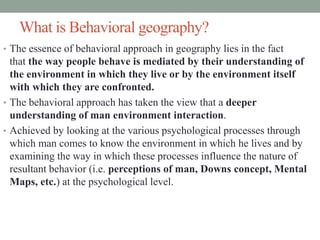
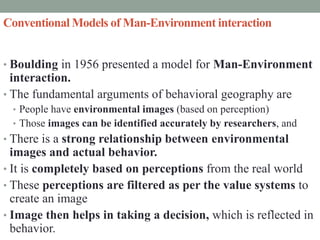

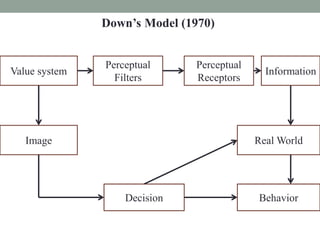
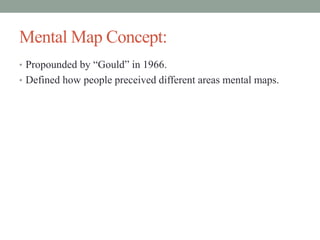



- Behavioral geography is an approach that studies human activity, place, and environment at the individual level. It aims to understand human behavior by examining psychological processes like perceptions, decision making, and environmental images. - Early models in behavioral geography treated humans as rational actors seeking to optimize outcomes. However, researchers like Wolpert found people often make suboptimal choices based on imperfect information. - Key concepts in behavioral geography include mental maps, which represent individual perceptions of space, and models of the relationships between environmental images, decisions, and resulting behaviors. Behavioral geography provided new insights into areas like migration and consumer patterns but was later criticized for oversimplifying human behavior.


