WHITE
LESIONS


   Prepared by:
        Dr. Rea Corpuz
White Lesions

 lesions of the oral mucosa,
  which are white results
  from a

    thickened layer of keratin

    epithelial hyperplasia

    intracellular epithelial
     edema

    reduced vascularity of subjacent connective
White Lesions

 white or yellow lesions
  may also be due to fibrous
  exudate covering an:

    ulcer
    submucosal deposit
    surface debris
    fungal colonies
White Lesions

 (1) Leukoedema

 (2) Leukoplakia

 (3) Lichen Planus

 (4) Candidiasis

 (5) White Sponge Nevus

 (6) Nicotine Stomatitis
White Lesions

 (7) Geographic Tongue

 (8) Hairy Tongue

 (9) Dental Lamina Cyst

 (10) Fordyce’s Disease

 (11) Perleche
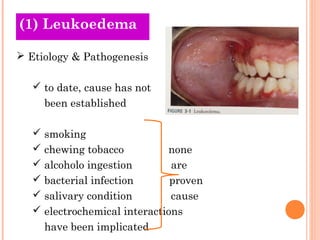
(1) Leukoedema

 generalized opacification
  of buccal mucosa that is
  regarded as a variation
  of normal

 can be identified in majority
  of population
(1) Leukoedema

 Etiology & Pathogenesis

    to date, cause has not
     been established

    smoking
    chewing tobacco          none
    alcoholo ingestion        are
    bacterial infection       proven
    salivary condition        cause
    electrochemical interactions
     have been implicated
(1) Leukoedema

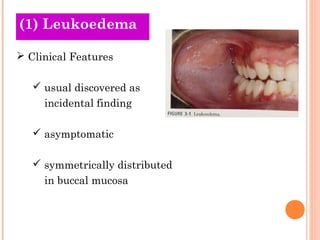
 Clinical Features

    usual discovered as
     incidental finding

    asymptomatic

    symmetrically distributed
     in buccal mucosa
(1) Leukoedema

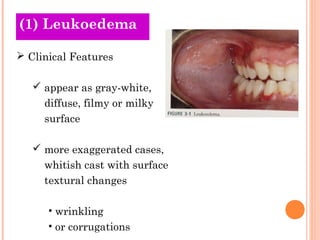
 Clinical Features

    appear as gray-white,
     diffuse, filmy or milky
     surface

    more exaggerated cases,
     whitish cast with surface
     textural changes

      • wrinkling
      • or corrugations
(1) Leukoedema

 Clinical Features

    with stretching of buccal
     mucosa, opaque changes
     dissipate

    more apparent in non-whites,
     especially African-American
(1) Leukoedema

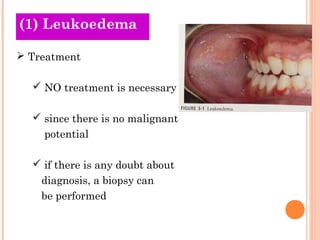
 Treatment

   NO treatment is necessary

   since there is no malignant
    potential

   if there is any doubt about
    diagnosis, a biopsy can
    be performed
(2) Leukoplakia

 also known as Leukokeratosis;
  Erythroplakia

 Leuko= white

 Plakia = patch

 defined by World Health Organization
  (WHO) as a white patch or plaque
  that cannot be characterized
  clinically or pathologically as
  any other disease
(2) Leukoplakia
Leukoplakia

 clinical term indicating a
  white patch or plaque of
  oral mucosa

 cannot be rubbed off

 cannot be characterized clinically
  as any other disease

 biopsy is mandatory to
  establish a definitive diagnosis
(2) Leukoplakia

 Mild or Thin Leukoplakia

 Homogenous or
  Thick Leukoplakia

 Granular or Nodular
  Leukoplakia

 Verrucous or Verruciform
  Leukoplakia
(2) Leukoplakia

 Proliferative Verrucous
  Leukoplakia (PVL)

 Erythroleukoplakia or
  Speckled Leukoplakia
(2) Leukoplakia
(2) Leukoplakia

 Mild or Thin Leukoplakia

    seldom shows dysplasia
     on biopsy

    may disappear or continue
     unchanged
(2) Leukoplakia

 Homogenous or Thick Leukoplakia

   for tobacco smokers who do
     not reduce their habit

   2/3 of such lesions slowly
     extend laterally, become
     thicker + acquire distinctly
     white appearance
(2) Leukoplakia

 Homogenous or Thick Leukoplakia

   affected mucosa may become
     leathery to palpation

   fissures may deepen

   become more numerous

   most thick, smooth lesions
     remain indefinitely at this
     stage
(2) Leukoplakia

 Homogenous or Thick Leukoplakia

   some, perhaps as many
     as 1/3, regress or disappear
(2) Leukoplakia

 Granular or Nodular Leukoplakia

   few become even more
     severe

   develop increased surface
     irregularities
(2) Leukoplakia

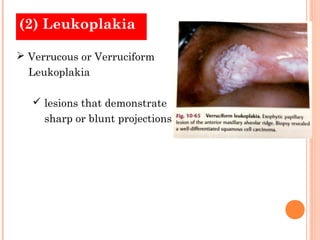
 Verrucous or Verruciform
  Leukoplakia

    lesions that demonstrate
     sharp or blunt projections
(2) Leukoplakia

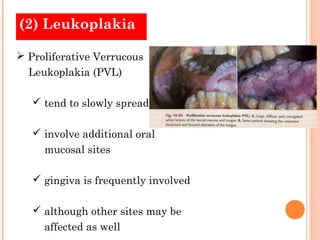
 Proliferative Verrucous
  Leukoplakia (PVL)

    high risk form of
     leukoplakia

    development of multiple
     keratotic plaques

    with roughened
     surface projections
(2) Leukoplakia

 Proliferative Verrucous
  Leukoplakia (PVL)

    tend to slowly spread

    involve additional oral
     mucosal sites

    gingiva is frequently involved

    although other sites may be
     affected as well
(2) Leukoplakia

 Proliferative Verrucous
  Leukoplakia (PVL)

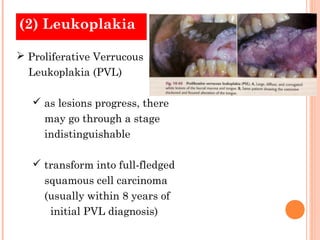
    as lesions progress, there
     may go through a stage
     indistinguishable

    transform into full-fledged
     squamous cell carcinoma
     (usually within 8 years of
      initial PVL diagnosis)
(2) Leukoplakia

 Proliferative Verrucous
  Leukoplakia (PVL)

    lesions rarely regress
     despite therapy

    strong female predilection

    minimal association with
     tobacco use
(2) Leukoplakia

 Erythroplakia

   leukoplakia may become
     dysplastic

   even invasive, with no change
     in its clinical appearance

   however, some lesions eventually
     demonstrate scattered patches
     of redness called erythroplakia
(2) Leukoplakia

 Erythroleukoplakia or
  Speckled Leukoplakia

    such areas usually represent
     sites in which epithelial
     cells are so immature
     or atrophic that they can no
     longer produce keratin
(2) Leukoplakia

 Erythroleukoplakia or
  Speckled Leukoplakia

    intermixed red-and-white
     lesion

    pattern of leukoplakia
     that frequently reveals
     advanced dysplasia on
     biopsy
(2) Leukoplakia

 Etiology & Prognosis

    many cases are etiologically
     related to use of tobacco
     in smoked or smokeless
     forms and may regress
     after discontinuation
     of tobacco use
(2) Leukoplakia

 Etiology & Prognosis

    other factors, such as

      • alcohol abuse         may have
      • trauma                 a role in
      • C. albicans infection etiology
(2) Leukoplakia

 Etiology & Prognosis

    nutritional factors have
     been cited as important,
     especially iron deficiency
     anemia
(2) Leukoplakia

 Clinical Features

    associated with middle-aged
     + older population

    vast majority of cases occur
     after age of 40 years
(2) Leukoplakia

 Site of Occurence

    Vestibule
    Buccal
    Palate
    Alveolar Ridge
    Lip
    Tongue
    Floor
(2) Leukoplakia

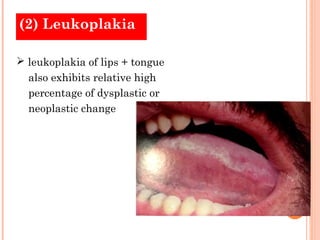
 leukoplakia of lips + tongue
  also exhibits relative high
  percentage of dysplastic or
  neoplastic change
(2) Leukoplakia

 Treatment & Prognosis

   absence of dysplastic or
    atypical epithelial changes

     • periodic examinations +
      rebiopsy of new suspicious
      areas are recommended
(2) Leukoplakia

 Treatment & Prognosis

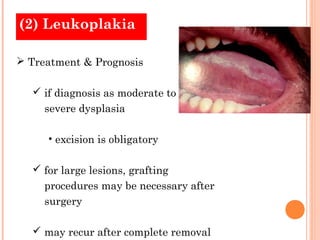
   if diagnosis as moderate to
     severe dysplasia

     • excision is obligatory

   for large lesions, grafting
     procedures may be necessary after
     surgery

   may recur after complete removal
(3) Lichen Planus

 chronic mucocutaneous
  disease of unknown cause

 relatively common

 typically presents as bilateral
  white lesions

 occasionally with associated
  ulcers
(3) Lichen Planus

 Pathogenesis

   although cause is unknown

   generally considered to be
     a immunologically mediated
     process

   resembles hypersensitivity
     reaction
(3) Lichen Planus

 Clinical Features

    disease of middle age

    affects men + women in
     nearly equal numbers

    children rarely affected
(3) Lichen Planus

 Clinical Features

    Types:

      • Reticular
      • Erosive (ulcerative)
      • Plaque
      • Papular
      • Erythematous (atrophic)
(3) Lichen Planus

 Clinical Features

    Reticular Form

      • most common type

      • numerous interlacing white
       keratotic lines or striae
       (Wickham’s striae)

          produces anular or lacy
           pattern
(3) Lichen Planus

 Clinical Features

    Reticular Form

      • buccal mucosa is the site
       most commonly involved

      • may also be noted on:

          tongue
          gingiva – less common
          lips
(3) Lichen Planus

 Clinical Features

    Plaque Form

      • resembles leukoplakia

      • but has multifocal distribution

      • range from slightly elevated
       to smooth and flat
(3) Lichen Planus

 Clinical Features

    Plaque Form

      • primary sites are

          dorsum of tongue
          buccal mucosa
(3) Lichen Planus

 Clinical Features

    Erythematous Form

      • red patches

      • with very fine white
       striae

      • attached gingiva commonly
       involved
(3) Lichen Planus

 Clinical Features

    Erythematous Form

      • patchy distribution often
       in four quadrants

      • patient may complain of

          burning
          sensitivity
          generalized discomfort
(3) Lichen Planus

 Clinical Features

    Erosive Form

      • central area of lesion is
       ulcerated

      • fibrinous plaque or
       pseudomembrane covers
       ulcer

      • changing patterns of involvement
        from week to week
(3) Lichen Planus

 Treatment

   although it cannot be
    generally cured

   some drugs can provide
    satisfactory control

   corticosteroids are the single
    most useful group of drugs
    in the management of lichen
    planus
(3) Lichen Planus

 Treatment

   corticosteroid

     • ability to modulate
      inflammation + immune
      response
(3) Lichen Planus

 Treatment

   topical application +
    local injection of steroids
    have been used successfully
    in controlling but not
    curing this disease
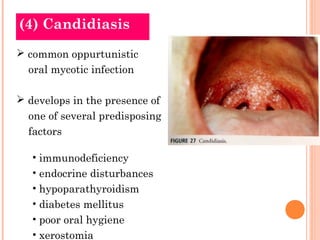
(4) Candidiasis
 common oppurtunistic
  oral mycotic infection

 develops in the presence of
  one of several predisposing
  factors

   • immunodeficiency
   • endocrine disturbances
   • hypoparathyroidism
   • diabetes mellitus
   • poor oral hygiene
   • xerostomia
(4) Candidiasis

 caused by Candida albicans

 infection with this organism
  is usually superficial, affecting
  the outer aspects of involved
  oral mucosa or skin
(4) Candidiasis

 in severely debilitated +
  immunocompromised patients
  such as patients with AIDS

    infection may extend into
     alimentary tract (candidal
     esophagitis

    bronchopulmonary tract

    and other organ system
(4) Candidiasis

 Clinical Features

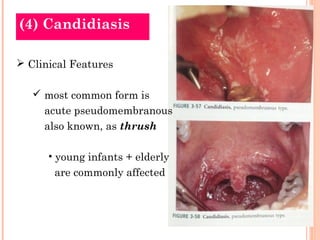
    most common form is
     acute pseudomembranous
     also known, as thrush

      • young infants + elderly
       are commonly affected
(4) Candidiasis

 Clinical Features

    oral lesion of acute
     candidiasis (thrush)

      • white
      • soft plaques that sometime
        grow centrifugally + merge
      • wiping plaques with gauze
         sponge leaves a painful,
         eroded, eryhtematous or
         ulcerated surface
(4) Candidiasis

 Clinical Features

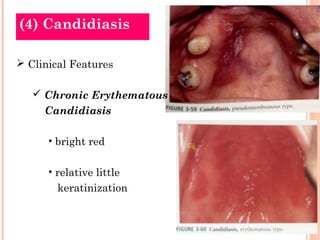
    Chronic Erythematous
     Candidiasis

      • commonly seen on
       geriatric individuals

      • who wear complete
        maxillary denture
(4) Candidiasis

 Clinical Features

    Chronic Erythematous
     Candidiasis

      • distinct predilection for
       palatal mucosa as
       compared with mandibular
       alveolar arch
(4) Candidiasis

 Clinical Features

    Chronic Erythematous
     Candidiasis

      • chronic low-grade
       resulting from poor
       prosthesis fit

      • failure to remove
       appliance at night
(4) Candidiasis

 Clinical Features

    Chronic Erythematous
     Candidiasis

      • bright red

      • relative little
        keratinization
(4) Candidiasis

 Clinical Features

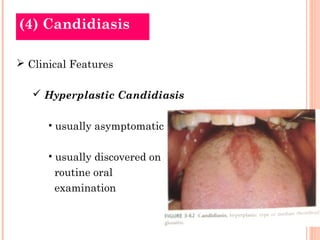
    Hyperplastic Candidiasis

      • may involve dorsum of
        tongue

      • pattern referred to as
       median rhomboid
       glossitis
(4) Candidiasis

 Clinical Features

    Hyperplastic Candidiasis

      • usually asymptomatic

      • usually discovered on
       routine oral
       examination
(4) Candidiasis

 Clinical Features

    Hyperplastic Candidiasis

      • found anterior to
       circumvallate
       papillae

      • oval or rhomboid
        outline
(4) Candidiasis

 Clinical Features

    Hyperplastic Candidiasis

      • may have smooth,
        nodular or fissured
        surface

      • range in color from
        white to more red
(4) Candidiasis

 Clinical Features

    Mucocutaneous Candidiasis

      • long standing

      • persistent candidiasis of

          oral mucosa
          skin
          vaginal mucosa
(4) Candidiasis

 Clinical Features

    Mucocutaneous Candidiasis

      • often resistant to treatment

      • begins as a pseudomembranous
        type of candidiasis

      • soon followed by nail +
       cutaneous involvement
(4) Candidiasis

 Treatment

   majority of infections may
    be simply treated with
    topical applications of
    nystatin suspension

     • nystatin cream or
      ointment often effective
      when applied directly to
      denture-bearing surface itself
(4) Candidiasis

 Treatment

   topical applications of either
    nystatin or clotrimazole
    should be continued for at
    least 1 week beyond
    disappearance of clinical
    manifestations of disease
(4) Candidiasis

 Treatment

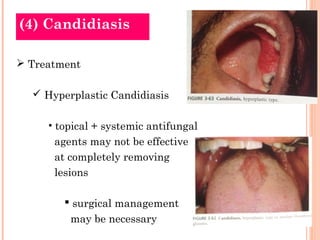
   Hyperplastic Candidiasis

     • topical + systemic antifungal
      agents may not be effective
      at completely removing
      lesions

         surgical management
         may be necessary
(4) Candidiasis

 Treatment

   Chronic Mucocutaneous
    Candidiasis associated
    with immunosuppression

     • topical agents may not
       be effective
(4) Candidiasis

 Treatment

   Chronic Mucocutaneous
    Candidiasis associated
    with immunosuppression

     • systemic administration
      of medications:

         Ketoconazole
         Fluconazole
         Itraconazole
(5) White Sponge Nevus

 autosomal-dominant condition

 due to point mutations for
  genes coding for keratin 4
  and/or 13.

 affects oral mucosa bilaterally

 NO treatment is required
(5) White Sponge Nevus

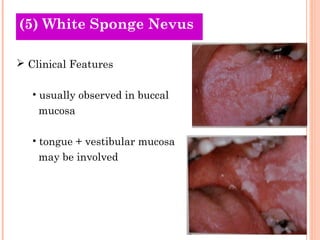
 Clinical Features

   • asymptomatic

   • folded white lesions

   • may affect several mucosal
    sites

   • lesions tend to be thickened
    + spongy consitency
(5) White Sponge Nevus

 Clinical Features

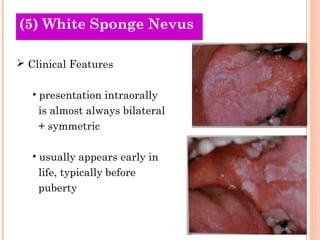
   • presentation intraorally
    is almost always bilateral
    + symmetric

   • usually appears early in
    life, typically before
    puberty
(5) White Sponge Nevus

 Clinical Features

   • usually observed in buccal
    mucosa

   • tongue + vestibular mucosa
    may be involved
(5) White Sponge Nevus

 Treatment

  • NO treatment necessary
   since it is asymptomatic
   + benign
(6) Nicotine Stomatitis

 common tobacco-related
  form of keratosis

 typically associated with pipe
  + cigar smoking

 with positive correlation
   between intensity of smoking
   + severity of condition
(6) Nicotine Stomatitis

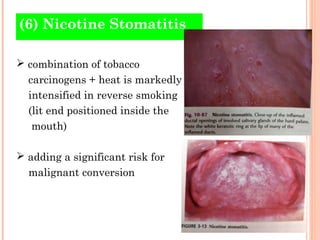
 combination of tobacco
  carcinogens + heat is markedly
  intensified in reverse smoking
  (lit end positioned inside the
   mouth)

 adding a significant risk for
  malignant conversion
(6) Nicotine Stomatitis

 Clinical Features

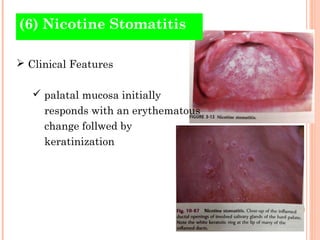
    palatal mucosa initially
     responds with an erythematous
     change follwed by
     keratinization
(6) Nicotine Stomatitis

 Clinical Features

    subsequent to opacification
     or keratinization of palate

      • red dots surrounded by
        white keratotic rings
        appear

          dot represent inflammation
          of salivary gland excretory
          duct
(6) Nicotine Stomatitis

 Treatment

   condition rarely evolves into
    malignancy

   except in individuals who
    reverse smoke

   discontinuation of tobacco
    habit
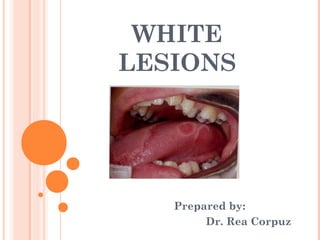
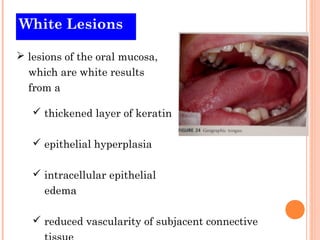
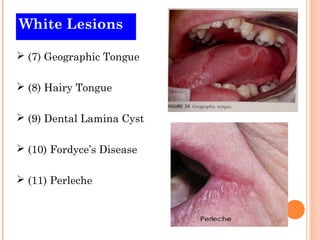
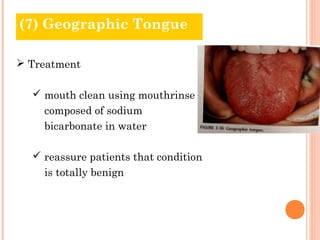
(7) Geographic Tongue

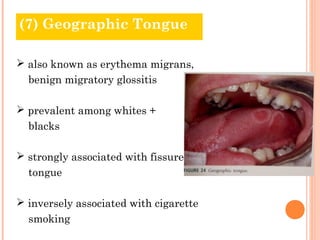
 also known as erythema migrans,
  benign migratory glossitis

 prevalent among whites +
  blacks

 strongly associated with fissure
  tongue

 inversely associated with cigarette
  smoking
(7) Geographic Tongue

 emotional stress may enhance
  the process
(7) Geographic Tongue

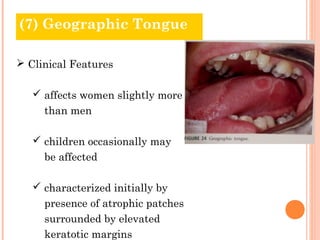
 Clinical Features

    affects women slightly more
     than men

    children occasionally may
     be affected

    characterized initially by
     presence of atrophic patches
     surrounded by elevated
     keratotic margins
(7) Geographic Tongue

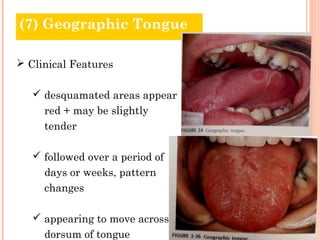
 Clinical Features

    desquamated areas appear
     red + may be slightly
     tender

    followed over a period of
     days or weeks, pattern
     changes

    appearing to move across
     dorsum of tongue
(7) Geographic Tongue

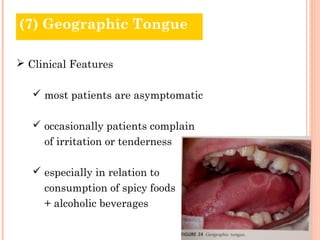
 Clinical Features

    most patients are asymptomatic

    occasionally patients complain
     of irritation or tenderness

    especially in relation to
     consumption of spicy foods
     + alcoholic beverages
(7) Geographic Tongue

 Clinical Features

    lesions periodically disappear

    recur for no apparent reason
(7) Geographic Tongue

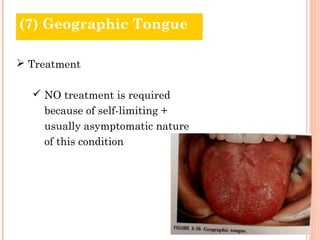
 Treatment

   NO treatment is required
    because of self-limiting +
    usually asymptomatic nature
    of this condition
(7) Geographic Tongue

 Treatment

   when symptoms occur,

     • topical steroids especially
       ones containing antifungal
       agent

         helpful in reducing symptoms
(7) Geographic Tongue

 Treatment

   mouth clean using mouthrinse
    composed of sodium
    bicarbonate in water

   reassure patients that condition
    is totally benign
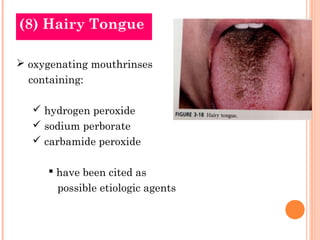
(8) Hairy Tongue

 clinical term referring to a
  condition of filiform papillae
  overgrowth on dorsal surface
  of tongue

 there are numerous initiating
  or predisposing factors for
  hairy tongue
(8) Hairy Tongue

 broad spectrum antibiotics
  such as penicillin + systemic
  cortiocosteroids are often
  identified in clinical
  history of patients with
  this condition
(8) Hairy Tongue

 oxygenating mouthrinses
  containing:

   hydrogen peroxide
   sodium perborate
   carbamide peroxide

       have been cited as
       possible etiologic agents
(8) Hairy Tongue

 Clinical Features

    clinical alteration translates
     to hyperplasia of filiform
     papillae; result is

      • thick           serves to trap
      • matted surface bacteria, fungi,
                        foreign materials
(8) Hairy Tongue

 Clinical Features

    extensive elongation of
     papillae occurs,

      • gagging             may be
      • tickiling sensation felt
(8) Hairy Tongue

 Clinical Features

    color may range from white
     to tan to deep brown
     depending on:

      • diet
      • oral hygiene
      • composition of bacteria
       inhabiting papillary surface
(8) Hairy Tongue

 Treatment

   brush/scrape tongue with
    baking soda

   maintain good oral hygiene

   emphasize to patients that
    this process is entirely benign
(8) Hairy Tongue

 Treatment

   self-limiting

   tongue should return to
    normal after institution
    of physical debridement
    + proper oral hygiene
(9) Dental Lamina Cyst

 also known as Gingival Cyst of
  New Born or Bohn’s nodules

 appear as multiple nodules
  along alveolar ridge in neonates
(9) Dental Lamina Cyst

 similar epithelial inclusion
  cysts may occur along midline
  of palate (palatine cyst of
  new born or Epstein’s pearls)

    developmental origin
    derived from epithelium
    included in fusion line
     between palatal shelves +
     nasal processes
    no treatment; resolve spontaneously
(9) Dental Lamina Cyst

 Treatment

   not necessary because nearly
    all spontaneously rupture
    before patient is 3 months
    of age
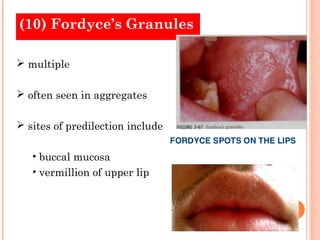
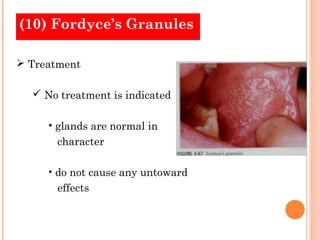
(10) Fordyce’s Granules

 represents ectopic sebaceous
  glands or sebaceous
  choristomas

    normal tissue in abnormal
     location

 regarded as developmental

 considered a variation of normal
(10) Fordyce’s Granules

 multiple

 often seen in aggregates

 sites of predilection include

   • buccal mucosa
   • vermillion of upper lip
(10) Fordyce’s Granules

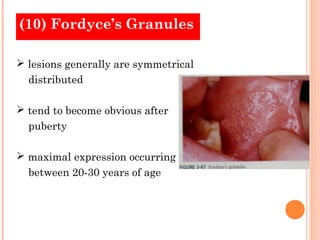
 lesions generally are symmetrical
  distributed

 tend to become obvious after
  puberty

 maximal expression occurring
  between 20-30 years of age
(10) Fordyce’s Granules

 lesions are asymptomatic

 discovered during routine
  oral examination
(10) Fordyce’s Granules

 Treatment

   No treatment is indicated

     • glands are normal in
       character

     • do not cause any untoward
       effects
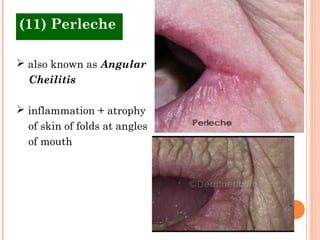
(11) Perleche

 also known as Angular
  Cheilitis

 inflammation + atrophy
  of skin of folds at angles
  of mouth
(11) Perleche

 may be due to:

    excessive lip licking

    thumb sucking

    sagging of facial skin
    in edentulous or elderly
    persons
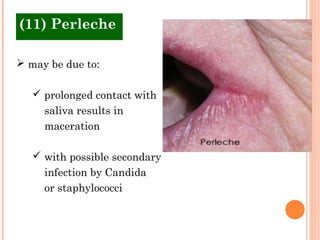
(11) Perleche

 may be due to:

    prolonged contact with
     saliva results in
     maceration

    with possible secondary
     infection by Candida
     or staphylococci
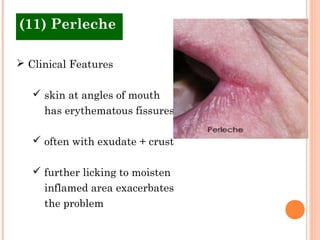
(11) Perleche

 Clinical Features

    skin at angles of mouth
     has erythematous fissures

    often with exudate + crust

    further licking to moisten
     inflamed area exacerbates
     the problem
(11) Perleche

 Treatment

   applying antimicrobial
    creams

   followed by low-potency
    steroid creams until
    symptoms resolve

   protective lip balm may help
    prevent recurrence
References:
 Books
   Cawson, R.A: Cawson’s Essentials of Oral
       Oral Pathology and Oral Medicine,
       8th Edition
        • (page 165-167 )
   Neville, et. al: Oral and Maxillofacial Pathology
        3rd Edition
        • (pages 388- 397; 590-592; 819-820)
  Regezi, et. al: Oral Pathology: Clinical Pathologic
       Correlations, 5th Edition
        • (pages 73-105; 241-242; 296-299; 394)

White lesions (2)

  • 1.
    WHITE LESIONS Prepared by: Dr. Rea Corpuz
  • 2.
    White Lesions  lesionsof the oral mucosa, which are white results from a  thickened layer of keratin  epithelial hyperplasia  intracellular epithelial edema  reduced vascularity of subjacent connective
  • 3.
    White Lesions  whiteor yellow lesions may also be due to fibrous exudate covering an:  ulcer  submucosal deposit  surface debris  fungal colonies
  • 4.
    White Lesions  (1)Leukoedema  (2) Leukoplakia  (3) Lichen Planus  (4) Candidiasis  (5) White Sponge Nevus  (6) Nicotine Stomatitis
  • 5.
    White Lesions  (7)Geographic Tongue  (8) Hairy Tongue  (9) Dental Lamina Cyst  (10) Fordyce’s Disease  (11) Perleche
  • 6.
    (1) Leukoedema  generalizedopacification of buccal mucosa that is regarded as a variation of normal  can be identified in majority of population
  • 7.
    (1) Leukoedema  Etiology& Pathogenesis  to date, cause has not been established  smoking  chewing tobacco none  alcoholo ingestion are  bacterial infection proven  salivary condition cause  electrochemical interactions have been implicated
  • 8.
    (1) Leukoedema  ClinicalFeatures  usual discovered as incidental finding  asymptomatic  symmetrically distributed in buccal mucosa
  • 9.
    (1) Leukoedema  ClinicalFeatures  appear as gray-white, diffuse, filmy or milky surface  more exaggerated cases, whitish cast with surface textural changes • wrinkling • or corrugations
  • 10.
    (1) Leukoedema  ClinicalFeatures  with stretching of buccal mucosa, opaque changes dissipate  more apparent in non-whites, especially African-American
  • 11.
    (1) Leukoedema  Treatment  NO treatment is necessary  since there is no malignant potential  if there is any doubt about diagnosis, a biopsy can be performed
  • 12.
    (2) Leukoplakia  alsoknown as Leukokeratosis; Erythroplakia  Leuko= white  Plakia = patch  defined by World Health Organization (WHO) as a white patch or plaque that cannot be characterized clinically or pathologically as any other disease
  • 13.
    (2) Leukoplakia Leukoplakia  clinicalterm indicating a white patch or plaque of oral mucosa  cannot be rubbed off  cannot be characterized clinically as any other disease  biopsy is mandatory to establish a definitive diagnosis
  • 14.
    (2) Leukoplakia  Mildor Thin Leukoplakia  Homogenous or Thick Leukoplakia  Granular or Nodular Leukoplakia  Verrucous or Verruciform Leukoplakia
  • 15.
    (2) Leukoplakia  ProliferativeVerrucous Leukoplakia (PVL)  Erythroleukoplakia or Speckled Leukoplakia
  • 16.
  • 17.
    (2) Leukoplakia  Mildor Thin Leukoplakia  seldom shows dysplasia on biopsy  may disappear or continue unchanged
  • 18.
    (2) Leukoplakia  Homogenousor Thick Leukoplakia  for tobacco smokers who do not reduce their habit  2/3 of such lesions slowly extend laterally, become thicker + acquire distinctly white appearance
  • 19.
    (2) Leukoplakia  Homogenousor Thick Leukoplakia  affected mucosa may become leathery to palpation  fissures may deepen  become more numerous  most thick, smooth lesions remain indefinitely at this stage
  • 20.
    (2) Leukoplakia  Homogenousor Thick Leukoplakia  some, perhaps as many as 1/3, regress or disappear
  • 21.
    (2) Leukoplakia  Granularor Nodular Leukoplakia  few become even more severe  develop increased surface irregularities
  • 22.
    (2) Leukoplakia  Verrucousor Verruciform Leukoplakia  lesions that demonstrate sharp or blunt projections
  • 23.
    (2) Leukoplakia  ProliferativeVerrucous Leukoplakia (PVL)  high risk form of leukoplakia  development of multiple keratotic plaques  with roughened surface projections
  • 24.
    (2) Leukoplakia  ProliferativeVerrucous Leukoplakia (PVL)  tend to slowly spread  involve additional oral mucosal sites  gingiva is frequently involved  although other sites may be affected as well
  • 25.
    (2) Leukoplakia  ProliferativeVerrucous Leukoplakia (PVL)  as lesions progress, there may go through a stage indistinguishable  transform into full-fledged squamous cell carcinoma (usually within 8 years of initial PVL diagnosis)
  • 26.
    (2) Leukoplakia  ProliferativeVerrucous Leukoplakia (PVL)  lesions rarely regress despite therapy  strong female predilection  minimal association with tobacco use
  • 27.
    (2) Leukoplakia  Erythroplakia  leukoplakia may become dysplastic  even invasive, with no change in its clinical appearance  however, some lesions eventually demonstrate scattered patches of redness called erythroplakia
  • 28.
    (2) Leukoplakia  Erythroleukoplakiaor Speckled Leukoplakia  such areas usually represent sites in which epithelial cells are so immature or atrophic that they can no longer produce keratin
  • 29.
    (2) Leukoplakia  Erythroleukoplakiaor Speckled Leukoplakia  intermixed red-and-white lesion  pattern of leukoplakia that frequently reveals advanced dysplasia on biopsy
  • 30.
    (2) Leukoplakia  Etiology& Prognosis  many cases are etiologically related to use of tobacco in smoked or smokeless forms and may regress after discontinuation of tobacco use
  • 31.
    (2) Leukoplakia  Etiology& Prognosis  other factors, such as • alcohol abuse may have • trauma a role in • C. albicans infection etiology
  • 32.
    (2) Leukoplakia  Etiology& Prognosis  nutritional factors have been cited as important, especially iron deficiency anemia
  • 33.
    (2) Leukoplakia  ClinicalFeatures  associated with middle-aged + older population  vast majority of cases occur after age of 40 years
  • 34.
    (2) Leukoplakia  Siteof Occurence  Vestibule  Buccal  Palate  Alveolar Ridge  Lip  Tongue  Floor
  • 35.
    (2) Leukoplakia  leukoplakiaof lips + tongue also exhibits relative high percentage of dysplastic or neoplastic change
  • 36.
    (2) Leukoplakia  Treatment& Prognosis  absence of dysplastic or atypical epithelial changes • periodic examinations + rebiopsy of new suspicious areas are recommended
  • 37.
    (2) Leukoplakia  Treatment& Prognosis  if diagnosis as moderate to severe dysplasia • excision is obligatory  for large lesions, grafting procedures may be necessary after surgery  may recur after complete removal
  • 38.
    (3) Lichen Planus chronic mucocutaneous disease of unknown cause  relatively common  typically presents as bilateral white lesions  occasionally with associated ulcers
  • 39.
    (3) Lichen Planus Pathogenesis  although cause is unknown  generally considered to be a immunologically mediated process  resembles hypersensitivity reaction
  • 40.
    (3) Lichen Planus Clinical Features  disease of middle age  affects men + women in nearly equal numbers  children rarely affected
  • 41.
    (3) Lichen Planus Clinical Features  Types: • Reticular • Erosive (ulcerative) • Plaque • Papular • Erythematous (atrophic)
  • 42.
    (3) Lichen Planus Clinical Features  Reticular Form • most common type • numerous interlacing white keratotic lines or striae (Wickham’s striae)  produces anular or lacy pattern
  • 43.
    (3) Lichen Planus Clinical Features  Reticular Form • buccal mucosa is the site most commonly involved • may also be noted on:  tongue  gingiva – less common  lips
  • 44.
    (3) Lichen Planus Clinical Features  Plaque Form • resembles leukoplakia • but has multifocal distribution • range from slightly elevated to smooth and flat
  • 45.
    (3) Lichen Planus Clinical Features  Plaque Form • primary sites are  dorsum of tongue  buccal mucosa
  • 46.
    (3) Lichen Planus Clinical Features  Erythematous Form • red patches • with very fine white striae • attached gingiva commonly involved
  • 47.
    (3) Lichen Planus Clinical Features  Erythematous Form • patchy distribution often in four quadrants • patient may complain of  burning  sensitivity  generalized discomfort
  • 48.
    (3) Lichen Planus Clinical Features  Erosive Form • central area of lesion is ulcerated • fibrinous plaque or pseudomembrane covers ulcer • changing patterns of involvement from week to week
  • 49.
    (3) Lichen Planus Treatment  although it cannot be generally cured  some drugs can provide satisfactory control  corticosteroids are the single most useful group of drugs in the management of lichen planus
  • 50.
    (3) Lichen Planus Treatment  corticosteroid • ability to modulate inflammation + immune response
  • 51.
    (3) Lichen Planus Treatment  topical application + local injection of steroids have been used successfully in controlling but not curing this disease
  • 52.
    (4) Candidiasis  commonoppurtunistic oral mycotic infection  develops in the presence of one of several predisposing factors • immunodeficiency • endocrine disturbances • hypoparathyroidism • diabetes mellitus • poor oral hygiene • xerostomia
  • 53.
    (4) Candidiasis  causedby Candida albicans  infection with this organism is usually superficial, affecting the outer aspects of involved oral mucosa or skin
  • 54.
    (4) Candidiasis  inseverely debilitated + immunocompromised patients such as patients with AIDS  infection may extend into alimentary tract (candidal esophagitis  bronchopulmonary tract  and other organ system
  • 55.
    (4) Candidiasis  ClinicalFeatures  most common form is acute pseudomembranous also known, as thrush • young infants + elderly are commonly affected
  • 56.
    (4) Candidiasis  ClinicalFeatures  oral lesion of acute candidiasis (thrush) • white • soft plaques that sometime grow centrifugally + merge • wiping plaques with gauze sponge leaves a painful, eroded, eryhtematous or ulcerated surface
  • 57.
    (4) Candidiasis  ClinicalFeatures  Chronic Erythematous Candidiasis • commonly seen on geriatric individuals • who wear complete maxillary denture
  • 58.
    (4) Candidiasis  ClinicalFeatures  Chronic Erythematous Candidiasis • distinct predilection for palatal mucosa as compared with mandibular alveolar arch
  • 59.
    (4) Candidiasis  ClinicalFeatures  Chronic Erythematous Candidiasis • chronic low-grade resulting from poor prosthesis fit • failure to remove appliance at night
  • 60.
    (4) Candidiasis  ClinicalFeatures  Chronic Erythematous Candidiasis • bright red • relative little keratinization
  • 61.
    (4) Candidiasis  ClinicalFeatures  Hyperplastic Candidiasis • may involve dorsum of tongue • pattern referred to as median rhomboid glossitis
  • 62.
    (4) Candidiasis  ClinicalFeatures  Hyperplastic Candidiasis • usually asymptomatic • usually discovered on routine oral examination
  • 63.
    (4) Candidiasis  ClinicalFeatures  Hyperplastic Candidiasis • found anterior to circumvallate papillae • oval or rhomboid outline
  • 64.
    (4) Candidiasis  ClinicalFeatures  Hyperplastic Candidiasis • may have smooth, nodular or fissured surface • range in color from white to more red
  • 65.
    (4) Candidiasis  ClinicalFeatures  Mucocutaneous Candidiasis • long standing • persistent candidiasis of  oral mucosa  skin  vaginal mucosa
  • 66.
    (4) Candidiasis  ClinicalFeatures  Mucocutaneous Candidiasis • often resistant to treatment • begins as a pseudomembranous type of candidiasis • soon followed by nail + cutaneous involvement
  • 67.
    (4) Candidiasis  Treatment  majority of infections may be simply treated with topical applications of nystatin suspension • nystatin cream or ointment often effective when applied directly to denture-bearing surface itself
  • 68.
    (4) Candidiasis  Treatment  topical applications of either nystatin or clotrimazole should be continued for at least 1 week beyond disappearance of clinical manifestations of disease
  • 69.
    (4) Candidiasis  Treatment  Hyperplastic Candidiasis • topical + systemic antifungal agents may not be effective at completely removing lesions  surgical management may be necessary
  • 70.
    (4) Candidiasis  Treatment  Chronic Mucocutaneous Candidiasis associated with immunosuppression • topical agents may not be effective
  • 71.
    (4) Candidiasis  Treatment  Chronic Mucocutaneous Candidiasis associated with immunosuppression • systemic administration of medications:  Ketoconazole  Fluconazole  Itraconazole
  • 72.
    (5) White SpongeNevus  autosomal-dominant condition  due to point mutations for genes coding for keratin 4 and/or 13.  affects oral mucosa bilaterally  NO treatment is required
  • 73.
    (5) White SpongeNevus  Clinical Features • asymptomatic • folded white lesions • may affect several mucosal sites • lesions tend to be thickened + spongy consitency
  • 74.
    (5) White SpongeNevus  Clinical Features • presentation intraorally is almost always bilateral + symmetric • usually appears early in life, typically before puberty
  • 75.
    (5) White SpongeNevus  Clinical Features • usually observed in buccal mucosa • tongue + vestibular mucosa may be involved
  • 76.
    (5) White SpongeNevus  Treatment • NO treatment necessary since it is asymptomatic + benign
  • 77.
    (6) Nicotine Stomatitis common tobacco-related form of keratosis  typically associated with pipe + cigar smoking  with positive correlation between intensity of smoking + severity of condition
  • 78.
    (6) Nicotine Stomatitis combination of tobacco carcinogens + heat is markedly intensified in reverse smoking (lit end positioned inside the mouth)  adding a significant risk for malignant conversion
  • 79.
    (6) Nicotine Stomatitis Clinical Features  palatal mucosa initially responds with an erythematous change follwed by keratinization
  • 80.
    (6) Nicotine Stomatitis Clinical Features  subsequent to opacification or keratinization of palate • red dots surrounded by white keratotic rings appear  dot represent inflammation of salivary gland excretory duct
  • 81.
    (6) Nicotine Stomatitis Treatment  condition rarely evolves into malignancy  except in individuals who reverse smoke  discontinuation of tobacco habit
  • 82.
    (7) Geographic Tongue also known as erythema migrans, benign migratory glossitis  prevalent among whites + blacks  strongly associated with fissure tongue  inversely associated with cigarette smoking
  • 83.
    (7) Geographic Tongue emotional stress may enhance the process
  • 84.
    (7) Geographic Tongue Clinical Features  affects women slightly more than men  children occasionally may be affected  characterized initially by presence of atrophic patches surrounded by elevated keratotic margins
  • 85.
    (7) Geographic Tongue Clinical Features  desquamated areas appear red + may be slightly tender  followed over a period of days or weeks, pattern changes  appearing to move across dorsum of tongue
  • 86.
    (7) Geographic Tongue Clinical Features  most patients are asymptomatic  occasionally patients complain of irritation or tenderness  especially in relation to consumption of spicy foods + alcoholic beverages
  • 87.
    (7) Geographic Tongue Clinical Features  lesions periodically disappear  recur for no apparent reason
  • 88.
    (7) Geographic Tongue Treatment  NO treatment is required because of self-limiting + usually asymptomatic nature of this condition
  • 89.
    (7) Geographic Tongue Treatment  when symptoms occur, • topical steroids especially ones containing antifungal agent  helpful in reducing symptoms
  • 90.
    (7) Geographic Tongue Treatment  mouth clean using mouthrinse composed of sodium bicarbonate in water  reassure patients that condition is totally benign
  • 91.
    (8) Hairy Tongue clinical term referring to a condition of filiform papillae overgrowth on dorsal surface of tongue  there are numerous initiating or predisposing factors for hairy tongue
  • 92.
    (8) Hairy Tongue broad spectrum antibiotics such as penicillin + systemic cortiocosteroids are often identified in clinical history of patients with this condition
  • 93.
    (8) Hairy Tongue oxygenating mouthrinses containing:  hydrogen peroxide  sodium perborate  carbamide peroxide  have been cited as possible etiologic agents
  • 94.
    (8) Hairy Tongue Clinical Features  clinical alteration translates to hyperplasia of filiform papillae; result is • thick serves to trap • matted surface bacteria, fungi, foreign materials
  • 95.
    (8) Hairy Tongue Clinical Features  extensive elongation of papillae occurs, • gagging may be • tickiling sensation felt
  • 96.
    (8) Hairy Tongue Clinical Features  color may range from white to tan to deep brown depending on: • diet • oral hygiene • composition of bacteria inhabiting papillary surface
  • 97.
    (8) Hairy Tongue Treatment  brush/scrape tongue with baking soda  maintain good oral hygiene  emphasize to patients that this process is entirely benign
  • 98.
    (8) Hairy Tongue Treatment  self-limiting  tongue should return to normal after institution of physical debridement + proper oral hygiene
  • 99.
    (9) Dental LaminaCyst  also known as Gingival Cyst of New Born or Bohn’s nodules  appear as multiple nodules along alveolar ridge in neonates
  • 100.
    (9) Dental LaminaCyst  similar epithelial inclusion cysts may occur along midline of palate (palatine cyst of new born or Epstein’s pearls)  developmental origin  derived from epithelium  included in fusion line between palatal shelves + nasal processes  no treatment; resolve spontaneously
  • 101.
    (9) Dental LaminaCyst  Treatment  not necessary because nearly all spontaneously rupture before patient is 3 months of age
  • 102.
    (10) Fordyce’s Granules represents ectopic sebaceous glands or sebaceous choristomas  normal tissue in abnormal location  regarded as developmental  considered a variation of normal
  • 103.
    (10) Fordyce’s Granules multiple  often seen in aggregates  sites of predilection include • buccal mucosa • vermillion of upper lip
  • 104.
    (10) Fordyce’s Granules lesions generally are symmetrical distributed  tend to become obvious after puberty  maximal expression occurring between 20-30 years of age
  • 105.
    (10) Fordyce’s Granules lesions are asymptomatic  discovered during routine oral examination
  • 106.
    (10) Fordyce’s Granules Treatment  No treatment is indicated • glands are normal in character • do not cause any untoward effects
  • 107.
    (11) Perleche  alsoknown as Angular Cheilitis  inflammation + atrophy of skin of folds at angles of mouth
  • 108.
    (11) Perleche  maybe due to:  excessive lip licking  thumb sucking  sagging of facial skin in edentulous or elderly persons
  • 109.
    (11) Perleche  maybe due to:  prolonged contact with saliva results in maceration  with possible secondary infection by Candida or staphylococci
  • 110.
    (11) Perleche  ClinicalFeatures  skin at angles of mouth has erythematous fissures  often with exudate + crust  further licking to moisten inflamed area exacerbates the problem
  • 111.
    (11) Perleche  Treatment  applying antimicrobial creams  followed by low-potency steroid creams until symptoms resolve  protective lip balm may help prevent recurrence
  • 112.
    References:  Books  Cawson, R.A: Cawson’s Essentials of Oral Oral Pathology and Oral Medicine, 8th Edition • (page 165-167 )  Neville, et. al: Oral and Maxillofacial Pathology 3rd Edition • (pages 388- 397; 590-592; 819-820) Regezi, et. al: Oral Pathology: Clinical Pathologic Correlations, 5th Edition • (pages 73-105; 241-242; 296-299; 394)