 Lichen planus (LP) is derived from the Greek
leichen meaning tree moss and the Latin planus
meaning flat
 Lichens are primitive plants composed of symbiotic
algae and fungi
 Planus in Latin for flat.
 Term suggests flat fungal condition
 Current evidence indicates –Immunologicaly
mediated mucocutaneous disorder.
Text book of oral medicine and radiology –ongole first edition
Erasmus Wilson first described LP in 1869, as
a chronic disease affecting the skin, scalp,
nails, and mucosa, with possible rare malignant
degeneration.
And is thought to affect 0.5 to 1% of the
worlds population.
 Francois Henri Hallopeau reported the first
oral lichen planus (OLP)–related
carcinoma in 1910.
Thibierge first described the oral lesions
symmetrically in 1893
Text book of oral medicine and radiology –ongole first edition
 WICKHAM 1895 described the characteristic
appearance of whitish striae and
punctuations that develop atop the flat
surfaced papules
Text book of oral medicine and radiology –ongole first edition
cont.....
Definition
Oral lichen planus (OLP) is defined as a common
chronic immunological mucocutaneous disorder
that varies in appearnce from keratotic to
erythematous and ulcerative
Lichen planus is relatively common disorder of the
stratified squamous epithelia
Wilson 1896
Duske and frick,1982: skully and El-kom1985
 Eisen D 2005 defined oral lichen planus as a
relatively common chronic inflammatory
disorder affecting the statified squamous
epithelia
 Lichen planus (LP) is a common disorder in
which auto-cytotoxic T lymphocytes trigger
apoptosis of epithelial cells leading to chronic
inflammation. Oral LP (OLP) can be a source
of severe morbidity and has a small potential
to be malignant.
Crispian Scully 2007
Text book of oral medicine and radiology –ongole first edition
 Inspite of extensive research ,exact etiology is still unknown
 The most accepted and current data suggests that OLP is a T
cell mediated inflammatory disease (Regezi et al., 1978)
(Gilhar et al., 1989), (Porter et al., 1997) (Sugerman et al.,
2002) in which there is a production of cytokines which leads
to apoptosis
 Auto cytotoxic CD8 and Tcells trigger apoptosis of oral
epithelial cells.(eversole 1997 porter et al 1997
Abnormal recognition and expression of basal keratinocytes
of epithelium as foreign antigens by langerhans cells
Text book of oral medicine and radiology –ongole first edition
 Other possible theories include the genetic
background ,where the weak association
between HLA antigen and lichen planus was
found by POWELL et al 1986 and roston 1994
 Vincent et al 1990 ,soto araya et al 2004
reported the strong association of
psychological factors like higher level of
anxiety, greater depression and psychic
disorders in patients with erosive lichen
planus.
Text book of oral medicine and radiology –ongole first edition
PREDISPOSING FACTORS
 GENETIC BACKGROUND
 AUTO IMMUNITY –ASSOCIATED WITH OTHER AUTO IMMUNE
DISEASE
 IMMUNODEFICIENCY
 DRUGS
 DENTAL MATERIALS
 STRESS
 HABITS
pathogenesis of oral lichen planus j oral pathol med 2010 19;729_734
1
•ANTIGEN SPECIFIC CELL MEDIATED MECHANISM
2
•NON SPECIFIC MECHANISM
3
•AUTOIMMUNE RESPONSE
4
•HUMORAL IMMUNITY
PATHOGENESIS OF OLP
The various mechanisms hypothesized to be
involved in the immunopathogenesis are:
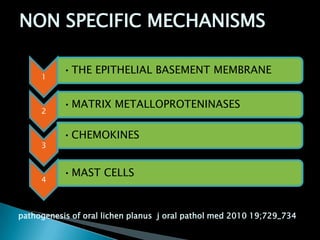
1
•THE EPITHELIAL BASEMENT MEMBRANE
2
•MATRIX METALLOPROTENINASES
3
•CHEMOKINES
4
•MAST CELLS
NON SPECIFIC MECHANISMS
pathogenesis of oral lichen planus j oral pathol med 2010 19;729_734
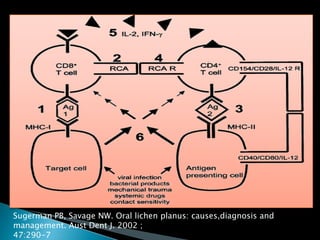
Sugerman PB, Savage NW. Oral lichen planus: causes,diagnosis and
management. Aust Dent J. 2002 ;
47:290-7
EPIDEMIOLOGY
•Very common- 1% of population
•In Indians 1.5%(average)
•3.7% mixed oral habits
•0.3% non users of tobacco
•Risk more among who smoke and chew tobacco
RACE
Oral lichen planus affects all racial groups.
SEX
The female-to-male ratio for oral lichen planus is
1.4:1
Text book of oral medicine-burkete‟s 11th edition
 Oral lichen planus is invariably a
disease that affects regions of the oral
cavity bilaterally.
 Oral lesions usually involve the
posterior buccal mucosa, or less
commonly the tongue and although
any site can be involved palatal and
sublingual lesions are not common
AGE- middle aged or elderly people
MEAN AGE OF ONSET- 5 th decade of life
rarely in young adults and children
Lichen planus commonly affects 1-2% of the general
population ,prevalance rate being 0.5to 2.2%
40% lesions occur on both oral and cutaneous
surfaces, 35% occur on cutaneous surfaces alone,and
25% occur on oral mucosa alone
Text book of oral medicine-burkete‟s 11th edition
 Cutaneous lesions of lichen planus (LP) are
self-limiting and cause itching.
 Appears as purple, pruritic ,polygonal, flat
topped –flexor surfaces
 Fine lace like network of white lines
(whikam s striae)
Text book of oral medicine-burkete‟s 11th edition
Louis frederic wickham
described the presence of
fine white or grey lines or
dots seen on the top of the
pruritic rash on the skin in
lichen planus .
These striae are popularly
referred to as
“WICKHAMS STRIAE or
HONITON LACE”
Text book of oral medicine and radiology –ongole first edition
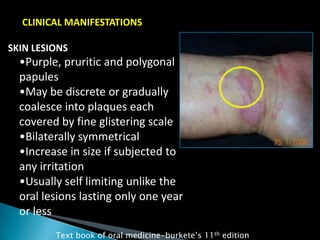
CLINICAL MANIFESTATIONS
SKIN LESIONS
•Purple, pruritic and polygonal
papules
•May be discrete or gradually
coalesce into plaques each
covered by fine glistering scale
•Bilaterally symmetrical
•Increase in size if subjected to
any irritation
•Usually self limiting unlike the
oral lesions lasting only one year
or less
Text book of oral medicine-burkete‟s 11th edition
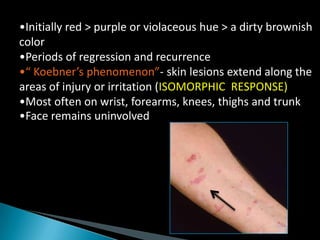
•Initially red > purple or violaceous hue > a dirty brownish
color
•Periods of regression and recurrence
•“ Koebner’s phenomenon”- skin lesions extend along the
areas of injury or irritation (ISOMORPHIC RESPONSE)
•Most often on wrist, forearms, knees, thighs and trunk
•Face remains uninvolved
TYPES OF CUTANEOUS LICHEN PLANUS
HYPERTROPHIC PLAQUES
VESICULAR LICHEN PLANUS
LICHEN PLANUS PEMPHIGOIDES
LICHEN PLANUS OF NAILS
LICHEN PLANOPILARIS
ACTINIC KERATOSIS (ON ARM)
ULCERATIVE LICHEN PLANUS
OVERLAP SYNDROME
TYPES OF ORAL LICHEN PLANUS:
The lichen planus can manifest in various clinical
forms ANDREASENS 1968 have described the clinical types.
They may be appearing as:
 RETICULAR
 PAPULES
 PLAQUE LIKE
 ATROPHIC
 EROSIVE
 BULLOUS
Text book of oral medicine and radiology –ongole first edition
 Most common and most readily
recognized form
 Mostly on posterior buccal mucosa.
 May not be seen on tongue ,less
commonly in gingiva &lips
 They are usually bilaterally seen.
 Characteristic pattern of interlacing
white lines (whikam s striae)
 The striae often displays a peripheral
erythematous zone ,which reflects the
subepithelial inflammation
• Lines are wavy and parallel
• Reticular olp can sometimes be
observed at the vermillion border
92%
Text book of oral medicine-burkete‟s 11th edition
 The papular type of olp is usually
present in the initial phase of the
disease.
 It is clinically characterized by
small white dots,which in most
occasions intermingle with the
reticular form.
 Sometimes the papular elements
merge with striae as part of the
natural course.
 SIZE 0.5MM
11%
Text book of oral medicine-burkete‟s 11th edition
 Plaque type olp shows a
homogenous well demarcated
white plaque often, but not
always surrounded by striae.
 Plaque type lesions may
clinically be very similar to
homogenous leukoplakia
 Common in tobacco users
 Single / multi focal
36%
Text book of oral medicine-burkete‟s 11th edition
It is characterized by a
homogenous red area.
 smooth, poorly defined
erythematus areas with or
without peripheral striae
Usually associated with
Desquamative gingivitis
ATROPHIC TYPE
Text book of oral medicine-burkete‟s 11th edition
44%
Pain and burning sensation
Keratotic changes combined with mucosal
erythema
Erythematous OLP requires a histopathologic
examination in order to arrive at a correct
When this type of lp is present in the buccal
mucosa or in the palate striae are frequently seen
in the periphery
ATROPHIC TYPE
Text book of oral medicine-burkete‟s 11th edition
 More significant for the patient because
the lesions are usually symptomatic.
 Atrophic areas with central ulceration of
varying degree
 Periphery of the atrophic regions is
usually bordered by fine ,white radiating
striae
 Atrophy and ulceration are –gingival
mucosa
• Pain, burning sensation, bleeding,
desquamative gingivitis
• Pseudo membrane covered ulcerations
with keratosis and erythema
Text book of oral medicine-burkete‟s 11th edition
9%
BULLOUS TYPE
Vesciculobullous presentation
combined with reticular or erosive
pattern
Rare form characterized by large
vesicles or bullae (4mm to 2cm)
Lesions usually develop within
an erythematus base, rupture
immediately leaving painful ulcers
Usually have peripheral radiating
striae and seen on posterior part
of buccal mucosa
1%
Text book of oral medicine-burkete‟s 11th edition
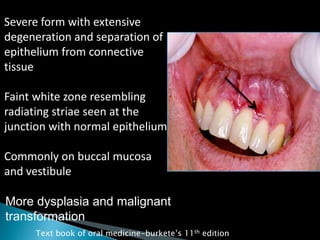
Severe form with extensive
degeneration and separation of
epithelium from connective
tissue
Faint white zone resembling
radiating striae seen at the
junction with normal epithelium
Commonly on buccal mucosa
and vestibule
More dysplasia and malignant
transformation
Text book of oral medicine-burkete‟s 11th edition
 They are the most disabling form
of oral lichen planus
 Clinically ,the fibrin coated ulcers
are surrounded by an
erythematous zone frequently
displaying radiating white striae.
 This appearance may reflect a
gradient of the intensity of sub
epithelial inflammation that is
most prominent at the centre of
the lesion.
Text book of oral medicine-burkete‟s 11th edition
Buccal mucosa 80%
Tongue 65%
Lips 20%
Gingiva,floor
of mouth& palate 10%
Text book of oral medicine-burkete‟s 11th edition
 Histopathology FIRST DESCRIBED BY DUBRENILL 1906
later revised by Shklar in 1972
◦Hyper orthokeratinisation or hyper parakeratinisation
◦Thickening of granular layer
◦Acanthosis of spinous layer
◦Intercellular oedema in spinous layer
◦“ Saw-tooth” rete pegs
◦Liquefaction necrosis of basal layer- Max Joseph spaces
◦Civatte ( hyaline or cytoid) bodies
◦Juxta epithelial band of inflammatory cells
◦An eosinophilic band may be seen just beneath the basement
membrane and represent fibrin covering lamina propria
Text book of oral medicine-burkete‟s 11th edition
HISTOLOGICAL PICTURES
Oral Lichen PlanusPallavi Parashar, BDS, DDS
World Health Organization diagnostic criteria
(1978) of oral lichen planus (OLP)
CLINICAL CRITERIA
Presence of white papule, reticular, annular,
plaque-type lesions,gray-white lines radiating
from the papules
Presence of a lace-like network of slightly
raised gray-whitelines (reticular pattern)
Presence of atrophic lesions with or without
erosion, may also Bullae
Correlation between clinical and histopathologic diagnoses of
oral lichen planus based on modified WHO diagnostic
criteria -Oral Surg Oral Med Oral Pathol Oral Radiol Endod 2009;107:796-800)
HISTOPATHOLOGIC CRITERIA
Presence of thickened ortho or parakeratinized layer in
sites with normally keratinized, and if site normally non
keratinized this layer may be very thin
Presence of Civatte bodies in basal layer, epithelium
and superficial part of the connective tissue
Presence of a well-defined band like zone of cellular
infiltration that is confined to the superficial part of the
connective tissue,consisting mainly of lymphocytes
Signs of „liquefaction degeneration‟ in the basal cell
layer
Correlation between clinical and histopathologic diagnoses of
oral lichen planus based on modified WHO diagnostic
criteria -Oral Surg Oral Med Oral Pathol Oral Radiol Endod 2009;107:796-800)
Modified World Health Organization diagnostic
criteria of OLP and OLL
CLINICAL CRITERIA
Presence of bilateral, more or less symmetrical lesions
Presence of a lacelike network of slightly raised gray-
white lines(reticular pattern)
Erosive, atrophic, bullous and plaque-type lesions are
accepted only as a subtype in the presence of reticular
lesion else where in the oral mucosa
In all other lesions that resemble OLP but do not complete
the aforemented criteria, the term “clinically compatible
with”should be used
HISOPATHOLOGIC CRITERIA
Presence of a well-defined bandlike zone of
cellular infiltrationthat is confined to the superficial
part of the connective tissue,consisting mainly of
lymphocytes
Signs of liquefaction degeneration in the basal cell
layer
Absence of epithelial dysplasia
When the histopathologic features are less
obvious, the term“histopathologically compatible
with” should be used
FINAL DIAGNOSIS FOR OLP OR OLL
To achieve a final diagnosis, clinical as well as histopathologic
criteria should be included
OLP A diagnosis of OLP requires fulfillment of both clinical and
histopathologic criteria
The term OLL will be used under the following
conditions:
1- Clinically typical of OLP but histopathologically only compatible with
OLP
2- Histopathologically typical of OLP but clinically only compatible with
OLP
3- Clinically compatible with OLP and histopathologically compatible
with OLP
 CD8+ T cells are activated in OLP andCD8+ T
cells co-localize with apoptotic keratinocytes
 in OLP lesions. CD8+ cytotoxic T cells are
known to trigger apoptosis of virally infected
cells.
 Herpes simplexvirus (HSV: human
herpesviruses types 1 and 2) causes an acute
gingivostomatitis, herpes labialis (cold
sores)and recurrent intra-oral herpes.
Oral lichen planus: Causes, diagnosis and managementAustralian Dental
Journal 2002;47:(4):290-297
Varicella-zoster virus
(VZV) human herpes virus 3causes chicken pox with
oral ulceration in children and shingles with pain and
oral ulceration in adults.
Epstein-Barr virus (EBV)
Human herpes virus 4 causes glandular fever
(infectious mononucleosis) with associated sore throat
and petechiae on the soft palate
Oral lichen planus: Causes, diagnosis and managementAustralian Dental
Journal 2002;47:(4):290-297
Cytomegalovirus (CMV:
Human herpes virus is associated with aphthous-type oral
ulceration
Human papillomavirus (HPV) 6 and 11
It cause oral warts (squamous papilloma) and condyloma
accuminatum whereas HPV 16 and 18 are associated with
some oral squamous cell carcinomas
The coxsackie RNA viruses may also infect the oral
mucosa. Coxsackie A4 causes herpangina, coxsackieA10
causes acute lympho reticular pharyngitis and coxsackie A16
causes hand, foot and mouth disease
 Lichen planus is often associated with immune
mediated diseases like
 Alopecia areata
 Dermatomyositis
 Lichen sclerosis et atrophicus
 Morphea
 Myasthenia gravis
 Ulcerative colitis
 Primary biliary sclerosis
Text book of oral medicine and radiology –ongole first edition
 GRINSPAN SYNDROME is the association of
OLP with diabetes and hypertension.
 GRAHAM LITTLE SYNDROME and VULVO-
VAGINO- GINGIVAL SYNDROME are other
syndromes associated with ORAL LICHEN
PLANUS, in which there is mucosal
involvement of gingival and genital
region, usually of erosive type.
Text book of oral medicine and radiology –ongole first edition
 OLP is considered a pre-malignant condition
 The reported transformation rates vary from 0 .5 to
2%. Over a period of 5 years
1.Increased risk of oral squamous cell carcinoma
2.Frequency of transformation is low, between 0.3% an3%
3.Erosive and atrophic forms commonly undergo
transformation
Holmpstrup et al 1998
COMPLICATIONS
 Oral lichen planus and its treatment may
predispose people to oral C albicans super
infection
Patients with oral lichen planus may have a
slightly increased risk of oral cancer,
 Oral SCC in patients with oral lichen planus
is a feared complication an controversial
issue.
Oral Lichen PlanusJ:ournal of Dental Sciences & Research 2:1: Pages 62-87
 Clinical aspect
 Histopathological features
 3 essential features
1. Hyperortho or para keratosis
2. Saw tooth rete pegs
3. Basal cell liquefaction degeneration
 Additional features
1. T lymphocyte infilterate
2. Civatte or colloid bodies
3. Artificial tearing b/t epithelium and
connective tissue.
Oral Lichen Planus is a diagnosis
that demands careful correlation of
the clinical setting with the results
of routine biopsy examination.
 Lichenoid reaction
 Oral leukoplakia
 Frictional keratosis
 Discoid Lupus Erythematosus
 Chronic Ulcerative Stomatitis
 Erythema multiformae
 Pemphigus Vulgaris
 Benign Mucous Membrane Pemphigoid
DD for Oral Maxillofacial Lesions-Wood&Goaz
1. LEUKOPLAKIA
 known irritant factor
 Clinical appearance
 Histopathology
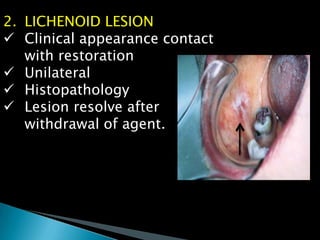
2. LICHENOID LESION
 Clinical appearance contact
with restoration
 Unilateral
 Histopathology
 Lesion resolve after
withdrawal of agent.
3.LUPUS ERYHTEMATOSUS
 Well demarcated
cutaneous lesions with
round or oval
erythematous plaques
with scales and
follicular plugging
 Histopathology
 Direct
immunofluorescence
 Butterfly like rashes
over the cheeks and
nose known as malar
rash.
4.PEMPHIGUS VULGARIS
Nikolsky sign positive
in pemphigus vulgaris
Patient gives the
recurrence history of
bullae and vesicle
formation
5.BENIGN MUCOUS MEMBRANE PEMPHIGOID
Eye involvement
Mucosal blistering,
ulceration, subsequent
scaring
Desquamative gingivitis
is the most common
manifestation and may be
the only manifestation of
the disease appearing
bright red
It is typically clinically
characterized by a white lesion
without any red elements
The lesion is observed in areas
of the oral mucosa subjected to
increased friction, or trauma
caused by ,for example food
intake.
Lesion is non symptomatic
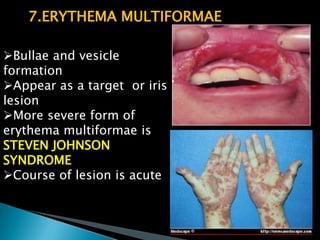
7.ERYTHEMA MULTIFORMAE
Bullae and vesicle
formation
Appear as a target or iris
lesion
More severe form of
erythema multiformae is
STEVEN JOHNSON
SYNDROME
Course of lesion is acute
8.CHRONIC ULCERATIVE STOMATITIS
Painful, exacerbating
and remitting oral
erosions, and
ulcerations
 Biopsy of the lesion should be done to
confirm the diagnosis
 Erosive lichen planus may be examined
histopathologically to assess for dysplastic
features
 Hypertrophic form of lichen planus resembles
homogenous leukoplakia
 In order to differentiate this condition from
leukoplakia the lesion can be biopsied.
Text book of oral medicine and radiology –ongole first edition
DIAGNOSTIC TESTS
Direct immunofluorescence is useful in distinguishing OLP
from other lesions, especially vesiculobullous lesions such
as PV BMMP and linear immunoglobulin A (IgA) bullous
dermatitis
Direct immunofluoresence demonstates a shaggy band of
fibrinogen in the basement membrane zone is 90 to 100 %
cases
Specimens for immunofluoresence should be stored in
MICHEL”S BOUINS SOLUTION or normal saline and then sent
to histopathology
Indirect immunofluorescence studies are not useful in the
clinical diagnosis of OLP. Serum test is negative
Text book of oral medicine and radiology –ongole first edition
Periodic acid-Schiff (PAS)staining of
biopsy specimens and candidal cultures or
smears may be performed.
Other Tests
Skin patch testing may be helpful in
identifying a contact allergy in some
patients with oral lichen planus.
Oral Lichen PlanusJ:ournal of Dental Sciences & Research 2:1: Pages 62-87
 Oral lichen planus is a chronic inflammatory
disease.
 The lesions of cutaneous lichen planus typically
resolve within1-2 years, whereas the lesions of
oral lichen planus are long lasting and persist for
20 years
 Resolution of the white striations, plaques, or
papules is rare.
 Current immunosuppressiv etherapies usually
control oral mucosal erythema, ulceration,and
symptoms in patients with oral lichen planus with
minimal adverse effects.
Oral Lichen PlanusJ:ournal of Dental Sciences & Research 2:1: Pages 62-87
 Advise patients that oral lichen planus lesions
may persist for many years with periods of
exacerbation and quiescence
 In the context of appropriate medical care,
the prognosis for most patients with oral
lichen planus is excellent.
Oral Lichen PlanusJ:ournal of Dental Sciences & Research 2:1: Pages 62-87
PATIENT EDUCATION IN ORAL LICHEN PLANUS
The importance of patient education in OLP has
been reported.
 The chronicity of oral lichen planus and the expected
periods of exacerbation and quiescence
 The aims of treatment,specifically the elimination of
mucosal erythema, ulceration,pain, and sensitivity
The possibility that several treatments may need to be
tried
 The potentially increased risk of oral cancer
The possibility of reducing the risk of oral cancer .
Oral Lichen PlanusJ:ournal of Dental Sciences & Research 2:1: Pages 62-87
Lichen planus like eruptions were first reported in
military personnel in World War II who had been
prescribed anti-malarial drugs.
Since that time, a wide variety of drugs have been
associated with precipitating lichen planus – like
eruptions and this phenomenon has been termed
lichenoid drug reaction.
Lichenoid lesions may be unilateral, asymmetric and
occur in uncommon sites and tend to be erosive.
Histological examination may show a more diffuse
lymphocytic infiltrate and more colloid bodies than in
classic LP
ORAL LICHENOID REACTION (OLR):
 Lichenoid reaction is a term used for lesions that
resemble OLP clinically and histologically, but have an
identifiable aetiology.
 Precipitants include chronic graft verses host disease
(cGVHD), some dental materials and a range of drugs
 They may be a manifestation of disease like lupus
erythematosus.
Oral mucosal disease;British Journal of Oral and Maxillofacial Surgery
46 (2008) 15–21
Lichenoid reaction to the amalgam restoration on the buccal
aspect of the molar tooth. This is an isolated response without the
symmetrical distribution seen in typical OLP.
Oral lichen planus: Causes, diagnosis and managementAustralian Dental
treatment
 General consideration
 Achieve specific goal
 Eliminate atrophic and ulcerated lesions
 Allevate symptoms
 Avoid mechanical trauma and irritation
 Absolutely there is no treatment
for OLP
 If no symptoms – no active
treatment is needed except
reassurance ,reviewed regularly.
 Corticosteroids
 Retinoid
 Grisofulvin
 Cyclosporin
 More useful in management of OLP
Topical corticosteriods
 Systemic steroids are contraindicated or the
patient refuses intralesional injections
 Safer , long-term use needs follow up
 Causes adrenal suppression
 Secondary candidiasis
 These have great value when there is acute
exacerbation of symptoms
 Used in combinations with topical steroids
 Adverse effects-GI upset, polyurea ,
insomnia
Retinoids
 First used for the treatment of
asymptomatic reticulated lichenplanus
 Tretinoin is the available Vit A 0.1% (applied
locally).
 RETINOIDS
 TOPICAL – 0.1% vit A
 Rapid elimination but with
relapse
 0.1% isotretenoin gel
 Tretenoin ointment – burning
sensation and irritation
 Systemic --- Etretinate 25 -
75 mg/day relapse after
discontinuatuon
CYCLOSPORIN
 Immunosuppressant
reduces lymphokines
 Reduces the proliferation
and function of T-
lymphocytes
 Renal dysfunction
GRISEOFULVIN
 In treatment of erosive Lp
when steroid is
contraindicated or
 When lesion is resistant to
steroids.
 Its appropriate to use topical with
intralesional preparations
 Causes atrophy of tissues and secondary
candidiasis
 DRUG THERAPY
 Optimal dose, duration and true
efficacy remain variable.
 Corticosteroids
 Topical 0.1% triamcinolone acetonide
 Potent preparation --- 0.1%
fluocinolone acetonide
--- 0.05%
fluocinonide
 Orobase
 Elixir form --- dexamethasome
---- triamcinolone
---- clobetasol
 SYSTEMIC STEROIDS
 Reserved for recalcitrant LP
 Daily dose of prednisone 40-80mg for
initial 5-7 days – gradually withdrawal
over 2-4 weeks
 Alternate day administration.
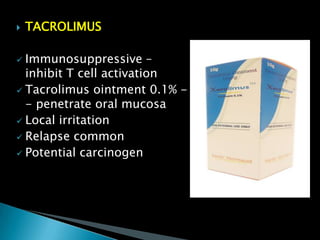
 TACROLIMUS
 Immunosuppressive –
inhibit T cell activation
 Tacrolimus ointment 0.1% -
- penetrate oral mucosa
 Local irritation
 Relapse common
 Potential carcinogen
 CYCLOSPORIN
 Suppress T cell cytokine production
 Solution of 100mg/ml --- bad taste,
burningsensation , high cost
 Alternative for initial control
 MISCELLANEOUS
1. ANTIFUNGAL
 Topical clotrimazole
2. ANTIBIOTIC
 2% auromycin mouth wash
 Tetracycline mouth wash
Surgery
Surgical excision, cryotherapy, CO2 laser,
andND:YAG laser have all been used in the
treatment of OLP.
 In general, surgery is reserved to remove
high-risk dysplastic areas.
management of oral lichen planus Arch Iranian Med 2005; 8 (4): 252 –
256
Laser
The 308 nm excimer laser has been used as a
possible and additional method in the treatment
of OLP.
 Treatments are painless and well tolerated.
Clinical improvement has been achieved in most
patients. Excimer 308 nm lasers could be an
effective choice in treating symptomatic OLP
management of oral lichen planus Arch Iranian Med 2005; 8 (4): 252 –
256
PHOTOCHEMOTHERAPY
In this method, clinician uses ultraviolet A(UVA) with
wavelengths ranging from the 320 –400 nm, after the injection of
psoralen.
The use of PUVA therapy in OLP waits further evaluation in large
controlled trails. In two studies ,UVA was applied to lesions, 2
hours after theinjection of psoralen.
After 2 months, most of thelesions had been notably improved
and the remission times ranged from 2 to 17 months
One potential draw back of PUVA therapy is
the risk of the squamous cell carcinoma (SCC) development in a
condition with premalignant potential,
management of oral lichen planus Arch Iranian Med 2005; 8 (4): 252 –
256
CONCLUSION
OLP is a chronic condition that is immune mediated and is
characterized by episodic exacerbations and remissions.
It is known to be a T cell–mediated condition with
predominantly cytotoxic CD8 T cells.
A definite diagnosis of OLP is based ona combination of clinical
and histologic findings.
The cause of OLP remains elusive,and therefore the treatment
goals are directed at alleviating related signs and symptoms
Topical steroids are the first line of treatment of symptomatic
OLP
Regular and long-term follow-up of patients with OLP is
recommended to evaluate for changes in the lesion and to
screen for malignancies.
 Text Book of Oral Medicine-Burkete‟s 11th Edition
 Text Book of Oral Pathology-Shafer-4th Edition
 Text book of oral & maxillofacial pathology –Neville 3rd Edition
 TEXT BOOK OF ORAL MEDICINE AND RADIOLOGY-ONGOLE
 CAWSONS ORAL PATHOLOGY AND ORAL MEDICINE
 TEXT BOOK OF ORAL PATHOLOGY .REGEZZI
 SUGERMAN PB, SAVAGE NW. ORAL LICHEN PLANUS:
CAUSES,DIAGNOSIS AND MANAGEMENT. AUST DENT J. 2002 ;
47:290-7
 ORAL LICHEN PLANUS –REVIEW MOLLAOGLU .N BOMFS 2000
 ORAL LICHEN PLANUS –REVIEW PETER JUNGELL 1990 JOPM
PATHOGENESIS OF ORAL LICHEN PLANUS J ORAL PATHOL MED 2010
VOL 39 729-734
CORRELATION BETWEEN CLINICAL AND HISTOPATHOLOGIC
DIAGNOSES OFORAL LICHEN PLANUS BASED ON MODIFIED WHO
DIAGNOSTIC CRITERIA -ORAL SURG ORAL MED ORAL PATHOL ORAL
RADIOL ENDOD 2009;107:796-800)
ORAL LICHEN PLANUS: CAUSES, DIAGNOSIS AND
MANAGEMENTAUSTRALIAN DENTAL JOURNAL
2002;47:(4):290-297
ORAL MUCOSAL DISEASE;BRITISH JOURNAL OF ORAL
AND MAXILLOFACIAL SURGERY 46 (2008) 15–21
ORAL LICHEN PLANUS: CLINICAL FEATURES, ETIOLOGY,
TREATMENT AND MANAGEMENT; A REVIEW OF
LITERATURE JODDD, VOL. 4, NO. 1 WINTER 2010
LICHEN PLANUS IS A DISEASE THAT
IS NOT “CURED” IN THE USUAL
SENSE OF THE WORD BUT
MERELY “CONTROLLED”
THANK YOU

oral lichen planus presentation

  • 3.
     Lichen planus(LP) is derived from the Greek leichen meaning tree moss and the Latin planus meaning flat  Lichens are primitive plants composed of symbiotic algae and fungi  Planus in Latin for flat.  Term suggests flat fungal condition  Current evidence indicates –Immunologicaly mediated mucocutaneous disorder. Text book of oral medicine and radiology –ongole first edition
  • 4.
    Erasmus Wilson firstdescribed LP in 1869, as a chronic disease affecting the skin, scalp, nails, and mucosa, with possible rare malignant degeneration. And is thought to affect 0.5 to 1% of the worlds population.  Francois Henri Hallopeau reported the first oral lichen planus (OLP)–related carcinoma in 1910. Thibierge first described the oral lesions symmetrically in 1893 Text book of oral medicine and radiology –ongole first edition
  • 5.
     WICKHAM 1895described the characteristic appearance of whitish striae and punctuations that develop atop the flat surfaced papules Text book of oral medicine and radiology –ongole first edition cont.....
  • 6.
    Definition Oral lichen planus(OLP) is defined as a common chronic immunological mucocutaneous disorder that varies in appearnce from keratotic to erythematous and ulcerative Lichen planus is relatively common disorder of the stratified squamous epithelia Wilson 1896 Duske and frick,1982: skully and El-kom1985
  • 7.
     Eisen D2005 defined oral lichen planus as a relatively common chronic inflammatory disorder affecting the statified squamous epithelia  Lichen planus (LP) is a common disorder in which auto-cytotoxic T lymphocytes trigger apoptosis of epithelial cells leading to chronic inflammation. Oral LP (OLP) can be a source of severe morbidity and has a small potential to be malignant. Crispian Scully 2007 Text book of oral medicine and radiology –ongole first edition
  • 8.
     Inspite ofextensive research ,exact etiology is still unknown  The most accepted and current data suggests that OLP is a T cell mediated inflammatory disease (Regezi et al., 1978) (Gilhar et al., 1989), (Porter et al., 1997) (Sugerman et al., 2002) in which there is a production of cytokines which leads to apoptosis  Auto cytotoxic CD8 and Tcells trigger apoptosis of oral epithelial cells.(eversole 1997 porter et al 1997 Abnormal recognition and expression of basal keratinocytes of epithelium as foreign antigens by langerhans cells Text book of oral medicine and radiology –ongole first edition
  • 9.
     Other possibletheories include the genetic background ,where the weak association between HLA antigen and lichen planus was found by POWELL et al 1986 and roston 1994  Vincent et al 1990 ,soto araya et al 2004 reported the strong association of psychological factors like higher level of anxiety, greater depression and psychic disorders in patients with erosive lichen planus. Text book of oral medicine and radiology –ongole first edition
  • 10.
    PREDISPOSING FACTORS  GENETICBACKGROUND  AUTO IMMUNITY –ASSOCIATED WITH OTHER AUTO IMMUNE DISEASE  IMMUNODEFICIENCY  DRUGS  DENTAL MATERIALS  STRESS  HABITS pathogenesis of oral lichen planus j oral pathol med 2010 19;729_734
  • 12.
    1 •ANTIGEN SPECIFIC CELLMEDIATED MECHANISM 2 •NON SPECIFIC MECHANISM 3 •AUTOIMMUNE RESPONSE 4 •HUMORAL IMMUNITY PATHOGENESIS OF OLP The various mechanisms hypothesized to be involved in the immunopathogenesis are:
  • 13.
    1 •THE EPITHELIAL BASEMENTMEMBRANE 2 •MATRIX METALLOPROTENINASES 3 •CHEMOKINES 4 •MAST CELLS NON SPECIFIC MECHANISMS pathogenesis of oral lichen planus j oral pathol med 2010 19;729_734
  • 14.
    Sugerman PB, SavageNW. Oral lichen planus: causes,diagnosis and management. Aust Dent J. 2002 ; 47:290-7
  • 15.
    EPIDEMIOLOGY •Very common- 1%of population •In Indians 1.5%(average) •3.7% mixed oral habits •0.3% non users of tobacco •Risk more among who smoke and chew tobacco RACE Oral lichen planus affects all racial groups. SEX The female-to-male ratio for oral lichen planus is 1.4:1 Text book of oral medicine-burkete‟s 11th edition
  • 16.
     Oral lichenplanus is invariably a disease that affects regions of the oral cavity bilaterally.  Oral lesions usually involve the posterior buccal mucosa, or less commonly the tongue and although any site can be involved palatal and sublingual lesions are not common
  • 17.
    AGE- middle agedor elderly people MEAN AGE OF ONSET- 5 th decade of life rarely in young adults and children Lichen planus commonly affects 1-2% of the general population ,prevalance rate being 0.5to 2.2% 40% lesions occur on both oral and cutaneous surfaces, 35% occur on cutaneous surfaces alone,and 25% occur on oral mucosa alone Text book of oral medicine-burkete‟s 11th edition
  • 18.
     Cutaneous lesionsof lichen planus (LP) are self-limiting and cause itching.  Appears as purple, pruritic ,polygonal, flat topped –flexor surfaces  Fine lace like network of white lines (whikam s striae) Text book of oral medicine-burkete‟s 11th edition
  • 19.
    Louis frederic wickham describedthe presence of fine white or grey lines or dots seen on the top of the pruritic rash on the skin in lichen planus . These striae are popularly referred to as “WICKHAMS STRIAE or HONITON LACE” Text book of oral medicine and radiology –ongole first edition
  • 20.
    CLINICAL MANIFESTATIONS SKIN LESIONS •Purple,pruritic and polygonal papules •May be discrete or gradually coalesce into plaques each covered by fine glistering scale •Bilaterally symmetrical •Increase in size if subjected to any irritation •Usually self limiting unlike the oral lesions lasting only one year or less Text book of oral medicine-burkete‟s 11th edition
  • 21.
    •Initially red >purple or violaceous hue > a dirty brownish color •Periods of regression and recurrence •“ Koebner’s phenomenon”- skin lesions extend along the areas of injury or irritation (ISOMORPHIC RESPONSE) •Most often on wrist, forearms, knees, thighs and trunk •Face remains uninvolved
  • 22.
    TYPES OF CUTANEOUSLICHEN PLANUS HYPERTROPHIC PLAQUES VESICULAR LICHEN PLANUS LICHEN PLANUS PEMPHIGOIDES
  • 23.
    LICHEN PLANUS OFNAILS LICHEN PLANOPILARIS ACTINIC KERATOSIS (ON ARM)
  • 24.
  • 25.
    TYPES OF ORALLICHEN PLANUS: The lichen planus can manifest in various clinical forms ANDREASENS 1968 have described the clinical types. They may be appearing as:  RETICULAR  PAPULES  PLAQUE LIKE  ATROPHIC  EROSIVE  BULLOUS Text book of oral medicine and radiology –ongole first edition
  • 26.
     Most commonand most readily recognized form  Mostly on posterior buccal mucosa.  May not be seen on tongue ,less commonly in gingiva &lips  They are usually bilaterally seen.  Characteristic pattern of interlacing white lines (whikam s striae)  The striae often displays a peripheral erythematous zone ,which reflects the subepithelial inflammation • Lines are wavy and parallel • Reticular olp can sometimes be observed at the vermillion border 92% Text book of oral medicine-burkete‟s 11th edition
  • 27.
     The papulartype of olp is usually present in the initial phase of the disease.  It is clinically characterized by small white dots,which in most occasions intermingle with the reticular form.  Sometimes the papular elements merge with striae as part of the natural course.  SIZE 0.5MM 11% Text book of oral medicine-burkete‟s 11th edition
  • 28.
     Plaque typeolp shows a homogenous well demarcated white plaque often, but not always surrounded by striae.  Plaque type lesions may clinically be very similar to homogenous leukoplakia  Common in tobacco users  Single / multi focal 36% Text book of oral medicine-burkete‟s 11th edition
  • 29.
    It is characterizedby a homogenous red area.  smooth, poorly defined erythematus areas with or without peripheral striae Usually associated with Desquamative gingivitis ATROPHIC TYPE Text book of oral medicine-burkete‟s 11th edition 44%
  • 30.
    Pain and burningsensation Keratotic changes combined with mucosal erythema Erythematous OLP requires a histopathologic examination in order to arrive at a correct When this type of lp is present in the buccal mucosa or in the palate striae are frequently seen in the periphery ATROPHIC TYPE Text book of oral medicine-burkete‟s 11th edition
  • 31.
     More significantfor the patient because the lesions are usually symptomatic.  Atrophic areas with central ulceration of varying degree  Periphery of the atrophic regions is usually bordered by fine ,white radiating striae  Atrophy and ulceration are –gingival mucosa • Pain, burning sensation, bleeding, desquamative gingivitis • Pseudo membrane covered ulcerations with keratosis and erythema Text book of oral medicine-burkete‟s 11th edition 9%
  • 32.
    BULLOUS TYPE Vesciculobullous presentation combinedwith reticular or erosive pattern Rare form characterized by large vesicles or bullae (4mm to 2cm) Lesions usually develop within an erythematus base, rupture immediately leaving painful ulcers Usually have peripheral radiating striae and seen on posterior part of buccal mucosa 1% Text book of oral medicine-burkete‟s 11th edition
  • 33.
    Severe form withextensive degeneration and separation of epithelium from connective tissue Faint white zone resembling radiating striae seen at the junction with normal epithelium Commonly on buccal mucosa and vestibule More dysplasia and malignant transformation Text book of oral medicine-burkete‟s 11th edition
  • 34.
     They arethe most disabling form of oral lichen planus  Clinically ,the fibrin coated ulcers are surrounded by an erythematous zone frequently displaying radiating white striae.  This appearance may reflect a gradient of the intensity of sub epithelial inflammation that is most prominent at the centre of the lesion. Text book of oral medicine-burkete‟s 11th edition
  • 35.
    Buccal mucosa 80% Tongue65% Lips 20% Gingiva,floor of mouth& palate 10% Text book of oral medicine-burkete‟s 11th edition
  • 36.
     Histopathology FIRSTDESCRIBED BY DUBRENILL 1906 later revised by Shklar in 1972 ◦Hyper orthokeratinisation or hyper parakeratinisation ◦Thickening of granular layer ◦Acanthosis of spinous layer ◦Intercellular oedema in spinous layer ◦“ Saw-tooth” rete pegs ◦Liquefaction necrosis of basal layer- Max Joseph spaces ◦Civatte ( hyaline or cytoid) bodies ◦Juxta epithelial band of inflammatory cells ◦An eosinophilic band may be seen just beneath the basement membrane and represent fibrin covering lamina propria Text book of oral medicine-burkete‟s 11th edition
  • 37.
    HISTOLOGICAL PICTURES Oral LichenPlanusPallavi Parashar, BDS, DDS
  • 38.
    Oral Lichen PlanusPallaviParashar, BDS, DDS
  • 40.
    World Health Organizationdiagnostic criteria (1978) of oral lichen planus (OLP) CLINICAL CRITERIA Presence of white papule, reticular, annular, plaque-type lesions,gray-white lines radiating from the papules Presence of a lace-like network of slightly raised gray-whitelines (reticular pattern) Presence of atrophic lesions with or without erosion, may also Bullae Correlation between clinical and histopathologic diagnoses of oral lichen planus based on modified WHO diagnostic criteria -Oral Surg Oral Med Oral Pathol Oral Radiol Endod 2009;107:796-800)
  • 41.
    HISTOPATHOLOGIC CRITERIA Presence ofthickened ortho or parakeratinized layer in sites with normally keratinized, and if site normally non keratinized this layer may be very thin Presence of Civatte bodies in basal layer, epithelium and superficial part of the connective tissue Presence of a well-defined band like zone of cellular infiltration that is confined to the superficial part of the connective tissue,consisting mainly of lymphocytes Signs of „liquefaction degeneration‟ in the basal cell layer Correlation between clinical and histopathologic diagnoses of oral lichen planus based on modified WHO diagnostic criteria -Oral Surg Oral Med Oral Pathol Oral Radiol Endod 2009;107:796-800)
  • 42.
    Modified World HealthOrganization diagnostic criteria of OLP and OLL CLINICAL CRITERIA Presence of bilateral, more or less symmetrical lesions Presence of a lacelike network of slightly raised gray- white lines(reticular pattern) Erosive, atrophic, bullous and plaque-type lesions are accepted only as a subtype in the presence of reticular lesion else where in the oral mucosa In all other lesions that resemble OLP but do not complete the aforemented criteria, the term “clinically compatible with”should be used
  • 43.
    HISOPATHOLOGIC CRITERIA Presence ofa well-defined bandlike zone of cellular infiltrationthat is confined to the superficial part of the connective tissue,consisting mainly of lymphocytes Signs of liquefaction degeneration in the basal cell layer Absence of epithelial dysplasia When the histopathologic features are less obvious, the term“histopathologically compatible with” should be used
  • 44.
    FINAL DIAGNOSIS FOROLP OR OLL To achieve a final diagnosis, clinical as well as histopathologic criteria should be included OLP A diagnosis of OLP requires fulfillment of both clinical and histopathologic criteria The term OLL will be used under the following conditions: 1- Clinically typical of OLP but histopathologically only compatible with OLP 2- Histopathologically typical of OLP but clinically only compatible with OLP 3- Clinically compatible with OLP and histopathologically compatible with OLP
  • 45.
     CD8+ Tcells are activated in OLP andCD8+ T cells co-localize with apoptotic keratinocytes  in OLP lesions. CD8+ cytotoxic T cells are known to trigger apoptosis of virally infected cells.  Herpes simplexvirus (HSV: human herpesviruses types 1 and 2) causes an acute gingivostomatitis, herpes labialis (cold sores)and recurrent intra-oral herpes. Oral lichen planus: Causes, diagnosis and managementAustralian Dental Journal 2002;47:(4):290-297
  • 46.
    Varicella-zoster virus (VZV) humanherpes virus 3causes chicken pox with oral ulceration in children and shingles with pain and oral ulceration in adults. Epstein-Barr virus (EBV) Human herpes virus 4 causes glandular fever (infectious mononucleosis) with associated sore throat and petechiae on the soft palate Oral lichen planus: Causes, diagnosis and managementAustralian Dental Journal 2002;47:(4):290-297
  • 47.
    Cytomegalovirus (CMV: Human herpesvirus is associated with aphthous-type oral ulceration Human papillomavirus (HPV) 6 and 11 It cause oral warts (squamous papilloma) and condyloma accuminatum whereas HPV 16 and 18 are associated with some oral squamous cell carcinomas The coxsackie RNA viruses may also infect the oral mucosa. Coxsackie A4 causes herpangina, coxsackieA10 causes acute lympho reticular pharyngitis and coxsackie A16 causes hand, foot and mouth disease
  • 48.
     Lichen planusis often associated with immune mediated diseases like  Alopecia areata  Dermatomyositis  Lichen sclerosis et atrophicus  Morphea  Myasthenia gravis  Ulcerative colitis  Primary biliary sclerosis Text book of oral medicine and radiology –ongole first edition
  • 49.
     GRINSPAN SYNDROMEis the association of OLP with diabetes and hypertension.  GRAHAM LITTLE SYNDROME and VULVO- VAGINO- GINGIVAL SYNDROME are other syndromes associated with ORAL LICHEN PLANUS, in which there is mucosal involvement of gingival and genital region, usually of erosive type. Text book of oral medicine and radiology –ongole first edition
  • 50.
     OLP isconsidered a pre-malignant condition  The reported transformation rates vary from 0 .5 to 2%. Over a period of 5 years 1.Increased risk of oral squamous cell carcinoma 2.Frequency of transformation is low, between 0.3% an3% 3.Erosive and atrophic forms commonly undergo transformation Holmpstrup et al 1998
  • 51.
    COMPLICATIONS  Oral lichenplanus and its treatment may predispose people to oral C albicans super infection Patients with oral lichen planus may have a slightly increased risk of oral cancer,  Oral SCC in patients with oral lichen planus is a feared complication an controversial issue. Oral Lichen PlanusJ:ournal of Dental Sciences & Research 2:1: Pages 62-87
  • 52.
     Clinical aspect Histopathological features  3 essential features 1. Hyperortho or para keratosis 2. Saw tooth rete pegs 3. Basal cell liquefaction degeneration  Additional features 1. T lymphocyte infilterate 2. Civatte or colloid bodies 3. Artificial tearing b/t epithelium and connective tissue.
  • 53.
    Oral Lichen Planusis a diagnosis that demands careful correlation of the clinical setting with the results of routine biopsy examination.
  • 54.
     Lichenoid reaction Oral leukoplakia  Frictional keratosis  Discoid Lupus Erythematosus  Chronic Ulcerative Stomatitis  Erythema multiformae  Pemphigus Vulgaris  Benign Mucous Membrane Pemphigoid DD for Oral Maxillofacial Lesions-Wood&Goaz
  • 55.
    1. LEUKOPLAKIA  knownirritant factor  Clinical appearance  Histopathology
  • 56.
    2. LICHENOID LESION Clinical appearance contact with restoration  Unilateral  Histopathology  Lesion resolve after withdrawal of agent.
  • 57.
    3.LUPUS ERYHTEMATOSUS  Welldemarcated cutaneous lesions with round or oval erythematous plaques with scales and follicular plugging  Histopathology  Direct immunofluorescence  Butterfly like rashes over the cheeks and nose known as malar rash.
  • 58.
    4.PEMPHIGUS VULGARIS Nikolsky signpositive in pemphigus vulgaris Patient gives the recurrence history of bullae and vesicle formation
  • 59.
    5.BENIGN MUCOUS MEMBRANEPEMPHIGOID Eye involvement Mucosal blistering, ulceration, subsequent scaring Desquamative gingivitis is the most common manifestation and may be the only manifestation of the disease appearing bright red
  • 60.
    It is typicallyclinically characterized by a white lesion without any red elements The lesion is observed in areas of the oral mucosa subjected to increased friction, or trauma caused by ,for example food intake. Lesion is non symptomatic
  • 61.
    7.ERYTHEMA MULTIFORMAE Bullae andvesicle formation Appear as a target or iris lesion More severe form of erythema multiformae is STEVEN JOHNSON SYNDROME Course of lesion is acute
  • 62.
    8.CHRONIC ULCERATIVE STOMATITIS Painful,exacerbating and remitting oral erosions, and ulcerations
  • 63.
     Biopsy ofthe lesion should be done to confirm the diagnosis  Erosive lichen planus may be examined histopathologically to assess for dysplastic features  Hypertrophic form of lichen planus resembles homogenous leukoplakia  In order to differentiate this condition from leukoplakia the lesion can be biopsied. Text book of oral medicine and radiology –ongole first edition
  • 64.
    DIAGNOSTIC TESTS Direct immunofluorescenceis useful in distinguishing OLP from other lesions, especially vesiculobullous lesions such as PV BMMP and linear immunoglobulin A (IgA) bullous dermatitis Direct immunofluoresence demonstates a shaggy band of fibrinogen in the basement membrane zone is 90 to 100 % cases Specimens for immunofluoresence should be stored in MICHEL”S BOUINS SOLUTION or normal saline and then sent to histopathology Indirect immunofluorescence studies are not useful in the clinical diagnosis of OLP. Serum test is negative Text book of oral medicine and radiology –ongole first edition
  • 65.
    Periodic acid-Schiff (PAS)stainingof biopsy specimens and candidal cultures or smears may be performed. Other Tests Skin patch testing may be helpful in identifying a contact allergy in some patients with oral lichen planus. Oral Lichen PlanusJ:ournal of Dental Sciences & Research 2:1: Pages 62-87
  • 66.
     Oral lichenplanus is a chronic inflammatory disease.  The lesions of cutaneous lichen planus typically resolve within1-2 years, whereas the lesions of oral lichen planus are long lasting and persist for 20 years  Resolution of the white striations, plaques, or papules is rare.  Current immunosuppressiv etherapies usually control oral mucosal erythema, ulceration,and symptoms in patients with oral lichen planus with minimal adverse effects. Oral Lichen PlanusJ:ournal of Dental Sciences & Research 2:1: Pages 62-87
  • 67.
     Advise patientsthat oral lichen planus lesions may persist for many years with periods of exacerbation and quiescence  In the context of appropriate medical care, the prognosis for most patients with oral lichen planus is excellent. Oral Lichen PlanusJ:ournal of Dental Sciences & Research 2:1: Pages 62-87
  • 68.
    PATIENT EDUCATION INORAL LICHEN PLANUS The importance of patient education in OLP has been reported.  The chronicity of oral lichen planus and the expected periods of exacerbation and quiescence  The aims of treatment,specifically the elimination of mucosal erythema, ulceration,pain, and sensitivity The possibility that several treatments may need to be tried  The potentially increased risk of oral cancer The possibility of reducing the risk of oral cancer . Oral Lichen PlanusJ:ournal of Dental Sciences & Research 2:1: Pages 62-87
  • 69.
    Lichen planus likeeruptions were first reported in military personnel in World War II who had been prescribed anti-malarial drugs. Since that time, a wide variety of drugs have been associated with precipitating lichen planus – like eruptions and this phenomenon has been termed lichenoid drug reaction. Lichenoid lesions may be unilateral, asymmetric and occur in uncommon sites and tend to be erosive. Histological examination may show a more diffuse lymphocytic infiltrate and more colloid bodies than in classic LP ORAL LICHENOID REACTION (OLR):
  • 70.
     Lichenoid reactionis a term used for lesions that resemble OLP clinically and histologically, but have an identifiable aetiology.  Precipitants include chronic graft verses host disease (cGVHD), some dental materials and a range of drugs  They may be a manifestation of disease like lupus erythematosus. Oral mucosal disease;British Journal of Oral and Maxillofacial Surgery 46 (2008) 15–21
  • 71.
    Lichenoid reaction tothe amalgam restoration on the buccal aspect of the molar tooth. This is an isolated response without the symmetrical distribution seen in typical OLP. Oral lichen planus: Causes, diagnosis and managementAustralian Dental
  • 72.
  • 73.
     General consideration Achieve specific goal  Eliminate atrophic and ulcerated lesions  Allevate symptoms  Avoid mechanical trauma and irritation
  • 74.
     Absolutely thereis no treatment for OLP  If no symptoms – no active treatment is needed except reassurance ,reviewed regularly.
  • 75.
     Corticosteroids  Retinoid Grisofulvin  Cyclosporin
  • 76.
     More usefulin management of OLP Topical corticosteriods  Systemic steroids are contraindicated or the patient refuses intralesional injections  Safer , long-term use needs follow up  Causes adrenal suppression  Secondary candidiasis
  • 77.
     These havegreat value when there is acute exacerbation of symptoms  Used in combinations with topical steroids  Adverse effects-GI upset, polyurea , insomnia Retinoids  First used for the treatment of asymptomatic reticulated lichenplanus  Tretinoin is the available Vit A 0.1% (applied locally).
  • 78.
     RETINOIDS  TOPICAL– 0.1% vit A  Rapid elimination but with relapse  0.1% isotretenoin gel  Tretenoin ointment – burning sensation and irritation  Systemic --- Etretinate 25 - 75 mg/day relapse after discontinuatuon
  • 79.
    CYCLOSPORIN  Immunosuppressant reduces lymphokines Reduces the proliferation and function of T- lymphocytes  Renal dysfunction GRISEOFULVIN  In treatment of erosive Lp when steroid is contraindicated or  When lesion is resistant to steroids.
  • 80.
     Its appropriateto use topical with intralesional preparations  Causes atrophy of tissues and secondary candidiasis
  • 81.
     DRUG THERAPY Optimal dose, duration and true efficacy remain variable.  Corticosteroids  Topical 0.1% triamcinolone acetonide  Potent preparation --- 0.1% fluocinolone acetonide --- 0.05% fluocinonide  Orobase  Elixir form --- dexamethasome ---- triamcinolone ---- clobetasol
  • 82.
     SYSTEMIC STEROIDS Reserved for recalcitrant LP  Daily dose of prednisone 40-80mg for initial 5-7 days – gradually withdrawal over 2-4 weeks  Alternate day administration.
  • 83.
     TACROLIMUS  Immunosuppressive– inhibit T cell activation  Tacrolimus ointment 0.1% - - penetrate oral mucosa  Local irritation  Relapse common  Potential carcinogen
  • 84.
     CYCLOSPORIN  SuppressT cell cytokine production  Solution of 100mg/ml --- bad taste, burningsensation , high cost  Alternative for initial control
  • 85.
     MISCELLANEOUS 1. ANTIFUNGAL Topical clotrimazole 2. ANTIBIOTIC  2% auromycin mouth wash  Tetracycline mouth wash
  • 86.
    Surgery Surgical excision, cryotherapy,CO2 laser, andND:YAG laser have all been used in the treatment of OLP.  In general, surgery is reserved to remove high-risk dysplastic areas. management of oral lichen planus Arch Iranian Med 2005; 8 (4): 252 – 256
  • 87.
    Laser The 308 nmexcimer laser has been used as a possible and additional method in the treatment of OLP.  Treatments are painless and well tolerated. Clinical improvement has been achieved in most patients. Excimer 308 nm lasers could be an effective choice in treating symptomatic OLP management of oral lichen planus Arch Iranian Med 2005; 8 (4): 252 – 256
  • 88.
    PHOTOCHEMOTHERAPY In this method,clinician uses ultraviolet A(UVA) with wavelengths ranging from the 320 –400 nm, after the injection of psoralen. The use of PUVA therapy in OLP waits further evaluation in large controlled trails. In two studies ,UVA was applied to lesions, 2 hours after theinjection of psoralen. After 2 months, most of thelesions had been notably improved and the remission times ranged from 2 to 17 months One potential draw back of PUVA therapy is the risk of the squamous cell carcinoma (SCC) development in a condition with premalignant potential, management of oral lichen planus Arch Iranian Med 2005; 8 (4): 252 – 256
  • 90.
    CONCLUSION OLP is achronic condition that is immune mediated and is characterized by episodic exacerbations and remissions. It is known to be a T cell–mediated condition with predominantly cytotoxic CD8 T cells. A definite diagnosis of OLP is based ona combination of clinical and histologic findings. The cause of OLP remains elusive,and therefore the treatment goals are directed at alleviating related signs and symptoms Topical steroids are the first line of treatment of symptomatic OLP Regular and long-term follow-up of patients with OLP is recommended to evaluate for changes in the lesion and to screen for malignancies.
  • 91.
     Text Bookof Oral Medicine-Burkete‟s 11th Edition  Text Book of Oral Pathology-Shafer-4th Edition  Text book of oral & maxillofacial pathology –Neville 3rd Edition  TEXT BOOK OF ORAL MEDICINE AND RADIOLOGY-ONGOLE  CAWSONS ORAL PATHOLOGY AND ORAL MEDICINE  TEXT BOOK OF ORAL PATHOLOGY .REGEZZI  SUGERMAN PB, SAVAGE NW. ORAL LICHEN PLANUS: CAUSES,DIAGNOSIS AND MANAGEMENT. AUST DENT J. 2002 ; 47:290-7  ORAL LICHEN PLANUS –REVIEW MOLLAOGLU .N BOMFS 2000  ORAL LICHEN PLANUS –REVIEW PETER JUNGELL 1990 JOPM
  • 92.
    PATHOGENESIS OF ORALLICHEN PLANUS J ORAL PATHOL MED 2010 VOL 39 729-734 CORRELATION BETWEEN CLINICAL AND HISTOPATHOLOGIC DIAGNOSES OFORAL LICHEN PLANUS BASED ON MODIFIED WHO DIAGNOSTIC CRITERIA -ORAL SURG ORAL MED ORAL PATHOL ORAL RADIOL ENDOD 2009;107:796-800) ORAL LICHEN PLANUS: CAUSES, DIAGNOSIS AND MANAGEMENTAUSTRALIAN DENTAL JOURNAL 2002;47:(4):290-297 ORAL MUCOSAL DISEASE;BRITISH JOURNAL OF ORAL AND MAXILLOFACIAL SURGERY 46 (2008) 15–21 ORAL LICHEN PLANUS: CLINICAL FEATURES, ETIOLOGY, TREATMENT AND MANAGEMENT; A REVIEW OF LITERATURE JODDD, VOL. 4, NO. 1 WINTER 2010
  • 93.
    LICHEN PLANUS ISA DISEASE THAT IS NOT “CURED” IN THE USUAL SENSE OF THE WORD BUT MERELY “CONTROLLED”
  • 94.