
CSP Risk Categories
PHARMACEUTICAL COMPOUNDING - STERILE PREPARATIONS
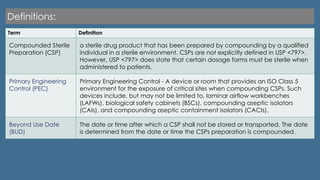
Definitions:
Term Definition
Compounded Sterile
Preparation (CSP)
a sterile drug product that has been prepared by compounding by a qualified
individual in a sterile environment. CSPs are not explicitly defined in USP <797>.
However, USP <797> does state that certain dosage forms must be sterile when
administered to patients.
Primary Engineering
Control (PEC)
Primary Engineering Control - A device or room that provides an ISO Class 5
environment for the exposure of critical sites when compounding CSPs. Such
devices include, but may not be limited to, laminar airflow workbenches
(LAFWs), biological safety cabinets (BSCs), compounding aseptic isolators
(CAIs), and compounding aseptic containment isolators (CACIs).
Beyond Use Date
(BUD)
The date or time after which a CSP shall not be stored or transported. The date
is determined from the date or time the CSPs preparation is compounded.
There are THREE contamination
categories for CSPs described in USP
Chapter <797>:
low-risk level, medium-risk level,
high-risk level
In addition to the THREE CSP
contamination categories, Chapter
<797> provides an immediate-use
provision for emergent situations
CSPs are assigned primarily
according to the potential for
microbial contamination during
the compounding of low-risk level
CSPs and medium-risk level CSPs
or the potential for not sterilizing
high-risk level CSPs
Appropriate risk levels are assigned
according to the corresponding
probability of:
Microbial contamination
(e.g., microbial organisms, spores, endotoxins)
Chemical and physical contamination
(e.g., foreign chemicals, physical matter)
Risk levels apply to the quality of
CSPs immediately after the final
aseptic mixing or filling or
immediately after the final
sterilization
Increased risk of chemical degradation of
ingredients, contamination from physical
damage to packaging, and permeability of
plastic and elastomeric packaging is
expected when freshly prepared CSPs are
stored and shipped. In such cases,
compounding personnel are responsible for
considering the potential additional risks to the
integrity of CSPs when assigning BUDs.
IMMEDIATE-USE CSPs
Immediate-use provision - intended only
for those situations where there is a need
for emergency or immediate patient
administration of a CSP where
preparation under low-risk conditions
would subject the patient to risk due to
delays in therapy
IMMEDIATE-USE CSPs
Immediate-use CSPs are not intended
for storage for anticipated needs or
batch compounding. Cannot be used
for medium-risk and high-risk level CSPs
IMMEDIATE-USE CSPs
Aseptic technique is followed
Simple transfers of nonhazardous or diagnostic radiopharmaceutical
products
Continuous compounding procedure not to exceed 1 hour
Administration begins not later than 1 hour following the start of
preparation. If not, preparation is safely discarded.
If not immediately administered, finished CSP is under continuous
supervision to minimize potential contact with nonsterile surfaces,
introduction of particulate matter, mix-ups, and direct contact of
outside surfaces
Must be labeled unless immediately and completely administered, or
administration is witnessed, by the person who prepared it.
IMMEDIATE-USE CSPs
LOW-RISK LEVEL CSPs
Compounded within ISO Class 5 or better air
Compounding involves only transfer, measuring, and mixing
manipulations using not more than 3 commercially
manufactured packages of sterile products and not more
than 2 entries into any one sterile container or package
(e.g., bag, vial) of sterile product or administration
container/device to prepare the CSP.
Manipulations are limited to aseptically opening ampuls,
penetrating disinfected stoppers on vials with sterile needles
and syringes, and transferring sterile liquids in sterile syringes
to sterile administration devices, package containers of
other sterile products, and containers for storage and
dispensing.
LOW-RISK CSPs
In the absence of passing a sterility test, the storage
periods for low-risk preparations cannot exceed the
following time periods: before administration, the CSPs
are properly stored and are exposed for not more
than
48 hours at controlled room temperature
14 days at a cold temperature
45 days in solid frozen state between −25° and −10°
LOW-RISK CSPs
Low-Risk Compounding examples
reconstitution of single-dose vials of antibiotics
or other small-volume parenterals, or
preparation of hydration solutions
LOW-RISK CSPs
Low-Risk Level CSPs with 12-Hour or Less BUD –
If the PEC is a CAI or CACI that does not meet the
requirements described in Placement of PECs or is a
laminar airflow workbench (LAFW) or a biological safety
cabinet (BSC) that cannot be located within an ISO Class
7 buffer area, then only low-risk level nonhazardous and
radiopharmaceutical CSPs pursuant to a physician's order
for a specific patient may be prepared, and
administration of such CSPs shall commence within 12
hours of preparation or as recommended in the
manufacturers' package insert, whichever is less.
LOW-RISK CSPs
Low-Risk Level CSPs with 12-Hour or Less BUD—
PECs (LAFWs, BSCs, CAIs, CACIs,) shall be ISO Class 5
Compounding area is segregated from non-compounding
areas.
Personnel shall follow the procedures described in Personnel
Cleansing and Garbing and Additional Personnel
Requirements prior to compounding.
Sinks should not be located adjacent to the ISO Class 5 PEC,
and separated from immediate area of the ISO Class 5 PEC
device.
Follow all specifications for cleaning and disinfecting,
personnel training and competency, aseptic work practices,
and environmental sampling.
LOW-RISK CSPs
All clear on Low-Risk
Level CSPs with 12-Hour
or Less BUD?
Suppose you have a satellite
pharmacy that has no ISO Class 7
area, but contains an ISO Class 5 PEC.
You may still prepare Low-Risk CSPs in
the PEC, but they would could only
have a 12-Hour or less BUD.
MEDIUM-RISK LEVEL CSPs
When CSPs are compounded aseptically under Low-Risk
Conditions and one or more of the following conditions
exists, such CSPs are at a medium risk of contamination.
1. Multiple individual or small doses of sterile products are
combined or pooled to prepare a CSP that will be
administered either to multiple patients or to one patient
on multiple occasions.
2. The compounding process includes complex aseptic
manipulations other than the single-volume transfer.
3. The compounding process requires unusually long
duration, such as that required to complete dissolution or
homogeneous mixing.
MEDIUM-RISK CSPs
In the absence of passing a sterility test, the storage
periods for medium-risk preparations cannot exceed
the following time periods: before administration, the
CSPs are properly stored and are exposed for not
more than:
30 hours at controlled room temperature
9 days at a cold temperature
45 days in solid frozen state between −25° and −10°
MEDIUM-RISK CSPs
Medium-Risk Compounding examples
Complex manipulations (e.g., TPN)
Batch preparations (e.g., syringes)
MEDIUM-RISK CSPs
HIGH-RISK LEVEL CSPs
High-risk level compounding:
1. Prepared from non-sterile ingredients.
2. Any of the following are exposed to air quality worse than ISO Class 5 for
more than 1 hour:
• sterile contents of commercially manufactured products,
• CSPs that lack effective antimicrobial preservatives, and
• sterile surfaces of devices and containers for the preparation, transfer,
sterilization, and packaging of CSPs.
3. Compounding personnel are improperly garbed and gloved (see Personnel
Cleansing and Use of Barrier Protective Equipment).
4. More than 6 hour delay from compounding to sterilization.
5. It is assumed, and not verified by examination of labeling and
documentation from suppliers or by direct determination, that the chemical
purity and content strength of ingredients meet their original or compendial
specifications in unopened or in opened packages of bulk ingredients.
HIGH-RISK CSPs
In the absence of passing a sterility test, the storage
periods for high-risk preparations cannot exceed the
following time periods: before administration, the CSPs
are properly stored and are exposed for not more
than:
24 hours at controlled room temperature
3 days at a cold temperature
45 days in solid frozen state between −25° and −10°
HIGH-RISK CSPs
High-Risk Compounding examples
Dissolving nonsterile bulk drug and nutrient powders to make
solutions that will be terminally sterilized.
Exposing sterile ingredients and components used to prepare
CSPs to room air quality worse than ISO Class 5 for more than 1
hour (see Immediate-Use CSPs).
Measuring and mixing sterile ingredients in nonsterile devices
before sterilization is performed.
Assuming, without appropriate evidence or direct
determination, that packages of bulk ingredients contain at
least 95% by weight of their active chemical moiety and have
not been contaminated or adulterated between uses.
HIGH-RISK CSPs
JERRY FAHRNI, PHARM.D.

USP 797 CSP Risk Categories

  • 1.
    CSP Risk Categories PHARMACEUTICALCOMPOUNDING - STERILE PREPARATIONS
  • 2.
    Definitions: Term Definition Compounded Sterile Preparation(CSP) a sterile drug product that has been prepared by compounding by a qualified individual in a sterile environment. CSPs are not explicitly defined in USP <797>. However, USP <797> does state that certain dosage forms must be sterile when administered to patients. Primary Engineering Control (PEC) Primary Engineering Control - A device or room that provides an ISO Class 5 environment for the exposure of critical sites when compounding CSPs. Such devices include, but may not be limited to, laminar airflow workbenches (LAFWs), biological safety cabinets (BSCs), compounding aseptic isolators (CAIs), and compounding aseptic containment isolators (CACIs). Beyond Use Date (BUD) The date or time after which a CSP shall not be stored or transported. The date is determined from the date or time the CSPs preparation is compounded.
  • 3.
    There are THREEcontamination categories for CSPs described in USP Chapter <797>: low-risk level, medium-risk level, high-risk level
  • 4.
    In addition tothe THREE CSP contamination categories, Chapter <797> provides an immediate-use provision for emergent situations
  • 5.
    CSPs are assignedprimarily according to the potential for microbial contamination during the compounding of low-risk level CSPs and medium-risk level CSPs or the potential for not sterilizing high-risk level CSPs
  • 6.
    Appropriate risk levelsare assigned according to the corresponding probability of: Microbial contamination (e.g., microbial organisms, spores, endotoxins) Chemical and physical contamination (e.g., foreign chemicals, physical matter)
  • 7.
    Risk levels applyto the quality of CSPs immediately after the final aseptic mixing or filling or immediately after the final sterilization
  • 8.
    Increased risk ofchemical degradation of ingredients, contamination from physical damage to packaging, and permeability of plastic and elastomeric packaging is expected when freshly prepared CSPs are stored and shipped. In such cases, compounding personnel are responsible for considering the potential additional risks to the integrity of CSPs when assigning BUDs.
  • 9.
  • 10.
    Immediate-use provision -intended only for those situations where there is a need for emergency or immediate patient administration of a CSP where preparation under low-risk conditions would subject the patient to risk due to delays in therapy IMMEDIATE-USE CSPs
  • 11.
    Immediate-use CSPs arenot intended for storage for anticipated needs or batch compounding. Cannot be used for medium-risk and high-risk level CSPs IMMEDIATE-USE CSPs
  • 12.
    Aseptic technique isfollowed Simple transfers of nonhazardous or diagnostic radiopharmaceutical products Continuous compounding procedure not to exceed 1 hour Administration begins not later than 1 hour following the start of preparation. If not, preparation is safely discarded. If not immediately administered, finished CSP is under continuous supervision to minimize potential contact with nonsterile surfaces, introduction of particulate matter, mix-ups, and direct contact of outside surfaces Must be labeled unless immediately and completely administered, or administration is witnessed, by the person who prepared it. IMMEDIATE-USE CSPs
  • 13.
  • 14.
    Compounded within ISOClass 5 or better air Compounding involves only transfer, measuring, and mixing manipulations using not more than 3 commercially manufactured packages of sterile products and not more than 2 entries into any one sterile container or package (e.g., bag, vial) of sterile product or administration container/device to prepare the CSP. Manipulations are limited to aseptically opening ampuls, penetrating disinfected stoppers on vials with sterile needles and syringes, and transferring sterile liquids in sterile syringes to sterile administration devices, package containers of other sterile products, and containers for storage and dispensing. LOW-RISK CSPs
  • 15.
    In the absenceof passing a sterility test, the storage periods for low-risk preparations cannot exceed the following time periods: before administration, the CSPs are properly stored and are exposed for not more than 48 hours at controlled room temperature 14 days at a cold temperature 45 days in solid frozen state between −25° and −10° LOW-RISK CSPs
  • 16.
    Low-Risk Compounding examples reconstitutionof single-dose vials of antibiotics or other small-volume parenterals, or preparation of hydration solutions LOW-RISK CSPs
  • 17.
    Low-Risk Level CSPswith 12-Hour or Less BUD – If the PEC is a CAI or CACI that does not meet the requirements described in Placement of PECs or is a laminar airflow workbench (LAFW) or a biological safety cabinet (BSC) that cannot be located within an ISO Class 7 buffer area, then only low-risk level nonhazardous and radiopharmaceutical CSPs pursuant to a physician's order for a specific patient may be prepared, and administration of such CSPs shall commence within 12 hours of preparation or as recommended in the manufacturers' package insert, whichever is less. LOW-RISK CSPs
  • 18.
    Low-Risk Level CSPswith 12-Hour or Less BUD— PECs (LAFWs, BSCs, CAIs, CACIs,) shall be ISO Class 5 Compounding area is segregated from non-compounding areas. Personnel shall follow the procedures described in Personnel Cleansing and Garbing and Additional Personnel Requirements prior to compounding. Sinks should not be located adjacent to the ISO Class 5 PEC, and separated from immediate area of the ISO Class 5 PEC device. Follow all specifications for cleaning and disinfecting, personnel training and competency, aseptic work practices, and environmental sampling. LOW-RISK CSPs
  • 19.
    All clear onLow-Risk Level CSPs with 12-Hour or Less BUD?
  • 20.
    Suppose you havea satellite pharmacy that has no ISO Class 7 area, but contains an ISO Class 5 PEC. You may still prepare Low-Risk CSPs in the PEC, but they would could only have a 12-Hour or less BUD.
  • 21.
  • 22.
    When CSPs arecompounded aseptically under Low-Risk Conditions and one or more of the following conditions exists, such CSPs are at a medium risk of contamination. 1. Multiple individual or small doses of sterile products are combined or pooled to prepare a CSP that will be administered either to multiple patients or to one patient on multiple occasions. 2. The compounding process includes complex aseptic manipulations other than the single-volume transfer. 3. The compounding process requires unusually long duration, such as that required to complete dissolution or homogeneous mixing. MEDIUM-RISK CSPs
  • 23.
    In the absenceof passing a sterility test, the storage periods for medium-risk preparations cannot exceed the following time periods: before administration, the CSPs are properly stored and are exposed for not more than: 30 hours at controlled room temperature 9 days at a cold temperature 45 days in solid frozen state between −25° and −10° MEDIUM-RISK CSPs
  • 24.
    Medium-Risk Compounding examples Complexmanipulations (e.g., TPN) Batch preparations (e.g., syringes) MEDIUM-RISK CSPs
  • 25.
  • 26.
    High-risk level compounding: 1.Prepared from non-sterile ingredients. 2. Any of the following are exposed to air quality worse than ISO Class 5 for more than 1 hour: • sterile contents of commercially manufactured products, • CSPs that lack effective antimicrobial preservatives, and • sterile surfaces of devices and containers for the preparation, transfer, sterilization, and packaging of CSPs. 3. Compounding personnel are improperly garbed and gloved (see Personnel Cleansing and Use of Barrier Protective Equipment). 4. More than 6 hour delay from compounding to sterilization. 5. It is assumed, and not verified by examination of labeling and documentation from suppliers or by direct determination, that the chemical purity and content strength of ingredients meet their original or compendial specifications in unopened or in opened packages of bulk ingredients. HIGH-RISK CSPs
  • 27.
    In the absenceof passing a sterility test, the storage periods for high-risk preparations cannot exceed the following time periods: before administration, the CSPs are properly stored and are exposed for not more than: 24 hours at controlled room temperature 3 days at a cold temperature 45 days in solid frozen state between −25° and −10° HIGH-RISK CSPs
  • 28.
    High-Risk Compounding examples Dissolvingnonsterile bulk drug and nutrient powders to make solutions that will be terminally sterilized. Exposing sterile ingredients and components used to prepare CSPs to room air quality worse than ISO Class 5 for more than 1 hour (see Immediate-Use CSPs). Measuring and mixing sterile ingredients in nonsterile devices before sterilization is performed. Assuming, without appropriate evidence or direct determination, that packages of bulk ingredients contain at least 95% by weight of their active chemical moiety and have not been contaminated or adulterated between uses. HIGH-RISK CSPs
  • 29.