Compounding in hospital
Archana Chavhan
M.Pharm (QA)
KYDSCT’s college of pharmacy,
sakegaon
Compounding in hospital pharmacy is preparation of
customized formulations of a medication to fulfill the
unique need of patient which cannot be fulfilled by
commercially available product
Physician may choose to prescribe a compounded
medication for a patient with an unusual health need such
as;
 Who cannot take commercially prepared drug
 Who require limited dose strength
 Who require different formulation such as turning pill/ liquid
 Who require allergen free medication
 Children who want flavor compounds
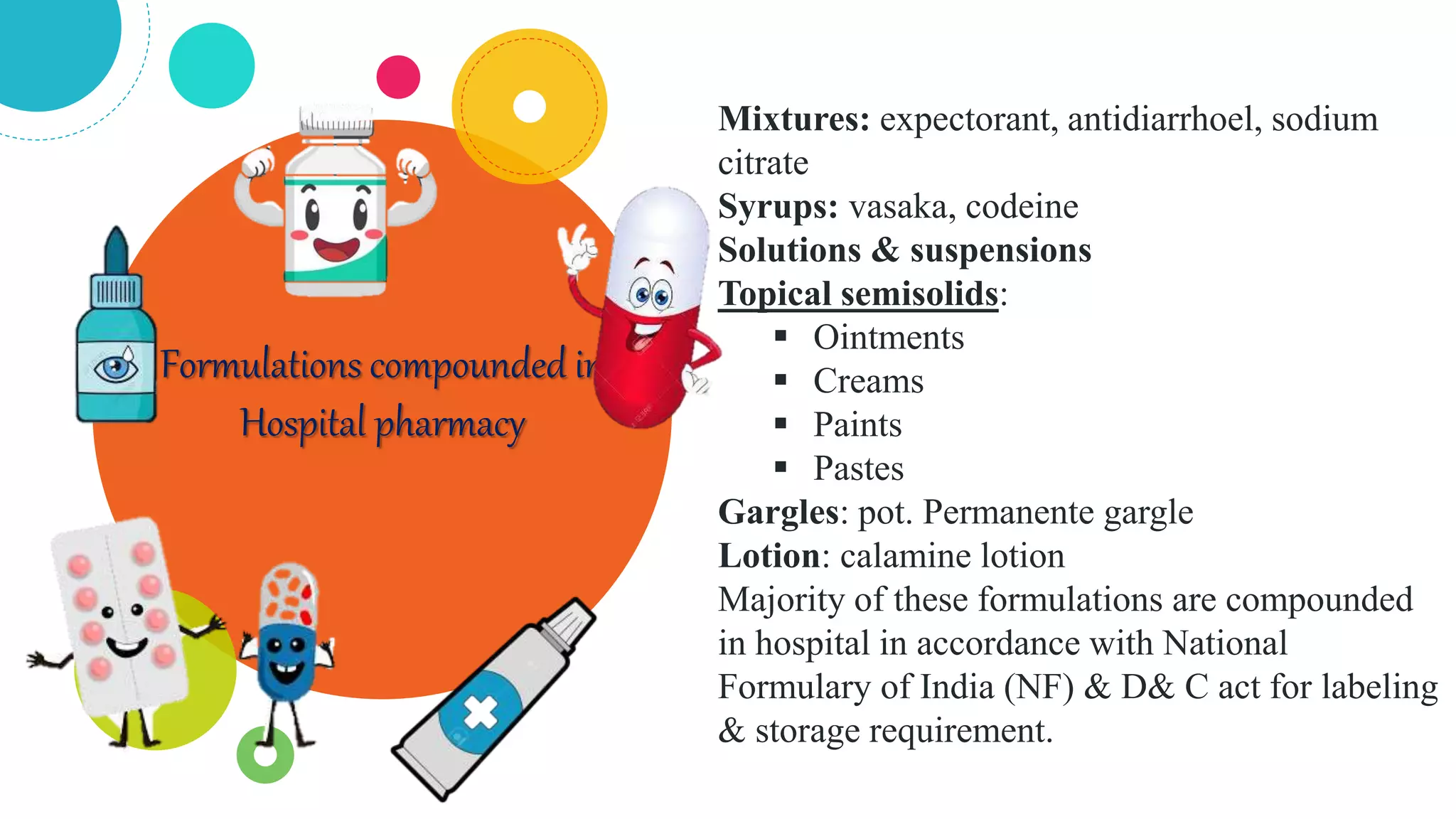
Formulations compounded in
Hospital pharmacy
Mixtures: expectorant, antidiarrhoel, sodium
citrate
Syrups: vasaka, codeine
Solutions & suspensions
Topical semisolids:
 Ointments
 Creams
 Paints
 Pastes
Gargles: pot. Permanente gargle
Lotion: calamine lotion
Majority of these formulations are compounded
in hospital in accordance with National
Formulary of India (NF) & D& C act for labeling
& storage requirement.
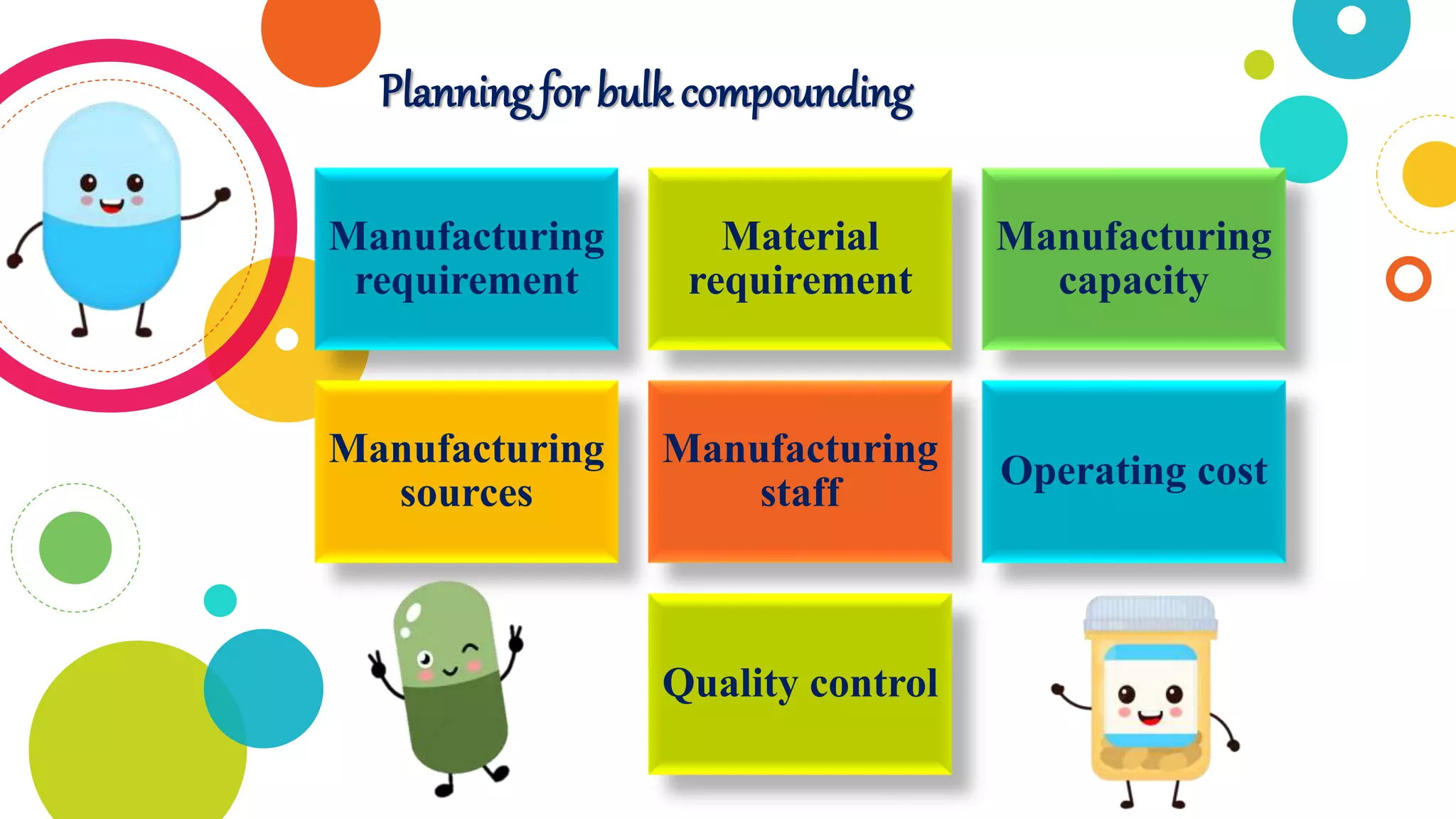
Planning for bulk compounding
Manufacturing
requirement
Material
requirement
Manufacturing
capacity
Manufacturing
sources
Manufacturing
staff
Operating cost
Quality control
IV ADMIXTURE SERVICES & INCOMPABILITIES
◎ An IV admixture is a sterile solutions prepared by mixing 1
or more drugs with IV fluids alone or in combination and
administered via IV administration set directly to patient’s
vein for medication purposes
◎ Following objectives expected to achieve by the pharmacist
◉ Preparation of final product under septic condition
◉ Rational choice of additive & mixing techniques for
avoiding drug interactions
◉ Appropriate labeling, dispensing & storage of final
product
IV fluids commonly usedfor IV admixtures
Injection Concentration pH Therapeutic use
Dextrose 2.5%-50% 3.5-6.5 Nutrient replenisher
Dextrose/NaCl 5%-20% 3.5-6.5 Nutrient replenisher
Lactated Ringer’s
solution
0.5% 6-7.5 Systemic
alkalizer/electrolyte
replenisher
Sodium chloride 045%,09%,2%,5% 4.5-7 Nutrient replenisher
IV fluids are commonly used for number of clinical conditions
1. Correction of disturbances in electrolyte balance
2. Correction of disturbances in body fluids
3. Provides basic nutrition
4. As a vehicle for other drug substances
5. Provide total parenteral nutrition
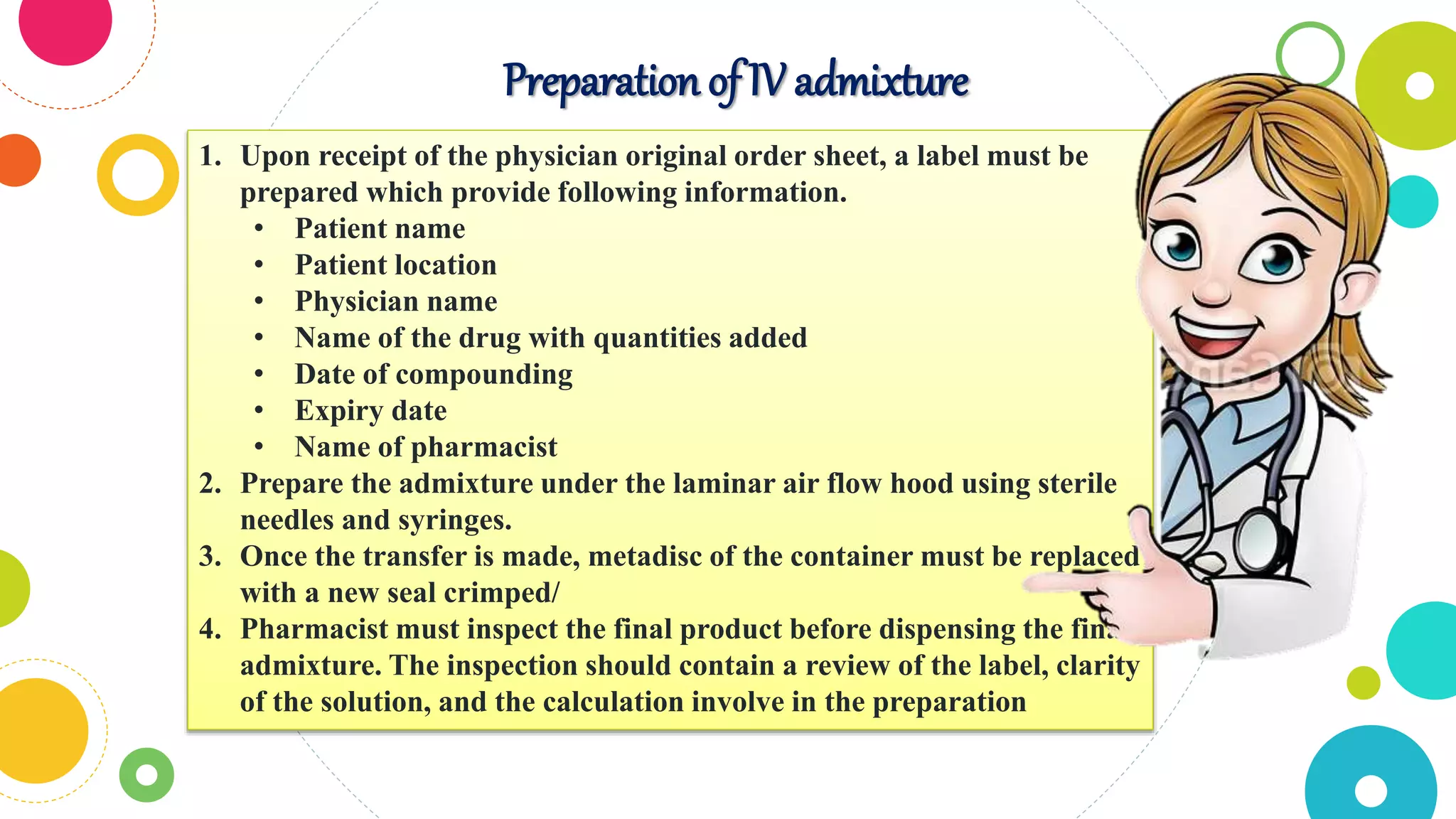
Preparation of IV admixture
1. Upon receipt of the physician original order sheet, a label must be
prepared which provide following information.
• Patient name
• Patient location
• Physician name
• Name of the drug with quantities added
• Date of compounding
• Expiry date
• Name of pharmacist
2. Prepare the admixture under the laminar air flow hood using sterile
needles and syringes.
3. Once the transfer is made, metadisc of the container must be replaced
with a new seal crimped/
4. Pharmacist must inspect the final product before dispensing the final
admixture. The inspection should contain a review of the label, clarity
of the solution, and the calculation involve in the preparation
Environment
• Laminar air flow hood in which air is filtered through HEPA filters moves in a
parallel flow configuration at a velocity of 90ft. Per minute is used.
• It removes 99.97% particles larger than 03um. The inside of the hood is
thoroughly wipe down with disinfectant & allowed to run for at least 30 min.
before starting manipulation
• Laminar air flow must be maintained and ensured that they are functioning
properly
• Velocity of air flow need to be checked routinely
• For evaluation of proper functioning of HEPA filters, the DOP test should be
used.it should be evaluated every 6 months.
Additives
• Additives are injections packaged in ampoules or vials or sterile solids to be
reconstituted by adding suitable diluent before addition to IV fluid
• A fresh sterile syringe is used for each additive
IV admixture therapy has been a complex process
requiring proper preparation before the administration.
It has been highly associated with medication errors
which may occur at any steps of the preparation and
administration
1. Wrong dose and dose errors
2. Wrong diluent errors
3. Wrong rate of administration errors
4. Errors in following aseptic methods
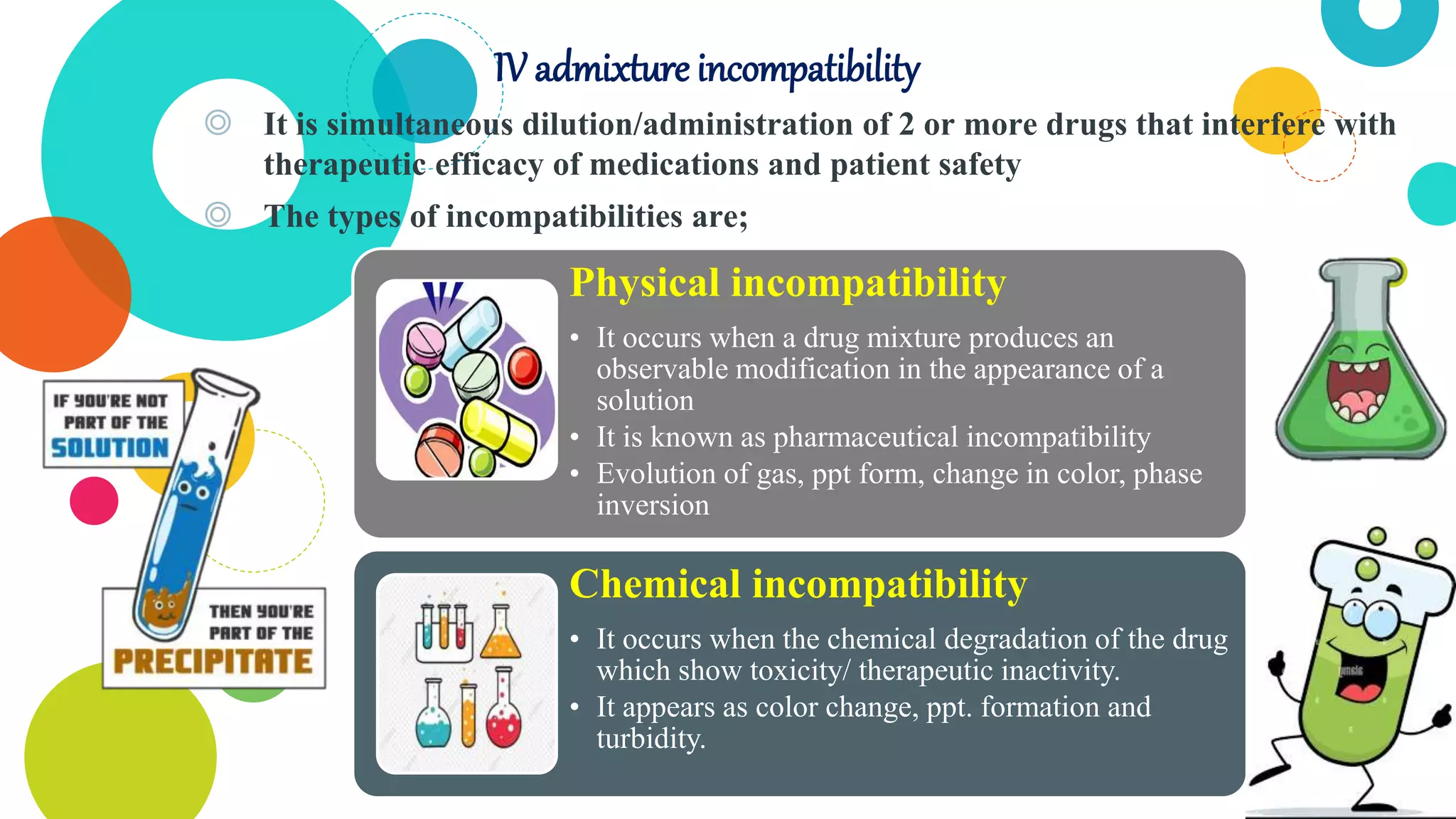
IV admixture incompatibility
◎ It is simultaneous dilution/administration of 2 or more drugs that interfere with
therapeutic efficacy of medications and patient safety
◎ The types of incompatibilities are;
Physical incompatibility
• It occurs when a drug mixture produces an
observable modification in the appearance of a
solution
• It is known as pharmaceutical incompatibility
• Evolution of gas, ppt form, change in color, phase
inversion
Chemical incompatibility
• It occurs when the chemical degradation of the drug
which show toxicity/ therapeutic inactivity.
• It appears as color change, ppt. formation and
turbidity.
◎ Drug-drug incompatibility
◎ Drugs & materials of IV
container
◎ When these are mixed together
in similar infusion line
◎ When these are administered one
after the other in the same
infusion line
◎ Drugs & unsuitable diluents
◎ Drugs and adjuvants
CAUSES OF
INCOMPATIBILITY
◎ Damage from toxic products:
◉ Multi-organ failure,
renal failure, systemic
allergic reactions etc.
◎ Tissue irritation due to major
pH modifications
◎ Therapeutic failure
◎ Adverse effects of drug
incompatibilities
CONSEQUENCES OF
INCOMPATIBILITIES
TPN
◎ PN refers to feeding of nutritional
products to a person intravenously
bypassing the usual process of eating
and digestion
◎ When nutrition mix containing glucose,
salts, amino acids, lipids & vitamins is
administered to a person, it is called as
TPN
SITES OF DELIVERY
 Administered through central
venous catheter that is placed in a
large vein that goes directly to the
heart (superior vena cava, right
atrium or inferior vena cava)
INDICATION FOR USE
TPN medication is only possible choice for patients who do not have a GIT
functioning or who have disorders needing complete bowel rest, such as;
 Inability to absorb nutrients via the GIT
 Patient who is not expected to eat sufficiently
 Organ failures-liver, renal, respiratory
 Malnourished oncology patient
 Patient with intestinal cancer
 Patient with inflammatory bowel diseases
CONTENTS OF TPN
 Carbohydrates: dextrose & monohydrates of glucose used as pri.
Source of carbohydrate. Galactose, fructose, sorbitol should not be
used as energy source in TPN
 Lipids: linoleic acid is useful as precursors of prostaglandins & in
the synthesis of essential fatty acids
 Electrolytes: sodium( 100-200 mEq, potassium (80-120 mEq,
magnesium (8-16 mEq), calcium (5-10mEq), chloride (100-20mEq)
 Vitamins: water soluble ( B1,B2,B3,B5,B6,B7,B9,B12 &C) fat
soluble (A,D,E,K)
Compounding in hospital.pptx

Compounding in hospital.pptx

  • 1.
    Compounding in hospital ArchanaChavhan M.Pharm (QA) KYDSCT’s college of pharmacy, sakegaon
  • 2.
    Compounding in hospitalpharmacy is preparation of customized formulations of a medication to fulfill the unique need of patient which cannot be fulfilled by commercially available product Physician may choose to prescribe a compounded medication for a patient with an unusual health need such as;  Who cannot take commercially prepared drug  Who require limited dose strength  Who require different formulation such as turning pill/ liquid  Who require allergen free medication  Children who want flavor compounds
  • 3.
    Formulations compounded in Hospitalpharmacy Mixtures: expectorant, antidiarrhoel, sodium citrate Syrups: vasaka, codeine Solutions & suspensions Topical semisolids:  Ointments  Creams  Paints  Pastes Gargles: pot. Permanente gargle Lotion: calamine lotion Majority of these formulations are compounded in hospital in accordance with National Formulary of India (NF) & D& C act for labeling & storage requirement.
  • 4.
    Planning for bulkcompounding Manufacturing requirement Material requirement Manufacturing capacity Manufacturing sources Manufacturing staff Operating cost Quality control
  • 5.
    IV ADMIXTURE SERVICES& INCOMPABILITIES ◎ An IV admixture is a sterile solutions prepared by mixing 1 or more drugs with IV fluids alone or in combination and administered via IV administration set directly to patient’s vein for medication purposes ◎ Following objectives expected to achieve by the pharmacist ◉ Preparation of final product under septic condition ◉ Rational choice of additive & mixing techniques for avoiding drug interactions ◉ Appropriate labeling, dispensing & storage of final product
  • 6.
    IV fluids commonlyusedfor IV admixtures Injection Concentration pH Therapeutic use Dextrose 2.5%-50% 3.5-6.5 Nutrient replenisher Dextrose/NaCl 5%-20% 3.5-6.5 Nutrient replenisher Lactated Ringer’s solution 0.5% 6-7.5 Systemic alkalizer/electrolyte replenisher Sodium chloride 045%,09%,2%,5% 4.5-7 Nutrient replenisher IV fluids are commonly used for number of clinical conditions 1. Correction of disturbances in electrolyte balance 2. Correction of disturbances in body fluids 3. Provides basic nutrition 4. As a vehicle for other drug substances 5. Provide total parenteral nutrition
  • 7.
    Preparation of IVadmixture 1. Upon receipt of the physician original order sheet, a label must be prepared which provide following information. • Patient name • Patient location • Physician name • Name of the drug with quantities added • Date of compounding • Expiry date • Name of pharmacist 2. Prepare the admixture under the laminar air flow hood using sterile needles and syringes. 3. Once the transfer is made, metadisc of the container must be replaced with a new seal crimped/ 4. Pharmacist must inspect the final product before dispensing the final admixture. The inspection should contain a review of the label, clarity of the solution, and the calculation involve in the preparation
  • 8.
    Environment • Laminar airflow hood in which air is filtered through HEPA filters moves in a parallel flow configuration at a velocity of 90ft. Per minute is used. • It removes 99.97% particles larger than 03um. The inside of the hood is thoroughly wipe down with disinfectant & allowed to run for at least 30 min. before starting manipulation • Laminar air flow must be maintained and ensured that they are functioning properly • Velocity of air flow need to be checked routinely • For evaluation of proper functioning of HEPA filters, the DOP test should be used.it should be evaluated every 6 months. Additives • Additives are injections packaged in ampoules or vials or sterile solids to be reconstituted by adding suitable diluent before addition to IV fluid • A fresh sterile syringe is used for each additive
  • 9.
    IV admixture therapyhas been a complex process requiring proper preparation before the administration. It has been highly associated with medication errors which may occur at any steps of the preparation and administration 1. Wrong dose and dose errors 2. Wrong diluent errors 3. Wrong rate of administration errors 4. Errors in following aseptic methods
  • 10.
    IV admixture incompatibility ◎It is simultaneous dilution/administration of 2 or more drugs that interfere with therapeutic efficacy of medications and patient safety ◎ The types of incompatibilities are; Physical incompatibility • It occurs when a drug mixture produces an observable modification in the appearance of a solution • It is known as pharmaceutical incompatibility • Evolution of gas, ppt form, change in color, phase inversion Chemical incompatibility • It occurs when the chemical degradation of the drug which show toxicity/ therapeutic inactivity. • It appears as color change, ppt. formation and turbidity.
  • 11.
    ◎ Drug-drug incompatibility ◎Drugs & materials of IV container ◎ When these are mixed together in similar infusion line ◎ When these are administered one after the other in the same infusion line ◎ Drugs & unsuitable diluents ◎ Drugs and adjuvants CAUSES OF INCOMPATIBILITY
  • 12.
    ◎ Damage fromtoxic products: ◉ Multi-organ failure, renal failure, systemic allergic reactions etc. ◎ Tissue irritation due to major pH modifications ◎ Therapeutic failure ◎ Adverse effects of drug incompatibilities CONSEQUENCES OF INCOMPATIBILITIES
  • 14.
    TPN ◎ PN refersto feeding of nutritional products to a person intravenously bypassing the usual process of eating and digestion ◎ When nutrition mix containing glucose, salts, amino acids, lipids & vitamins is administered to a person, it is called as TPN
  • 15.
    SITES OF DELIVERY Administered through central venous catheter that is placed in a large vein that goes directly to the heart (superior vena cava, right atrium or inferior vena cava)
  • 16.
    INDICATION FOR USE TPNmedication is only possible choice for patients who do not have a GIT functioning or who have disorders needing complete bowel rest, such as;  Inability to absorb nutrients via the GIT  Patient who is not expected to eat sufficiently  Organ failures-liver, renal, respiratory  Malnourished oncology patient  Patient with intestinal cancer  Patient with inflammatory bowel diseases
  • 17.
    CONTENTS OF TPN Carbohydrates: dextrose & monohydrates of glucose used as pri. Source of carbohydrate. Galactose, fructose, sorbitol should not be used as energy source in TPN  Lipids: linoleic acid is useful as precursors of prostaglandins & in the synthesis of essential fatty acids  Electrolytes: sodium( 100-200 mEq, potassium (80-120 mEq, magnesium (8-16 mEq), calcium (5-10mEq), chloride (100-20mEq)  Vitamins: water soluble ( B1,B2,B3,B5,B6,B7,B9,B12 &C) fat soluble (A,D,E,K)