
Jerry Fahrni, Pharm.D. April 14, 2010 Cloud Computing and Health Care Facing the Future
Objectives Describe what cloud computing is and what cloud computing is not  Separate fact from fiction when talking about “the cloud” Discuss the advantages and disadvantages of cloud computing Identify who’s using cloud computing and why Discuss why cloud computing is a good idea for healthcare
Myths about “the cloud”   It’s just a fad It’s only remote storage It’s just centralized computing It’s only for consumers and small businesses It’s just another word for computing over the internet
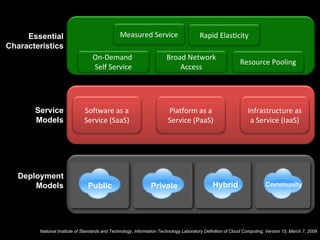
NIST Definition of Cloud Computing Cloud computing is a model for enabling convenient, on-demand network access to a shared pool of configurable computing resources (e.g., networks, servers, storage, applications, and services) that can be rapidly provisioned and released with minimal management effort or service provider interaction.  This cloud model promotes availability and is composed of five essential  characteristics,  three  service models , and four  deployment models
Cloud Computing  Community Private Hybrid Public Essential Characteristics Service Models Deployment Models National Institute of Standards and Technology, Information Technology Laboratory Definition of Cloud Computing, Version 15, March 7, 2009 Software as a Service (SaaS) Platform as a Service (PaaS) Infrastructure as a Service (IaaS) Measured Service Rapid Elasticity On-Demand  Self Service Broad Network Access Resource Pooling
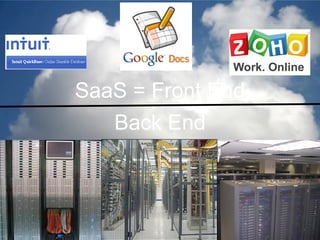
Back End SaaS = Front End
Software-as-a-Service (SaaS) The face of “the cloud” A model of software deployment Hosted by a service provider Evolution of the ASP model Pricing typically based on usage
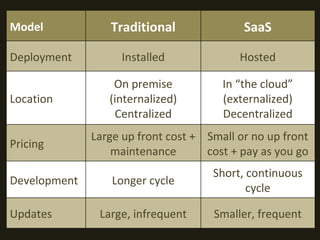
Model Traditional SaaS Deployment Installed Hosted Location On premise (internalized) Centralized In “the cloud” (externalized) Decentralized Pricing Large up front cost + maintenance Small or no up front cost + pay as you go Development Longer cycle Short, continuous cycle Updates Large, infrequent Smaller, frequent
Potential advantages of SaaS Lower cost Software infrastructure Third party tools Hardware  Re-implementation / Replacement Labor
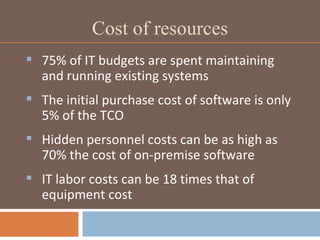
Cost of resources 75% of IT budgets are spent maintaining and running existing systems The initial purchase cost of software is only 5% of the TCO Hidden personnel costs can be as high as 70% the cost of on-premise software IT labor costs can be 18 times that of equipment cost
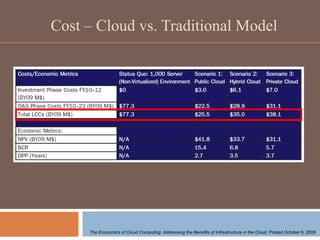
Cost – Cloud vs. Traditional Model The Economics of Cloud Computing: Addressing the Benefits of Infrastructure in the Cloud.  Posted October 6, 2009
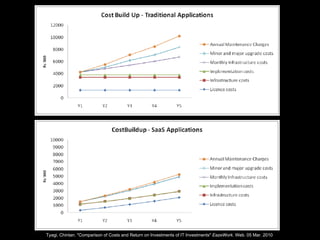
Tyagi, Chintan. "Comparison of Costs and Return on Investments of IT Investments"  EazeWork . Web. 05 Mar. 2010
Other advantages of SaaS Decreased resources for IT operations and support Lower risk Increased flexibility and scalability Superior operations Practical
Serendipitous advantages Facilitate information exchange Track chronic medical conditions across providers Make aggregate data available for study Eliminate transcription in favor of direct access Reduced need to “pull a chart” Reduce duplicate diagnostic tests
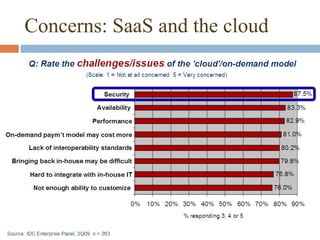
Concerns: SaaS and the cloud
 
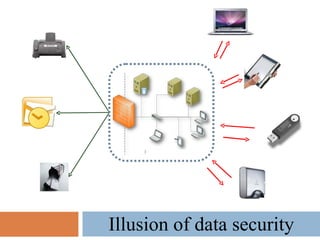
Illusion of data security
Security and mobility – Laptops The Cost of a Lost Laptop  - Ponemon Institute, April 2009 10,000 laptops lost in airports each week Average cost of a lost or stolen laptop is $49,246 For a healthcare laptop the average is $67,873
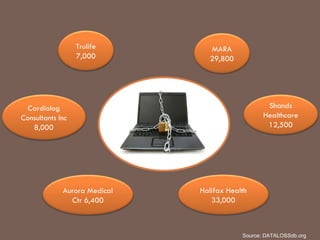
Source: DATALOSSdb.org Trulife 7,000 Cardiolog Consultants Inc 8,000 Aurora Medical Ctr 6,400 MARA 29,800 Shands Healthcare 12,500 Halifax Health 33,000
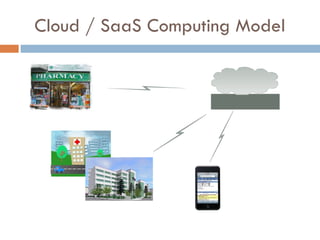
Cloud / SaaS Computing Model “The scale and flexibility of cloud computing gives the providers a security edge”
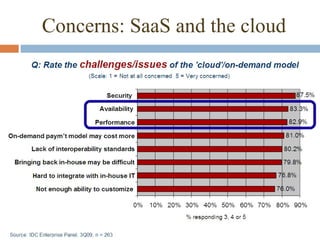
Concerns: SaaS and the cloud ReliaCloud survey version 1.0 | January 13, 2010
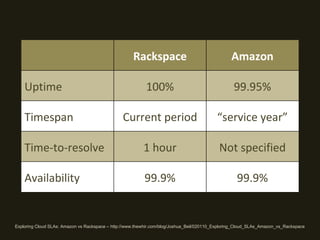
Exploring Cloud SLAs: Amazon vs Rackspace – http://www.thewhir.com/blog/Joshua_Beil/020110_Exploring_Cloud_SLAs_Amazon_vs_Rackspace Rackspace Amazon Uptime 100% 99.95% Timespan Current period “ service year” Time-to-resolve 1 hour Not specified Availability 99.9% 99.9%
… .why should we care?
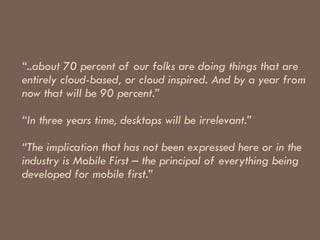
“ ..about 70 percent of our folks are doing things that are entirely cloud-based, or cloud inspired. And by a year from now that will be 90 percent.”    “In three years time, desktops will be irrelevant.”    “The implication that has not been expressed here or in the industry is Mobile First – the principal of everything being developed for mobile first.”
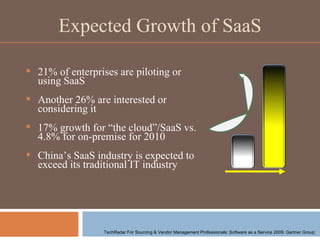
Expected Growth of SaaS TechRadar For Sourcing & Vendor Management Professionals: Software as a Service 2009; Gartner Group;  21% of enterprises are piloting or using SaaS Another 26% are interested or considering it 17% growth for “the cloud”/SaaS vs. 4.8% for on-premise for 2010 China’s SaaS industry is expected to exceed its traditional IT industry
Popularity of SaaS / “the cloud” in healthcare Fujitsu tsClinical Humedica Google Health Microsoft Healthvault SharEHR   Pharmacy OneSource IBM Infosphere Oracle Clinical Development Analytics Practice Fusion EHR
Beth Israel Deaconess (BID) "We could have gone with a classic environment - server clusters and building arrays for storage; the problem was that we'd have to build it for the largest load we'd ever need and we had no guarantee anyone would use it." Large scale migration to EHR. EHR and practice management system from eClinicalWorks to approximately 175 practices Access via PC with thin-client connector that provides encryption, authentication and connectivity to the cloud Additional  software and hardware upgrades approximately $20,000 in virtualized model vs. $325,000 for traditional model Using virtual servers saved BID $300,000
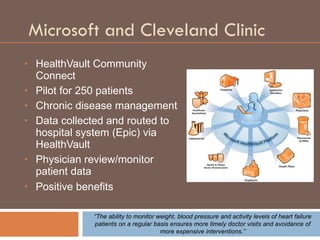
Microsoft and Cleveland Clinic HealthVault Community Connect Pilot for 250 patients Chronic disease management Data collected and routed to hospital system (Epic) via HealthVault  Physician review/monitor patient data Positive benefits   “ The ability to monitor weight, blood pressure and activity levels of heart failure patients on a regular basis ensures more timely doctor visits and avoidance of more expensive interventions.”
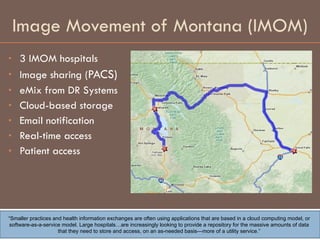
Image Movement of Montana (IMOM) 3 IMOM hospitals Image sharing (PACS) eMix from DR Systems  Cloud-based storage  Email notification Real-time access Patient access “ Smaller practices and health information exchanges are often using applications that are based in a cloud computing model, or software-as-a-service model. Large hospitals…are increasingly looking to provide a repository for the massive amounts of data that they need to store and access, on an as-needed basis—more of a utility service.”
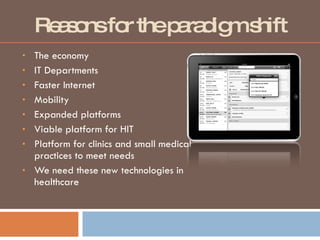
Reasons for the paradigm shift The economy  IT Departments Faster Internet Mobility Expanded platforms Viable platform for HIT Platform for clinics and small medical practices to meet needs We need these new technologies in healthcare
Final thoughts:  what can “the cloud” ultimately do for me? Handle eHealth data Improved patient care Provide complete, accurate, and searchable health information Make information available at the point of care Remove the wait associated with the exchange information Provide earlier diagnosis and characterization of disease Reduce adverse drug events, drug-drug interactions, duplicate tests
 
Questions? Jerry Fahrni, Pharm.D.  [email_address]

Cloud computing and health care - Facing the Future

  • 1.
    Jerry Fahrni, Pharm.D.April 14, 2010 Cloud Computing and Health Care Facing the Future
  • 2.
    Objectives Describe whatcloud computing is and what cloud computing is not Separate fact from fiction when talking about “the cloud” Discuss the advantages and disadvantages of cloud computing Identify who’s using cloud computing and why Discuss why cloud computing is a good idea for healthcare
  • 3.
    Myths about “thecloud” It’s just a fad It’s only remote storage It’s just centralized computing It’s only for consumers and small businesses It’s just another word for computing over the internet
  • 4.
    NIST Definition ofCloud Computing Cloud computing is a model for enabling convenient, on-demand network access to a shared pool of configurable computing resources (e.g., networks, servers, storage, applications, and services) that can be rapidly provisioned and released with minimal management effort or service provider interaction. This cloud model promotes availability and is composed of five essential characteristics, three service models , and four deployment models
  • 5.
    Cloud Computing Community Private Hybrid Public Essential Characteristics Service Models Deployment Models National Institute of Standards and Technology, Information Technology Laboratory Definition of Cloud Computing, Version 15, March 7, 2009 Software as a Service (SaaS) Platform as a Service (PaaS) Infrastructure as a Service (IaaS) Measured Service Rapid Elasticity On-Demand Self Service Broad Network Access Resource Pooling
  • 6.
    Back End SaaS= Front End
  • 7.
    Software-as-a-Service (SaaS) Theface of “the cloud” A model of software deployment Hosted by a service provider Evolution of the ASP model Pricing typically based on usage
  • 8.
    Model Traditional SaaSDeployment Installed Hosted Location On premise (internalized) Centralized In “the cloud” (externalized) Decentralized Pricing Large up front cost + maintenance Small or no up front cost + pay as you go Development Longer cycle Short, continuous cycle Updates Large, infrequent Smaller, frequent
  • 9.
    Potential advantages ofSaaS Lower cost Software infrastructure Third party tools Hardware Re-implementation / Replacement Labor
  • 10.
    Cost of resources75% of IT budgets are spent maintaining and running existing systems The initial purchase cost of software is only 5% of the TCO Hidden personnel costs can be as high as 70% the cost of on-premise software IT labor costs can be 18 times that of equipment cost
  • 11.
    Cost – Cloudvs. Traditional Model The Economics of Cloud Computing: Addressing the Benefits of Infrastructure in the Cloud. Posted October 6, 2009
  • 12.
    Tyagi, Chintan. "Comparisonof Costs and Return on Investments of IT Investments"  EazeWork . Web. 05 Mar. 2010
  • 13.
    Other advantages ofSaaS Decreased resources for IT operations and support Lower risk Increased flexibility and scalability Superior operations Practical
  • 14.
    Serendipitous advantages Facilitateinformation exchange Track chronic medical conditions across providers Make aggregate data available for study Eliminate transcription in favor of direct access Reduced need to “pull a chart” Reduce duplicate diagnostic tests
  • 15.
  • 16.
  • 17.
  • 18.
    Security and mobility– Laptops The Cost of a Lost Laptop - Ponemon Institute, April 2009 10,000 laptops lost in airports each week Average cost of a lost or stolen laptop is $49,246 For a healthcare laptop the average is $67,873
  • 19.
    Source: DATALOSSdb.org Trulife7,000 Cardiolog Consultants Inc 8,000 Aurora Medical Ctr 6,400 MARA 29,800 Shands Healthcare 12,500 Halifax Health 33,000
  • 20.
    Cloud / SaaSComputing Model “The scale and flexibility of cloud computing gives the providers a security edge”
  • 21.
    Concerns: SaaS andthe cloud ReliaCloud survey version 1.0 | January 13, 2010
  • 22.
    Exploring Cloud SLAs:Amazon vs Rackspace – http://www.thewhir.com/blog/Joshua_Beil/020110_Exploring_Cloud_SLAs_Amazon_vs_Rackspace Rackspace Amazon Uptime 100% 99.95% Timespan Current period “ service year” Time-to-resolve 1 hour Not specified Availability 99.9% 99.9%
  • 23.
  • 24.
    “ ..about 70percent of our folks are doing things that are entirely cloud-based, or cloud inspired. And by a year from now that will be 90 percent.”   “In three years time, desktops will be irrelevant.”   “The implication that has not been expressed here or in the industry is Mobile First – the principal of everything being developed for mobile first.”
  • 25.
    Expected Growth ofSaaS TechRadar For Sourcing & Vendor Management Professionals: Software as a Service 2009; Gartner Group; 21% of enterprises are piloting or using SaaS Another 26% are interested or considering it 17% growth for “the cloud”/SaaS vs. 4.8% for on-premise for 2010 China’s SaaS industry is expected to exceed its traditional IT industry
  • 26.
    Popularity of SaaS/ “the cloud” in healthcare Fujitsu tsClinical Humedica Google Health Microsoft Healthvault SharEHR Pharmacy OneSource IBM Infosphere Oracle Clinical Development Analytics Practice Fusion EHR
  • 27.
    Beth Israel Deaconess(BID) "We could have gone with a classic environment - server clusters and building arrays for storage; the problem was that we'd have to build it for the largest load we'd ever need and we had no guarantee anyone would use it." Large scale migration to EHR. EHR and practice management system from eClinicalWorks to approximately 175 practices Access via PC with thin-client connector that provides encryption, authentication and connectivity to the cloud Additional software and hardware upgrades approximately $20,000 in virtualized model vs. $325,000 for traditional model Using virtual servers saved BID $300,000
  • 28.
    Microsoft and ClevelandClinic HealthVault Community Connect Pilot for 250 patients Chronic disease management Data collected and routed to hospital system (Epic) via HealthVault Physician review/monitor patient data Positive benefits “ The ability to monitor weight, blood pressure and activity levels of heart failure patients on a regular basis ensures more timely doctor visits and avoidance of more expensive interventions.”
  • 29.
    Image Movement ofMontana (IMOM) 3 IMOM hospitals Image sharing (PACS) eMix from DR Systems Cloud-based storage Email notification Real-time access Patient access “ Smaller practices and health information exchanges are often using applications that are based in a cloud computing model, or software-as-a-service model. Large hospitals…are increasingly looking to provide a repository for the massive amounts of data that they need to store and access, on an as-needed basis—more of a utility service.”
  • 30.
    Reasons for theparadigm shift The economy IT Departments Faster Internet Mobility Expanded platforms Viable platform for HIT Platform for clinics and small medical practices to meet needs We need these new technologies in healthcare
  • 31.
    Final thoughts: what can “the cloud” ultimately do for me? Handle eHealth data Improved patient care Provide complete, accurate, and searchable health information Make information available at the point of care Remove the wait associated with the exchange information Provide earlier diagnosis and characterization of disease Reduce adverse drug events, drug-drug interactions, duplicate tests
  • 32.
  • 33.
    Questions? Jerry Fahrni,Pharm.D. [email_address]

Editor's Notes

  • #8 Service-based software: the future for flexible software 2000 ● Software as a Service: Strategic Backgrounder. February 2001. Software & Information Industry Association
  • #11 Source: Messaging Total Cost of Ownership: Microsoft Exchange 2003 and Lotus Domino in Small and Medium Organizations, META Group, July 2004 Timothy Chou, The End of Software, SAMS Publishing, 2005 Microsoft Wages Campaign Against Using Free Software, The Wall Street Journal, December 9, 2002 Robert Mahowald, Do Service Providers Deliver Value and Reduce Enterprise Costs?, IDC, 2003 18:1 statistics, Trends in technology’, survey, Berkeley University of California, USA, March 2002
  • #12 O&S – operations and support LCC – Life cycle cost NPV – net present value (calculated as each cloud scenario’s discounted net benefits minus the one-time investment. Positive dollar fiture = positive economic benefit vs. SQ (status quo data center) environment BCR – Benefit-to-cost ratio – discounted net benefits divided by its discounted investment costs. # >1 indicates a positive economic benefit vs. SQ environment DPP – discounted payback period -# years it takes for each scenario’s accumulated annual benefits to equal its total investment cost
  • #15 The Office of the National Coordinator of Health Information Technology (ONC) / National Health Information Network (NHIN)
  • #19 The Cost of a Lost Laptop - Ponemon Institute, April 2009
  • #21 European Network and Information Security Agency Report
  • #23 •  99.95% Uptime : Approximately 21.9 minutes per month or .365 hours per month, which is equal to 262.8 minutes per year or  4.38 hours per year
  • #24 A lot of people don’t care and that’s a mistake.
  • #25 “ ..about 70 percent of our folks are doing things that are entirely cloud-based, or cloud inspired. And by a year from now that will be 90 percent.” – Steve Ballmer, Microsoft CEO, March 4, 2010 at speech delivered at Paul G. Allen Center for Computer Science & Engineering, University of Washington http://www.microsoft.com/presspass/exec/steve/2010/03-04Cloud.mspx   “In three years time, desktops will be irrelevant.” – John Herlihy, European Director of Google online sales, Digital Landscapes conference Dublin   “The implication that has not been expressed here or in the industry is Mobile First – the principal of everything being developed for mobile first.” – Eric Schmidt, Google CEO, Mobile World Congress in Barcelona
  • #28 http://www.computerworld.com/s/article/9160918/Cloud_servers_help_hospital_with_digital_records "We could have gone with a classic environment - server clusters and building arrays for storage; the problem was that we'd have to build it for the largest load we'd ever need and we had no guarantee anyone would use it." Bill Gillis, eHealth Technical Director
  • #29 HealthVault Community Connect 250 Patient pilot Looked at patients with chronic diseases HTN Diabetes Heart Failure Data collected Glucometers Blood pressure monitors Scales Pedometers Data Sent to HealthVault and sent to hospital system Increased days between visits 71% for diabetes 26% for HTN According to Randall C. Starling, M.D., M.P.H., Section Head of Heart Failure & Cardiac Transplant Medicine, Cleveland Clinic. “The ability to monitor weight, blood pressure and activity levels of heart failure patients on a regular basis ensures more timely doctor visits and avoidance of more expensive interventions.”
  • #30 http://www.cmio.net/index.php?option=com_articles&view=article&id=21390:cloud-computing-the-forecast-for-image-management http://www.healthcareitnews.com/news/montana-providers-use-cloud-computing-share-radiology-data http://www.emix.com/pdfs/Facilities%20Use%20Cloud%20Computing%20to%20Share%20Radiology%20Images.pdf A-b 245 miles b-c 67 miles A = Great Falls Clinic B= Kalispell Med Ctr C = St. Luke Hosp PACS http://www.expresshealthcare.in/200702/radiologybuzz04.shtml “ Smaller practices and  health information exchange s are often using applications that are based in a cloud computing model, or software-as-a-service [SaaS] model,” says Moore. “Large hospitals and IDNs are increasingly looking to provide a repository for the massive amounts of data that they need to store and access, on an as-needed basis—more of a utility service.” - managing partner at  Chilmark Research , a healthcare technology industry analyst firm. 
  • #32 http://healthit.hhs.gov/, U.S. Department of Health & Human Services Considerations for eHealth data Data volume Interoperability Portability and access